







































Description
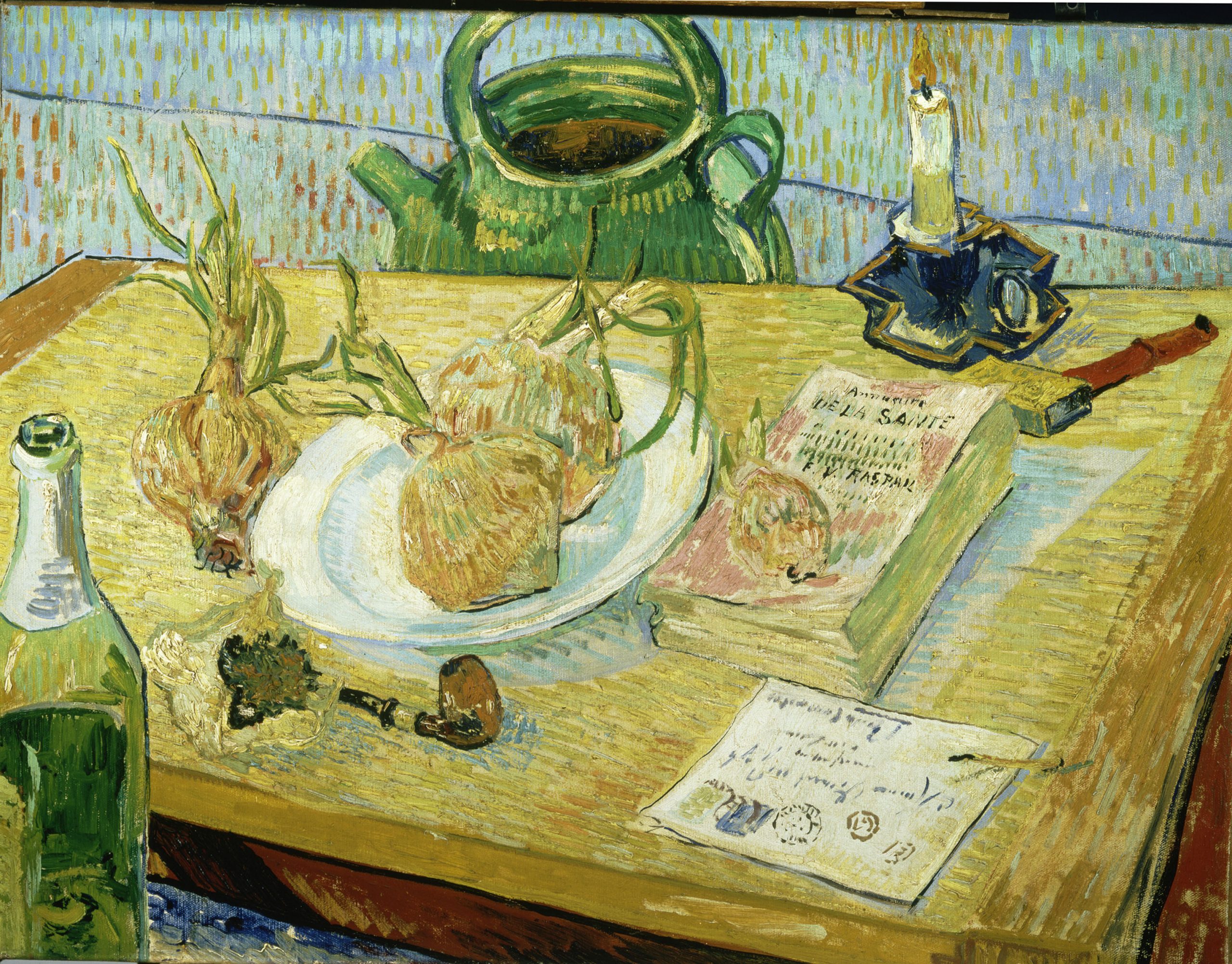
Still Life with Drawing Board, Pipe, Onions and Sealing Wax is the painting Vincent van Gogh made in Arles in early January 1889, just after he left hospital: on a yellow drawing board lie a plate of sprouting onions, a pipe and tobacco, a book, a letter, a lit candle and a stick of sealing wax, with a green coffee pot behind them and a bottle on the left. The original measures 50 x 64 cm and is in the Kröller-Müller Museum in Otterlo. We paint it by hand in oil on canvas, in 18 sizes from 40 x 30 to 190 x 151 cm or to your own measurement, and send you a photograph of the finished work for approval before dispatch.
| Title: | Still Life with Drawing Board, Pipe, Onions and Sealing Wax |
| Other titles: | Still Life with a Plate of Onions · Stilleven rond een bord met uien |
| Painter: | Vincent van Gogh (1853–1890) |
| Year painted: | early January 1889, Arles |
| Original size: | 50 cm x 64 cm |
| Original technique: | Oil on canvas |
| Painting style: | Post-Impressionism |
| Located at: | Kröller-Müller Museum, Otterlo (accession no. KM 111.075) |
| Our reproduction: | Hand-painted oil on canvas, 18 sizes or made to measure |
Still Life with Drawing Board, Pipe, Onions and Sealing Wax – Vincent van Gogh
What does this still life show?
A wide drawing board of yellow ochre fills most of the canvas and tilts towards the viewer. In the middle stands a white plate with large golden onions whose long green sprouts curl up and over the rim. More onions lie on the board at the left and beside the book. In front of the plate lie a pipe with a brown bowl and a crumpled tobacco pouch.
At the top, a green earthenware coffee pot with a round handle stands against the wall, and on the right a lit candle burns in a dark blue candlestick, with a red stick of sealing wax next to it. A thick book with a pink cover lies at the right; the words DE LA SANTÉ can be read on it. In the lower right corner lies an opened letter with stamps and handwriting, and at the left edge a green glass bottle is cut off by the frame. The wall behind is pale blue-green, covered in short upright strokes of red and orange.
Why did Van Gogh paint this still life in January 1889?
Because he wanted to start working again. According to the Kröller-Müller Museum, Van Gogh had rented the Yellow House in Arles and invited Paul Gauguin to work with him there, but they soon disagreed; after a heated argument Van Gogh became disoriented and cut off his own left ear. He was admitted to the hospital in Arles and discharged on 7 January 1889.
That same day he wrote to his brother Theo. In his letter of 7 January 1889 he says he will get back to work the next day and begin with one or two still lifes to get back into the way of painting. The museum names this still life as one of those two paintings.
What does the painting mean?
In the museum’s reading, the objects show that Van Gogh had picked up the routine of everyday life again: the letter from Theo, the onions, the pipe with tobacco, the bottle of wine or absinthe, the coffee pot, the candle and the book Annuaire de la santé, on good nutrition and hygiene. The museum also notes the contrasting colours and the brushwork: the drawing board is built of almost horizontal strokes, the wall behind it of vertical ones.
The Italian Wikipedia reads the objects as strongly autobiographical. In its account, the pipe and tobacco pouch stand for Van Gogh himself, the onions, the coffee pot and the empty wine bottle for his intention to return to a simpler life, and the book, whose author it names as Raspail, for his recent illness. It also reports that the envelope is addressed to Monsieur Vincent van Gogh.
Where is the original today?
The original is in the Kröller-Müller Museum in Otterlo, in the Netherlands, under the accession number KM 111.075. The museum lists it as Still Life with a Plate of Onions, in Dutch Stilleven rond een bord met uien, dated early January 1889, oil on canvas. The Italian Wikipedia gives 50 x 64 cm.
Our shop title names four of the objects on the table; both titles refer to the same canvas in Otterlo.
This still life or another painting from Arles – which to choose?
Four paintings in our range come from his time in Arles. Van Gogh’s Chair was painted in 1888 and shows his own chair with a pipe and tobacco on the seat. Self-Portrait with Bandaged Ear dates from January 1889, the same month as this still life, after he left hospital. Choose the still life if you want those weeks told through objects rather than a face.
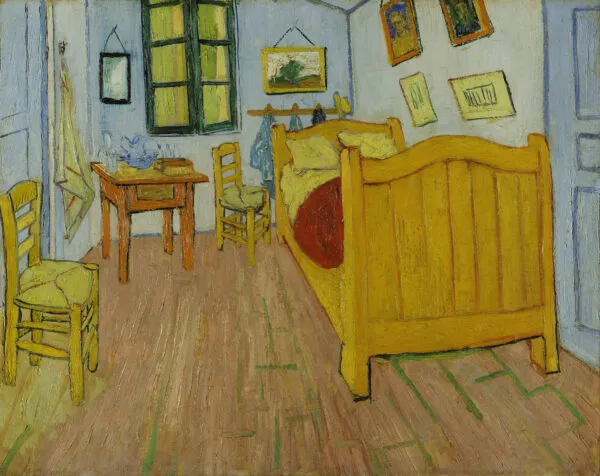
The Yellow House shows the house in Arles where he lived and worked, and Bedroom in Arles his bedroom inside it. This still life shows the same home close up, on his table.
How is our hand-painted still life made?
The painter first draws the slanting board, the plate, the coffee pot, the book and the letter. Then come the blue-green wall in short upright strokes and the yellow board in long, almost horizontal ones, and last the onions, the candle flame, the pipe and the lettering on the book. Our oil painting reproduction is painted by hand in oil on canvas with real impasto: the paint goes on thickly, so the brushstrokes stand up from the canvas as they do in the original and catch the light.
On this painting the relief matters most in the onions and their sprouts, in the strokes of the drawing board and in the dashes on the wall. A print shows only a flat surface; on our painting the strokes are real.
Every painting is a hand-painted copy made for your order, so no two are quite the same.
Which size for which wall?
Short answer: 64 x 50 cm, the size of the original, above a desk, a sideboard or in a kitchen, 100 x 80 or 120 x 90 cm above a sofa, and 190 x 151 cm for a large wall. The landscape format suits a dining room, a kitchen or a study.
There are 18 sizes: 40 x 30, 50 x 40, 64 x 50, 70 x 55, 80 x 60, 90 x 68, 93 x 74, 100 x 80, 110 x 85, 120 x 90, 125 x 99, 135 x 105, 145 x 113, 150 x 120, 160 x 127, 170 x 134, 180 x 142 and 190 x 151 cm (width x height). The original is 64 cm wide and 50 cm high, so our 64 x 50 cm size matches it. With its yellow ochre, pale blue-green and the touches of red and green, it sits well on a white, light grey or warm cream wall. A 40 x 30 cm size fits above a bedside table or on a bookshelf. A painting for the living room should take up about two thirds of the width of the furniture below it.
Hang it with the centre of the canvas about 150 cm above the floor, leaving 20 to 30 cm between the furniture and the bottom edge. The small objects read most clearly from 80 x 60 cm upwards, though 64 x 50 cm keeps the original’s scale.
What if I need a custom size or a frame?
If none of the 18 sizes fits your wall, we paint it to measure. Keep the proportions close to the original, otherwise the plate turns oval or the drawing board loses its slant. Send us the width and height you want and we will quote a price and a lead time. Every painting we make is stretched over a wooden stretcher and ready to hang.
For the moulding, use our 3D application: it shows each of our frame profiles on this subject, so you can compare gold, silver, black, white and natural wood – the application is for choosing the frame only. Seeing the painting on your own wall is our separate room placement service. A gold frame picks up the yellow of the drawing board and the onions, and a natural wood frame suits the warm table and the homely objects.
How does delivery work, and what is the guarantee?
Every painting is made to order in our studio in Slovenia, so allow 15 to 45 days depending on the size you choose. We ship it stretched and protected, framed if you chose a frame, across the EU with no customs. Before dispatch you receive a photograph of the finished work to approve, and we correct anything that is not right. Our returns policy applies to every order.
You will find more famous Van Gogh paintings among all our Vincent van Gogh paintings, and there is more about the painter in our article on Vincent van Gogh. If you are giving it as a present and are not sure of the size, a wall art voucher lets the recipient choose.
Frequently asked questions
Where is the original of this still life today?
In the Kröller-Müller Museum in Otterlo, in the Netherlands, under the accession number KM 111.075. The museum lists it as Still Life with a Plate of Onions, early January 1889, oil on canvas. The longer title Still Life with Drawing Board, Pipe, Onions and Sealing Wax names the same canvas, and the Italian Wikipedia gives its size as 50 x 64 cm.
When and where did Van Gogh paint this still life?
In Arles, in early January 1889. According to the Kröller-Müller Museum, he was discharged from the hospital in Arles on 7 January 1889 and wrote to Theo that same day that he would start working on still lifes the following day. The museum names this painting as one of the two still lifes with which he began painting again.
What objects are in the still life?
A drawing board with a plate of onions, a pipe and a tobacco pouch, a book, a letter, a lit candle in a candlestick, a stick of sealing wax, a green coffee pot and a bottle. The museum also names a box of matches and identifies the book as the Annuaire de la santé and the bottle as wine or absinthe; the letter, in its words, is the letter from Theo.
What does the still life mean?
According to the Kröller-Müller Museum, the objects show that Van Gogh had picked up the routine of everyday life again after his stay in hospital. The Italian Wikipedia reads them as autobiographical: the pipe and tobacco stand for the painter himself, the onions, the coffee pot and the empty bottle for a simpler life, and the book for his recent illness. These are readings, not statements by Van Gogh.
What is the book in the still life?
It is the Annuaire de la santé, and the words DE LA SANTÉ can be read on its cover in the painting. The Kröller-Müller Museum describes it as a book about good nutrition and hygiene, and the Italian Wikipedia names its author as Raspail. In Wikipedia’s reading, the book and the lit candle refer to his recent illness and to Gauguin, whom it calls the fugitive.
Is the letter in the still life from Theo?
Yes, according to the Kröller-Müller Museum, which calls it the letter from Theo, Vincent’s brother. The Italian Wikipedia reports that the envelope is addressed to Monsieur Vincent van Gogh, and in its reading the letter, together with the spent match and the sealing wax beside it, refers to Theo’s worries. In the painting it lies opened in the lower right corner.
How big is the original of the still life?
The original is 50 cm high and 64 cm wide, a landscape format, according to the Italian Wikipedia. Our 64 x 50 cm size matches it, and there are smaller and larger sizes from 40 x 30 up to 190 x 151 cm, as well as custom sizes painted to measure. Above a sofa, 100 x 80 or 120 x 90 cm is a good choice, and 64 x 50 cm suits a desk, a kitchen or a sideboard.
Does your Still Life with Drawing Board, Pipe, Onions and Sealing Wax have the raised brushstrokes of the original?
Yes. We paint our copy in impasto: the paint goes on thickly, so the brushstrokes stand up from the canvas as on Van Gogh’s original. You see it best in the round onions and their green sprouts, in the long strokes of the drawing board and in the short upright dashes on the wall, where the relief catches the light and changes as you walk past the painting.
Is this still life a good gift?
It suits someone who is drawn to Van Gogh’s months in Arles, to the story of his recovery, or to still lifes of simple everyday things, and it works well in a kitchen, a dining room or a study. As a canvas painting in warm yellow and pale blue-green with a burning candle, it brings a quiet, homely mood into a room, and a voucher lets the recipient choose the size.
- Subject: a drawing board on a table with a plate of sprouting onions, a pipe and tobacco, a book, a letter, a lit candle, sealing wax, a coffee pot and a bottle.
- Original: early January 1889, Arles, 50 x 64 cm, Kröller-Müller Museum, Otterlo.
- Ours: a Van Gogh reproduction painted by hand in oil on canvas, in 18 sizes from 40 x 30 to 190 x 151 cm or made to measure.
- Worth knowing: our 64 x 50 cm size is the size of the original in Otterlo.