



Vincent van Gogh
Vincent van Gogh – born March 30, 1853 – July 29, 1890
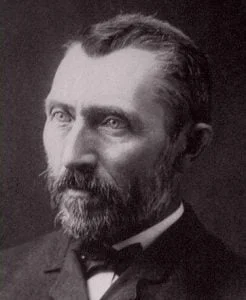
Dutch post-impressionist painter. Posthumously became one of the most famous painters in Western art. In just a decade, he created around 850 artistic paintings. He painted most of the paintings in the last two years of his life. His paintings include landscapes, still lifes, portraits and self-portraits. He is characterized by strong colors, drama, impulsiveness and expressive technique. He laid the foundations of modern art. It was not a sales success itself. He struggled with severe psychological disorders and poverty. He committed suicide at the age of 37.
Van Gogh was born into a family into the middle class. Described as a serious, quiet and thoughtful child. He liked to draw. Already as a teenager he came into contact with art – as a merchant. He traveled frequently on business, but became depressed when he was transferred to London. He became religious and spent some time as a Protestant missionary in southern Belgium. In 1881 he returned home and took up painting himself. He had a younger brother, Theo, who supported him financially. They corresponded a lot, so his life is well known. Early works, mostly still lifes and portrayals of farm workers, contain vivid colors that also characterized his later paintings. In 1886 he moved to Paris, where he met members of the avant-garde, including Émil Bernard and Paul Gauguin. Over time, he created a new approach to still life paintings and local landscapes. His paintings became brighter as he developed a style that was fully realized during his stay in Arles in the south of France in 1888. During that time he expanded his subject matter to paintings of olive trees, wheat fields and sunflowers.
Van Gogh suffered from mental disorders. Although he was concerned about his mental health, he neglected his physical activity, ate poorly, drank heavily and smoked. The friendship with Gauguin ended after a fight when he cut off part of his own left ear with a razor in anger. According to another version, Gaugin cut off his ear. He moved to the Saint-Rémy clinic When he was fired, he moved to theAuberge Ravoux in Auvers-sur -Oise near Paris – to homeopath and painter dr. Paul Gachet‘s. Depressive disorders persisted and on July 27, 1890 Van Gogh shot himself in the chest with a revolver. Died two days later from an infection.


Van Gogh was a business failure during his lifetime and was considered a madman. He became famous only after his suicide and became seen in the public eye as a misunderstood genius. His fame grew in the early 20th century when elements of his style were incorporated by the Fausts and German Expressionists. In the decades that followed, it achieved widespread critical and commercial success. He became an important painter whose troubled personality is the typical romantic ideal of the tortured artist. Today, van Gogh’s paintings are among the most expensive in the world. His legacy is mainly kept by the Van Gogh Museum in Amsterdam.
Early years
Vincent Willem van Gogh was born on March 30 1853 in Groot-Zundert, Netherlands. He was the eldest surviving child of his father Theodorus van Gogh (1822–1885), a minister in the Dutch Reformist Church, and his wife Anne Cornelie Carbentus (1819–1907). Vincent is named after his grandfather. Vincent was a common name in the Van Gogh family. The grandfather was a prominent art dealer (1789-1874) with six sons, three of whom became art dealers.
Van Gogh’s mother came from a wealthy family in The Hague. Her father was the son of a minister of state. She and Vincent’s father met when Anna’s younger sister Cornelia married Theodorus’ older brother Vincent (Cent). Van Gogh’s parents married in May 1851 and moved to Zundert. His brother Theo was born on May 1, 1857. He also had a brother Cor and three sisters: Elisabeth, Anna and Willemina (known as “Wil”). In later life, Van Gogh remained in contact only with Willemina and Theo.
Van Gogh’s mother was strict and a religious woman. Stressed the importance of family to the point of claustrophobia. Theodore’s income was modest, but the church provided the family with a house, a maid, two cooks, a gardener, a carriage and a horse. Ana instilled in her children the duty to maintain the high social status of the family.
Van Gogh was a serious kid. He was taught at home by his mother and governess. In 1860, he was sent to the village school. In 1864 he was sent to a boarding school in Zevenbergen. He did not feel well here and wanted to return home. Instead of home, in 1866 he was sent to a high school in Tilburg, where he was also very unhappy. His interest in art began at a young age. His mother encouraged him to paint as a child. His early drawings are expressive but do not approach the intensity of his later work.
In Tilburg, students were taught by Constant Cornelis Huijsmans, a successful artist from Paris. His philosophy was a rejection of technique in favor of capturing impressions of things, especially nature or ordinary objects. Van Gogh’s unhappiness in that period seems to have overlooked these lessons. He returned home in March 1868. He later recalled that his youth was “strict, cold and sterile”.
In July 1869, hee Uncle Cent secured a job with the art dealer Goupil & Cie in The Hague. After completing his training in 1873, he was transferred to the London branch. It was a happy time for Van Gogh. He was successful at work and by the age of 20 he was earning more than his father. Theo’s wife later recalled that these were the best years of Vincent’s life. He fell in love with the daughter of his landlady, Eugénie Loyer. The rejection, because she was secretly engaged to a former tenant, led him to loneliness and religious zeal. In 1875, his father and uncle arranged for him to be transferred to Paris, where he lasted only a year due to disputes at work.
In April 1876 he traveled back to England and took an unpaid job as a teacher in a small boarding school. When the owner moved to Isleworth, Middlesex, Van Gogh followed but the deal fell through. Meanwhile, his parents moved to Etten. He returned home for Christmas. He got a job in a bookstore in Dordrecht. He was not happy with the work, but spent his time translating passages from the Bible into English, French and German. He deepened his faith and became more and more pious.
According to his roommate at the time, Paulus van Görlitz, Van Gogh ate modestly and avoided meat.
To support his religious beliefs and desire to become a pastor , the family sent him in 1877 to his uncle Johannes Stricker, a prominent theologian, in Amsterdam. When he failed the theological university exam, he left his uncle’s house in July 1878. He attended a three-month course at a Protestant mission school in Laeken, near Brussels. Without success.
In January 1879, he got a job as a missionary in Petit-Wasmes. The Borinage coalfield in Belgium. To show support for his impoverished congregation, he gave up his comfortable lodgings in a bakery to a homeless man and moved into a small hut where he slept on straw. However, his poor living conditions did not please the church authorities. He was dismissed for “undermining the dignity of the priesthood”. He walked 75 kilometers to Brussels and then returned home to Etten. He stayed there in March 1880. His father was disappointed and took his son to the Geel asylum.
In August 1980, he returned to Cuesmes. He stayed with the miner until October. It was during this time that he decided to become a painter. He was interested in the people and scenes around him. He recreated the drawings after Theo’s suggestion that he take up art seriously. Later that year he traveled to Brussels to follow Theo’s idea to study with the Dutch painter Willem Roelofs. Despite the fact that he did not like formal art schools, he allowed himself to be convinced – in November 1880 he enrolled at the Royal Academy of Arts, where he studied anatomy and the standard rules of modeling and perspective.
“I don’t know anything with certainty, but seeing the stars makes me dream.”
Vincent van Gogh
In April 1881 he returned to Etten. He continued painting. In August 1881, his recently widowed cousin Cornelia “Kee” Vos-Stricker came to visit. They went for long walks and van Gogh fell in love. Kee was seven years older and had an eight-year-old son. Van Gogh surprised everyone when he confessed his love to her and proposed marriage. She rejected him with the words “No, no, never”. Van Gogh went to The Hague with the intention of selling paintings and met his cousin, Anton Mauve. Mauve, a successful artist, invited him to return in a few months. He suggested that in the meantime he draws with charcoal and pastels. Van Gogh returned to Etten and followed the advice.

In November 1881 he went to Amsterdam. Kee refused to accept him, and her parents wrote that his “obstinacy was disgusting”. In desperation, he held his left hand in the flame of the lamp, saying, “Let me see her while I can keep my hand in the flame.” He did not remember the event very well, but later concluded that his uncle had passed outflame. Kee’s father was clear – she must consider her refusal. Marriage is not possible due to van Gogh’s inability to support himself.
Mauve took van Gogh as a student and introduced him to watercolor, with which he engaged in for a month before returning home for Christmas. She and her father had an argument because he refused to go to church. He returned to The Hague and in January 1882 Mauve turned him to oil painting. He lent him money for the studio. Within a month, Van Gogh and Mauve had an argument. Van Gogh paid models – people off the street – which Mauve disapproved of. In June, van Gogh contracted gonorrhea and spent three weeks in the hospital. Then he continued painting. He bought the painting materials with money borrowed from Theo. He enjoyed working with this medium. Sprayed the paint heavily, scraped it off the canvas and applied it back with a brush. He wrote that he was surprised at how good the results were.

By March 1882, Mauve had distanced himself from Van Gogh and stopped answering his letters. He found out about Van Gogh’s new relationship with the prostitute Clasina Maria “Sien” Hoornik (1850-1904) and her young daughter. Van Gogh met Sien in January 1882, when she had a five-year-old daughter and was pregnant. She had previously given birth to two children who died, but Van Gogh did not know this. On July 2, she gave birth to a boy, Willem. When Van Gogh’s father discovered the relationship, he insisted that he leave Sien and her two children. Vincent initially defied him and considered moving the family out of town, but at the end of 1883 he left Siena and the children.
Van Gogh may have felt that family life was incompatible with his artistic development. Sien gave her daughter to her mother and Willem to her brother. Willem remembered visiting Rotterdam when he was about 12 years old. The uncle tried to convince Sien to marry in order to legitimize the child. He believed that van Gogh was his father. However, given the time of birth, this is unlikely. Sien drowned in 1904.
In September 1883, Van Gogh moved to Drenthe in the north of the Netherlands. In December, loneliness brought him back to his parents, and then to Nuenen.
Rise in Art
Here van Gogh really concentrated on painting and drawing. He painted outdoors and very quickly completed sketches and paintings of weavers and their houses. During this time, he painted Parsonage Garden in Nuenen, stolen from Singer Laren in March 2020. From August 1884, Margot Begemann, a neighbor’s daughter ten years older, joined him on his excursions. She professed her love for him and he responded, albeit less enthusiastically. They wanted to get married, but neither side of their families was in favor. In desperation, Margot took an overdose of strychnine, but survived when van Gogh took her to a nearby hospital. On March 26, 1885, his father died of a heart attack.
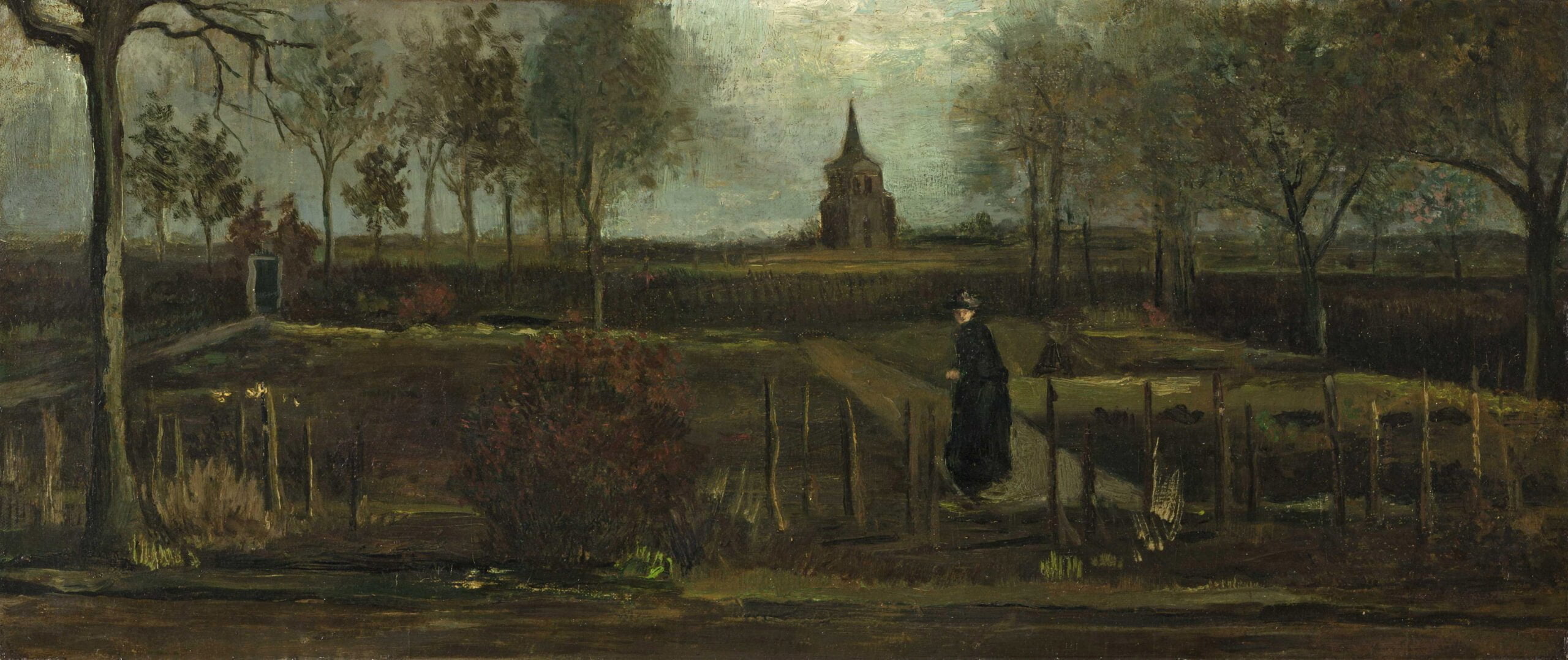
Van Gogh painted several still lifes in 1885. During his two-year stay in Nuenen, he completed watercolors and almost 200 oil paintings. His palette consisted mainly of gloomy earth tones, especially dark brown. There was no trace vivid colors that distinguished his later works.
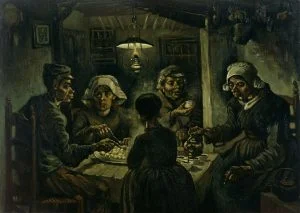
In early 1885, he attracted the interest of an art dealer in Paris. Theo asked Vincent if he had the paintings ready for exhibition. In May, van Gogh responded with his first major work The Potato Eaters and a series of “studies of peasant characters”, which were the culmination of many years of work. He complained to his brother about the sale of the paintings, and Theo replied that they were too dark and not in keeping with the bright style of Impressionism. In August, his work was exhibited publicly in shop windows for the first time of the dealer Leurs in The Hague.
One of the painter’s young peasant extras became pregnant in September 1885. Van Gogh was accused of forcing himself on her, and the village priest forbade the priests to paint for him.
In November left Antwerp and settled above a paint shop in the Rue des Images. He lived in poverty and ate poorly. The money that Theo sent was spent on painting materials and extras. Bread, coffee and tobacco became his staple diet. In February 1886 he wrote to Theo that he remembered only six hot meals the previous May. He had problems with his teeth, which became loose and painful.

In Antwerp he studied color theory and visited museums – studied Rubens – and expanded the color palette to carmine, cobalt blue and emerald green. He drank heavily and was hospitalized for alcoholism between February and March 1886, when he was probably also being treated for syphilis.
After his recovery, despite his resistance to academic teaching, he took the higher level entrance exams at the Academy of Fine Arts in Antwerp and graduated in painting and drawing in January 1886. He fell ill and suffered from overwork, poor diet and excessive smoking.
He started attending drawing classes with extras at Academy in Antwerp in January 1886. He quickly argued with Charles Verlat, director of the academy and class painting teacher. A dispute over his painting style. Van Gogh also argued with his drawing instructor Franz Vinck. He began attending drawing classes based on antique plaster models brought to him by Eugène Siberdt.
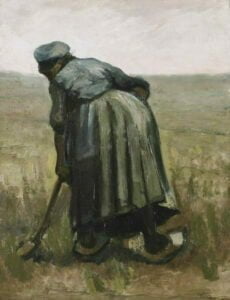
He and Siberdt had an argument when he failed to comply with Siberdt’s instructions that drawings should express contour and focus on line. Van Gogh painted the Venus de Milo during the course, but he drew the naked body without limbs. Siberdt took this as a contempt of management and corrected the drawing with his pencil so much that he tore the paper. Van Gogh burst out and yelled at Siberdt: ‘You obviously don’t know what a young woman is like, dammit! A woman must have hips, buttocks, a pelvis in which she can carry a child!’ According to some sources, this incident was the last time he visited the academy. He went to Paris – March 31, 1886, a month after the incident with Siberdt. At that time, the academy decided that 17 students, including Van Gogh, had to repeat the year. The story that van Gogh was expelled from the academy by Siberdt is therefore unfounded.

In Asnières he painted parks, restaurants and the river Seine. In November 1887, Theo and Vincent became friends with Paul Gauguin. Towards the end of the year, Vincent exhibited together with Bernard, Anquetin and Toulouse-Lautrec at the Grand-Bouillon Restaurant du Chalet. Bernard wrote that the exhibition was a step ahead of all others in Paris. There Bernard and Anquetin sold their first paintings and Van Gogh exchanged work with Gauguin. Debates about art, artists and their social problems arose here, and they also spread to the bullies – Camille Pissarro and his son Lucien, Signac and Seurat. In February 1888, van Gogh went to Paris, where he completed over 200 paintings. Before leaving, he visited Seurat in his studio for the first and last time.
Mature years and success
Due to alcohol and smoking, he sought help in Arles in February 1888. He wanted to establish an artistic colony there. Dane Christian Mourier-Petersen joined him for two months. He adored Arles.
This is one of van Gogh’s more fruitful periods. He painted 200 paintings and more than 100 drawings and watercolors. He was fascinated by the landscape. His paintings from this period are rich in yellow, ultramarine and purple. These are images of harvests, wheat fields and rural sights – e.g. The Old Mill – one of the canvases he swapped for works with Paul Gauguin. In the paintings of Arles, you can see his Dutch upbringing; the fields and avenues are flat and perspective is lacking, but they are distinguished by their color.
In March 1888, landscapes with “ perspective framework”. American artist Dodge MacKnight visited him in April. On May 1, 1888, he signed a lease for 15 francs a month in the Yellow House in Lamartine. The rooms were unfurnished and empty for several months.
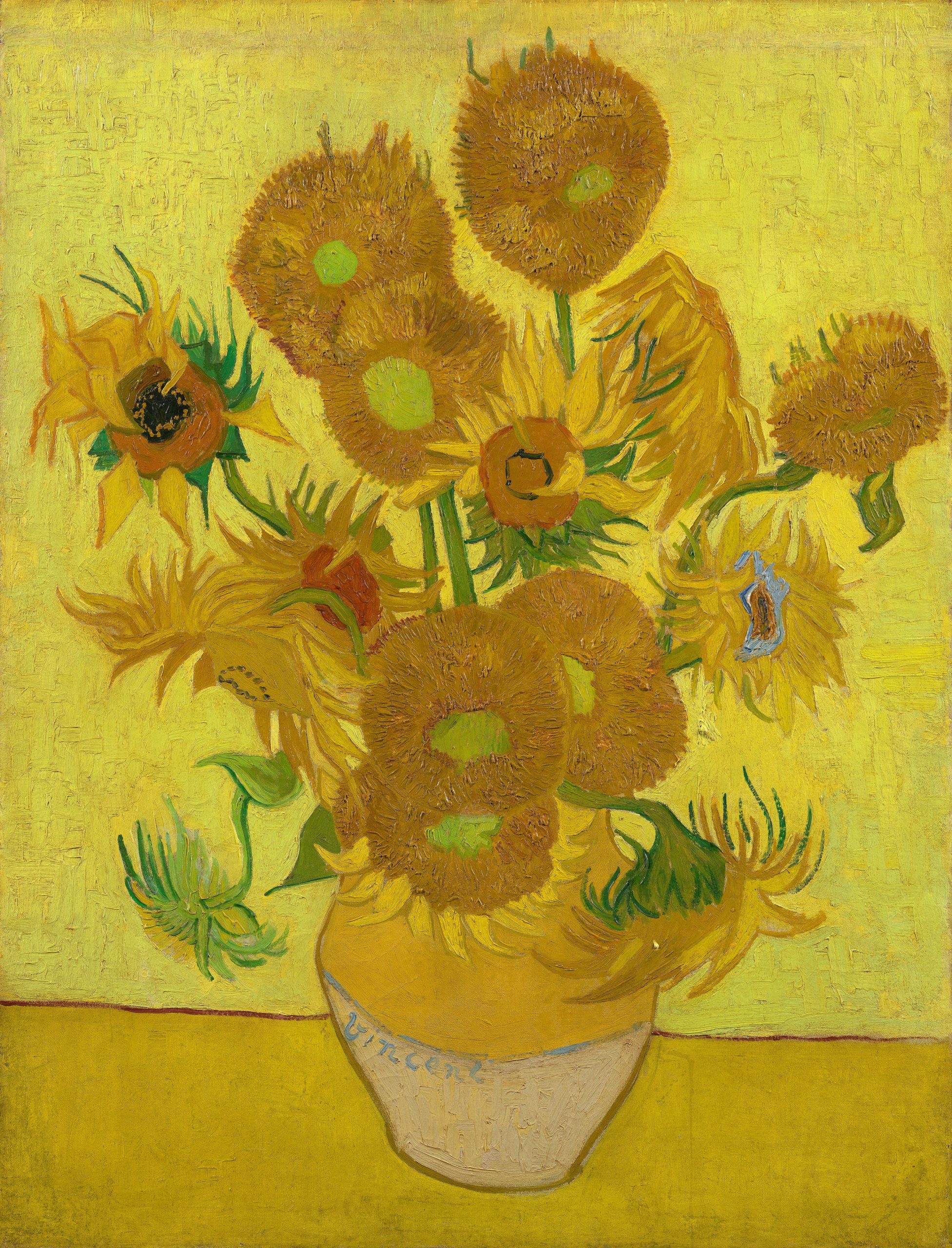
7. In May he moved to the Hôtel Carrel in the Café de la Gare and befriended the owners Joseph and Marie Ginoux. He had to furnish the yellow house before he could move in, but he was already using it as a studio. At the same time, he wanted to open his own gallery in the house where he would exhibit his works. At that time, he painted a series of paintings that eventually included Van Gogh’s Chair (1888), Bedroom in Arles (1888), Night Cafe (1888), Café Terrace at Night (September 1888), Starry Night over the Rhone (1888) and Still Life – Vase with Twelve Sunflowers (1888). All with the aim of equipping the gallery in the Yellow House.
For The Night Café wrote that he tried to “express the idea that a cafe is a place where you can destroy yourself, go crazy or commit a crime”. In June he visited Saintes-Maries-de-la-Mer and instructed Second Lieutenant Paul-Eugène Milliet. He painted boats at sea and villages. MacKnight introduced van Gogh to Eugène Boch, a Belgian painter who used to stay in Fontvieille, and they exchanged visits in July.
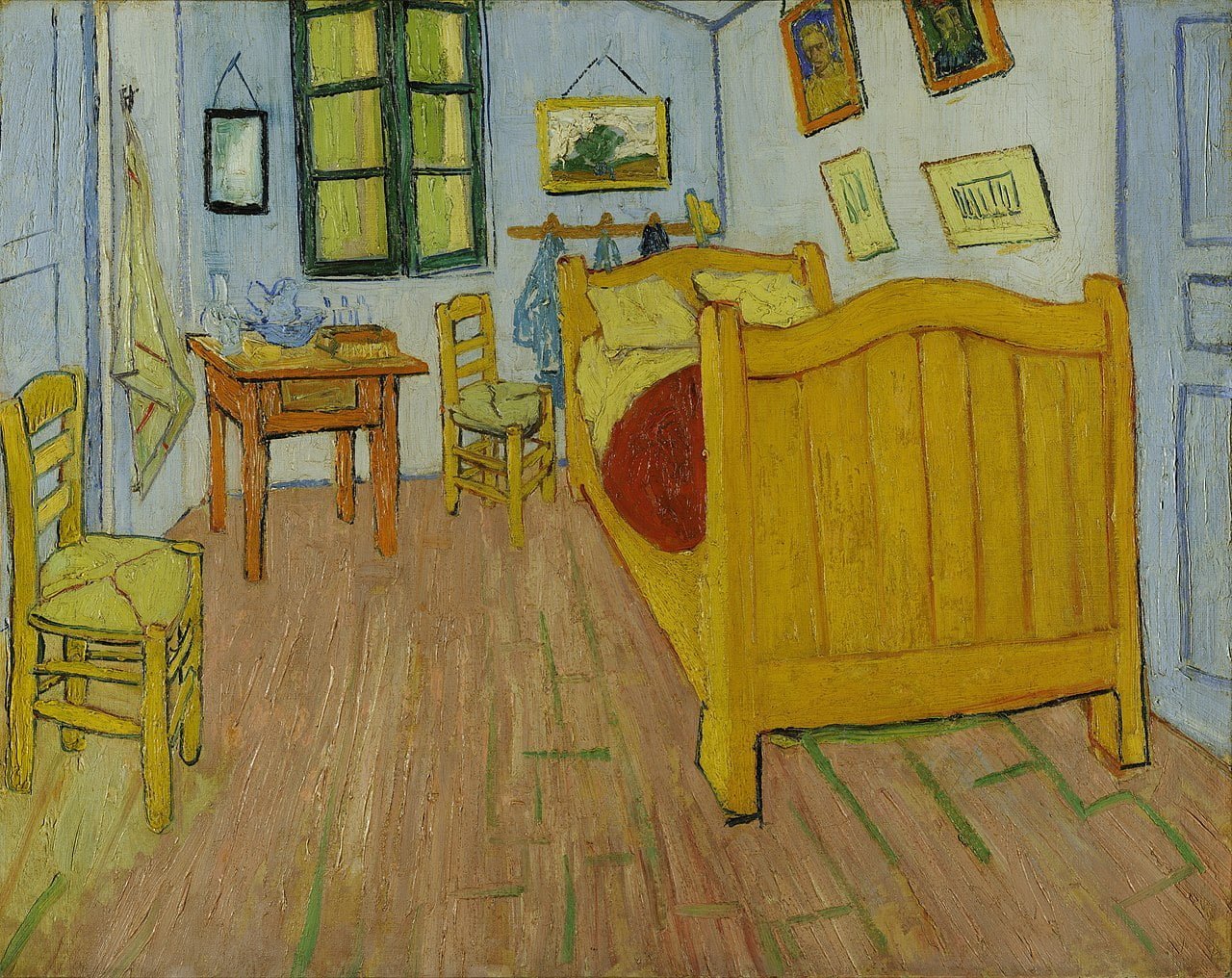
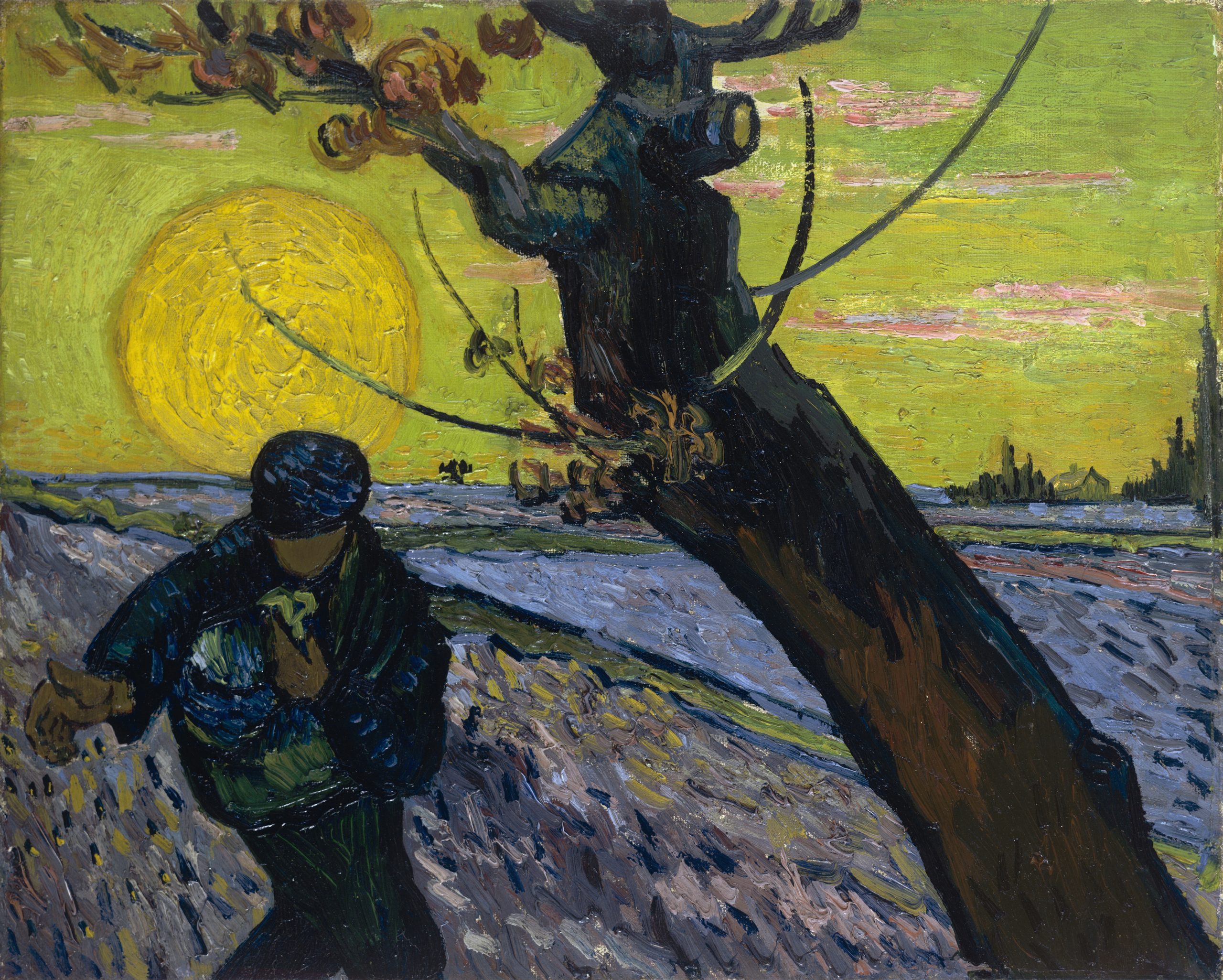
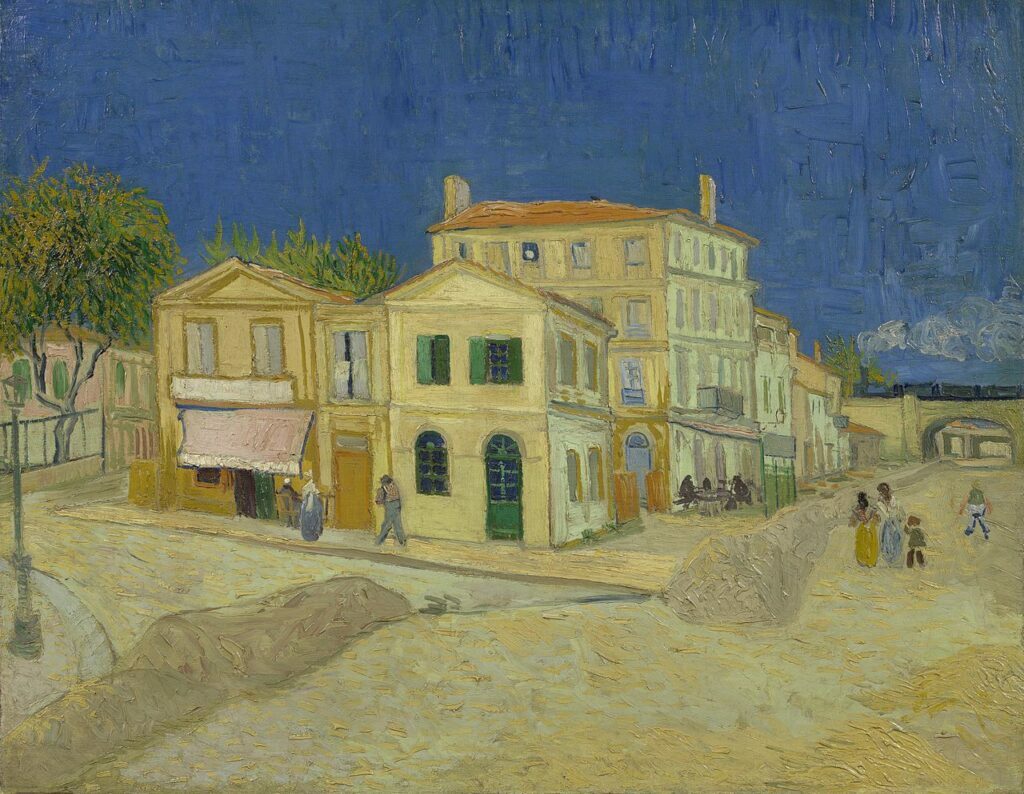
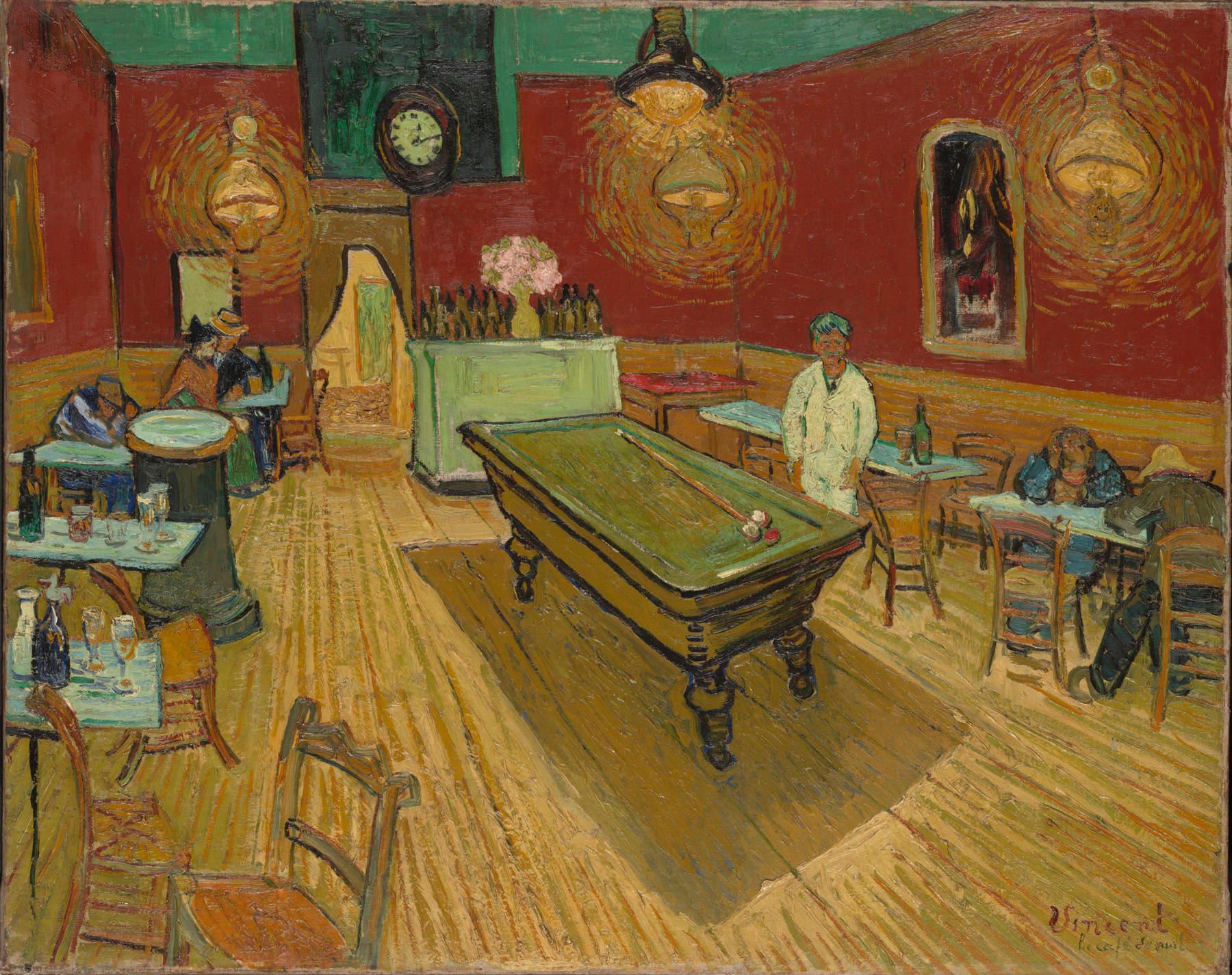



Visit Gaugen 1888
Gauguin visited Arles in 1888 and Van Gogh hoped for friendship and the realization of his idea of an artistic collective. While waiting, he painted Sunflowers in August. On the visit In Bocha, Van Gogh painted his portrait, the painting The Poet against the Starry Sky.
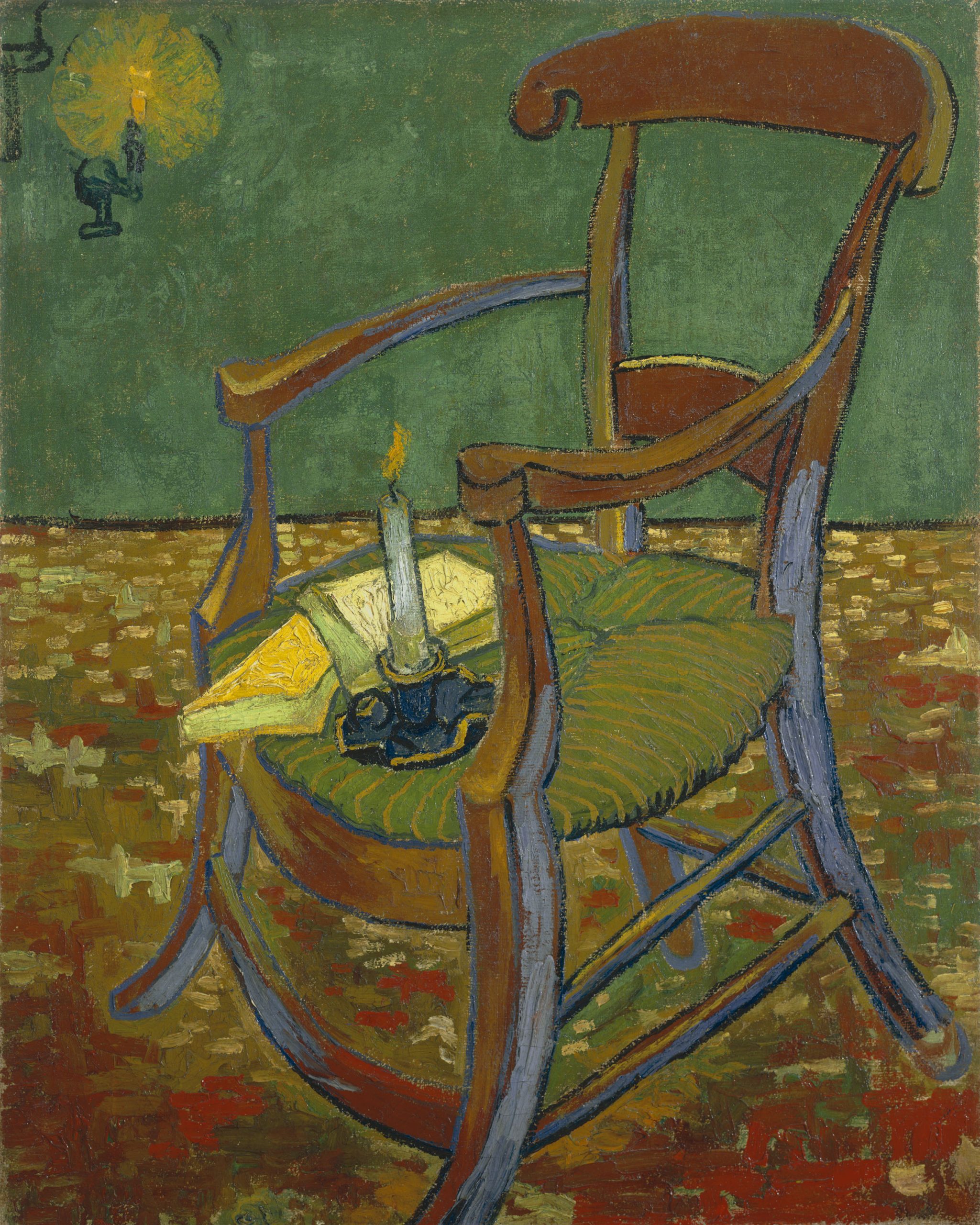
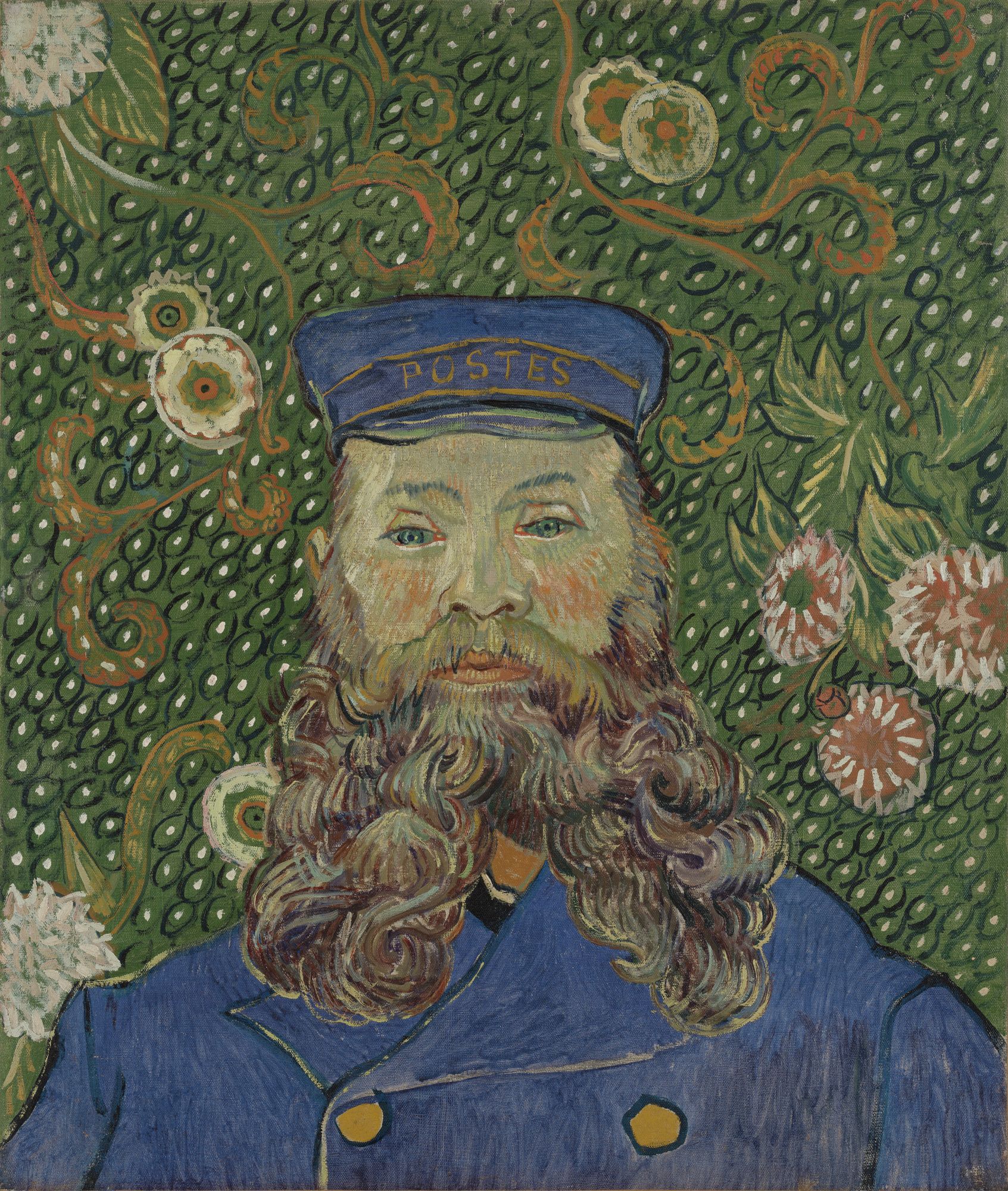
In preparation for Gauguin’s visit, he advised bought the postman Joseph Roulin two beds. He painted his portrait. September 17. At that time he spent the first night in the ill-equipped Yellow House. Gauguin finally agreed to work and live with him in Arles. Van Gogh began to furnish theYellow house, in probably the most ambitious endeavor he ever undertook.He completed two paintings of chairs: Van Gogh’s Chair and Gauguin’s chair.
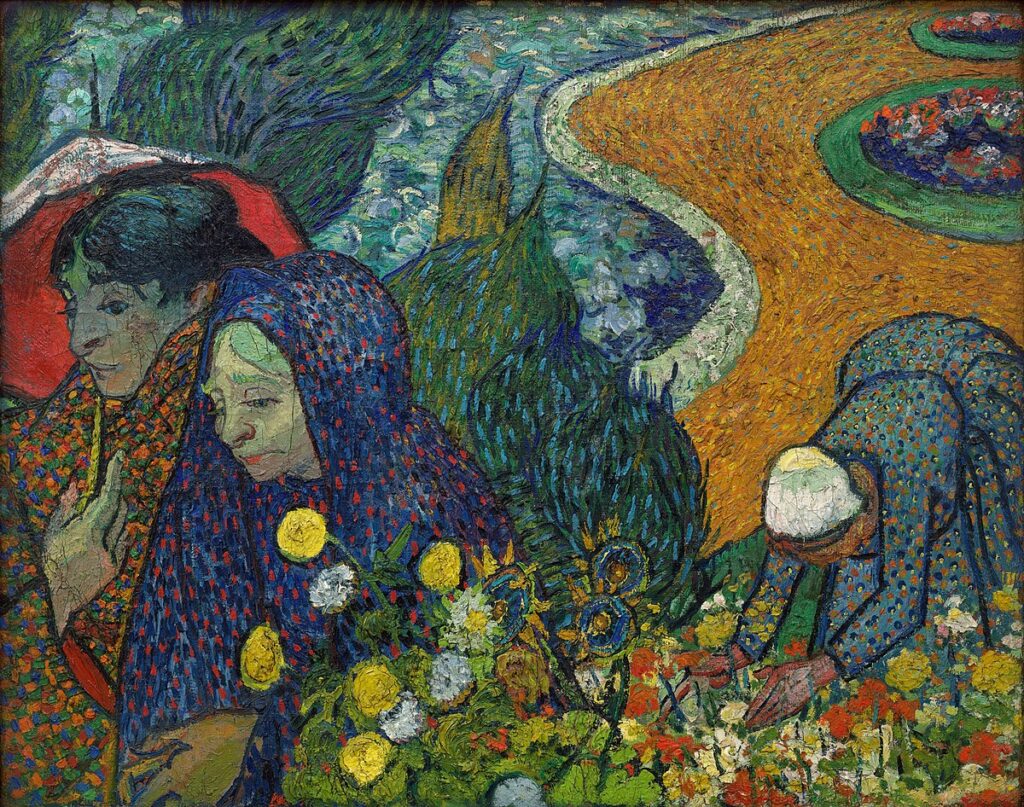
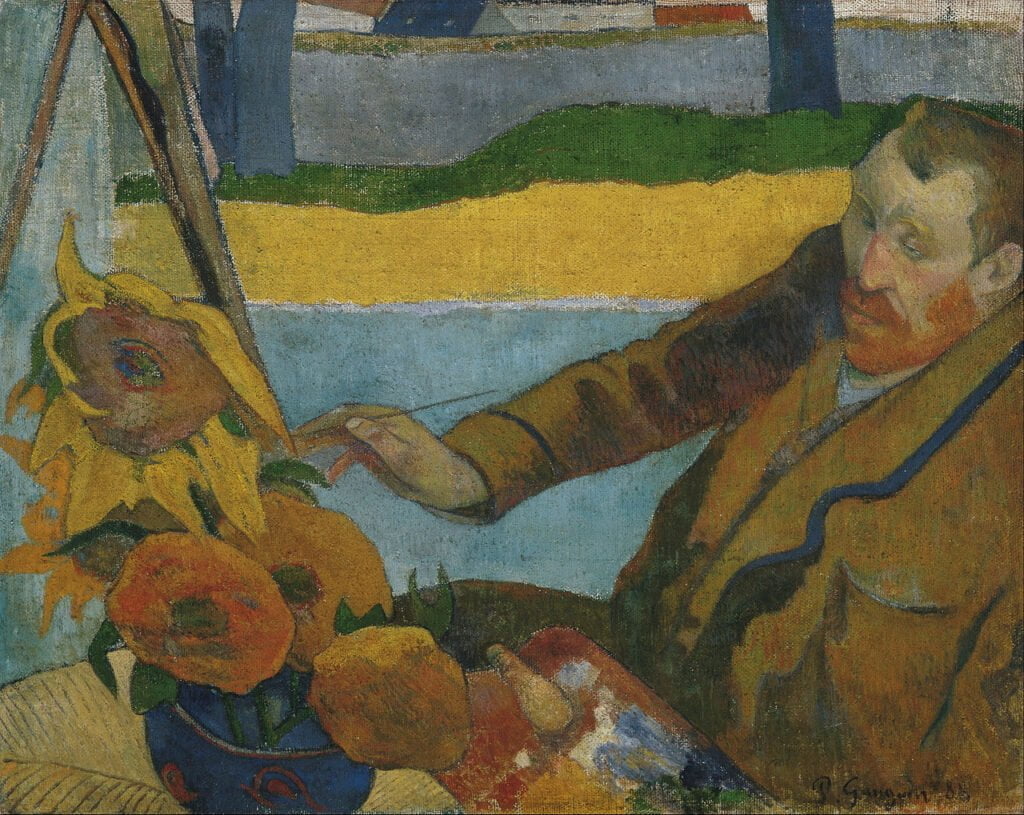
Gauguin arrived on October 23 and they painted together in November. Gauguin depicted Van Gogh painting sunflowers. Van Gogh, on the other hand, painted from memory, which was Gauguin’s suggestion. Among these works is Memory of a Garden in Etten.
Their first outdoor painting together was at Alyscamps. The only painting Gauguin completed during his visit was his portrait of Van Gogh.
Van Gogh and Gauguin went to Montpellier in December 1888. They visited the Musée Fabre and the works of Courbet and Delacroix. Their relationship began to deteriorate. Van Gogh admired Gauguin. He wanted them to be treated equally. Gauguin, on the other hand, was haughty and domineering, which annoyed Van Gogh. They often argued. Van Gogh was afraid that Gauguin would leave. He described the time as “excessive tension”.
The Severed Ear (December 1888)
The events surrounding van Gogh’s severed ear are not exactly known. After 15 years, Gauguin mentioned that they fought several times that night and physically threatened each other. Their relationship was complicated. Theo probably owed Gaugin money. He was suspicious that the brothers were exploiting him financially. Van Gogh was worried that Gauguin wanted to leave him. These days it was bad weather with heavy rain, as a result of which they were confined in the Yellow House. Gauguin later stated that Van Gogh followed him when Gauguin went for a walk and attacked him. “I saw him rushing towards me with an open razor in his hand.” The incident has not been confirmed. Gauguin was almost certainly not in the Yellow House that night, most likely he was sleeping in a hotel.
After the argument with Gauguin, on the evening of December 23, 1888, Van Gogh returned to his room, where he was attacked by voices in his head and he cut off his left ear with a razor (in whole or in part, statements differ). This caused severe bleeding. He bandaged the wound, wrapped the ear in a newspaper and handed the package to the woman in the brothel they were visiting. Van Gogh was found unconscious by a policeman the next morning and taken to the hospital. He was attended to by Félix Rey, a young doctor in training. The ear was delivered to the hospital, but Rey did not attempt to reattach it as too much time had passed. The identity of the woman in the brothel is Gabrielle. She died in Arles at the age of 80 in 1952. Her descendants still live just outside Arles. Gabrielle, known as “Gaby” in her youth, was a 17-year-old cleaner in a brothel and other local establishments at the time Van Gogh gave her his ear.
Van Gogh did not remember the event, which suggests that he suffered a mental breakdown. The hospital diagnosis was “acute mania with generalized delirium”. Within a few days, the local police ordered him to be hospitalized. Gauguin immediately informed Theo, who proposed marriage to his old friend Andries Bonger’s sister Johanna on 24 December. Theo rushed to the station to board the night train to Arles. He came on Christmas Day and comforted Vincent, who seemed only half himself. He returned to Paris that evening.
Gauguin fled Arles. They did not see each other again with Van Gogh. They continued to correspond. In 1890, Gauguin suggested that they establish a studio in Antwerp.
Despite the pessimistic diagnosis, Van Gogh recovered and Returned to the Yellow House on January 7, 1889. He spent a month between hospital care and home, suffering from hallucinations and delusions. In March, the police seized his house following a petition by 30 townspeople (including the Ginoux family), who described him as a red-haired lunatic. Van Gogh returned to the hospital. Paul Signac visited him twice in March. In April, Van Gogh moved into the rooms of Dr. Rey. The floods damaged the paintings in his home. Two months later he left Arles and voluntarily entered a mental institution in Saint-Rémy-de-Provence. He wrote: “Sometimes moods of indescribable anxiety, sometimes moments when the veil of time and the fatality of circumstances seem to be torn for a moment.”
Van Gogh donated his Portrait of Doctor Félix Rey from 1889 dr. Ray. The doctor did not like the painting and used it to repair the chicken coop, then donated it. In 2016, the portrait was stored in the Pushkin Museum of Fine Arts and is estimated at more than 50 million dollars.
Institute for the mentally ill (May 1889 – May 1890)
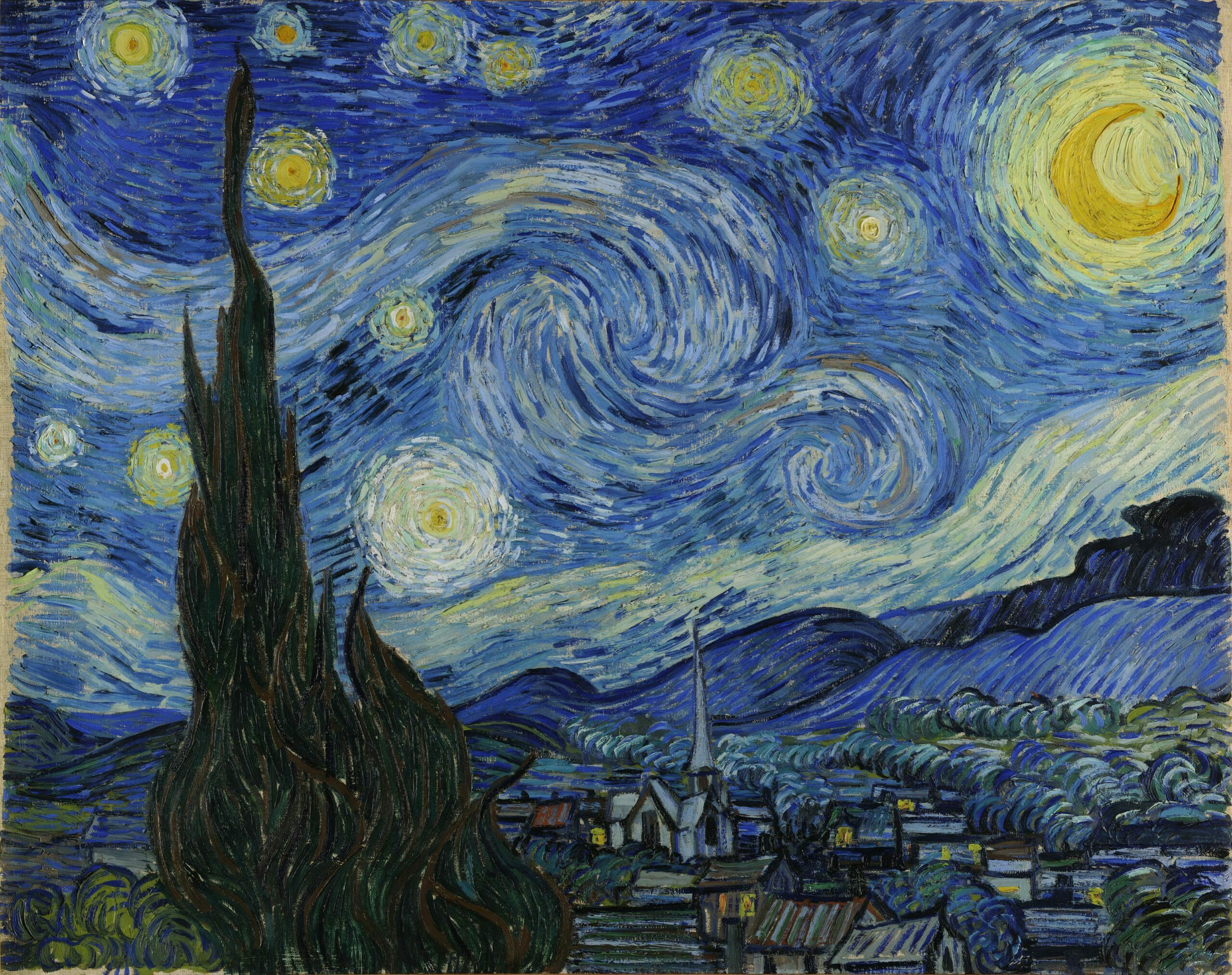
Van Gogh h arrived at Saint-Paul-de-Mausole on May 8, 1889. Saint-Paul, a former monastery in Saint-Rémy, located less than 30 kilometers (19 miles) from Arles, under the leadership of naval doctor Théophile Peyron. Van Gogh lived in two cells with barred windows. One was intended for the studio. The clinic and its garden became the main subjects of his paintings. He drew several studies of hospital interiors (Vestibule of the Asylum in Saint-Rémy – September 1889) and its gardens, such as Lilacs (May 1889). Some paintings are characterized by swirls, for example Starry night – Starry night. He was allowed short walks under supervision. During this time he painted cypresses and olives, among others Valley with a ploughman– seen from above, Olives with the Alps in the background 1889, Cypresses 1889 , A wheat field with cypresses (1889), Country Road and Night in Provence(1890). In September 1889, he produced two more versions of Rooms in Arles.
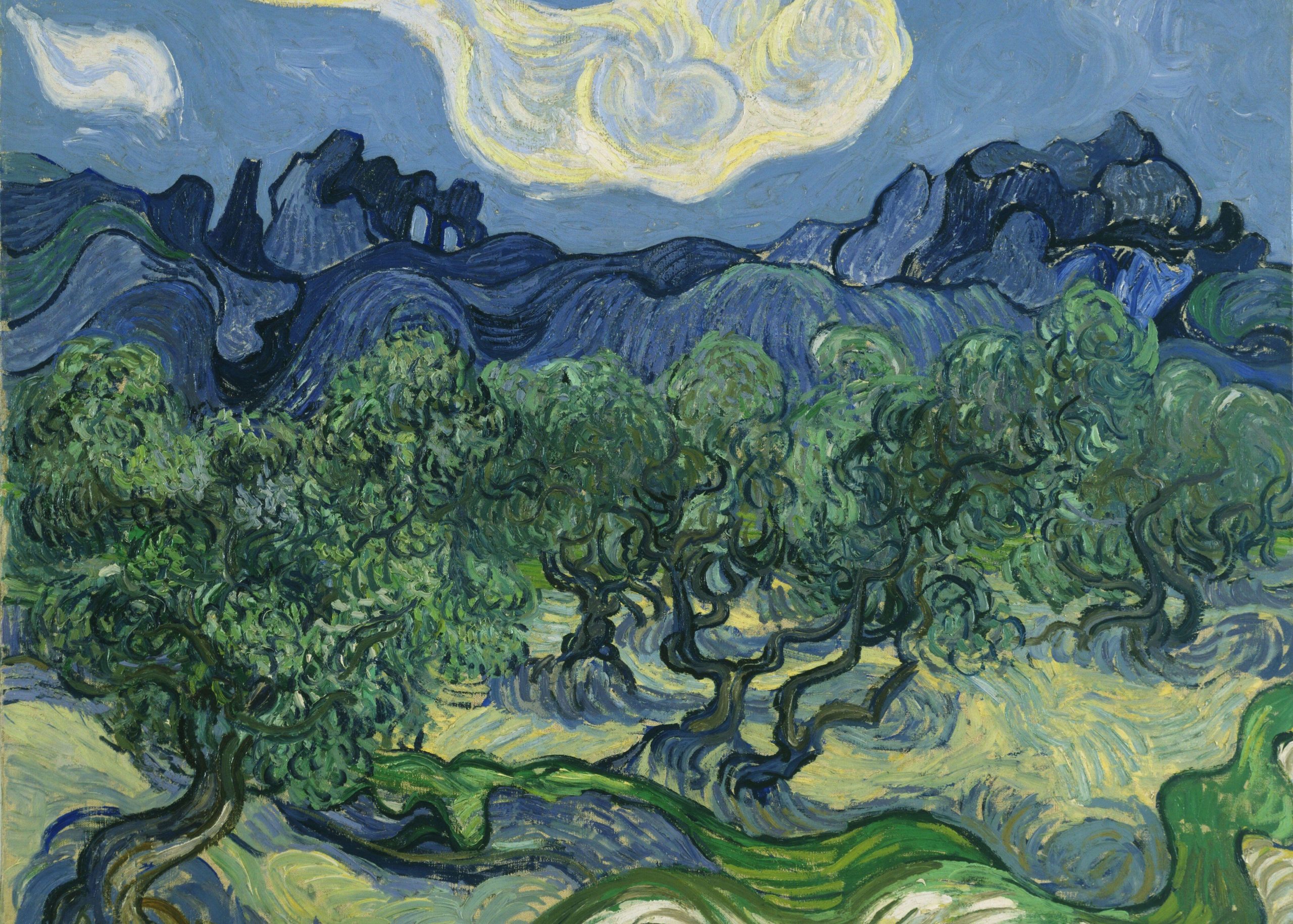
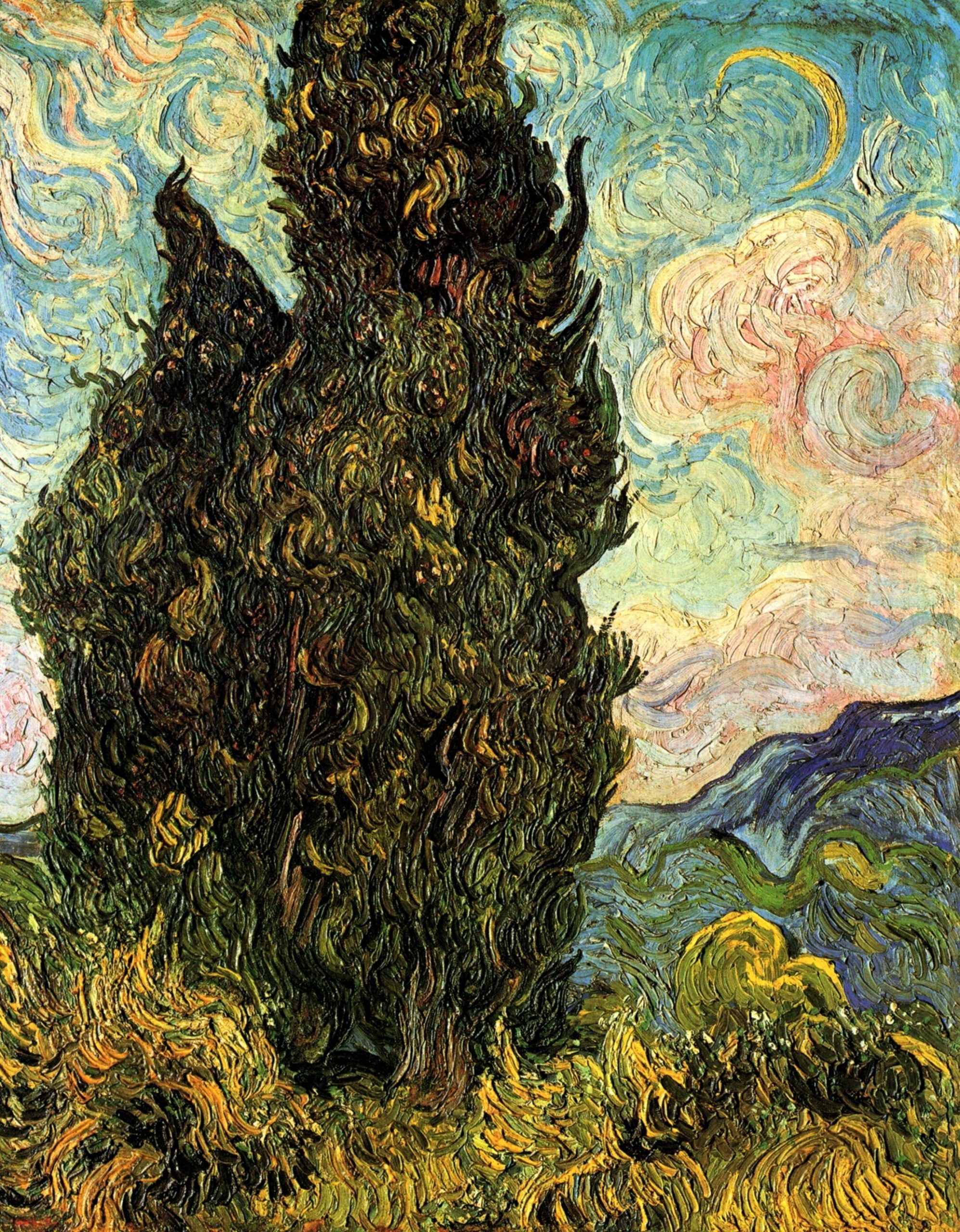
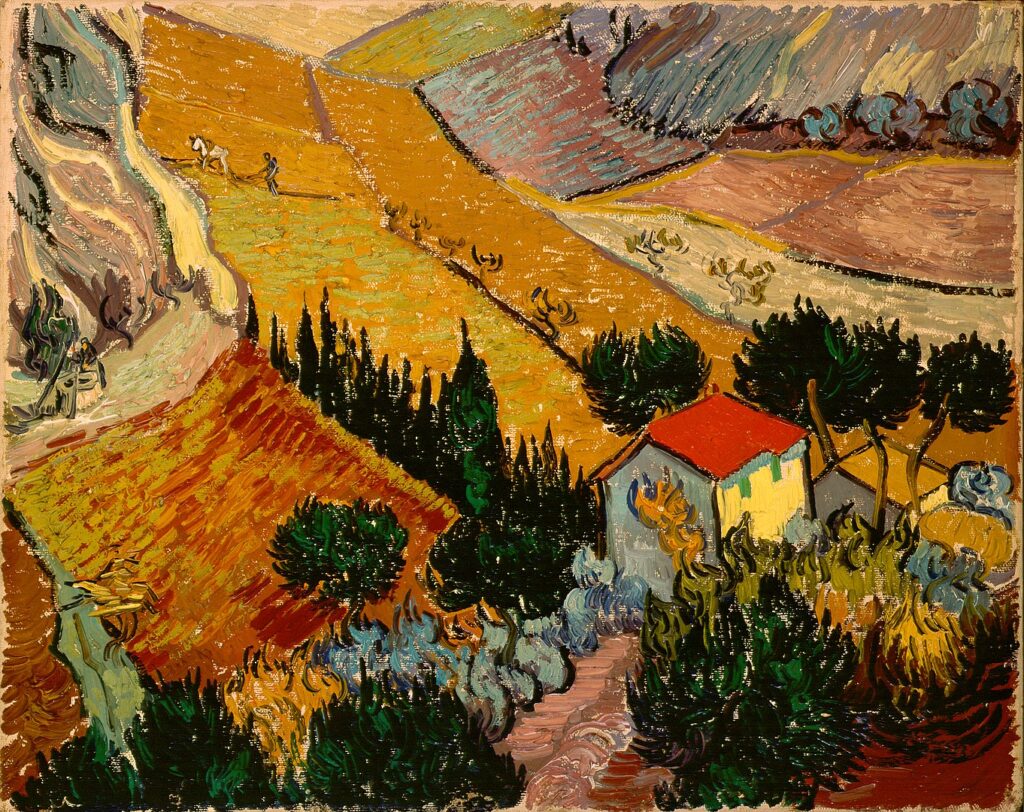
Limited access to life resulted in a lack of items for painting. Van Gogh therefore interpreted the paintings of other artists such as Millet – The Sower and Midday Rest and variations of his earlier paintings. Van Gogh was an admirer of Gustave Courbet and Millet and compared his copies with interpretations of Beethoven’s symphonies.
Image He painted the group of prisoners after an engraving by Gustave Dore (1832-1883). Tralbaut suggests that the face of the captive in the center of the painting, looking towards the viewer, is Van Gogh himself.
During February and in April 1890 the situation worsened. He became depressed and could not bring himself to write. He could always paint and draw a little, and later he wrote to Theo that he made some small paintings “from memory… to the north”. Among these paintings were two peasant women digging in a snowy field at sunset. This short period was the only time when Van Gogh’s illness significantly affected his work. He asked his mother and brother to send him drawings and unfinished work he had drawn in the early 1880s so that he could work on new paintings based on his old sketches. To this period belongs Sorrowing Old Man (“At Eternity’s Gate”), a color study that Hulsker describes as “another unmistakable memory of a time long gone.” His late paintings show the artist at the height of his abilitiessti, according to the art critic Robert Hughes, “yearning for brevity and grace”.
After the birth of his nephew Van Gogh wrote: “I immediately started making a picture for him to hang in their bedroom, branches of a white almond blossom against a blue sky.”

Auvers sur Oise (May–July 1890)
In May 1890 he left the clinic in Saint-Rémy and went with dr. Paul Gachet. Gachet homeopath and amateur painter. He treated several artists. Van Gogh’s first impression was that Gachet was “better than me, I thought, or just as good.”
In the last weeks in Saint-Rémy when his thoughts returned to “memories of the north” some of the approximately 70 oils painted in as many days in Auvers-sur-Oise recall northern scenes. In June 1890, he painted several portraits of his doctor, including Portrait of Dr. Gachet and his only etching. There are other paintings that are unfinished, including thatched cottages on a hill.
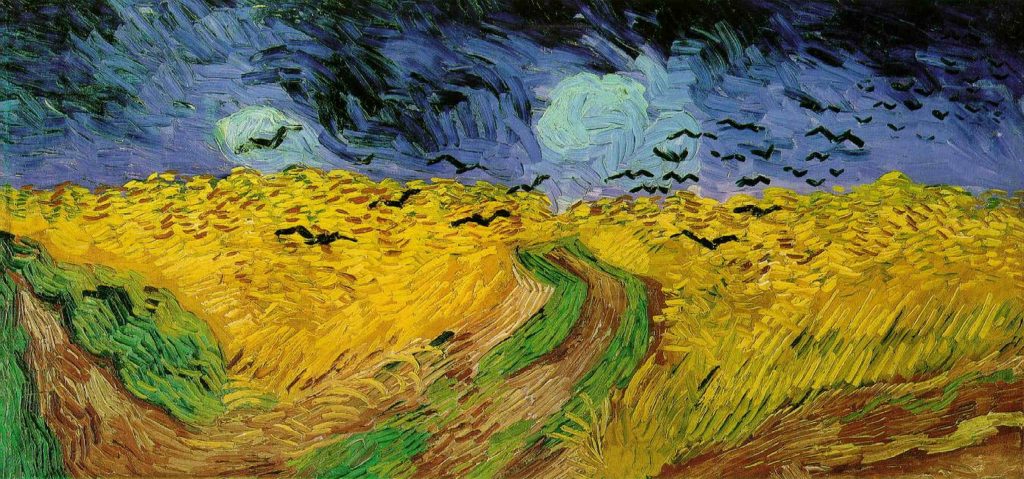
In July, Van Gogh wrote, that he immersed himself in the “huge plain against the hills, boundless like the sea, soft yellow”. The fields first enchanted him in May, when the wheat was young and green. In July, Theu described “huge fields of wheat under a restless sky.”
He wrote that they represented his “sorrow and extreme loneliness” and that “the canvases will tell you what I can’t say with words, i.e. how healthy and invigorating I find the countryside”. Wheat field with crows , although not his last oil work, is from July 1890 and is associated with “melancholy and extreme loneliness”. Hulsker identifies seven oil paintings from Auvers that follow the completion of Wheatfield with Crows.
It is very likely that the exact location of Van Gogh’s last work Tree Roots, what 150 meters from the Auberge Ravoux inn where he stayed. A tangle of gnarled roots grew on the hillside. Van Gogh probably worked on the painting only a few hours before his death.
Death
On July 27, 1890, at the age of 37, Van Gogh was most likely shot in the chest with a 7mm Lefaucheux pinfire revolver. There were no witnesses. He died 30 hours after the event. He is said to have shot himself in a wheat field where he was painting, or in a local barn.
She was shot ricocheted off the rib and penetrated the chest without causing obvious damage to the internal organs. She probably stopped at the spine. He walked back to the Auberge Ravoux where two doctors attended to him, but without a surgeon the bullet could not be removed. The doctors tried their best and then left him alone in his room smoking a pipe. The next morning Theo rushed to his brother and found him in good spirits. But within hours, Vincent began to fail, due to an infection resulting from the wound. He died in the early hours of the 29thpours. According to Theo, Vincent’s last words were: “Grief will last forever”.
Van Gogh was buried 30 .July at the municipal cemetery of Auvers-sur-Oise.
The gun with which Van Gogh shot himself was was found in 1965 and was sold at auction on June 19, 2019 as “the most famous weapon in the history of art” for 162,500 euros.
Source: Wikipedia
Vincent Van Gogh – 10 interesting things
- Vincent van Gogh was a Dutch post-impressionist painter, one of the most famous and influential figures in the history of Western art.
- During his lifetime he sold only one painting , and today his paintings are among the most expensive in the world.
- Van Gogh was a prolific letter writer and many of his letters to his brother Theo have been preserved, providing insight into his life and work.
- He had mental health issues and was admitted to the Saint-Paul-de-Mausole asylum in Saint Rémy de Provence, France.
- Van Gogh’s most famous painting “The Starry Night” was created during his stay in the asylum and is considered one of the most recognizable works of art in the world.
- The artist was self-taught and developed his own, recognizable style.
- He was a passionate painter and completed more than 2,000 works in just over a decade, including 860 oil paintings.
- Van Gogh was also an avid collector of Japanese art, and was greatly influenced by the style and compositions of traditional Japanese woodcuts.
- He had a close friendship with the French painter Paul Gauguin, which ended in an argument that caused him to lose part of his left ear.
- Died in 1890 in Auvers-sur-Oise, France, aged 37, of a gunshot wound , which he set himself. His death is believed to be a suicide, but is still debated.
Van Gogh’s most famous paintings
The Starry Night (1889), painted in Saint-Rémy, hangs at MoMA in New York – its lesser-known sister, Starry Night over the Rhône, he painted a year earlier in Arles, and we explain the difference between the two in a separate article. The Sunflowers, a series of still lifes in yellow, were made for Gauguin’s arrival in Arles; Café Terrace at Night glows without a single black stroke; other high points include the Irises, the Almond Blossom and the self-portraits. You will find them all as hand-painted reproductions of Van Gogh paintings. The Starry Night and Sunflowers are among the works gathered in our overview of the most celebrated paintings.
Style: colour as emotion
Van Gogh laid the paint on thickly and visibly – the impasto technique – in short, swirling strokes you can recognise from across a room. Yellow and blue are his signature: the sun-yellow of Arles against the night blue of Provence. It is exactly this raised, layered surface that lets a hand-painted reproduction carry his work into a room the way a print cannot.
Frequently asked questions about Vincent van Gogh
Which is Van Gogh’s most famous painting?
The Starry Night of 1889, which hangs at MoMA in New York. It is often confused with Starry Night over the Rhône of 1888 – these are two different paintings, and we explain the difference in our article on Starry Night over the Rhône.
Why did Van Gogh cut off his ear?
In December 1888, in Arles, in severe mental distress after the quarrel with Gauguin, he injured his left ear. The episode speaks of the illness he fought all his life – and alongside which he still created more than 850 paintings.
How many paintings did Van Gogh sell in his lifetime?
Only a single sale is reliably documented – The Red Vineyard. Today his works are among the most expensive in the world; the fame came only after his death in 1890.
Can I buy a hand-painted reproduction of a Van Gogh painting?
Yes. In our online gallery you will find hand-painted reproductions of Van Gogh’s works – The Starry Night, the Sunflowers, Café Terrace and other motifs, on canvas in the size you choose.
Read next: Starry Night over the Rhône – where the original hangs and the story of the painting.