







































Description
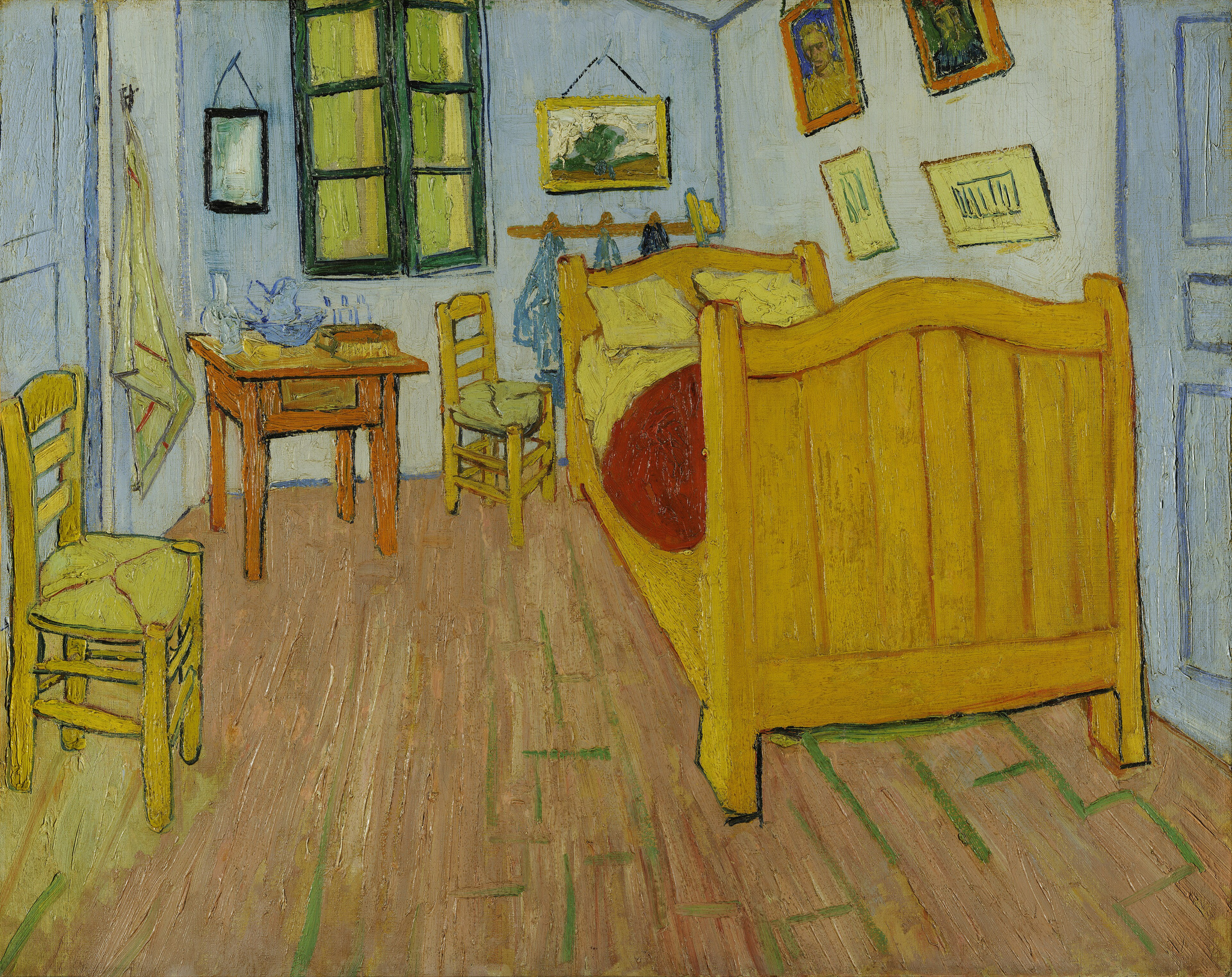
Bedroom in Arles is the painting Vincent van Gogh made in October 1888 of his own room in the Yellow House in Arles: a wooden bed with a scarlet blanket, two chairs, a small table with a basin, portraits on the wall and a window with closed shutters, all in flat, bright colours meant to suggest rest. This first version, 72.4 x 91.3 cm, hangs in the Van Gogh Museum in Amsterdam. We paint it by hand in oil on canvas, in seventeen sizes from 50 x 40 to 120 x 100 cm or to your own measurement, and send you a photograph of the finished work for approval before dispatch.
| Title: | Bedroom in Arles |
| Other titles: | The Bedroom · La Chambre à Arles · Slaapkamer te Arles |
| Painter: | Vincent van Gogh (1853–1890) |
| Year painted: | October 1888, Arles |
| Original size: | 72.4 cm x 91.3 cm |
| Original technique: | Oil on canvas |
| Painting style: | Post-Impressionism |
| Located at: | Van Gogh Museum, Amsterdam (inv. s0047V1962) |
| Our reproduction: | Hand-painted oil on canvas, seventeen sizes or made to measure |
Bedroom in Arles – Vincent van Gogh
What does Bedroom in Arles show?
We look into a small room from the doorway. Against the right-hand wall stands a heavy wooden bed, painted yellow, with two pillows, a pale green sheet and a scarlet blanket. In the foreground and beside the bed are two simple rush-seated chairs, and on the left a small table with a jug, a basin, a few bottles and a brush. Above the table hangs a mirror, beside it a towel on a nail, and on the wall over the bed two small portraits and a landscape. Clothes and a straw hat hang on pegs behind the bed.
At the back is the window with its green shutters, the floor is laid with red tiles, and there is a door on each side. Nothing in the room is decorated or expensive.
How did Van Gogh furnish his room in the Yellow House?
In 1888 Van Gogh lived in the Yellow House at 2, Place Lamartine in Arles, a town in the south of France, and he prepared his bedroom there himself, with plain furniture and with his own work on the walls. The door on the right led to the stairs, the door on the left to the guest room he had made ready for Paul Gauguin.
He began the painting in the middle of October 1888, while he was waiting for Gauguin, after a few days in which illness had kept him in bed. The room itself was not rectangular but a trapezoid. That is why the back wall seems to run off at an odd angle: the corner really was skewed, as the Van Gogh Museum notes.
What did Van Gogh want Bedroom in Arles to say?
He explained it to his brother Theo in a letter. This time it was simply his bedroom, but the colour had to do the job, so that looking at the painting would rest the mind, or rather the imagination. The bright colours were meant to express absolute repose, or sleep. The solid furniture, he wrote, should also express unshakeable rest.
He listed the colours one by one: walls of pale violet, a floor of red tiles, a bed and chairs of fresh butter yellow, a sheet and pillows of very bright lemon green, a scarlet blanket, a green window, an orange dressing table, a blue basin and lilac doors. He also left out the shadows and flattened the room on purpose, so that it would look like a Japanese print.
Van Gogh was very pleased with the result. After a later illness he wrote that, when he saw his canvases again, the one that seemed best to him was the bedroom.
Where does the original hang, and how did it get there?
This first version hangs in the Van Gogh Museum in Amsterdam, on view in the permanent collection, and belongs to the Vincent van Gogh Foundation. While Van Gogh was in hospital in Arles, the canvas was damaged when the Rhône flooded. At the end of April 1889 he sent it to Theo in Paris, and Theo suggested having it relined and sent back so that Vincent could copy it.
The painting never left the family: after Theo it passed to his widow Jo van Gogh-Bonger and their son Vincent Willem, who transferred it in 1962 to the Vincent van Gogh Foundation. It has hung in the Van Gogh Museum since the museum opened in 1973.
Bedroom in Arles – which version is this, and what goes with it?
Van Gogh painted the bedroom three times. This page offers the first version, painted in October 1888, with the original in Amsterdam. In September 1889 he made a repetition at the same scale, now in the Art Institute of Chicago, and soon after a smaller version for his mother and his sister Wil, now in the Musée d’Orsay in Paris. If you want the room as Van Gogh first painted it, choose this one.
One of the chairs of the Yellow House has its own portrait: Van Gogh’s Chair, painted in Arles in 1888 and now in the National Gallery in London, shows a simple rush-seated chair like the two in this room. From the same months in Arles come Sunflowers I, Café Terrace at Night and Starry Night over the Rhône.
How is our hand-painted Bedroom in Arles made?
The painter first draws the room on the canvas, with the tilted floor, the bed and the two doors, then lays in the large flat areas of colour: the walls, the red floor, the yellow furniture. Our oil painting reproduction is painted by hand in oil on canvas with real impasto: the paint goes on thickly, so the brushstrokes stand up from the canvas as on Van Gogh’s original, in the floor tiles and the blanket as much as in the walls.
One question comes up with this painting: should the walls be blue or violet? Today the original looks blue, but research at the Van Gogh Museum showed that the walls and doors were first purple and have faded over the years. We paint the bedroom as the original looks in the museum today.
Every painting is a hand-painted copy made for your order, so no two are quite the same. A printed reproduction shows only a flat surface; on ours the strokes and layers of paint are real.
Which size of Bedroom in Arles for which wall?
Short answer: 105 x 85 or 120 x 100 cm above a double bed or a sofa, 75 x 60 or 80 x 65 cm above a chest of drawers or in a smaller room, and 50 x 40 or 60 x 50 cm for a narrow wall or a hallway. As the painting of a bedroom, it sits naturally above a bed, but it suits a living room just as well.
There are seventeen sizes: 50 x 40, 60 x 50, 70 x 55, 70 x 56, 70 x 58, 75 x 60, 80 x 63, 80 x 65, 85 x 69, 88 x 70, 91 x 72, 97 x 80, 100 x 80, 103 x 84, 105 x 85, 105 x 87 and 120 x 100 cm, always given as width by height. The 91 x 72 cm size is practically the original, which is 91.3 cm wide and 72.4 cm high, so on your wall it works as it does in Amsterdam. A painting for the living room should cover about two thirds of the furniture below it: above a 160 cm sofa or bed, that is 105 cm.
Hang it with the centre of the canvas about 150 cm above the floor, and 20 to 30 cm above a sofa or a headboard.
What if I need a custom size or a frame?
If none of the seventeen sizes fits your wall, we paint it to measure. We recommend keeping the proportions close to the original, otherwise the room gets squeezed or stretched. Send us the width and height you want and we will quote a price and a lead time. Every painting we make is stretched over a wooden stretcher and ready to hang.
For the moulding, use our 3D application: it shows each of our frame profiles on this subject – the application is for choosing the frame only. If you would like to see how the painting will look on your own wall, that is our separate room placement service. Van Gogh himself wrote that the frame should be white, because there is no white in the painting, so a plain white or light frame is a choice with history behind it.
How does delivery work, and what is the guarantee?
Every painting is made to order in our studio in Slovenia, so allow 15 to 45 days depending on the size you choose. We ship it stretched and protected, framed if you chose a frame, across the EU with no customs. Before dispatch you receive a photograph of the finished work to approve; if anything is not right, we correct it while the canvas is still in our workshop. Our returns policy applies to every order.
More famous Van Gogh paintings are in the Vincent van Gogh gallery, and there is more about the painter in our article on Vincent van Gogh. For a gift, a wall art voucher lets the recipient choose size and subject.
Frequently asked questions
Where is the original Bedroom in Arles today?
The first version is in the Van Gogh Museum in Amsterdam, on view in the permanent collection and owned by the Vincent van Gogh Foundation. The two later versions are elsewhere: the repetition of September 1889 in the Art Institute of Chicago and the smaller one in the Musée d’Orsay in Paris.
When and where did Van Gogh paint Bedroom in Arles?
In October 1888, in Arles in the south of France, in the Yellow House on Place Lamartine, where he lived. He started it in the middle of the month, after a few days in bed through illness, while he was preparing the guest room next door for Paul Gauguin. The room he painted was his own bedroom.
How many versions of Bedroom in Arles are there?
Three. The first, of October 1888, is in the Van Gogh Museum in Amsterdam; the second, a repetition at the same scale from September 1889, is in the Art Institute of Chicago; the third, a smaller version made for his mother and sister, is in the Musée d’Orsay. In 2016 all three were shown together in Chicago; there is more on Wikipedia.
Why do the walls in Bedroom in Arles look slanted?
Partly because the room really was crooked: it was a trapezoid, and the Van Gogh Museum notes that the skewed corner is no mistake. The rest is deliberate. Van Gogh wrote that he had flattened the interior and left out the shadows so that it would look like a Japanese print, so the perspective is a choice, not a lapse.
What does Bedroom in Arles mean?
Van Gogh meant it to express rest. He wrote to Theo that the colour had to do the job here and that looking at the painting should rest the mind, or rather the imagination. The solid furniture was to express unshakeable repose. It also shows the home he had made for himself in the Yellow House, simple and his own.
Why are the walls in Bedroom in Arles blue when he described them as violet?
Because the colour has changed. Van Gogh wrote of pale violet walls and lilac doors, and research at the Van Gogh Museum shows that the walls and doors were originally purple rather than blue. The strongly contrasting colours we see today are the result of discolouration over the years, so the room once looked softer and warmer than it does now.
Whose portraits hang on the wall in Bedroom in Arles?
In this first version the two small portraits above the bed are miniatures of Van Gogh’s own portraits of his friends Eugène Boch and Paul-Eugène Milliet, known as The Poet and The Lover. In the later versions the portraits on that wall are different, which is the easiest way to tell the three canvases apart.
Is your Bedroom in Arles a print?
No. Each one is painted by hand in oil on canvas, with the paint laid on thickly in impasto, as Van Gogh did. So what you receive is a real canvas painting, stretched and ready to hang, and before dispatch we photograph it and send you that photograph to approve.
Does your Bedroom in Arles have the raised brushstrokes of the original?
Yes. We paint Bedroom in Arles in impasto, so the brushstrokes stand up from the canvas as on Van Gogh’s original, in the lines of the floor, the folds of the blanket and the walls. Look at it from the side and the relief catches the light. A print cannot have this: its surface is flat, however good its colours.
- Subject: Van Gogh’s own bedroom in the Yellow House, with a yellow bed, a scarlet blanket, two chairs and portraits on the wall.
- Original: October 1888, Arles, 72.4 x 91.3 cm, Van Gogh Museum, Amsterdam.
- Ours: a Van Gogh reproduction painted by hand in oil on canvas, in seventeen sizes from 50 x 40 to 120 x 100 cm or made to measure.
- Worth knowing: you receive a photograph of the finished work for approval before dispatch.