







































Description
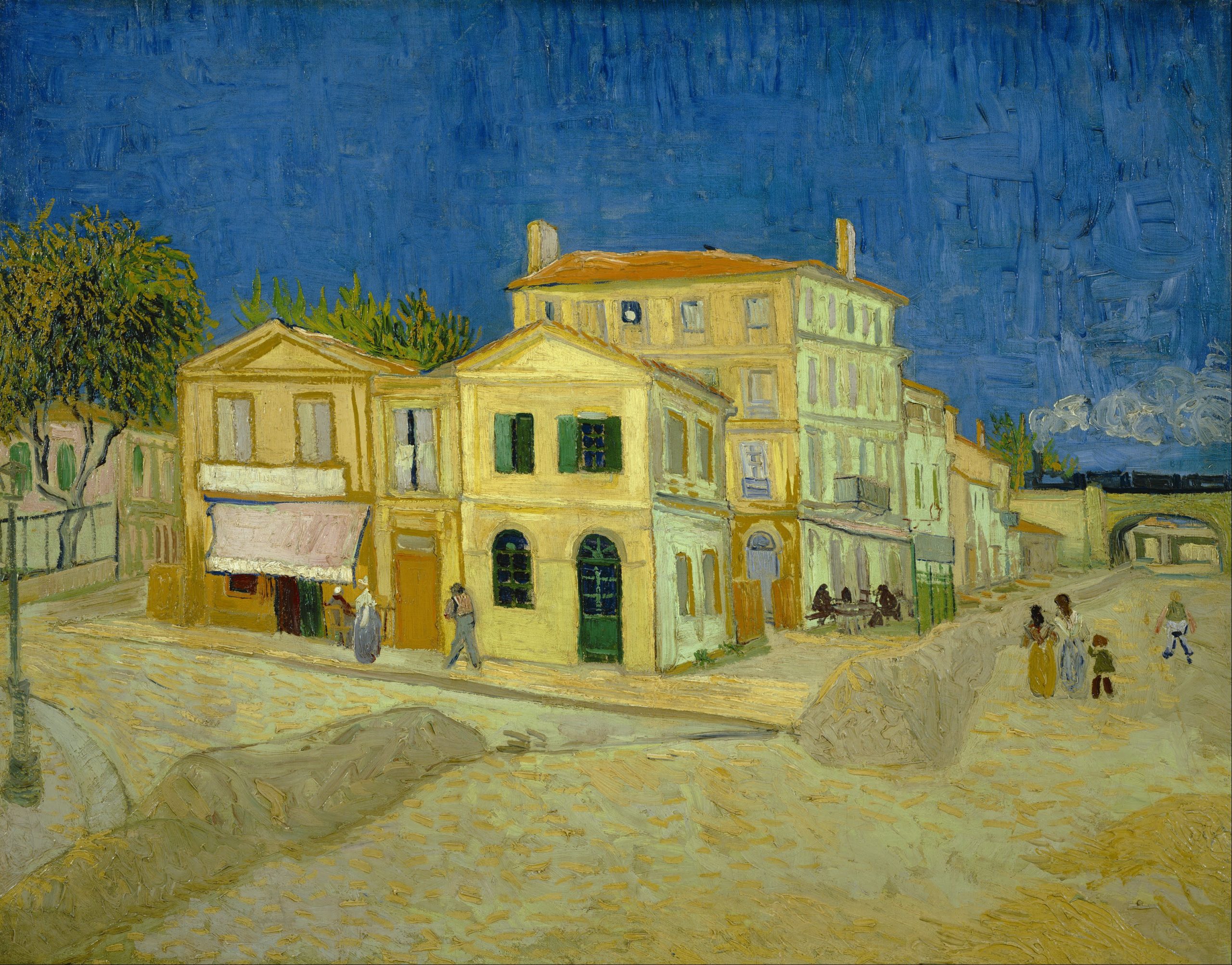
The Yellow House is the painting Vincent van Gogh made in Arles in September 1888 of the house where he lived: a yellow corner building with green shutters on Place Lamartine, under a deep blue sky, with a pink restaurant on the left and two railway bridges on the right. The original, 72 x 91.5 cm, hangs in the Van Gogh Museum in Amsterdam. We paint it by hand in oil on canvas, in 17 sizes from 50 x 40 to 190 x 151 cm or to your own measurement, and send you a photograph of the finished work for approval before dispatch.
| Title: | The Yellow House |
| Other titles: | The Street · Het gele huis · La Rue |
| Painter: | Vincent van Gogh (1853–1890) |
| Year painted: | September 1888, Arles |
| Original size: | 72 cm x 91.5 cm |
| Original technique: | Oil on canvas |
| Painting style: | Post-Impressionism |
| Located at: | Van Gogh Museum, Amsterdam (inv. no. s0032V1962) |
| Our reproduction: | Hand-painted oil on canvas, 17 sizes or made to measure |
The Yellow House – Vincent van Gogh
What does The Yellow House show?
A sunny square opens in front of you. In the middle stands a corner house painted yellow, with green shutters: this is the house on Place Lamartine in Arles where Van Gogh rented four rooms in May 1888. On its left, in the shade of a tree, stands a pink building, the restaurant where he often ate. On the right a street runs down past more yellow houses towards two railway bridges, and on the nearer bridge a train passes, leaving a small white cloud of steam.
In the foreground lie mounds of yellow earth, and a few small figures walk along the street. Above everything stretches a deep cobalt-blue sky without a single cloud. Almost everything in the painting is yellow – the houses, the ground, the sunlight on the walls – and the blue makes it glow. Van Gogh wrote to his brother Theo about it: “it’s tremendous, these yellow houses in the sunlight and then the incomparable freshness of the blue.”
Why did Van Gogh paint his own house?
In May 1888 Van Gogh rented four rooms in the right wing of 2 Place Lamartine, the corner house in this painting. He used the two large rooms on the ground floor as his studio and kitchen, and two smaller rooms on the first floor faced the square. For the first time in Arles he had a place where he could not only paint but also have friends come to stay.
In September 1888 he painted the house and its surroundings and sent Theo a sketch of the composition: “the house and its setting under a sulphur sun under a pure cobalt sky.” Van Gogh himself called the painting The Street.
What does The Yellow House mean?
The painting is the portrait of a hope. Van Gogh’s plan, as the Van Gogh Museum describes it, was to turn the yellow corner building into an artists’ house, where like-minded painters could live and work together. One painter did come: Paul Gauguin lived in the guest room for nine weeks from late October 1888. That room is behind the first-floor window nearest the corner, the one with both shutters open; behind the next window, with its shutters nearly closed, was Van Gogh’s own bedroom.
It is also a record of his everyday life. He often ate at the restaurant on the left, and the home of his friend the postman Joseph Roulin lay just beyond the second railway bridge. The night café he painted that month is not in the painting: Van Gogh wrote that it stood to the left of the restaurant. The yellow house sits at the centre of his small world – home, studio, his daily meal and the road to his friends.
Where does the original hang?
The original hangs in the Van Gogh Museum in Amsterdam, where it is currently on view. The museum lists it as The Yellow House (The Street), Arles, September 1888, oil on canvas, 72 x 91.5 cm, under object number s0032V1962, held by the Vincent van Gogh Foundation. The painting never left the family: it went to Theo, then to his widow Jo van Gogh-Bonger and their son, who transferred it to the foundation in 1962, and it has been in the museum since it opened in 1973.
The house itself no longer exists. According to the Wikipedia article on the painting, it was severely damaged in an Allied bombing raid on 25 June 1944 and later demolished. The square looks almost the same today, and a plaque recalls the house where Van Gogh lived.
Which Arles paintings go with The Yellow House?
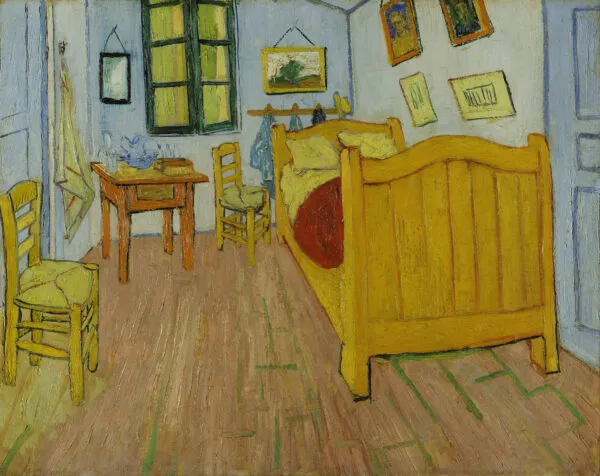
The Yellow House shows the outside of a story we paint in several chapters. Bedroom in Arles shows the room behind the nearly closed shutters on the first floor, painted in October 1888 with its simple furniture and his own works on the wall. Van Gogh’s Chair is the portrait of a plain rush-seated chair like the ones in that bedroom.
From the same month, September 1888, come two night scenes of Arles: Café Terrace at Night, the café on the Place du Forum under a starry sky, and Starry Night over the Rhône, the river with the lights of the town. Choose The Yellow House for the bright midday of Arles, and one of those two for the same town at night.
How is our hand-painted Yellow House made?
The painter first draws the corner of the house, the line of the street and the two bridges, because the whole painting rests on that perspective. Then come the deep blue sky laid on thickly, the yellow walls and the yellow ground in short strokes of several yellows, the green shutters and the pink restaurant, and last the small figures and the white steam of the train. Our oil painting reproduction is painted by hand in oil on canvas with real impasto: the paint goes on thickly, so the brushstrokes stand up from the canvas as they do in the original and catch the light.
On this painting the relief is easy to see in the sky, where the blue is laid down in dense strokes, and on the sunlit walls. A print shows only a flat surface; on our painting the strokes are real.
Every painting is a hand-painted copy made for your order, so no two are quite the same. Before dispatch we photograph it, sending you the photograph to approve.
Which size for which wall?
Short answer: 91 x 72 cm if you want the painting at the size of the original, 70 x 55 or 80 x 65 cm above a chest of drawers or a desk, 120 x 100 or 135 x 109 cm above a sofa, and 190 x 151 cm for a large empty wall. The landscape format suits long furniture, and the yellow and the blue still read clearly from across the room.
There are 17 sizes: 50 x 40, 60 x 50, 70 x 55, 75 x 60, 80 x 65, 85 x 69, 91 x 72, 100 x 80, 105 x 85, 110 x 90, 120 x 100, 135 x 109, 150 x 120, 160 x 127, 170 x 134, 180 x 142 and 190 x 151 cm (width x height). The original is 91.5 cm wide and 72 cm high, so our 91 x 72 cm is practically the size of the canvas in Amsterdam, and the simple shapes of the house and the street hold up well at every size. A painting for the living room should cover about two thirds of the width of the furniture below it: 135 x 109 cm above a sofa of about 200 cm.
Hang it with the centre of the canvas about 150 cm above the floor. Above a sofa or a sideboard, leave 20 to 30 cm between the furniture and the bottom edge.
What if I need a custom size or a frame?
If none of the 17 sizes fits your wall, we paint it to measure. We recommend keeping the proportions close to the original, otherwise the house and the street get squeezed or stretched. Send us the width and height you want and we will quote a price and a lead time. Every painting we make is stretched over a wooden stretcher and ready to hang.
For the moulding, use our 3D application: it shows each of our frame profiles on this subject, so you can compare gold, silver, black, white and natural wood – the application is for choosing the frame only. Seeing the painting on your own wall is our separate room placement service. The yellow walls suit a warm gold or a natural wood frame; a black profile makes the deep blue sky look even deeper.
How does delivery work, and what is the guarantee?
Every painting is made to order in our studio in Slovenia, so allow 15 to 45 days depending on the size you choose. We ship it stretched and protected, framed if you chose a frame, across the EU with no customs. Before dispatch you receive a photograph of the finished work to approve, and we correct anything that is not right. Our returns policy applies to every order.
More famous Van Gogh paintings are in the Vincent van Gogh gallery, and there is more about the painter in our article on Vincent van Gogh. If you are not sure of the size, or the painting is a gift, a wall art voucher lets the recipient choose.
Frequently asked questions
Where is The Yellow House by Van Gogh today?
The painting hangs in the Van Gogh Museum in Amsterdam, where it is currently on view under object number s0032V1962, held by the Vincent van Gogh Foundation. The real house it shows is gone: it stood on Place Lamartine in Arles, was badly damaged by bombing in June 1944 and was later demolished.
Where was The Yellow House in Arles?
On Place Lamartine in Arles, in the south of France. Van Gogh rented four rooms in the right wing of number 2 from May 1888. To the right of the house the Avenue Montmajour ran down to the two railway bridges seen in the painting. The square still looks much the same, and a plaque marks the place.
When did Van Gogh paint The Yellow House?
In September 1888, a few months after he rented it. That month he sent his brother Theo a sketch of the composition with the words “the house and its setting under a sulphur sun under a pure cobalt sky”, and wrote that the theme was a hard one, which was exactly why he wanted to conquer it.
Why is The Yellow House also called The Street?
Because that was Van Gogh’s own title. He first called it The House and its Surroundings, then chose The Street, in homage to a series of Paris street scenes by Jean-François Raffaëlli published in Le Figaro. The Van Gogh Museum still lists the painting as The Yellow House (The Street).
Which window in The Yellow House was Van Gogh’s bedroom?
On the first floor, the second window from the corner, the one with its shutters nearly closed. The window nearest the corner, with both shutters open, belonged to the guest room where Paul Gauguin lived for nine weeks from late October 1888. The bedroom itself is the subject of his painting Bedroom in Arles.
Did Gauguin live in The Yellow House?
Yes. Van Gogh wanted to turn the house into an artists’ house where like-minded painters could live and work together, and Paul Gauguin was the one who came. From late October 1888 he lived for nine weeks in the guest room on the first floor, behind the window nearest the corner with both shutters open.
What is the pink building on the left of The Yellow House?
It is the restaurant where Van Gogh often ate, at 28 Place Lamartine. It was run by the widow Venissac, who was also his landlady and owned several of the other buildings in the painting. The night café he painted that autumn stood just to the left of it, outside the painting.
How big is the original The Yellow House?
The original is 72 cm high and 91.5 cm wide. Our 91 x 72 cm size is practically the size of the canvas in Amsterdam, and there are 16 other sizes from 50 x 40 to 190 x 151 cm, as well as custom sizes for a particular wall or piece of furniture.
Does your The Yellow House have the raised brushstrokes of the original?
Yes. We paint our version in impasto: the paint goes on thickly, so the brushstrokes stand up from the canvas as on Van Gogh’s original. You see it best in the deep blue sky, laid down in dense strokes, and on the sunlit yellow walls. A print cannot have this relief, because its surface is flat, while a canvas painting carries it.
- Subject: Van Gogh’s yellow corner house in Arles, with green shutters, a pink restaurant and two railway bridges under a cobalt sky.
- Original: September 1888, Arles, 72 x 91.5 cm, Van Gogh Museum, Amsterdam.
- Ours: a Van Gogh reproduction painted by hand in oil on canvas, in 17 sizes from 50 x 40 to 190 x 151 cm or made to measure.
- Worth knowing: our 91 x 72 cm size is practically the size of the original.