







































Description
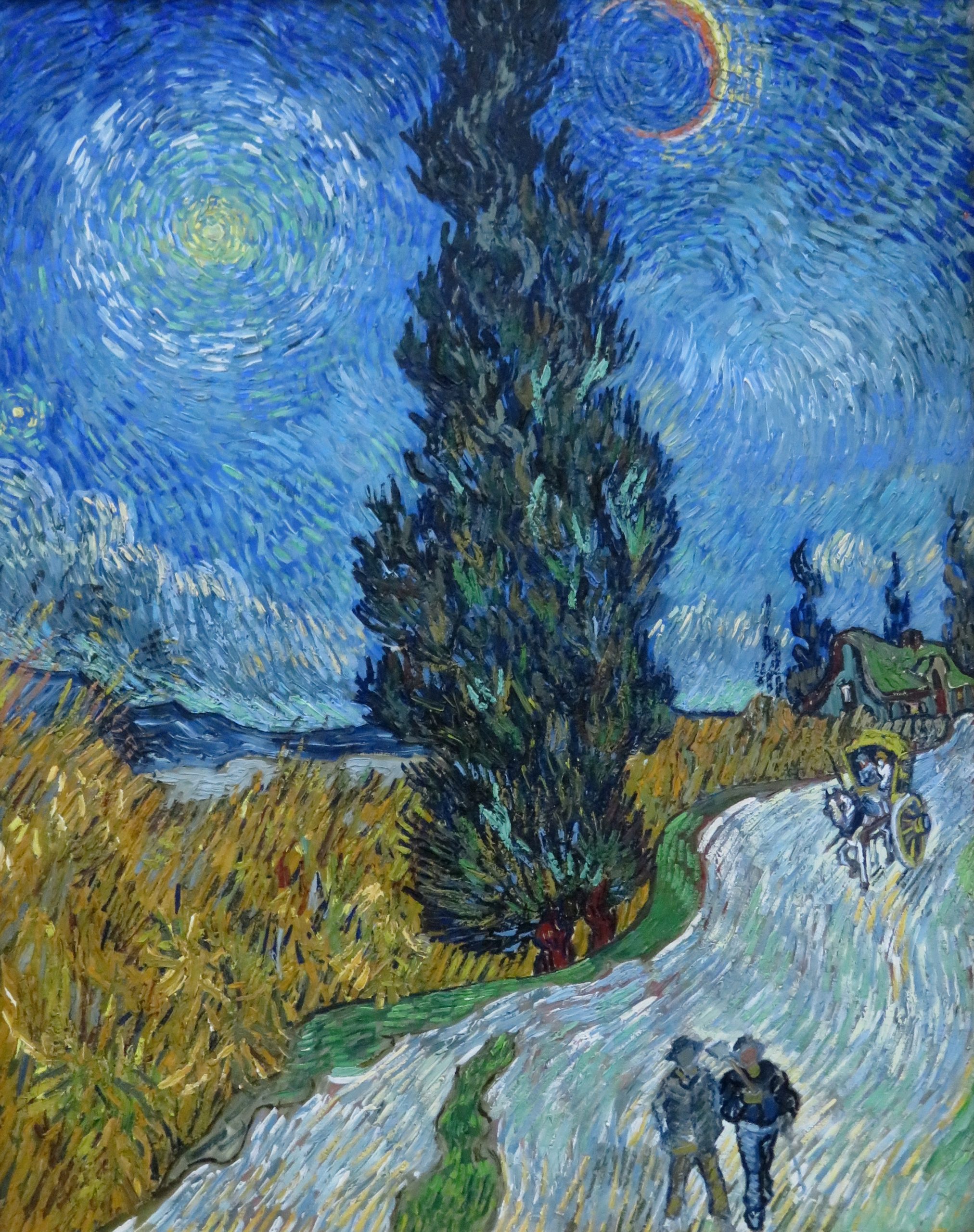
Road with Cypress and Star is the night landscape Vincent van Gogh painted at Saint-Rémy-de-Provence in May 1890, shortly before he left the asylum there: a tall, dark cypress rising through the middle of the canvas, a swirling blue sky with a bright star on the left and a thin crescent moon on the right, and below them a pale country road with two walkers, a small yellow carriage and a farmhouse with lit windows. The original measures about 91 x 72 cm and belongs to the Kröller-Müller Museum in Otterlo, the Netherlands. We paint it by hand in oil on canvas, in 16 sizes from 40 x 50 to 164 x 210 cm or to your own measurement, and send you a photograph of the finished work for approval before dispatch.
| Title: | Road with Cypress and Star |
| Other titles: | Country Road in Provence by Night · Landweg in de Provence bij nacht · Cypres bij sterrennacht |
| Painter: | Vincent van Gogh (1853–1890) |
| Year painted: | May 1890, Saint-Rémy-de-Provence |
| Original size: | 90.6 cm x 72 cm |
| Original technique: | Oil on canvas |
| Painting style: | Post-Impressionism |
| Located at: | Kröller-Müller Museum, Otterlo (inv. KM 108.488) |
| Our reproduction: | Hand-painted oil on canvas, 16 sizes or made to measure |
Road with Cypress and Star – Vincent van Gogh
What does Road with Cypress and Star show?
The painting shows a country road in Provence at night. In the middle stands a single cypress, tall, narrow and almost black-green, painted in short curling strokes of dark green and blue. It rises from the roadside to the top edge, where its tip is cut off, and divides the sky into two halves.
On the left of the tree hangs a large star with rings of pale yellow and green light around it; on the right a thin crescent moon glows orange and yellow. The whole sky is made of short, curved strokes of blue, white and green that turn around the two lights.
Below, a pale road curves in from the lower edge. Two men walk side by side towards us, followed by a small yellow carriage pulled by a white horse. On the right, behind smaller cypresses, stands a low farmhouse with lit windows. On the left rise tall yellow stalks and a strip of blue hills.
What did Van Gogh write about the painting to Gauguin?
In a letter to Paul Gauguin from Auvers-sur-Oise, dated to about 17 June 1890, Van Gogh described this canvas and drew a small sketch of it. The letter was never finished or sent; it was found among his papers.
In it he calls the painting a last try: a night sky with a moon without brightness, the slender crescent barely emerging from the shadow of the earth, and a star with exaggerated brightness, a soft glow of pink and green in the ultramarine sky where clouds run. Below, in his words, a road bordered by tall yellow canes with the blue low Alpilles behind them, an old inn with orange lighted windows and a very tall cypress, very straight, very dark, and on the road a yellow carriage harnessed to a white horse and two late walkers. His own verdict: very romantic, if you like, but also Provençal.
What does the painting mean?
The Kröller-Müller Museum writes that this is not an existing landscape. Van Gogh composed it freely, shortly before he left the asylum at Saint-Rémy, presumably as a final reminder of the place and a summary of his impressions of Provence.
For Van Gogh the cypress was the tree of Provence. The museum quotes his letter to his brother Theo: the cypresses still preoccupied him, he wanted to do something with them like the canvases of the sunflowers, and he found the tree beautiful in its lines and proportions, like an Egyptian obelisk.
The art historian Kathleen Powers Erickson, as cited in the Wikipedia article on Road with Cypress and Star, reads the star on the left and the new crescent on the right as the old and the new, with the cypress between them as an obelisk of death.
Where does the original hang?
The original belongs to the Kröller-Müller Museum in Otterlo, in the Hoge Veluwe National Park in the Netherlands. The museum lists it as Country Road in Provence by Night, about 12 to 15 May 1890, oil on canvas, under the number KM 108.488. The edition of Van Gogh’s letters gives its size as 90.6 x 72 cm, catalogue numbers F 683 and JH 1982.
Road with Cypress and Star or The Starry Night – which to choose?
Both are Saint-Rémy night skies with a cypress, but they are different paintings. The Starry Night was painted in June 1889: a dark cypress at the left edge, a sleeping village below and a sky full of swirling stars. Road with Cypress and Star followed in May 1890 and brings people into the night, with the cypress in the centre and the road, the walkers and the lit farmhouse around it. Choose The Starry Night for the wide sky, this one for a tall scene you can walk into.
If the tree is what draws you, Cypresses, painted at Saint-Rémy in June 1889, is a close view of the trees themselves, and A Wheat Field with Cypresses, also from 1889, sets them beside the gold of the wheat. Hospital at Saint-Rémy, painted in 1889, shows the place where Van Gogh lived at the time.
How is our hand-painted Road with Cypress and Star made?
The painter first sets out the cypress, the road and the horizon, then builds up the sky stroke by stroke around the star and the moon, and finishes with the walkers and the dark foliage of the tree. Our oil painting reproduction is painted by hand in oil on canvas with real impasto: the paint goes on thickly, so the brushstrokes stand up from the canvas as they do in the original and catch the light.
The Kröller-Müller Museum points out the short, rhythmic, wavy strokes placed side by side that give this painting its movement. On our version the relief matters most in the rings around the star, in the cypress and in the road. A print shows only a flat surface; on our painting the strokes are real.
Every painting is a hand-painted copy made for your order, so no two are quite the same.
Which size for which wall?
Short answer: 56 x 70 or 60 x 80 cm beside a window or above a bedside table, 70 x 90 or 80 x 100 cm above a sideboard or a desk, 90 x 120 or 104 x 135 cm as the main painting of a room, and 121 x 150 cm or larger for a high wall or a staircase. The tall format suits a narrow wall or a hallway.
There are 16 sizes: 40 x 50, 50 x 62, 50 x 65, 56 x 70, 60 x 80, 70 x 90, 80 x 100, 90 x 120, 97 x 127, 104 x 135, 111 x 145, 121 x 150, 130 x 162, 138 x 180, 150 x 195 and 164 x 210 cm (width x height). The original is 72 cm wide and 90.6 cm high; our 70 x 90 cm size is the closest to it. With so much deep blue and dark green, it sits well on a white, cream or light grey wall, or on a warm sand colour that picks up the yellow canes. Above a sofa, a tall painting for the living room looks best when it is at least half as wide as the sofa.
Hang it with the centre of the canvas about 150 cm above the floor.
What if I need a custom size or a frame?
If none of the 16 sizes fits your wall, we paint it to measure. Keep the proportions close to the original, otherwise the cypress and the curve of the road get squeezed or stretched. Send us the width and height you want and we will quote a price and a lead time. Every painting we make is stretched over a wooden stretcher and ready to hang.
For the moulding, use our 3D application: it shows each of our frame profiles on this subject, so you can compare gold, silver, black, white and natural wood – the application is for choosing the frame only. Seeing the painting on your own wall is our separate room placement service. A gold frame picks up the star and the yellow canes, and a black or dark wood frame deepens the night sky.
How does delivery work, and what is the guarantee?
Every painting is made to order in our studio in Slovenia, so allow 15 to 45 days depending on the size you choose. We ship it stretched and protected, framed if you chose a frame, across the EU with no customs. Before dispatch you receive a photograph of the finished work to approve, and we correct anything that is not right. Our returns policy applies to every order.
You will find more famous Van Gogh paintings among all our Vincent van Gogh paintings, and there is more about the painter in our article on Vincent van Gogh. If you are giving it as a present and are not sure of the size, a wall art voucher lets the recipient choose.
Frequently asked questions
Where is the original Road with Cypress and Star today?
In the Kröller-Müller Museum in Otterlo, in the Hoge Veluwe National Park in the Netherlands. The museum lists it as Landweg in de Provence bij nacht, or Country Road in Provence by Night, dated about 12 to 15 May 1890, oil on canvas, number KM 108.488.
When and where did Van Gogh paint Road with Cypress and Star?
In May 1890 at Saint-Rémy-de-Provence, in the south of France, while he was staying at the asylum there. The Kröller-Müller Museum dates it to about 12 to 15 May 1890, shortly before he left for Auvers-sur-Oise. Wikipedia describes it as the last painting he made in Saint-Rémy.
Why are there a star and a moon in Road with Cypress and Star?
Because Van Gogh chose to put both into one sky. In his letter to Gauguin he described a moon without brightness, a slender crescent barely emerging from the shadow of the earth, and a star with exaggerated brightness. Wikipedia mentions the idea that the sky may reflect a meeting of Mercury and Venus in April 1890.
What does the cypress mean in Road with Cypress and Star?
For Van Gogh the cypress was the tree of Provence. In a letter to Theo, quoted by the Kröller-Müller Museum, he wrote that cypresses still preoccupied him and that the tree was beautiful in line and proportion, like an Egyptian obelisk. One art historian reads it here as an obelisk of death between the old star and the new moon.
Is Road with Cypress and Star related to The Starry Night?
They are close relatives. Both were painted at Saint-Rémy, both put a dark cypress against a swirling night sky, and both have bright stars and a moon. The Starry Night dates from June 1889 and shows a village below the sky. Road with Cypress and Star followed in May 1890, with the cypress in the centre and travellers on a road.
How big is the original Road with Cypress and Star, and which size should I choose?
The original is 90.6 cm high and 72 cm wide, a tall format. Our 70 x 90 cm size is almost exactly the same, and there are 16 sizes from 40 x 50 up to 164 x 210 cm, as well as custom sizes. For a sideboard, 80 x 100 cm works well; for a large living room wall, choose 104 x 135 cm or more.
Does your Road with Cypress and Star have the raised brushstrokes of the original?
Yes. We paint our copy in impasto: the paint goes on thickly, so the brushstrokes stand up from the canvas as on Van Gogh’s original. You see it best in the rings of light around the star, in the curling foliage of the cypress and in the long strokes of the road, where the relief catches the light.
Is Road with Cypress and Star a good gift?
It is a calm, deep-coloured gift for someone drawn to night skies, travel or Provence, and it suits a study, a bedroom or a hallway. As a canvas painting about a road under the stars, it also fits a move, a new job or a farewell, and a voucher lets the recipient choose the size and frame.
- Subject: a tall cypress on a country road in Provence at night, with a bright star, a crescent moon, two walkers, a yellow carriage and a lit farmhouse.
- Original: May 1890, Saint-Rémy-de-Provence, 90.6 x 72 cm, Kröller-Müller Museum, Otterlo.
- Ours: a Van Gogh reproduction painted by hand in oil on canvas, in 16 sizes from 40 x 50 to 164 x 210 cm or made to measure.
- Worth knowing: our 3D application shows every frame profile on this painting, so you can choose the frame before you order.