







































Description
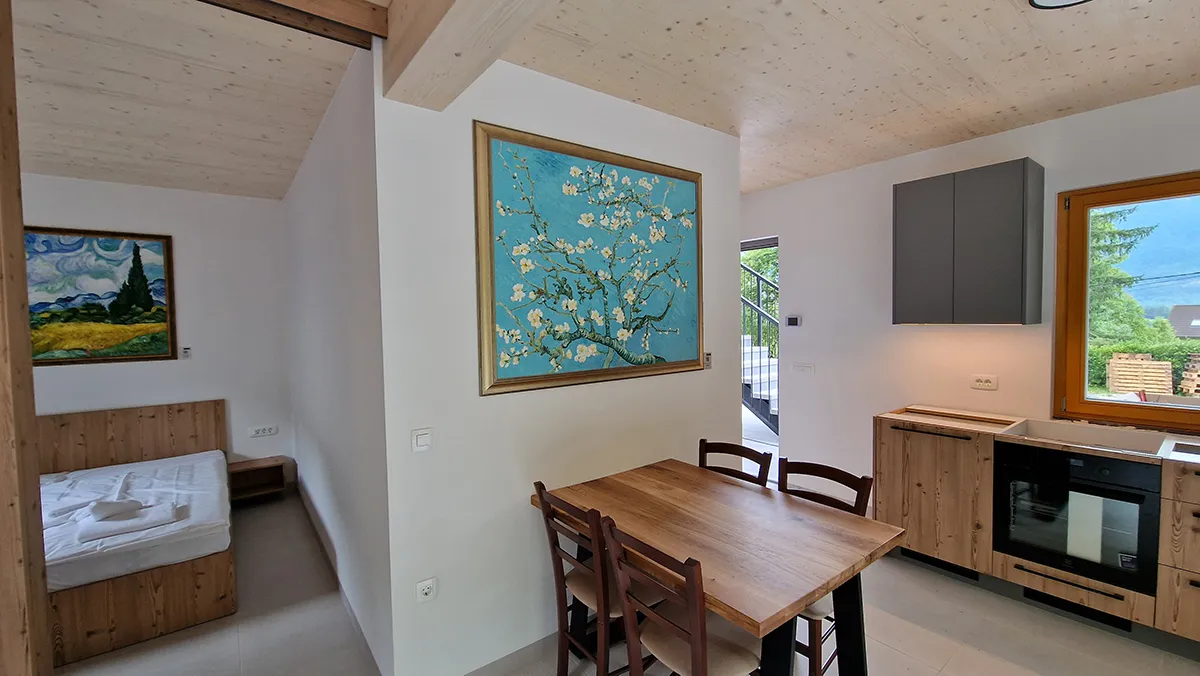
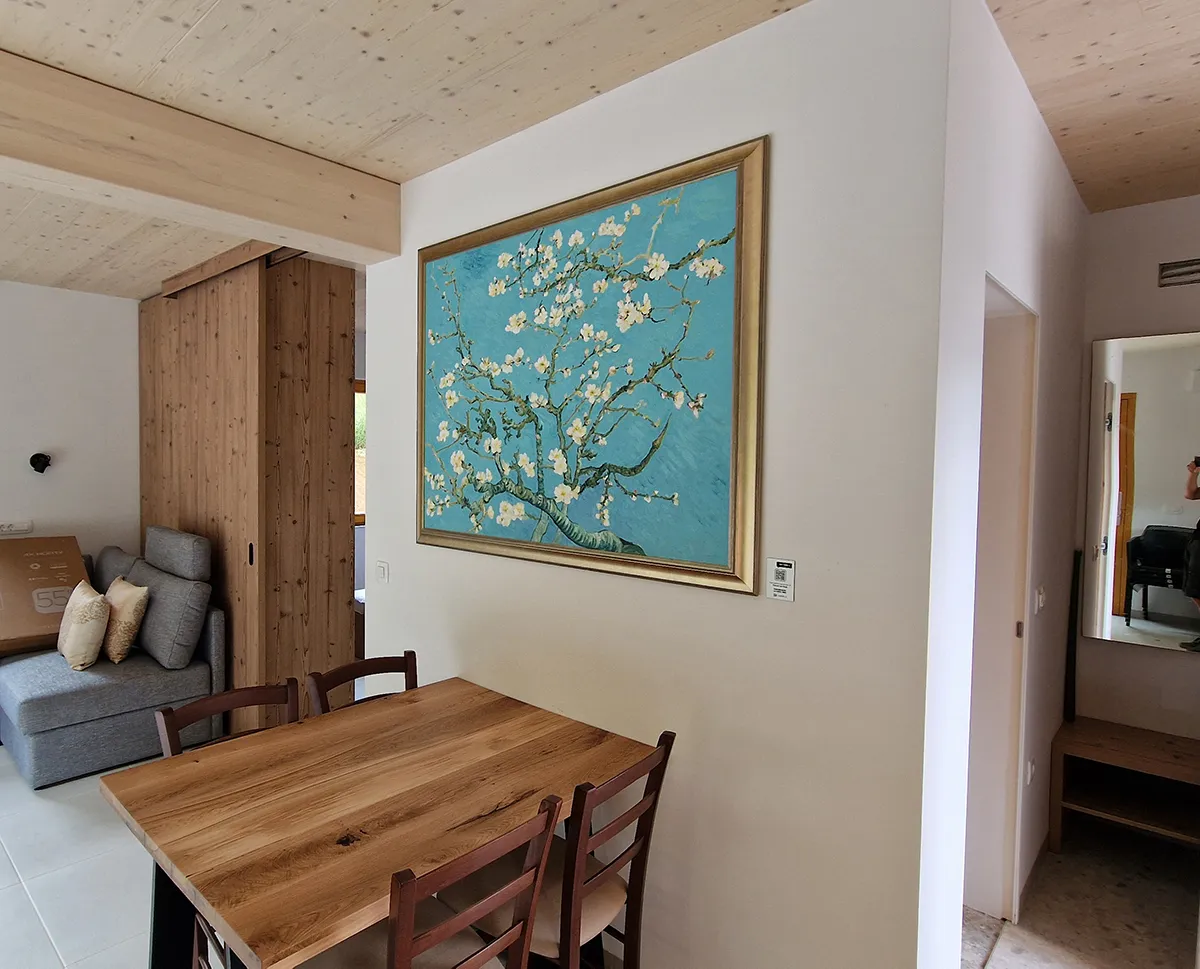
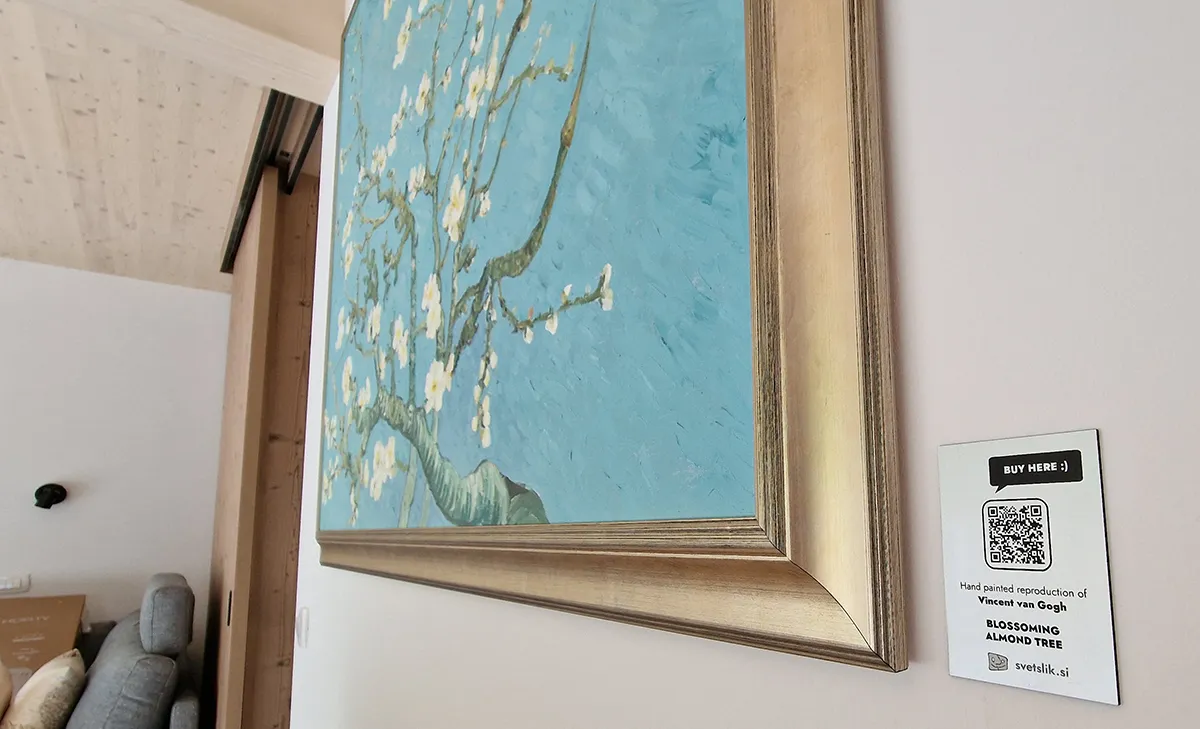
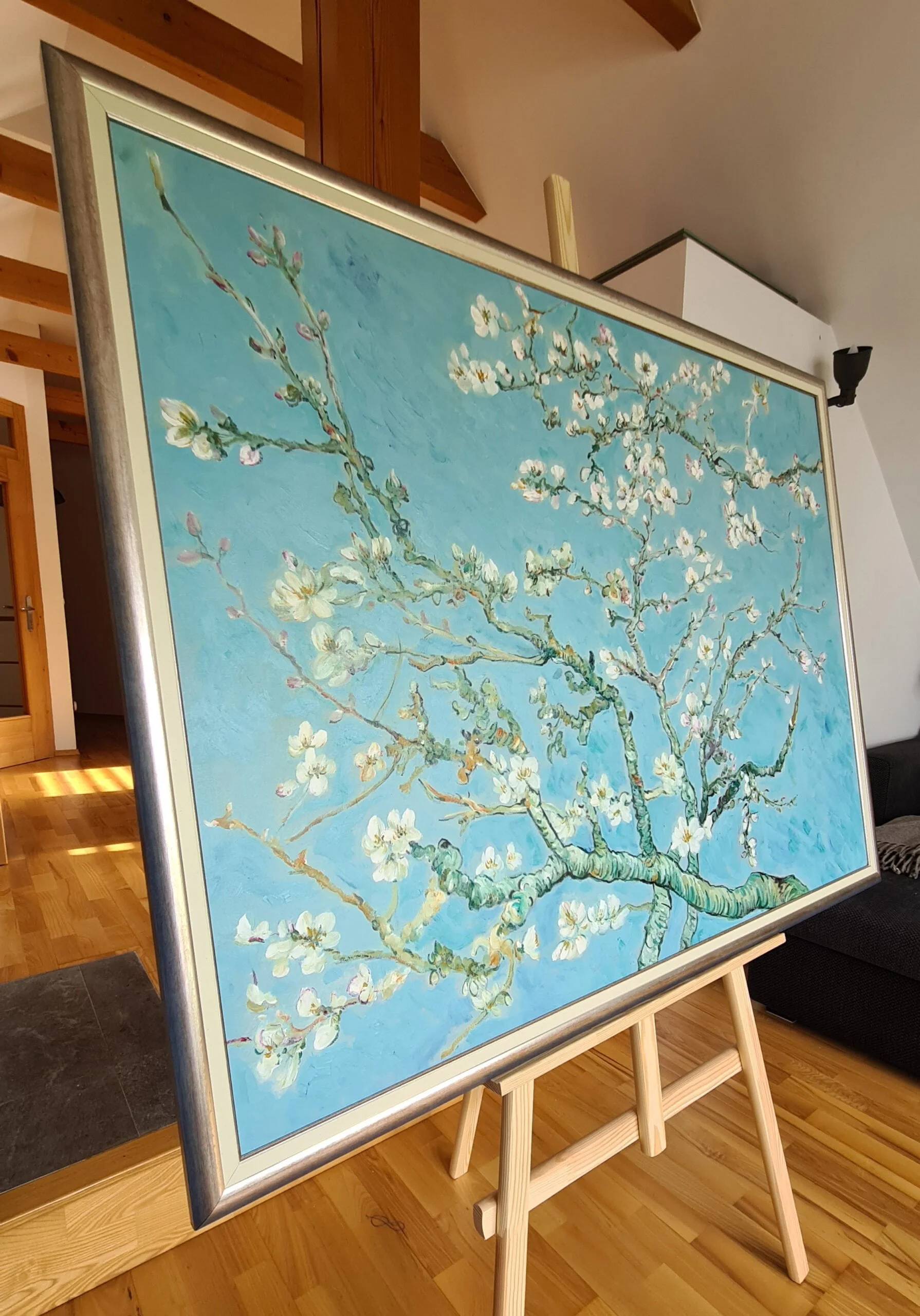
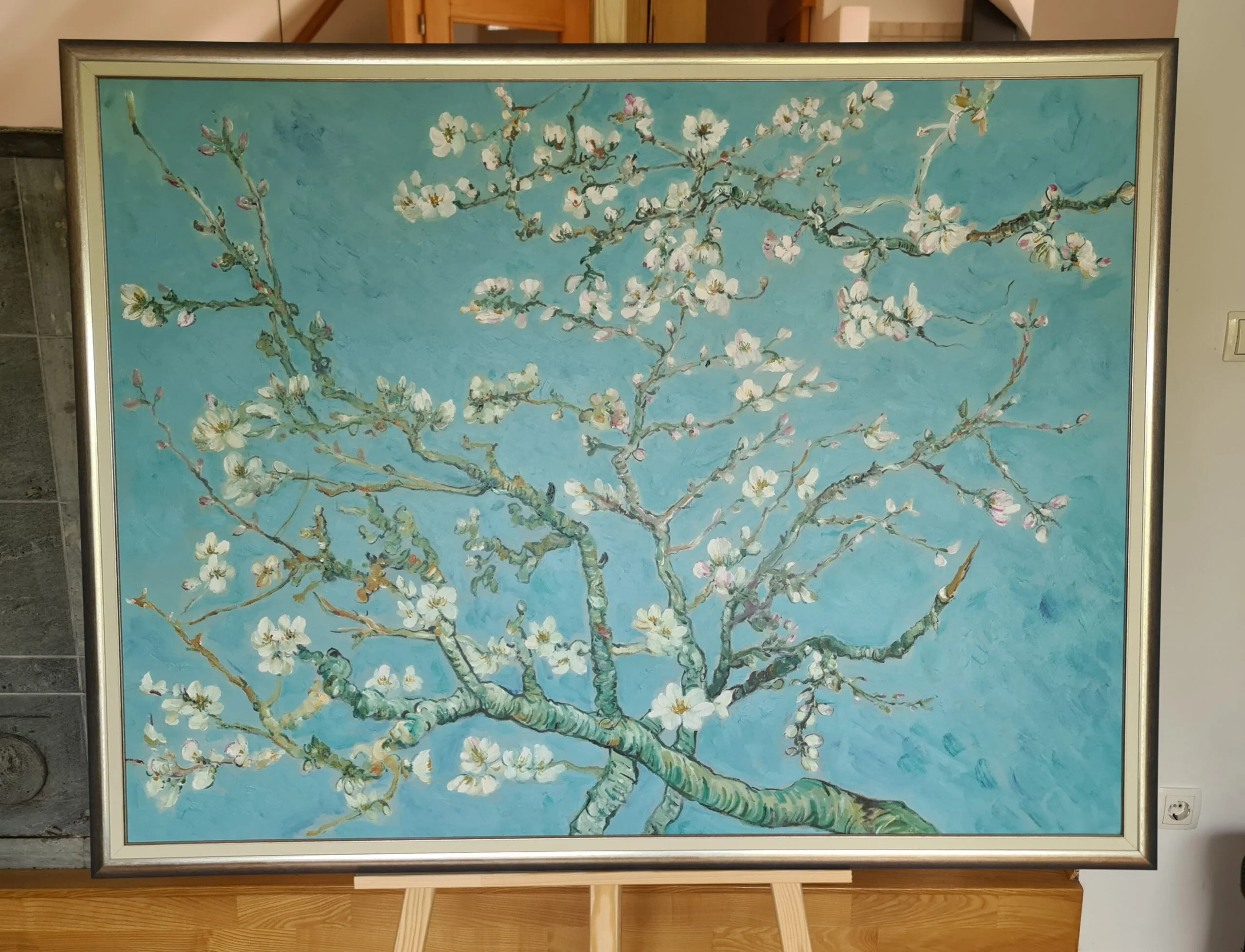
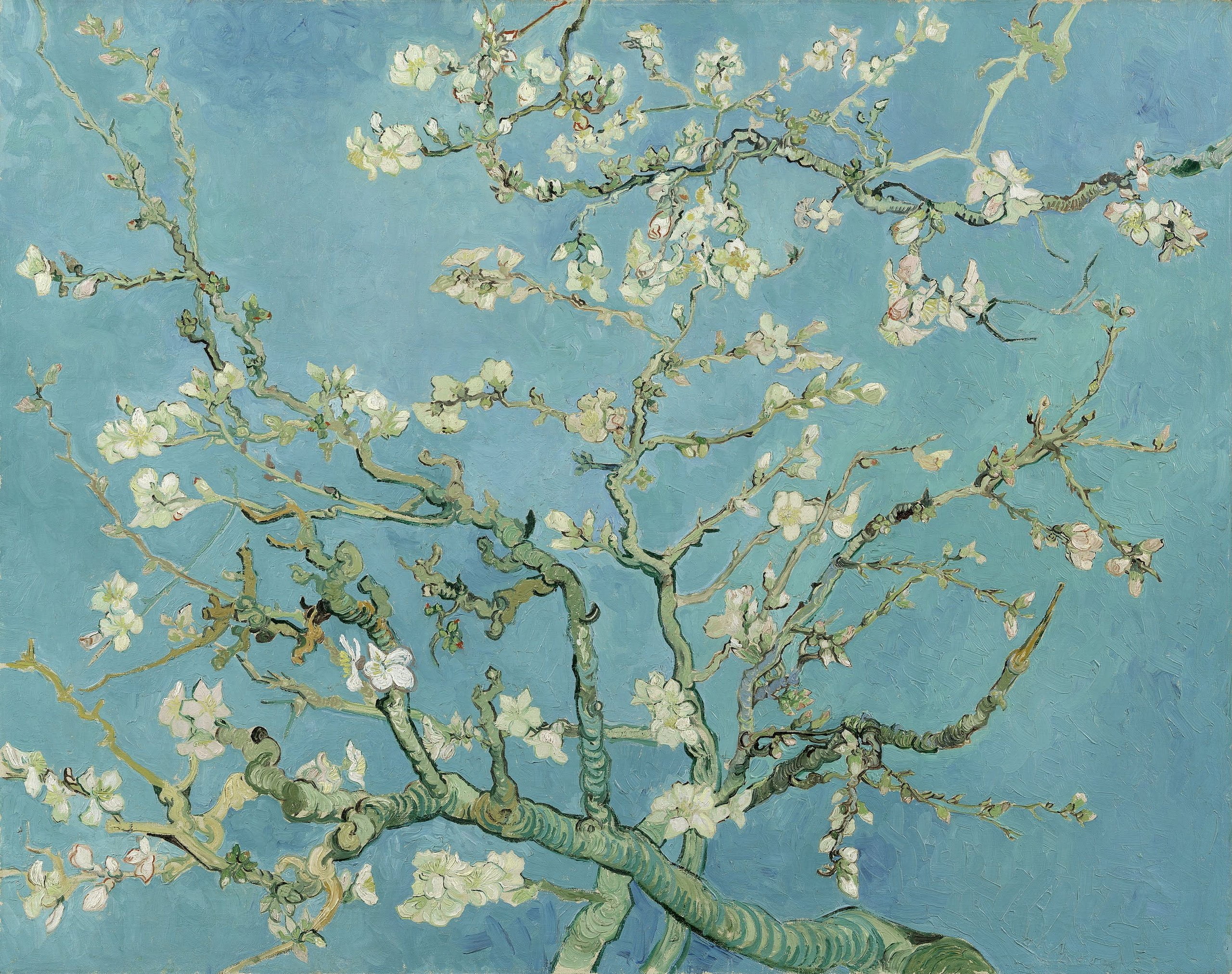
Almond Blossom is the painting Vincent van Gogh made in February 1890 in Saint-Rémy-de-Provence as a gift for his newborn nephew: big branches of white almond blossom against a clear blue sky. The original measures 73.3 x 92.4 cm and hangs in the Van Gogh Museum in Amsterdam, the museum founded by that same nephew. We paint it by hand in oil on canvas, in fifteen sizes from 50 x 40 to 190 x 151 cm or to your own measurement, and send you a photograph of the finished work for approval before dispatch.
| Title: | Almond Blossom |
| Other titles: | Almond Blossoms · Blossoming Almond Tree · Amandelbloesem |
| Painter: | Vincent van Gogh (1853–1890) |
| Year painted: | February 1890, Saint-Rémy-de-Provence |
| Original size: | 73.3 cm x 92.4 cm |
| Original technique: | Oil on canvas |
| Painting style: | Post-Impressionism |
| Located at: | Van Gogh Museum, Amsterdam (inv. s0176V1962) |
| Our reproduction: | Hand-painted oil on canvas, fifteen sizes or made to measure |
Almond Blossom – Vincent van Gogh
What does Almond Blossom show?
There is no ground, no trunk and no horizon: only branches of an almond tree seen from below, crossing a blue sky from edge to edge. A thick, twisting bough comes in from the lower right, and from it thinner branches spread out in every direction, some cut off by the edge, as if the tree went on beyond the frame.
Along the branches sit white blossoms with a hint of pink, some wide open, some still in bud. Van Gogh drew the branches with dark outlines and filled them with greens and browns, and painted the sky in many shades of blue and turquoise, lighter in some places and deeper in others.
Why did Van Gogh paint Almond Blossom for his nephew?
On 31 January 1890 his brother Theo wrote from Paris to tell him that his wife Jo had given birth to a son, Vincent Willem. Theo added: “As we told you, we’ll name him after you, and I’m making the wish that he may be as determined and as courageous as you.” Van Gogh was then living in the asylum at Saint-Rémy-de-Provence, where he had gone of his own accord in May 1889.
He was moved by the news. To his mother he wrote that he would rather the boy had been named after their father, but that he had started right away on a painting for the baby, to hang in the parents’ bedroom: big branches of white almond blossom against a blue sky. He worked on it calmly, until a new attack of his illness interrupted him. In April 1890 he sent the finished canvas to Paris.
What does Almond Blossom mean, and why is the sky so blue?
The meaning lies in the tree. The almond is one of the first trees to flower in spring, often while the nights are still cold, and the Van Gogh Museum describes it as a symbol of new life. For a painting celebrating a birth, that is the whole message.
The blue sky was Van Gogh’s own choice; that is how he described the painting to his mother. It gives the white blossom a strong, even ground, so every flower and every branch stands out clearly. The museum also points to Japanese printmaking, from which he took the subject, the bold outlines and the way the tree is placed in the composition. Van Gogh collected Japanese woodblock prints, and in their manner the branches are seen close up against a plain background.
Where does the original Almond Blossom hang, and how did it get there?
The original hangs in the Van Gogh Museum in Amsterdam, under object number s0176V1962. It has never been sold. In April 1890 Van Gogh sent it to Theo in Paris; after Theo died in January 1891 it stayed with his widow Jo and their son, the same Vincent Willem for whom it had been painted.
The museum notes that this work remained closest to the hearts of the Van Gogh family. In 1962 Vincent Willem transferred the family collection to the Vincent van Gogh Foundation, and when the Van Gogh Museum opened in Amsterdam on 2 June 1973, the painting went on permanent loan there. The gift for a baby now hangs in the museum that the baby founded.
Almond Blossom or the Arles orchards – which one is which?
The tree in this painting is an almond, not a cherry, even though its white blossom against blue sky is easily taken for Japanese cherry blossom. He painted flowering trees in another series too: when he arrived in Arles in March 1888 the orchards were about to bloom, and within a month he made fourteen paintings of blossoming apricot, peach and plum trees, whole trees standing in the fields. Almond Blossom of 1890 is different: no orchard, no ground, only branches against the sky. If you want that close, calm view, choose this one.
For another flower painting from Saint-Rémy with a Japanese feel, see Irises, painted in the asylum garden in May 1889. From the same years we also paint The Starry Night, Cypresses and, for yellow instead of blue, Sunflowers I.
How is our hand-painted Almond Blossom made?
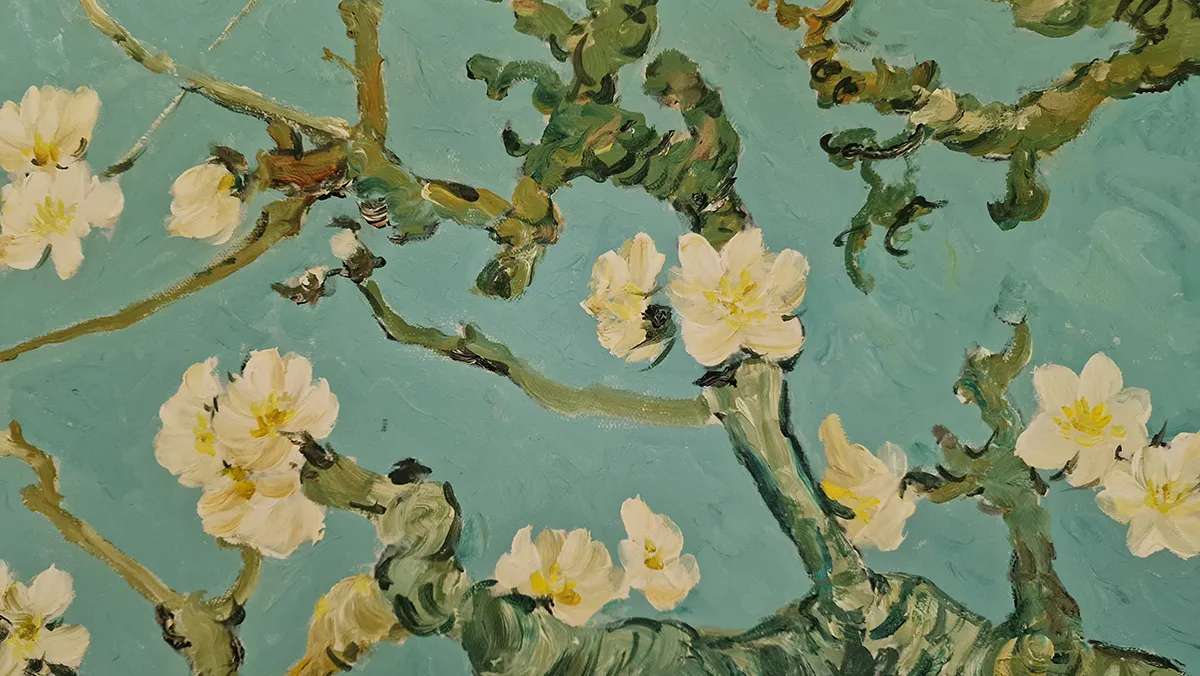
The painter first lays in the sky in its many blues, then draws the branches with their dark outlines, and last sets the blossoms on them one by one. Our oil painting reproduction is painted by hand in oil on canvas with real impasto: the paint goes on thickly, so the brushstrokes stand up from the canvas as on Van Gogh’s original, and each petal has its own small relief.
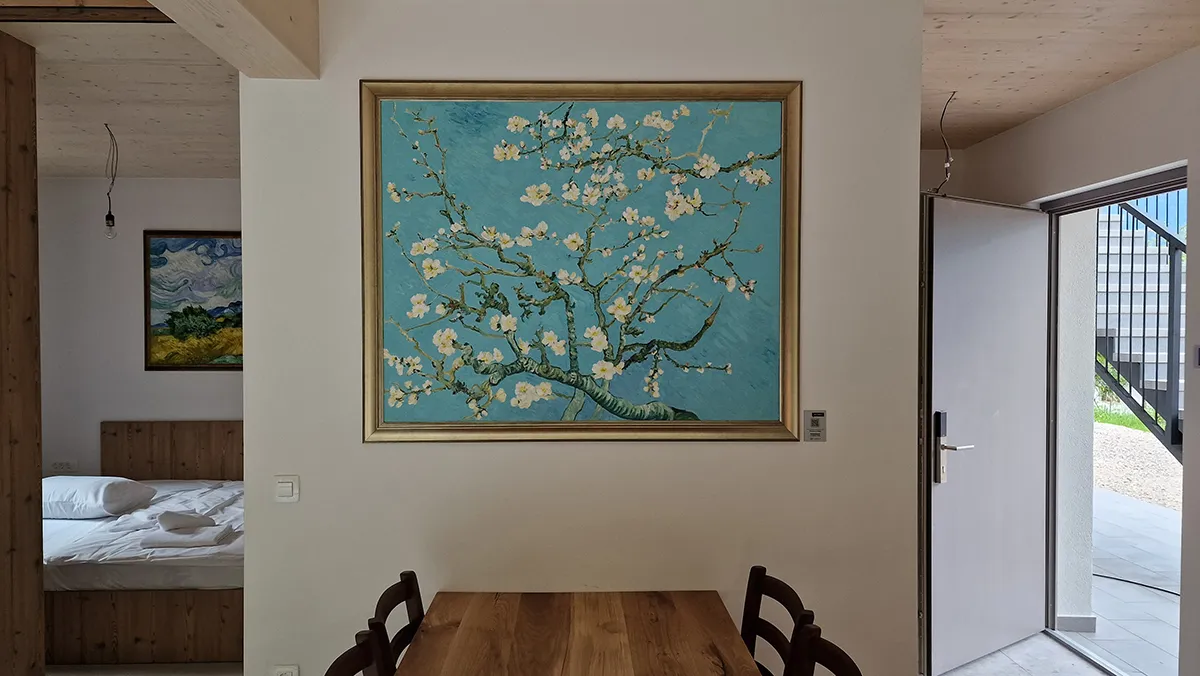
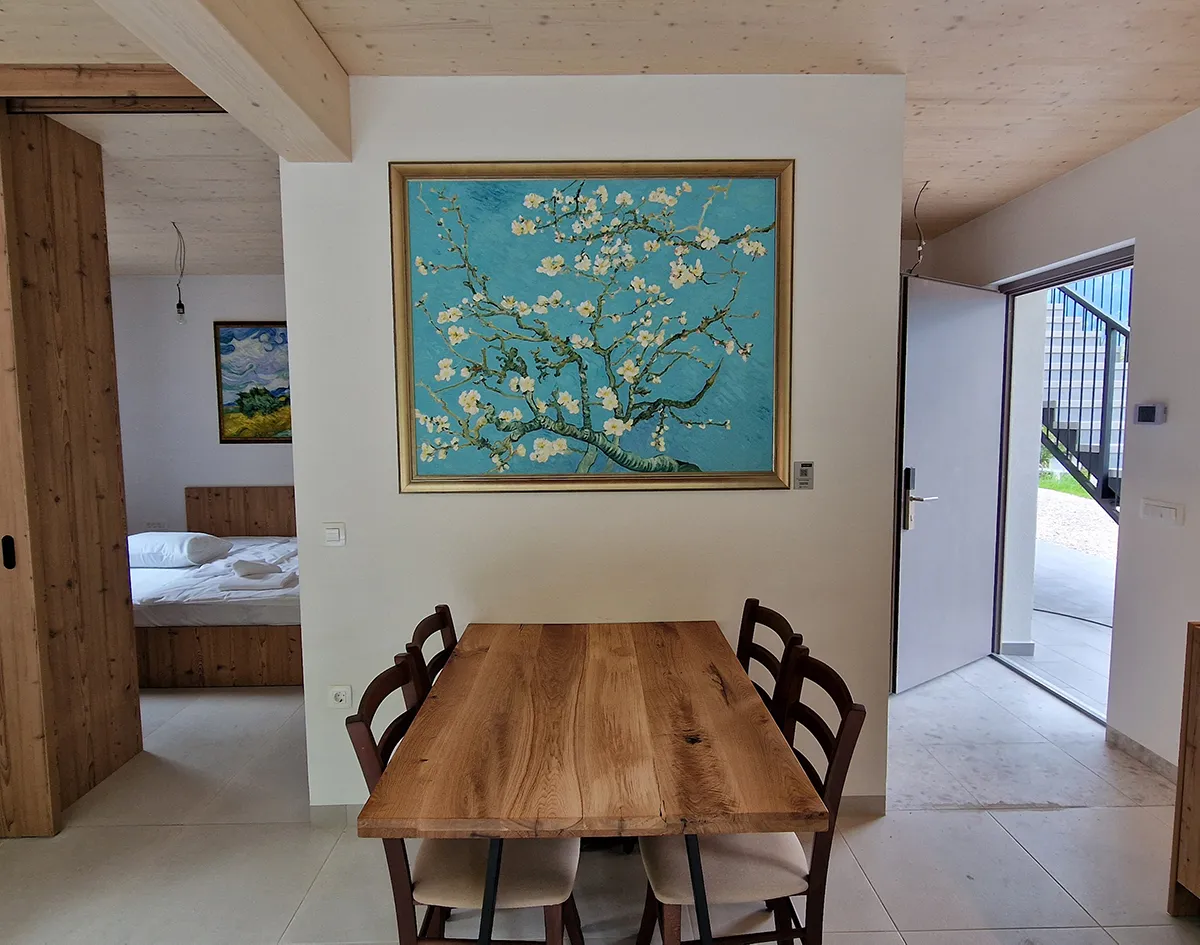
The video at the top of this page is our own footage of the finished painting: first a close-up of the painted blossoms, then the whole painting framed on an easel in our workshop. The first photograph and the three after it show the painting in a room setting: our finished painting in a gold frame hanging above a wooden dining table with chairs, seen from different angles. The fifth photograph is a side view of the framed painting on the wall, so you can see the depth of the frame. The sixth photograph is a close-up of the blossoms, where the raised paint of the petals and branches is easy to see. The last two show the painting in a silver frame on an easel, first at an angle and then from the front.
Every painting is a hand-painted copy made for your order, so no two are quite the same. A printed reproduction shows only a flat surface; on ours the strokes and layers of paint are real.
Which size for which wall?
Short answer: 120 x 90 or 130 x 106 cm above a sofa or a double bed, 70 x 60 or 80 x 60 cm above a chest of drawers or in a smaller room, and from 160 x 127 cm upwards for a large empty wall. The landscape format suits long, low furniture, and the calm blue makes it easy to place in a bedroom, as Van Gogh intended.
There are fifteen sizes: 50 x 40, 55 x 45, 60 x 50, 70 x 60, 80 x 60, 90 x 70, 105 x 83, 120 x 90, 130 x 106, 136 x 116, 150 x 120, 160 x 127, 170 x 134, 180 x 142 and 190 x 151 cm. The 90 x 70 cm size is closest to the original, which is 92.4 cm wide and 73.3 cm high. A painting for the living room should cover about two thirds of the furniture below it: 120 cm above a 180 cm sofa.
Hang it with the centre of the canvas about 150 cm above the floor, and 20 to 30 cm above a sofa or a headboard.
What if I need a custom size or a frame?
If none of the fifteen sizes fits your wall, we paint it to measure. We recommend keeping the proportions close to the original, so the branches keep their space in the sky. Send us the width and height you want and we will quote a price and a lead time. Every painting we make is stretched over a wooden stretcher and ready to hang.
For the moulding, use our 3D application: it shows each of our frame profiles on this subject – the application is for choosing the frame only. If you would like to see how the painting will look on your own wall, that is our separate room placement service. A gold frame warms the blue, as in the room photographs; a silver frame keeps it cool and light, as on the easel.
How does delivery work, and what is the guarantee?
Every painting is made to order in our studio in Slovenia, so allow 15 to 45 days depending on the size you choose. Some sizes are in stock and ship within a few days; the size list shows the delivery time next to each size. We ship it stretched and protected, framed if you chose a frame, across the EU with no customs. Before dispatch you receive a photograph of the finished work to approve; if anything is not right, we correct it while the canvas is still in our workshop. Our returns policy applies to every order.
Almond Blossom was itself painted as a gift for a birth, and it makes just as good a gift for a new baby or a new home. More famous Van Gogh paintings are in the Vincent van Gogh gallery, and there is more about the painter in our article on Vincent van Gogh. If you would rather let the recipient choose, a wall art voucher leaves size and subject to them.
Frequently asked questions
Where is the original Almond Blossom by Van Gogh today?
In the Van Gogh Museum in Amsterdam, under object number s0176V1962. It came there from the Van Gogh family itself: it was painted for Theo’s son Vincent Willem, who later founded the museum, and it has been on permanent loan there since the museum opened in 1973. It has never been sold.
When and where did Van Gogh paint Almond Blossom?
In February 1890, in Saint-Rémy-de-Provence in the south of France, where he was living at the Saint-Paul-de-Mausole asylum. He started it as soon as he heard of his nephew’s birth at the end of January, and in April he sent the finished canvas to his brother in Paris.
Why did Van Gogh paint Almond Blossom?
As a gift for his brother Theo and sister-in-law Jo, whose son was born on 31 January 1890 and named Vincent after him. Van Gogh wrote to his mother that he started at once on a painting for the baby, to hang in the parents’ bedroom: big branches of white almond blossom against a blue sky.
What does Almond Blossom symbolise?
New life. The almond is one of the first trees to flower, at the very start of spring, and the Van Gogh Museum calls it a symbol of new life. Painted for a newborn child, the blossoming branches stand for a new beginning: a wish for the baby’s life, made in paint rather than in words.
Is Almond Blossom a cherry or an almond tree?
An almond. Van Gogh himself called it almond blossom, and the painting shows the white, slightly pink flowers of the almond tree. It is often mistaken for cherry blossom because of its Japanese look. His blossoming orchards of 1888 in Arles, with apricot, peach and plum trees, are a different series painted two years earlier.
Why is the sky blue in Almond Blossom?
Because that is how Van Gogh conceived it: in his letter he described white almond blossom against a blue sky. The even blue, in many shades from deep to turquoise, gives every white flower and dark branch a clear ground to stand out on, in the manner of the Japanese prints he admired.
How did Japanese prints influence Almond Blossom?
Strongly. The Van Gogh Museum notes that he took the subject, the bold outlines and the placing of the tree from Japanese printmaking. He collected hundreds of these prints. Like them, Almond Blossom shows a close-up of branches against a plain background, outlined in dark lines, with no ground and no shadows.
Did Van Gogh paint Almond Blossom more than once?
This large painting of branches against the sky exists only once. In Arles in 1888 he also painted a small almond sprig in a glass and a little almond tree in bloom, but those are different, much smaller works. You can read about the whole group on Wikipedia.
Is your Almond Blossom a print?
No. Each one is painted by hand in oil on canvas, with the paint laid on thickly in impasto, as Van Gogh did. So what you receive is a real canvas painting, stretched and ready to hang, and before dispatch we photograph it and send you that photograph to approve.
Does your Almond Blossom have the raised brushstrokes of the original?
Yes. We paint Almond Blossom in impasto, so the brushstrokes stand up from the canvas as on Van Gogh’s original, in the petals of every blossom and in the twisting branches. The close-up photograph on this page shows it well. A print cannot have this relief: its surface is flat, however good its colours.
- Subject: branches of an almond tree in white blossom against a blue sky.
- Original: February 1890, 73.3 x 92.4 cm, Van Gogh Museum, Amsterdam.
- Ours: a Van Gogh reproduction painted by hand in oil on canvas, in fifteen sizes from 50 x 40 to 190 x 151 cm or made to measure.
- Worth knowing: you receive a photograph of the finished work for approval before dispatch.