







































Description
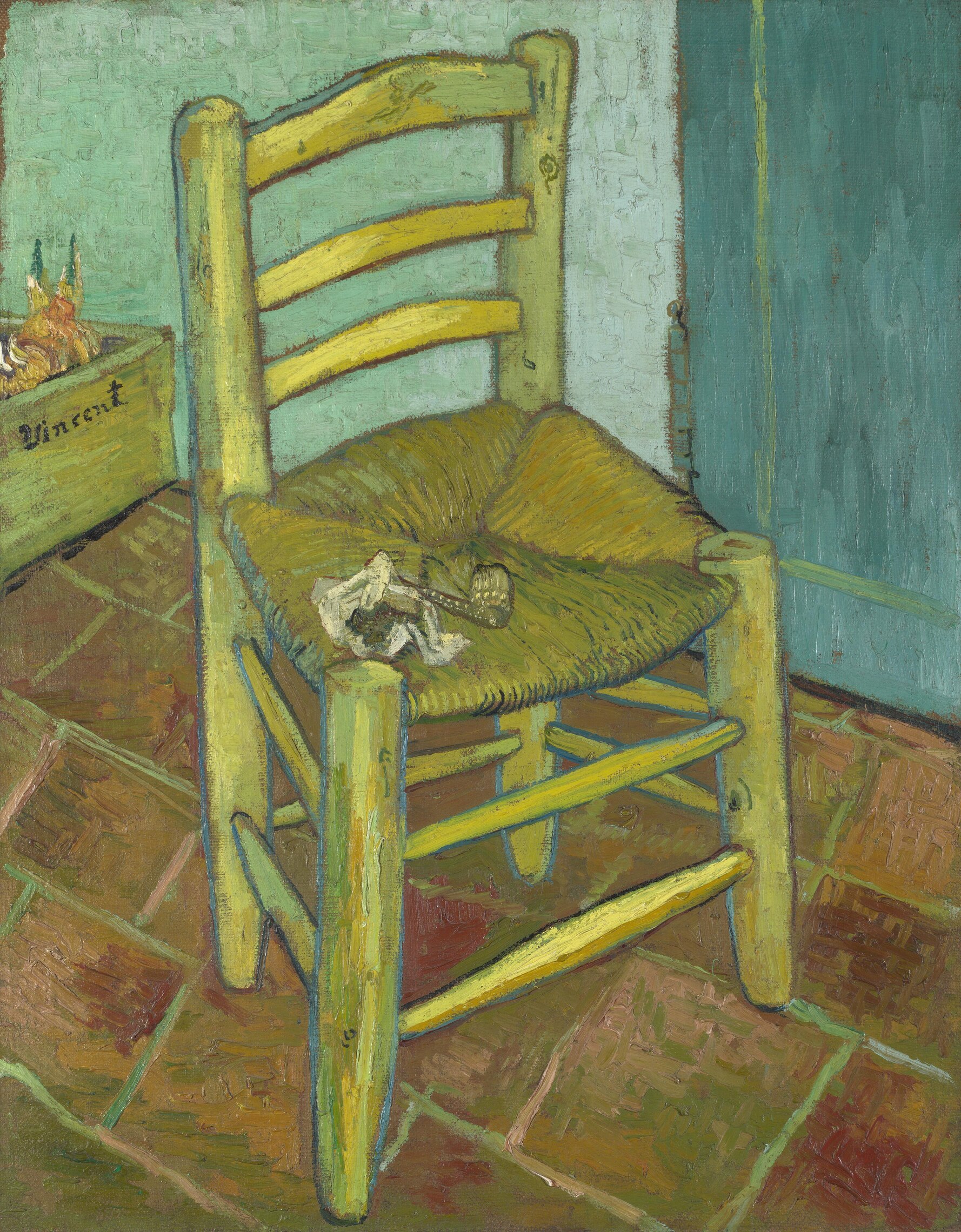
Van Gogh’s Chair is the painting Vincent van Gogh made in Arles at the end of 1888, soon after Paul Gauguin had come to live with him: a plain yellow chair with a rush seat on a floor of red terracotta tiles, with his pipe and tobacco pouch on the seat. The original measures 91.8 x 73 cm and hangs in the National Gallery in London. We paint it by hand in oil on canvas, in 16 sizes from 40 x 50 to 151 x 190 cm or to your own measurements, and send you a photograph of the finished painting for approval before dispatch.
| Title: | Van Gogh’s Chair |
| Other titles: | Vincent’s Chair with His Pipe · La sedia di Vincent · Van Gogh széke |
| Painter: | Vincent van Gogh (1853–1890) |
| Year painted: | 1888, Arles (slightly reworked in January 1889) |
| Original size: | 91.8 cm x 73 cm |
| Original technique: | Oil on canvas |
| Painting style: | Post-Impressionism |
| Located at: | National Gallery, London (inv. NG3862) |
| Our reproduction: | Hand-painted oil on canvas, 16 sizes or made to measure |
Van Gogh’s Chair – Vincent van Gogh
What does Van Gogh’s Chair show?
A plain wooden chair stands on a floor of red terracotta tiles, seen slightly from above, and fills almost the whole canvas. It has a straight back, no armrests and a seat of woven rush, and the wood is painted yellow. It is a simple country chair, sturdy but roughly made: the legs are not quite aligned.
On the seat lie his pipe and a tobacco pouch. Behind the chair, on the left, stands a low box signed Vincent, with sprouting bulbs in it, possibly onions. On the right you see part of a blue door, whose large hinge repeats the line of the chair legs. The scene is set in daylight, in bright, plain colours.
Why did Van Gogh paint an empty chair?
He began the painting in November 1888, soon after Paul Gauguin had joined him in Arles, where the two lived together in the Yellow House. Van Gogh had furnished the house for this visit, and the chair may have been one of the dozen he bought in September. He hoped Gauguin’s stay would be the first step towards a studio in the south, a circle of painters working side by side.
At the same time he painted a second canvas, Gauguin’s Chair, which is now in the Van Gogh Museum in Amsterdam. The two were meant to hang together, one chair turned to the right and the other to the left. In December 1888 he described them to Theo: his own chair all yellow on red tiles, by day, and Gauguin’s armchair as a red and green night effect, with two novels and a candle on the seat. Neither painting shows a person; each chair stands for its owner.
What do the pipe, the onions and the empty seat mean?
The National Gallery describes the two chairs as surrogate portraits: they represent the characters and the artistic outlooks of the two painters. Van Gogh’s chair is simple and functional, painted in the bright daylight of the south; Gauguin’s is an elegant, finely carved armchair, shown at night by candle and gas light. Van Gogh gave his own chair blue and orange, and Gauguin’s red and green – in each case a pair of complementary colours.
The pipe and tobacco may stand for simple, homely comforts. Shortly after his father died, Van Gogh sketched his father’s pipe, and in seventeenth-century Dutch painting a pipe was a sign of how quickly life passes. The sprouting onions, with his name on the box, recall how much nature meant to him.
Where does the original hang, and how did it reach London?
The original hangs in the National Gallery in London, under the inventory number NG3862, in a seventeenth-century Italian frame. The gallery bought it in 1924 with money from the Courtauld Fund.
After Van Gogh’s death the canvas belonged to his sister-in-law, Jo van Gogh-Bonger, and then to her son, V. W. van Gogh. It was shown in Amsterdam, New York and London before the trustees of the Courtauld Fund bought it through the Leicester Galleries. Its partner, Gauguin’s Chair, stayed in the Netherlands.
Van Gogh’s Chair or Bedroom in Arles – which should you choose?
Both paintings come from the Yellow House in Arles. Two very similar chairs stand in the room he painted in 1888, which we paint as Bedroom in Arles. The bedroom shows the whole room; the chair painting shows a single piece of furniture up close, almost like a still life.
For a complete interior with its bed and window, choose the bedroom; for a quiet, personal motif that suits a narrow wall or a study, choose the chair. From the same months in Arles we also paint Sunflowers I, one of the sunflower paintings he made to decorate the Yellow House, and the night scene Café Terrace at Night. In January 1889, after his stay in hospital, he painted Self-Portrait with Bandaged Ear.
How is our hand-painted Van Gogh’s Chair made?
The painter first draws the chair, the tiles, the box and the door, and checks the perspective against the original. Next come the red-brown tiles and the pale wall, then the yellow of the chair in long strokes that follow the wood, the woven seat in short crossing strokes, and last the pipe, the tobacco and the onions. Our oil painting reproduction is painted by hand on canvas, with real impasto: the paint goes on thickly, so the brushstrokes stand up from the canvas as they do in the original and catch the light.
That matters here, because the chair is built from strong, separate strokes of pure colour – the yellow wood against the blue door, the rush seat against the red floor. A print is completely flat; on our painting the brushstrokes and the layers of paint are real.
Every painting is a hand-painted copy made for your order, so no two are quite the same.
Which size for which wall?
Short answer: 60 x 80 or 70 x 90 cm above a chest of drawers or a desk, 80 x 100 or 90 x 113 cm above a sofa or a bed, and 120 x 150 cm for a large empty wall. The upright format of the chair suits a narrow wall, the space between two windows, a hallway or a kitchen corner.
There are 16 sizes: 40 x 50, 50 x 62, 51 x 65, 56 x 70, 60 x 80, 70 x 90, 80 x 100, 85 x 105, 90 x 113, 100 x 130, 110 x 140, 120 x 150, 127 x 160, 134 x 170, 142 x 180 and 151 x 190 cm (width x height). The original is 73 cm wide and 91.8 cm high; our 70 x 90 cm size is the closest to it, so the chair on your wall is almost as large as it is in the gallery. A painting for the living room should cover about two thirds of the width of the furniture below it; an upright canvas can be narrower when it hangs above a slim piece of furniture.
Hang it with the centre of the canvas about 150 cm above the floor. Above a sofa or a headboard, leave 20 to 30 cm between the top of the furniture and the bottom of the canvas.
What if I need a custom size or a frame?
If none of the 16 sizes fits your wall, we paint it to measure. We recommend keeping the proportions close to the original, otherwise the chair gets squeezed or stretched. Send us the width and height you want and we will quote you a price and a delivery time. Every painting we make is mounted on a wooden stretcher, ready to hang.
Our 3D app shows each of our frame profiles on this painting, so you can compare gold, silver, black, white and natural wood before you decide. The app is for choosing the frame only. If you would like to see how the painting will look on your own wall, we offer that through our separate room placement service. The yellow chair and the red tiles suit a natural wooden frame or a warm gold profile.
How does delivery work, and what is the guarantee?
Every painting is made to order in our studio in Slovenia, so allow 15 to 45 days depending on the size you choose. We ship it on its stretcher, carefully packed (and framed, if you chose a frame), across the EU with no customs duty. Before dispatch we send you a photograph of the finished painting to approve; if anything is not right, we correct it while the canvas is still in our workshop. Our returns policy applies to every order.
You will find more of Van Gogh’s famous paintings in our Vincent van Gogh gallery, and there is more about the painter in our article on Vincent van Gogh. If it is a gift and you are not sure of the size, a wall art voucher lets the recipient choose the size and the subject.
Frequently asked questions
Where does the original Van Gogh’s Chair hang?
The original hangs in the National Gallery in London, where it is listed as NG3862. The gallery bought it in 1924 through the Courtauld Fund. Its partner painting, Gauguin’s Chair, is not in London but in the Van Gogh Museum in Amsterdam, so you need to visit two cities to see the pair.
When and where did Van Gogh paint Van Gogh’s Chair?
In Arles, in the south of France, at the end of 1888. He began it in November, soon after Paul Gauguin had joined him in the Yellow House, and described it to Theo in a letter in December. After a fortnight in hospital he returned to the canvas in January 1889 and slightly reworked it.
Is Van Gogh’s Chair one of a pair?
Yes. Van Gogh painted it together with Gauguin’s Chair, now in the Van Gogh Museum in Amsterdam. The two were meant to hang side by side, one chair turned to the right and the other to the left: his own simple chair by day in blue and orange, Gauguin’s armchair at night in red and green. There is more on the pair on Wikipedia.
What does the empty seat in Van Gogh’s Chair mean?
The chair stands in for the painter himself. The National Gallery calls the two chair paintings surrogate portraits: instead of a face, objects tell you who the owner is. Van Gogh had long been moved by empty chairs – he wept at the sight of his father’s vacant chair in 1885 – and he knew Luke Fildes’s engraving of the empty chair of Charles Dickens.
Why is there a pipe on Van Gogh’s Chair?
Because the pipe and the tobacco pouch are his own, and they show the man without showing his face. They may stand for simple, homely comforts; after his father’s death Van Gogh sketched his father’s pipe. In seventeenth-century Dutch painting a pipe was also a sign that life passes like smoke.
What is in the box behind Van Gogh’s Chair?
Sprouting bulbs, possibly onions, in a low box that bears the name Vincent. Together with the bright daylight, the onions point to nature, which mattered greatly to him, and the name on the box makes it unmistakable whose chair this is. On our painting the lettering on the box is painted by hand like everything else.
Is the chair in Van Gogh’s Chair the same as in his bedroom painting?
Very likely the same kind. The National Gallery notes that two very similar chairs appear in his painting of his bedroom from 1888, and both belonged to the furnishings of the Yellow House, for which he may have bought a dozen chairs in September. If you want the whole room, our bedroom painting shows the chairs in place.
How big is the original Van Gogh’s Chair?
The original is 91.8 cm high and 73 cm wide, an upright format that already works above a desk or a chest of drawers. Our 70 x 90 cm size is the closest to the original, and there are smaller and larger sizes from 40 x 50 up to 151 x 190 cm, as well as custom sizes.
Is the original Van Gogh’s Chair for sale, and what is it worth?
No, the original is not for sale. It belongs to the National Gallery in London, which bought it in 1924, so it has no market price. What we can tell you is the price of our hand-painted version, shown on this page for the size you choose: a real canvas painting in oil for your own wall, while the original stays in London.
Does your Van Gogh’s Chair have the raised brushstrokes of the original?
Yes. We paint it in impasto, building up each brushstroke in thick oil, so the surface is raised like Van Gogh’s original. You see the relief best in the rush seat and the yellow wood of the chair, where the short strokes catch the light.
- Subject: a plain yellow chair with a rush seat on red tiles, with his pipe and tobacco on the seat.
- Original: 1888, Arles, 91.8 x 73 cm, National Gallery, London.
- Ours: a Van Gogh reproduction painted by hand in oil on canvas, in 16 sizes from 40 x 50 to 151 x 190 cm or made to measure.