




Description
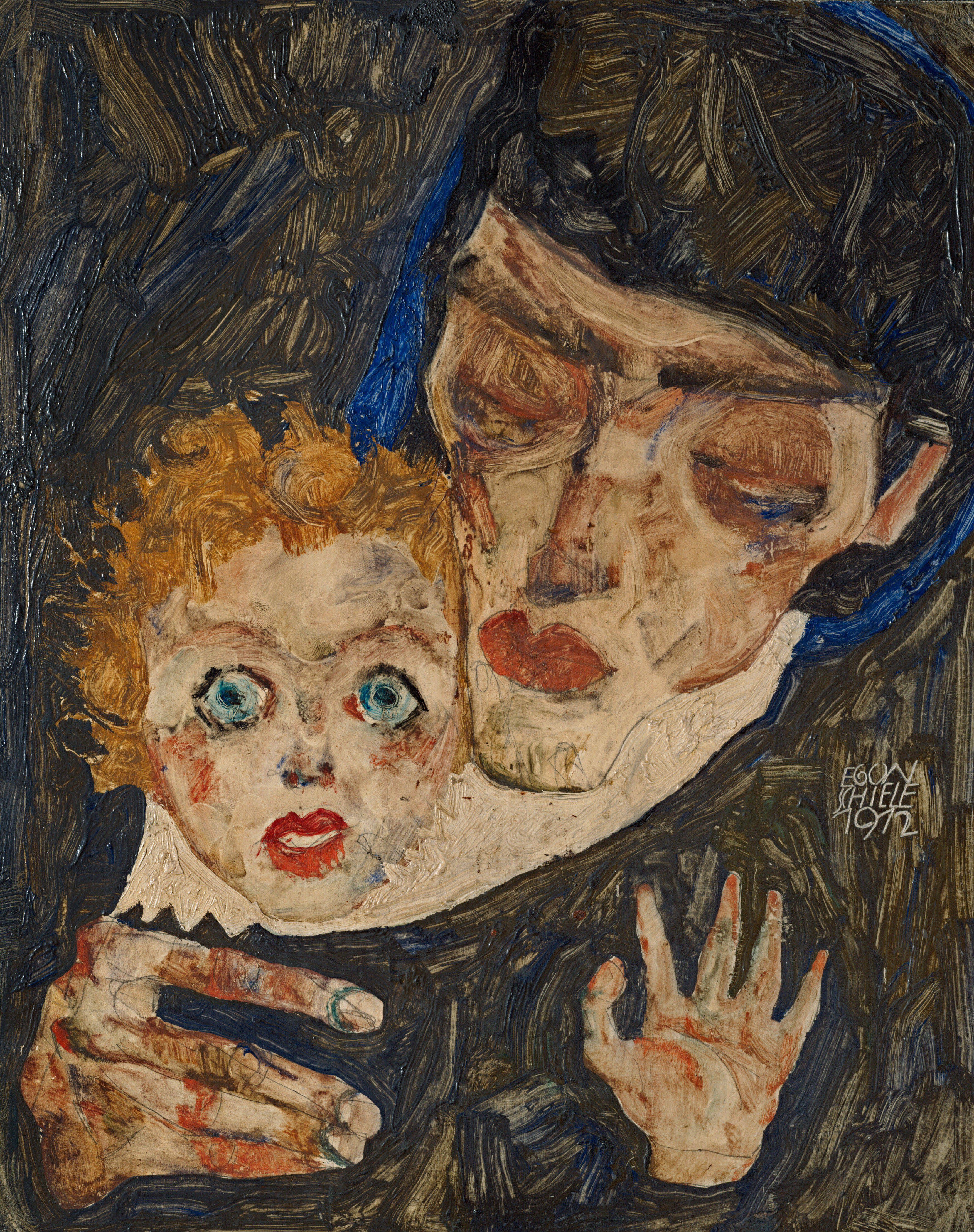
Mother and Child is a small 1912 work by Egon Schiele in oil on wood: a child with wide blue eyes and a mother with lowered lids, their two heads pressed together above a white collar against a dark ground. We paint it by hand in oils at the size you choose, and before dispatch we send you a photograph of the finished work for approval.
| Title: | Mother and Child |
| Other titles: | Mutter und Kind · Mati in otrok |
| Painter: | Egon Schiele (1890–1918) |
| Year: | 1912, signed and dated at the right |
| Original size (width × height): | 29.2 cm x 36.5 cm |
| Original technique: | Oil on wood |
| Style: | Expressionism |
| Location: | Leopold Museum, Vienna |
| Our reproduction: | hand-painted oil on canvas, 16 sizes from 41 x 50 cm to 160 x 195 cm, or a made-to-measure size |
Mother and Child – Egon Schiele
What does the painting show?
Two heads fill most of the panel. At the left is the child: a round, pale face under curly golden-orange hair, wide pale blue eyes ringed in black, and red lips slightly open. Pressed against it from the right is the mother’s long, narrow face, tilted down, with her eyes almost closed and full red lips. A white collar runs under both chins and joins the two faces into one form. Below, two hands come up out of the dark: one lies across the lower left, the other is open with its fingers spread. The ground is a dark brown-black worked in thick, restless strokes, and a strong blue line curves round the top and down the right side of the mother’s head. At the right, beside her shoulder, the Austrian painter signed and dated the panel.
Why do people love it?
Because it is close and direct. There is no room, no furniture and no landscape, only two faces and two hands, so the eye goes straight to them. The contrast holds you: the child stares straight out, wide awake, while the mother looks down with her eyes almost shut. The colours are few and strong – pale skin, golden hair, red lips, the white collar and a single blue line against the dark – so the work reads clearly from across a room. And the paint itself is part of the pleasure: thick, visible strokes give the surface a texture that rewards a closer look.
Provenance
The painting was owned by Emil Toepfer in Vienna and by the Neue Galerie in Vienna, then by Paul Clairmont in Zurich (before 1930 to 1942) and Christoph Clairmont in Zurich (1942–1958); Rudolf Leopold acquired it in 1958 (1958–1994); it is now at the Leopold Museum in Vienna.
Where does it sit among Schiele’s works?
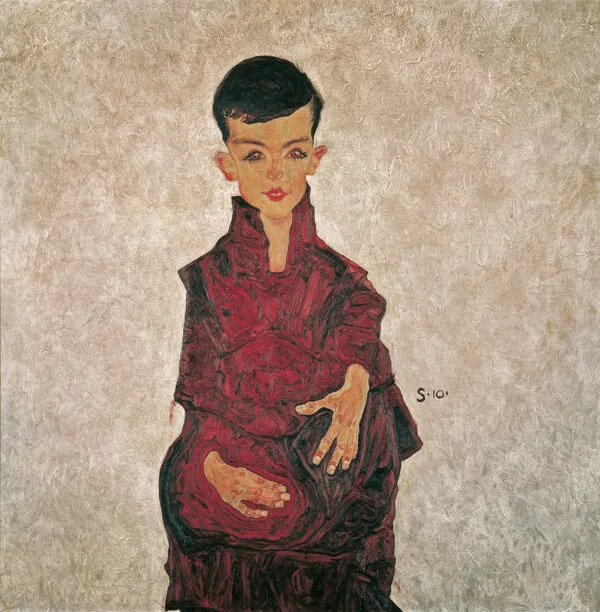
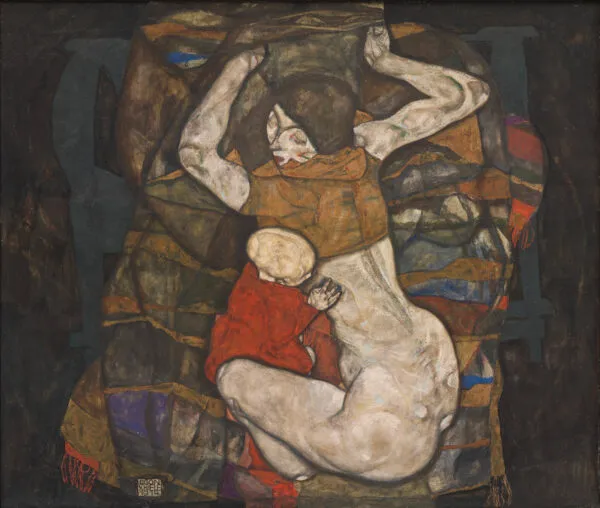
It belongs with his portraits and figure works. On our shelf you will also find Mother with Two Children III, Portrait of Herbert Reiner (Reiner Boy) and The Lyricist; if you are choosing between them, open them side by side. The full selection is in the Egon Schiele gallery, with more on his life in our article about Egon Schiele.
How is our hand-painted version made?
A painter in our workshop paints every copy by hand in oils, stroke by stroke, for your order – it is not a machine print. On this work two things matter most. The first is the child’s eyes: large, pale blue and ringed in black; made smaller or softer, they lose what holds the viewer. The second is the dark ground, which has to keep its thick, visible strokes rather than turn into a flat brown surface. The original is painted on a wooden panel; our copy is oil on canvas. When the work is finished we photograph it and send you the photograph for approval, and only then does it ship. This work has not yet been photographed in our workshop; we will add photographs to this page once we have them. It can arrive stretched on a wooden stretcher bar; you choose that under the Stretcher option.
Which size for which wall?
The original is small, 29.2 x 36.5 cm. With only two faces and two hands on the surface, the size you choose decides how large those faces will be in your room. Above a chest of drawers or a desk, 50 x 60 cm or 60 x 73 cm works well. Above a sofa in a living room, choose 80 x 100 cm or 90 x 110 cm. On a large wall, in a stairwell or in a tall room, 130 x 160 cm or 160 x 195 cm gives the two heads real presence. A canvas painting at the larger sizes needs distance: close up, the strokes of the dark ground read one by one, and the faces come together from a few steps back. Our smallest size is 41 x 50 cm. A hand-painted painting hangs best with its centre at eye level, roughly 145–150 cm from the floor; above a sofa, 15–25 cm above the backrest.
Custom size, stretcher bar and frame
If none of the sixteen sizes suits your wall, we paint the work to your own measurement. If you choose “YES” under the Stretcher option, the canvas comes stretched on a wooden stretcher bar, ready to hang. Our 3D application is for choosing a frame only, not for showing the work on your wall. The frame is chosen separately and need not be part of the order.
Delivery and guarantee
We paint to order and deliver to sixteen countries in the European Union, among them Slovenia, Croatia, Austria, Italy, Hungary, Germany and France; the United Kingdom and Ireland are not currently among them. The painting travels protectively packed. Before dispatch we send you a photograph of the finished work to approve. Production time depends on the size. Every order is covered by our Returns and Refund Policy.
Frequently asked questions
What does Schiele’s Mother and Child mean?
The Leopold Museum reads it as a dissonant mother-and-child relationship, marked by opposed emotions and a sense of being trapped. The mother turns to the child with lowered eyes and a closed expression, while the child looks straight out with bright, wide-open eyes. The two hands rising from the dark below carry the same contrast into gesture.
When did Schiele paint Mother and Child?
In 1912; the panel is signed and dated at the right “SCHIELE 1912”. It is painted in oils on wood and is small, only 29.2 x 36.5 cm.
Why does Mother and Child look like an icon?
The Leopold Museum describes its staging as icon-like. The two heads are fused into one form by a continuous white collar and set against an unspecific dark ground of agitated, thickly applied strokes, with nothing else around them.
Why did Schiele paint mothers and children so often?
From 1910 on he returned to the mother-and-child motif again and again, and it produced some of his most expressive and enigmatic works. Among them are Dead Mother I of 1910, Blind Mother of 1914 and Mother with Two Children II of 1915. As in Dead Mother I, painted two years earlier, the relationship shown here is uneasy rather than tender.
Where is Mother and Child today?
In the Leopold Museum in Vienna, under inventory number 652. Since 1994 it has belonged to the Leopold Museum Private Foundation, which holds the collection of Rudolf Leopold.
Does it work as a gift?
Yes; if you are unsure which size to choose, there is a gift voucher.