Description
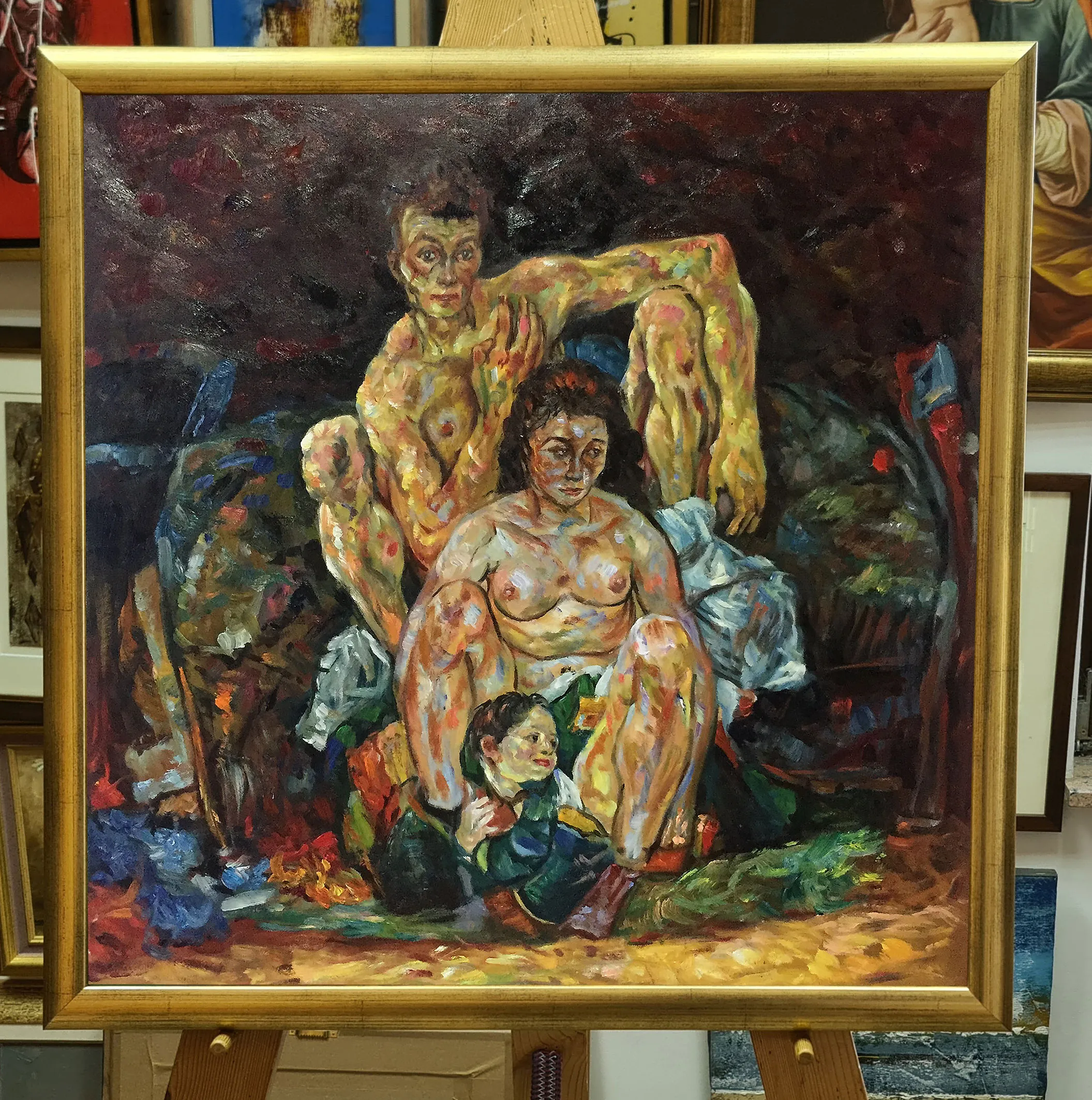
Squatting Couple (The Family) is one of Egon Schiele’s last large canvases, painted in 1918, in which a man and a woman, both nude, crouch in a dark room while a child peers out from between the woman’s legs. The original is on display at the Upper Belvedere in Vienna under inventory number 4277. We make it as a hand-painted oil painting on canvas, in fifteen sizes or to your own measurement, and we send you a photograph of the finished work for approval before it ships.
| Title: | Squatting Couple (The Family) |
| Other titles: | Kauerndes Menschenpaar · Die Familie · Počepujoč par |
| Painter: | Egon Schiele (1890–1918) |
| Year: | 1918; the museum record lists the work as unsigned |
| Original size (width × height): | 150 cm x 160.8 cm |
| Original technique: | Oil on canvas |
| Style: | Expressionism |
| Location: | Belvedere, Vienna (inv. no. 4277), on display at the Upper Belvedere |
| Our reproduction: | hand-painted oil on canvas, 15 sizes from 50 x 55 cm to 200 x 210 cm, or a made-to-measure size |
Squatting Couple (The Family) – Egon Schiele
What does the work show?
The Belvedere’s record is unusually specific here, and we report it rather than add to it: a man and a woman, both nude, are crouching in a dark room, and a child peers out from between the woman’s legs. Positioned protectively behind them both, the man with alert eyes reveals Schiele’s features. His bony body contrasts with the woman’s soft curves; she looks down, lost in thought. Despite their physical proximity, the two bodies appear isolated. That is the whole content of the scene: no narrative, no placeable room, only three people and the dark around them.
Who is the man in the work?
The museum record says the man with alert eyes reveals Schiele’s features. It is therefore a self-portrait inside the scene, not the portrait of a model. Who the woman and the child are, the record does not say, and we do not guess. What follows from it is the point: the painter put himself into a role he never lived to hold, and that is the only thing recorded about his intent.
Where does the title The Family come from?
Not from Schiele. The museum record states that the art critic Berta Zuckerkandl first used the title The Family for Squatting Couple, after the painter’s death. The reason lies in what happened in the autumn of 1918: Schiele’s wife Edith died of Spanish flu on 28 October, six months pregnant, and Schiele died three days later. The family the title names never came into existence. The title is a posthumous reading and should be read as one.
Why does this work matter?
Because it is late and because it is at this scale. The canvas measures 150 x 160.8 cm and is among the largest Schiele painted; it comes from the year he did not survive. The exhibition list in the museum record shows how the work has been read over time: the Belvedere showed it among new acquisitions in 1951 and 1959, in its survey of nineteenth- and twentieth-century Austrian holdings in 1954, in the large Schiele exhibition of 1968, and in 1990 in a show devoted to the self-portrait — which supports reading the man’s face as the painter’s. As an expressionist painting it is exceptional because it is no longer provocation: here Schiele does not shock, he records.
What does the work mean?
The museum record offers one reading and we stop there: despite their physical proximity the bodies appear isolated. That is description, not symbolism. What can be added is what any viewer sees: none of the three figures looks in the same direction. The man looks straight out, the woman down, the child off to one side. Three people in one bundle of bodies, three lines of sight apart. Whether Schiele meant that as a statement about family or whether it follows from how he built the composition is written down nowhere, so we draw no conclusion.
What is the canvas like and what is the colour like?
It is an almost square canvas: the museum record gives 150 x 160.8 cm, a ratio less than ten per cent away from square. The dark around the figures is not black but built from deep red, brown and blue-green passages that are hard to tell apart, so the figures stand out from the ground more than any light in the scene would explain. The bodies are painted in small patches of yellow, pink and green set beside one another rather than blended, which is why the skin looks alive and ill at the same time. The record also lists the work as unsigned.
Where does it come from and where is it now?
The work is in the Belvedere in Vienna under inventory number 4277 and, according to the museum record, on display at the Upper Belvedere. Its route there is short and well documented; it is set out below, in the provenance section, and carried across unchanged, because it is a record of owners and not a description we are entitled to rephrase.
Provenance
From 1918 the painting was owned by Hans Böhler (Vienna and New York); the Belvedere purchased it from him in 1948.
Where does The Family sit among Schiele’s works?
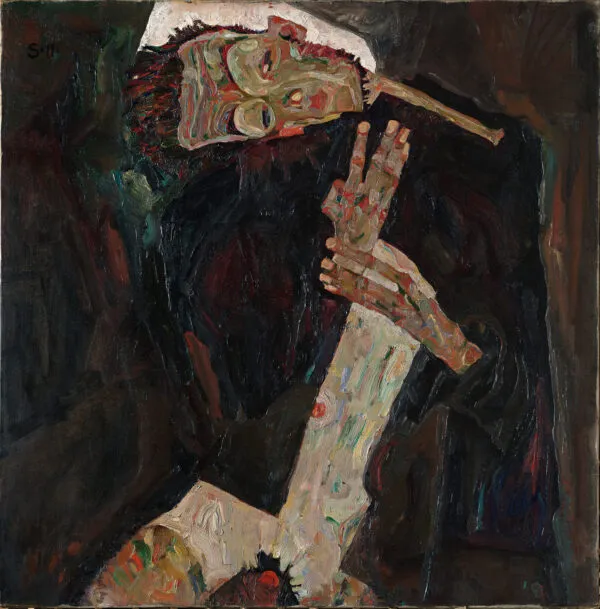
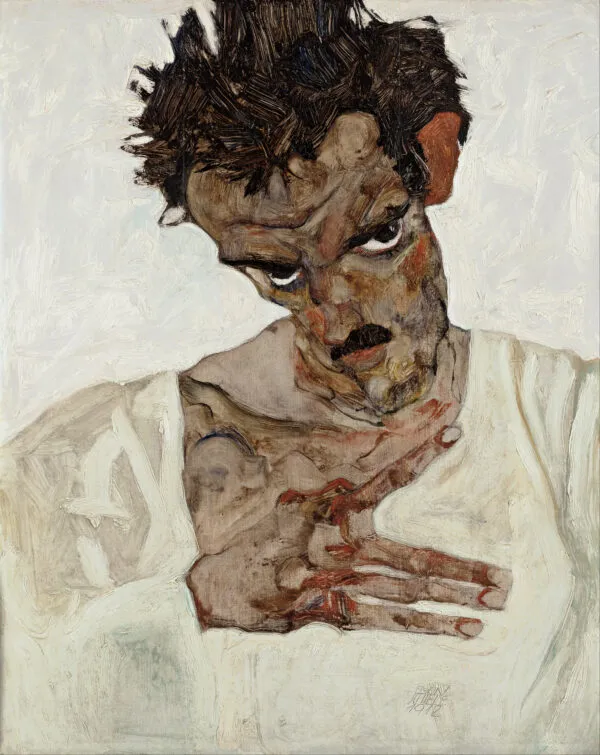
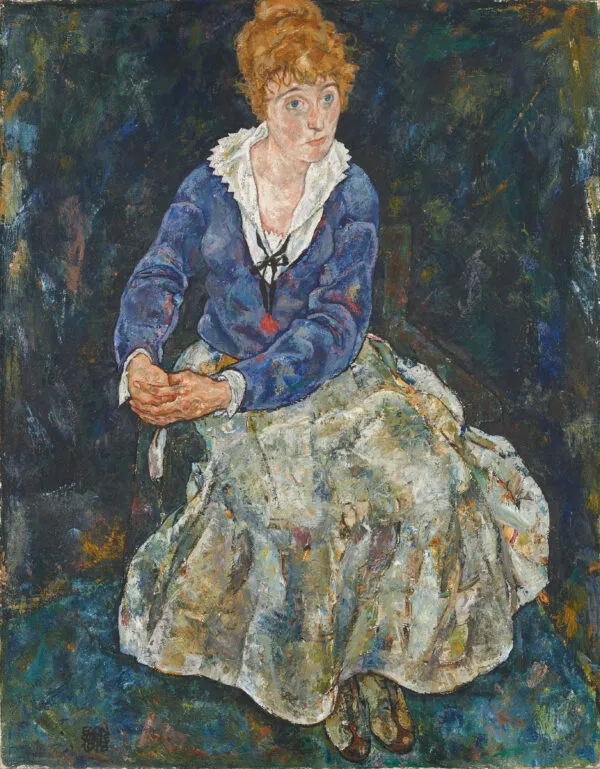
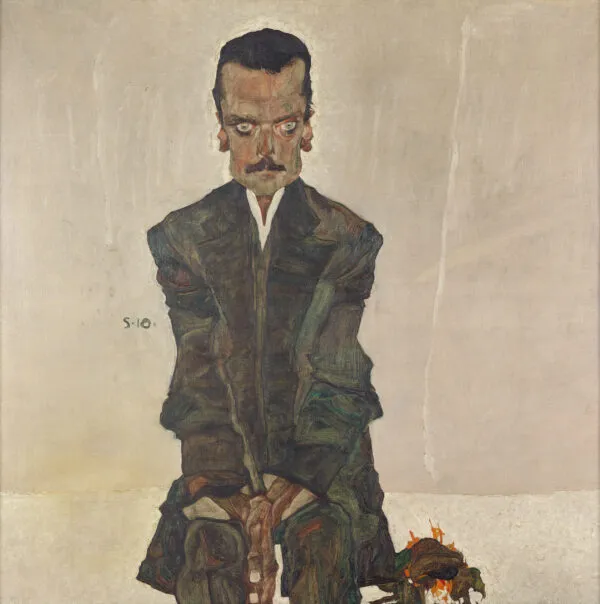
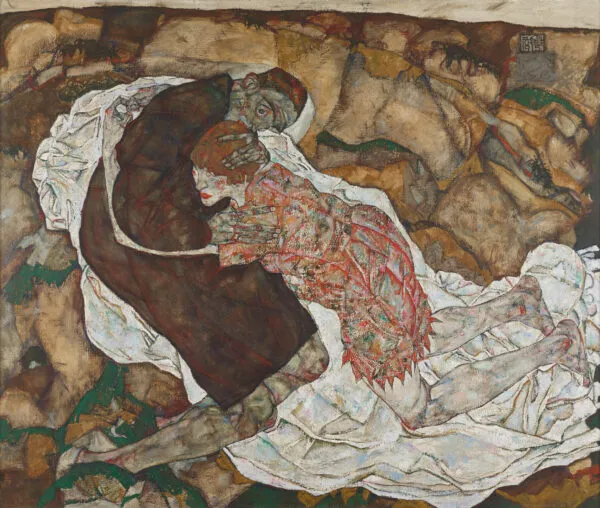
At the very end. A year earlier comes The Embrace, where the bodies are still fused and there is no face; here the bodies are together, both faces are visible, and both look elsewhere. Four Trees is from the same last year, where the same stillness is carried into a landscape. How far Schiele had travelled shows in a comparison with the Portrait of Herbert Reiner of 1910 and the Portrait of Wally Neuzil of 1912. The full selection is in the Egon Schiele gallery, and there is more on his life in our article about Egon Schiele. Schiele was a younger contemporary of Gustav Klimt, and the Vienna Secession was the milieu he came out of; Viennese Expressionism is the movement he helped define, and Austrian art of the period is still read through those two names.
How is our hand-painted version made?
Every canvas is painted by an artist in oils, stroke by stroke. It is not a machine impression but a hand-painted copy made specifically for your order. The photograph above shows one of our versions of this work: framed in a gold moulding and standing on a wooden easel in the workshop, among other canvases in progress. On this subject the hardest part is the skin: the patches have to stay separate and must not slide into a single colour, or the very thing that makes the work recognisable is lost. When the work is finished we photograph it and send you the photograph for approval, and only then does it ship. As a canvas reproduction it arrives stretched on a wooden bar and ready to hang.
Which size suits which wall?
Short answer: above a sofa choose 130 x 140 cm or larger; for a smaller wall 70 x 75 cm is enough. Because the motif is almost square it behaves differently from a horizontal one — it does not need a long piece of furniture beneath it, but quiet wall around it, so it also works alone on a narrow wall or in a hallway. Above a bed 120 x 130 cm is the usual choice. Our largest format is 200 x 210 cm and is meant for tall or open rooms; the smallest is 50 x 55 cm. A canvas painting at that scale needs distance: a dark canvas with three figures is looked at from a few metres, not from two steps away.
How do I order a made-to-measure size, stretcher bar and frame?
If none of the fifteen sizes suits your wall, we paint the work to your own measurement. The canvas comes stretched on a wooden bar; our 3D application is for choosing a frame only, not for showing the work on your own wall. You choose the frame separately and it is not necessarily part of the order.
How is it delivered and what do we guarantee?
We paint to order and deliver to sixteen countries in the European Union, among them Germany, France, Italy, the Netherlands and Poland; the United Kingdom and Ireland are not currently among them. Before dispatch we send you a photograph of the finished work for approval; if you are not satisfied with the result we correct it or paint it again. Because each painting is made individually, the production time varies with the size and with the studio’s current workload.
Frequently asked questions
Where is the original kept?
In the Belvedere in Vienna, inventory number 4277; the museum record has it on display at the Upper Belvedere.
Is the work signed?
No. The museum record lists this work as unsigned.
Is the man in the work Schiele?
According to the museum record, the man with alert eyes reveals Schiele’s features.
Is this a print?
No. Every canvas is painted by hand in oils by an artist.
Who gave the work the title The Family?
The critic Berta Zuckerkandl, after Schiele’s death. The painter’s title was Squatting Couple.
How large is the original canvas?
150 x 160.8 cm, so almost square.
Can I have a size that is not on the list?
Yes, we paint the work to any measurement you specify.
How does it arrive?
Stretched on a wooden bar and protectively packed; the frame is optional.
What is the work about, in one sentence?
That three people can be in one bundle of bodies and each still be alone.
Is the original for sale?
It is not for sale; it belongs to the public Belvedere collection and is not on the market.
Does it work as a gift?
It does, though the subject is demanding; if you are unsure which size to choose there is a gift voucher.
- Subject: a nude man and woman crouching in the dark, a child between the woman’s legs.
- Original: 1918, oil on canvas, 150 x 160.8 cm, unsigned, Belvedere Vienna, inv. no. 4277.
- Ours: hand-painted in oils, 15 sizes or a made-to-measure size, photograph sent before dispatch.
- Worth knowing: the title The Family was given to the work after the painter’s death by Berta Zuckerkandl.