



Description
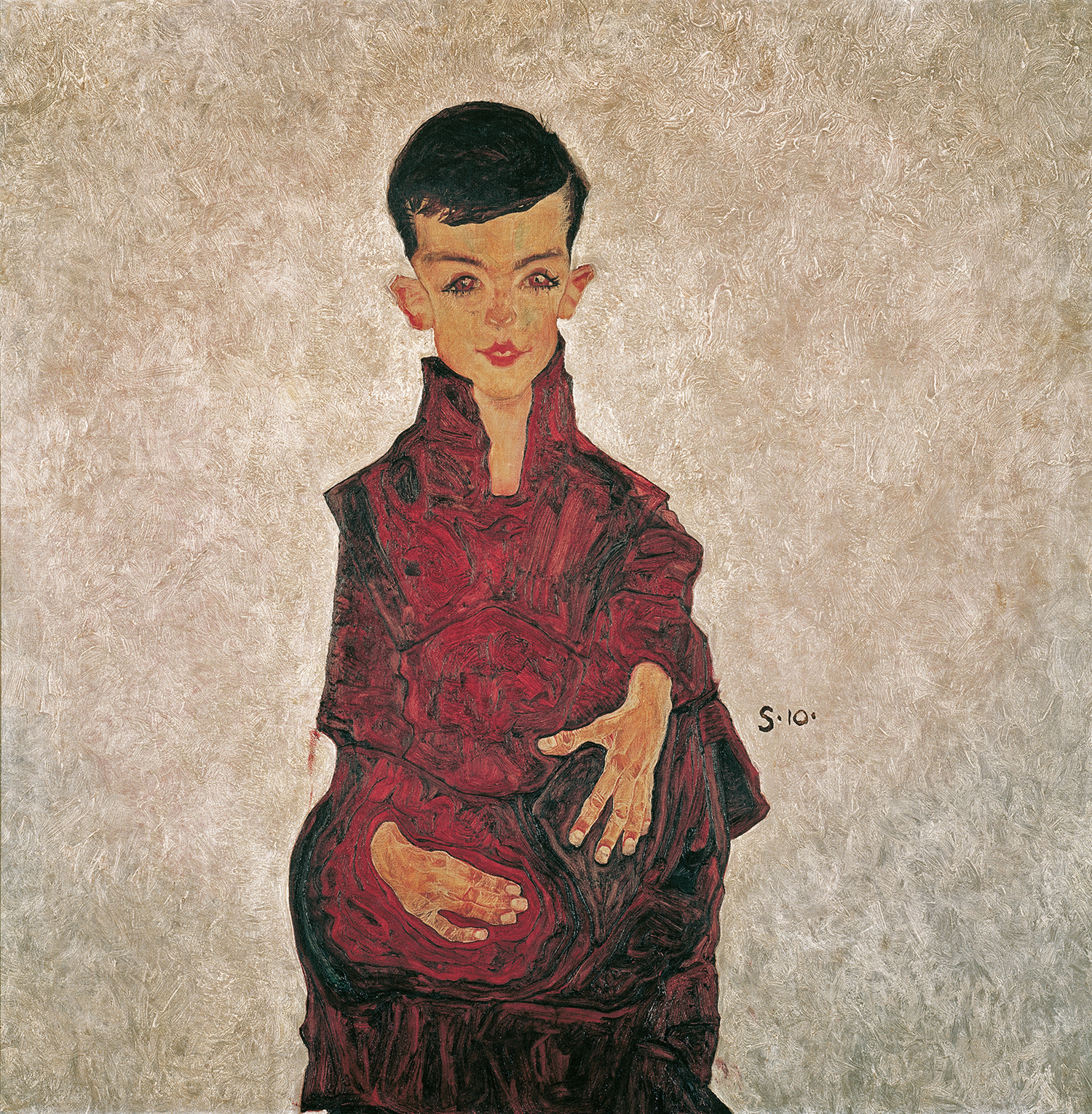
Portrait of Herbert Reiner (Reiner Boy) is a 1910 work by Egon Schiele: a commissioned portrait of a young boy standing before a blank ground, wrapped in a red garment like a loose cloak, with strikingly coarse hands. The original is held by the Belvedere in Vienna under inventory number 4766; it measures 101 x 101.5 cm and is almost square. We paint it by hand in oils, in fifteen sizes or to your own measurement, and before dispatch we send you a photograph of the finished work for approval.
| Title: | Portrait of Herbert Reiner (Reiner Boy) |
| Other titles: | The Reiner Boy · Bildnis Herbert Rainer · Rainerbub |
| Painter: | Egon Schiele (1890–1918) |
| Year: | 1910, signed and dated centre right “S.10.” |
| Original size (width × height): | 101 cm x 101.5 cm (the museum does not label the axes; almost square) |
| Original technique: | Oil on canvas |
| Style: | Expressionism |
| Location: | Belvedere, Vienna (inv. 4766) |
| Our reproduction: | hand-painted oil on canvas, 15 sizes from 50 x 50 cm to 200 x 200 cm, or a made-to-measure size |
Portrait of Herbert Reiner (Reiner Boy) – Egon Schiele
Who is in the painting?
Herbert Reiner, the son of the orthopaedic specialist Max Reiner. According to the Belvedere’s description, in 1910 Max Reiner commissioned a portrait of his five-year-old son Herbert from the young Egon Schiele (1890–1918); the caption under the museum’s own photograph gives the boy’s age as about six. The Austrian painter shows the boy alone, with nothing around him. The surname is written in two ways. The Metropolitan Museum of Art in New York, which holds a drawing of the same boy, titles that sheet Portrait of Herbert Rainer; the Belvedere writes Reiner in its English title and in its description, and Rainer in its German title. We give both spellings as the institutions write them and do not choose between them; our own title follows Reiner.
What is on the canvas?
A boy stands in front of a blank surface: no room, no furniture, no identifiable floor. He wears a red garment that envelops him like a loose cloak, and only the head and the hands come out of it. The hands are the part that holds the eye. The museum calls them strikingly coarse, and they look much older than the child they belong to; above them the face stays a child’s, with a gaze the record calls radiant and innocent. The palette is spare – red, ochre and a greyish-white ground – and the emptiness around the figure pushes it forward, towards the viewer. The format is almost square. The record’s Dimensions field gives 101 × 101.5 cm, while the caption under its photograph gives 100 x 100 cm; our table follows the Dimensions field.
Why does this painting matter?
For three reasons, all of them in the museum’s own record. The first is that it was commissioned, and the record names the patron, the sitter and the occasion: a father ordering a portrait of his son from the young Schiele. The second is its place in a group. The Belvedere writes that Schiele painted The Reiner Boy together with a series of portraits that are all in a square format and share similar compositions; the record names none of those portraits, so we do not name them either. The third is how often the museum has returned to it. Its exhibition list includes the Belvedere’s Schiele exhibitions of 1968, 1990, 2011 and 2018–2019.
What does the painting mean?
In the museum’s reading, it is about a contrast. Schiele gives the boy nothing that would show his age – there is no object in the picture at all – and lets the hands carry the portrait instead: strikingly coarse, they seem much older than the sitter himself and stand against the boy’s radiant, innocent gaze. The record goes no further than that, and neither do we. As an expressionist work it exaggerates not the pose but the hands.
Where does the work come from?
The Belvedere publishes the chain of owners in its record, in this order. First comes Max Reiner of Vienna – the name of the father who, by the museum’s description, commissioned the portrait. Then Sigmund Rosenbaum, also of Vienna. The next entry is dated 1919: Richard Lanyi, Vienna. Then, dated 1930, Arthur Stemmer, Vienna. The last entry is dated 1954 and records an exchange with Rudolf Leopold, Vienna. The same record lists the museum’s own showings of the work, beginning with the presentation of the Österreichische Galerie in the Upper Belvedere that opened on 17 July 1954, followed in 1957 by an exhibition of the gallery’s new acquisitions of 1952 to 1957. The record carries no note of a claim or of a restitution. The short note below gives the same chain in one sentence.
Provenance
The painting passed through several Vienna collectors (Max Reiner, Sigmund Rosenbaum, Richard Lanyi, Arthur Stemmer) before the Belvedere acquired it in 1954, where it remains today.
Where does this work sit among Schiele’s works?
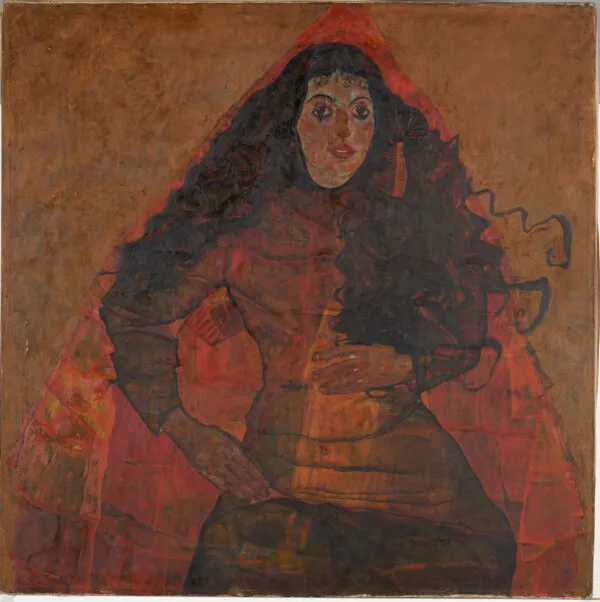
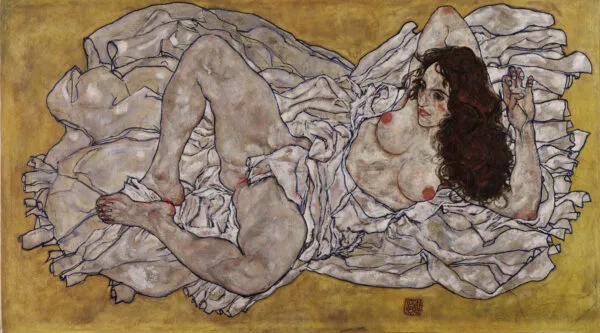
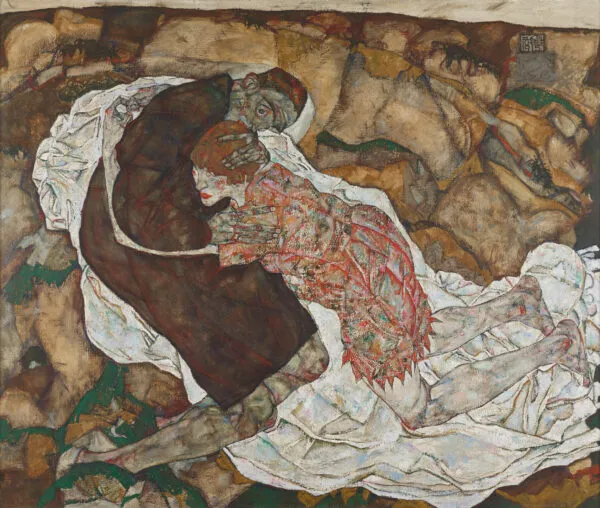
Among the canvases he painted between 1910 and 1913. The record ties this portrait to a series of square portraits without naming them; from our own selection, four canvases show the format around it. Closest in shape is Trude Engel, dated 1912–1913, oil paint on a square canvas of 100 x 100 cm, today in the Lentos Kunstmuseum in Linz. A year after the Reiner portrait came The Lyricist, 1911, at 80.5 x 80 cm and now in the Leopold Museum in Vienna. From 1912 and the same collection come the large square The Hermits, 181 x 181 cm, and Cardinal and Nun (Caress), which at 70 x 80.5 cm is no longer square. The full selection is in the Egon Schiele gallery, with more on his life in our article about Egon Schiele.
How is our hand-painted version made?
A painter works every canvas in oils, stroke by stroke: a hand-painted copy made for your order, not a machine print. Two passages are the hardest here. The first is the red of the garment: the paint has to stay alive, or the cloak loses its weight and turns into a flat patch of colour. The second is the hands, which are drawing inside a painting; they must stay coarse and exact, and anyone who softens them loses the very thing the museum singles out. The original is oil on canvas, and so is our copy, so the surface behaves the same way. When the work is finished we photograph it and send you the photograph for approval, and only then does it ship. This work has not yet been photographed in our workshop; we will add the photographs to this page once we have them. Like every canvas we send, it can arrive stretched on a wooden stretcher bar; you choose that under the Stretcher option.
Which size for which wall?
Short answer: closest to the original is our 100 x 100 cm; it is 1 cm smaller on one side and 1.5 cm smaller on the other, and the record does not say which side is which. Because the motif is square, it does not need a long piece of furniture beneath it but quiet wall around it, so it also works alone on a narrow wall, between two windows or in a hallway; there 60 x 60 cm or 70 x 70 cm is enough. Above a chest of drawers or a desk, 80 x 80 cm works; above a sofa in a living room, 100 x 100 cm or 120 x 120 cm; on a large wall, a stairwell or in a tall room, 150 x 150 cm and our largest size, 200 x 200 cm. A canvas painting at those sizes needs distance: a square that large is looked at from a few metres, not from two steps away. A hand-painted painting hangs best with its centre at eye level, roughly 145–150 cm from the floor; above a sofa, 15–25 cm above the backrest.
Custom size, stretcher bar and frame
If none of the fifteen sizes suits your wall, we paint the work to your own measurement. If you choose “YES” under the Stretcher option, the canvas comes stretched on a wooden stretcher bar, ready to hang. Our 3D application is for choosing a frame only, not for showing the work on your wall; seeing it on your wall is a separate service. The frame is chosen separately and need not be part of the order.
Delivery and guarantee
We paint to order and deliver to sixteen countries in the European Union, among them Slovenia, Croatia, Austria, Italy, Hungary, Germany and France; the United Kingdom and Ireland are not currently among them. Before dispatch we send you a photograph of the finished work to approve, and our returns policy applies to every order. Production time depends on the size and on the studio’s workload.
Frequently asked questions
Who was Herbert Reiner?
Herbert Reiner was the son of the Viennese orthopaedic specialist Max Reiner. According to the Belvedere, his father commissioned the portrait of the five-year-old boy from the young Egon Schiele in 1910; the caption under the museum’s photograph gives his age as about six.
Why is the name spelled both Reiner and Rainer?
Because the institutions write it differently. The Belvedere uses Reiner in its English title and description but Rainer in its German title, Rainerbub, and the Metropolitan Museum of Art in New York titles its drawing of the same boy Portrait of Herbert Rainer. The Reiner Boy, Rainerbub and Portrait of Herbert Reiner all name the same canvas.
When did Schiele paint the Reiner Boy?
In 1910: the canvas is signed and dated “S.10.” at centre right. It is painted in oils and is almost square, 101 x 101.5 cm; the Belvedere writes that Schiele painted it together with a series of square portraits with similar compositions.
Why do the boy’s hands look so old?
That is the contrast the Belvedere points to. Schiele gives the child no object that would show his age and lets the hands carry the portrait instead: strikingly coarse, they seem much older than the sitter and stand against his radiant, innocent gaze. The red, cloak-like garment leaves only the head and the hands visible, which sharpens the contrast.
Where is the Reiner Boy today?
In the Belvedere in Vienna, under inventory number 4766. Its record lists Max Reiner, Sigmund Rosenbaum, Richard Lanyi and Arthur Stemmer, all of Vienna, as owners, and the last entry, dated 1954, records an exchange with Rudolf Leopold. The Belvedere showed it in its Schiele exhibitions of 1968, 1990, 2011 and 2018–2019.
Does it work as a gift?
Yes; if you are unsure which size to choose, there is a gift voucher.
- Subject: Herbert Reiner as a boy before a blank ground, in a red, cloak-like garment, with strikingly coarse hands.
- Original: 1910, painted in oils on canvas, 101 x 101.5 cm, signed and dated centre right, Belvedere, Vienna, inv. 4766.
- Ours: hand-painted in oils, 15 sizes or made to measure, stretched on a stretcher bar if you choose Stretcher: “YES”.
- Worth knowing: the museum writes that Schiele painted it together with a series of square portraits with similar compositions.