







































Description
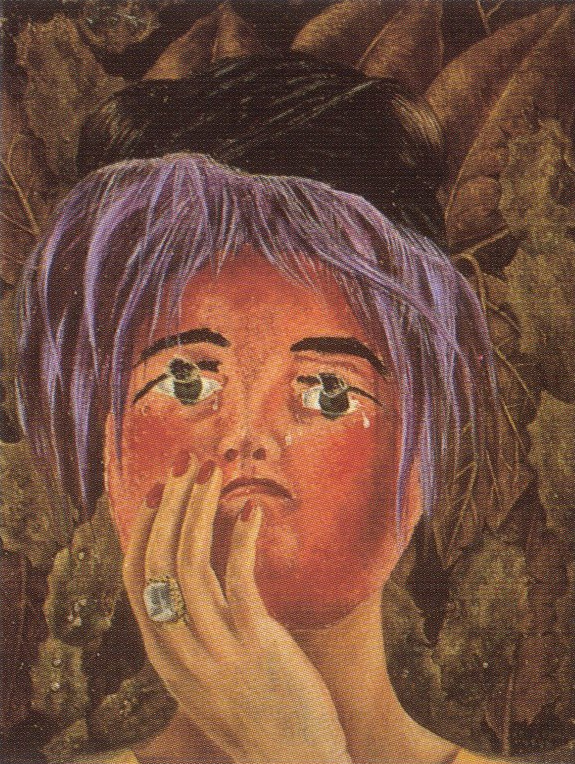
The Mask is a 1945 painting by Frida Kahlo: a hand with red-lacquered nails and a large ring holds a rosy red mask with big, tearful eyes in front of a face, lilac strands fall across the mask’s forehead, and brownish leaves crowd in behind. The original, oil on masonite, 40 cm high and 30.5 cm wide, belongs to the collection of the Museo Dolores Olmedo in Mexico City. Here a painter transfers it to canvas in oil colours, hand-painted in one of two portrait sizes, 40 x 50 or 45 x 60 cm, and before dispatch we send you a photograph of the finished work.
| Title: | The Mask |
| Other titles: | La máscara (de la locura) · Die Maske |
| Painter: | Frida Kahlo (1907–1954) |
| Year painted: | 1945 |
| Original size: | 40 cm x 30.5 cm (height x width) |
| Original technique: | Oil on masonite |
| Painting style: | Mexican modernism |
| Located at: | Museo Dolores Olmedo, Mexico City |
| Our reproduction: | Hand-painted oil on canvas, 2 sizes or made to measure |
The Mask – Frida Kahlo
What does The Mask show?
Almost the whole surface is taken up by a face that is not a real face but a mask in rosy red. The brows are dark and sharply drawn, the mouth is small with drooping corners, and the cheeks carry more colour than the forehead, so the mask seems to blush.
Through the eye holes two large dark pupils look out, ringed with white. Clear tears run from both eyes down the cheeks, and the gaze is fixed squarely on us; it is the only part of the face that feels alive.
Lilac strands hang over the mask’s forehead, laid in with long, thin strokes, as though the mask had been given a wig. Above them a dark mass of hair shows, belonging to whoever is hidden behind the mask.
Holding the mask at the chin is a hand with long fingers and nails painted dark red. On one finger gleams a broad ring with a pale, bluish stone in a yellowish setting.
The space around the head is filled with large leaves in ochre, olive and brown, picked out here and there with lighter veins.
When was it painted, and under what circumstances?
Kahlo painted this work in 1945. Its Spanish title is La máscara (de la locura); the addition in brackets means “of madness”, and the sources we rely on give no further reading of the title.
According to Wikipedia, her health was declining fast by the mid-1940s. In June 1945 she travelled to New York for an operation meant to straighten her spine with a bone graft and a steel support; the difficult surgery failed.
The same source lists Without Hope (1945) and The Wounded Deer (1946) among the works of that period which reflect her physical state. Whether The Mask belongs with them it does not say, so we do not claim it either.
Why does The Mask hold the eye?
Wikipedia notes that in most of her self-portraits Kahlo gave her face a still, mask-like look and arranged visual cues around it from which the viewer works out a deeper meaning. Here the mask is literally in front of us: a hand holds it up, and behind it hides someone we cannot see.
For more on her life, read the Frida Kahlo article on the English Wikipedia; it is about the painter, and there is no separate article on this painting.
Where is the original kept?
The original belongs to the collection of the Museo Dolores Olmedo in Mexico City.
Kahlo painted it in oil on masonite, a hard, smooth board of pressed wood fibres. Year, size, technique and collection come from the list of her works on the English Wikipedia; how the painting reached the museum our sources do not describe.
According to that list, the same Mexican collection also holds the Portrait of Doña Rosita Morillo from 1944, which we paint to order as well.
What you order from us differs from the original in its support: the painter works the mask in oil colours on canvas instead of masonite, so we can stretch it on a stretcher bar or put it in a frame.
The Mask or another Kahlo?
If a reserved, serious face appeals to you, look at Self-Portrait (1948) too, painted three years after the mask with the lilac hair.
From the same years, when illness shaped more and more of her days, comes The Wounded Deer of 1946. Dualism, which Wikipedia counts among the central elements of her painting, takes centre stage in The Two Fridas.
All the famous Frida Kahlo paintings we make to order are gathered on the Frida Kahlo page.
How does our painter handle the mask, the tears and the ring?
Kahlo worked on smooth board, so the painter first gives the canvas for your Mask several thin coats of primer to keep it as even as her surface.
Work starts with the leafy background: the darker brown and olive areas go down first, then the lighter veins are drawn with a fine brush. Only after that is the mask built up in thin layers of pink and brick red, a colour that deepens towards the cheeks.
The eyes take the most care. The whites get pure white, the pupils a very dark tone, and the painter adds tiny white highlights to the tears so they look wet and clear.
The lilac strands come from long, thin strokes, the nails from a touch of dark red, the ring from a bluish-grey stone and a yellowish setting. The result is a Frida Kahlo reproduction that the painter builds up layer by layer for you alone.
Which size will suit your wall?
In short: 40 x 50 cm for a bedroom, a desk corner or a narrow hallway, 45 x 60 cm for the wall above a chest of drawers, beside a sofa or in a dining room.
For The Mask we offer just two sizes, both portrait format (width x height): 40 x 50 cm and 45 x 60 cm. Both are larger than the original, which measures about 31 x 40 cm: the smaller is 9.5 cm wider and 10 cm taller, the larger 14.5 cm wider and 20 cm taller.
The 45 x 60 cm size has a 3 : 4 ratio, almost exactly that of the original, while at 40 x 50 cm the painting comes out a touch wider. As a painting for the living room the larger size works better, hung at eye level beside the seating or between two windows.
Is another size possible, and which frame should I choose?
If you need The Mask in other dimensions, give us the width and height through our paintings made to order page. We reply with a price and a time frame for that size.
We can send the mask rolled, stretched on a wooden stretcher bar or ready framed. Stretching and framing are done by our workshop in Slovenia, which prepares each canvas painting we sell.
You choose the frame in our 3D app, which is meant for frame choice only; seeing the painting on a photo of your own wall is a separate service.
How long does it take, and how is it delivered?
Once you confirm the order, the painter completes The Mask within 15 to 45 working days. Before we pack it, we send you a photograph of the finished painting, and if you would like something changed, the painter makes the correction before dispatch.
Within Slovenia and to the rest of the EU, the painting of the mask travels without customs formalities. The Mask, like every order we take, is covered by our returns policy.
With its clear face at the centre, The Mask makes a fine gift for anyone drawn to Mexican art and to pictures that carry a story. If you are unsure which of the two sizes would suit better, give a wall art voucher and let the recipient choose.
Frequently asked questions
Where can I see the original Mask?
At the Museo Dolores Olmedo in Mexico City, which has the work in its collection.
What is the hand holding in the painting?
A rosy red mask with big, tearful eyes and lilac hair, held close in front of a face.
Is The Mask an oil painting reproduction or a printed copy?
It is painted with a brush on canvas, so every copy of The Mask is real oil paint with no printed layer.
How big is the original Mask?
It is 40 cm high and 30.5 cm wide, so smaller than both of the sizes we offer.
Can I get The Mask in a different size?
Yes, send us the width and height you want; before you order we tell you whether it is feasible and what it costs.
How soon will it arrive?
Painting takes 15 to 45 working days, then we ship it; within the EU there is no customs to pay.
Is it suitable for a bedroom or a study?
Yes. The smaller size looks good above a bed or a desk, and the warm browns of the leaves give the room a calm feel.
What does the mask in the painting mean?
The Spanish title adds the words “de la locura” (of madness); our sources offer no closer reading.
- Subject: a hand with red nails and a ring holds a rosy red mask with tearful eyes and lilac hair against brown leaves.
- Original: 1945, oil on masonite, 40 x 30.5 cm, Museo Dolores Olmedo, Mexico City.
- Ours: The Mask as a hand-painted copy in oil on canvas, in two portrait sizes: 40 x 50 or 45 x 60 cm.
- Worth knowing: both sizes are larger than the original; 45 x 60 cm keeps its proportions almost exactly.