







































Description
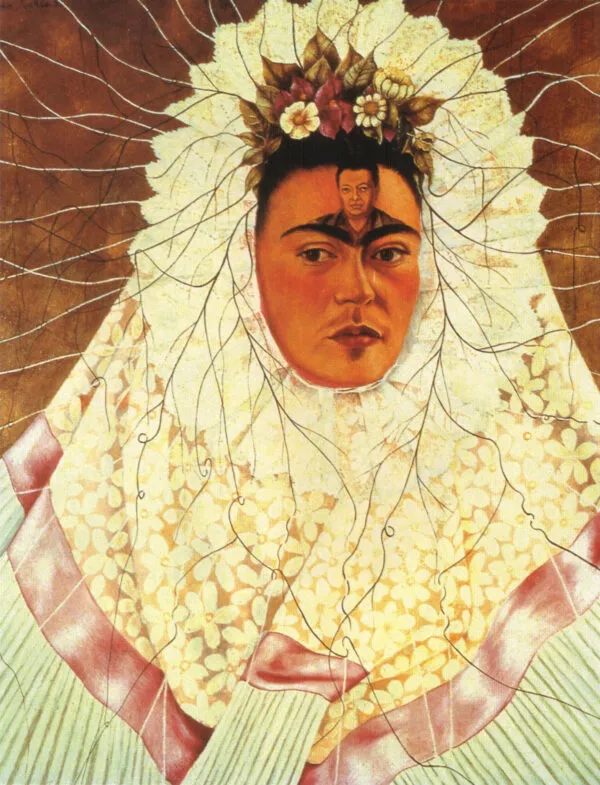
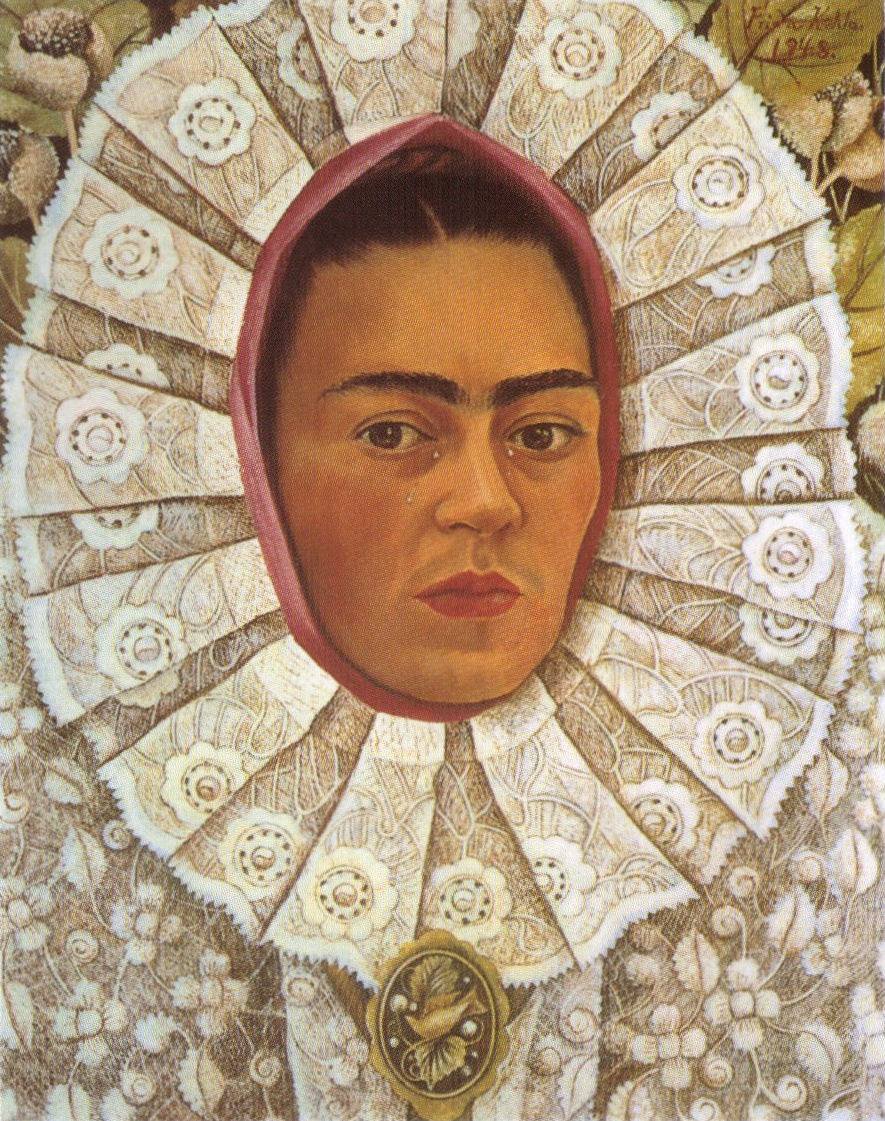
Self-Portrait (1948) is a late work by Frida Kahlo in which her face looks out from the middle of a vast white lace headdress, the kind worn by the women of Tehuantepec. A narrow band of dark red cloth hugs her cheeks, small tears glisten under her eyes, and an oval brooch is pinned below her chin. The original, oil on masonite, is 50 cm high and 39.5 cm wide and belongs to the collection of Dr. Samuel Fastlicht in Mexico City. Our painter transfers it to canvas in oil colours, in one of five portrait sizes between 40 x 49 and 68 x 90 cm, and before dispatch you receive a photograph of the completed painting.
| Title: | Self-Portrait (1948) |
| Other titles: | Autorretrato · Selbstporträt (1948) |
| Painter: | Frida Kahlo (1907–1954) |
| Year painted: | 1948 |
| Original size: | 50 cm x 39.5 cm (height x width) |
| Original technique: | Oil on masonite |
| Painting style: | Mexican modernism |
| Located at: | Collection of Dr. Samuel Fastlicht, Mexico City |
| Our reproduction: | Hand-painted oil on canvas, 5 sizes or made to measure |
Self-Portrait (1948) – Frida Kahlo
What does Self-Portrait (1948) show?
The face sits almost exactly in the centre and looks straight at us, calm and serious. Around it a white lace headdress opens out like a great wreath, built from broad pleated panels that run in towards the face from every side.
Each panel carries a white flower with a round, dotted centre, and the edges of the panels are finely scalloped. Thin brownish lines run between the flowers and give the lace the look of an old engraving.
A narrow band of dark red cloth wraps tightly around the face, and beneath it the black hair is parted smoothly down the middle. The brows meet above the nose in one dark arch, the lips are red and closed, and the skin has a warm, golden olive tone.
Small white tears hang beneath both eyes, and one has rolled further down the cheek. Under the chin is an oval brooch with a gold rim and a dark field bearing a plant motif.
What do we know about her life in those years?
Her health declined steadily through that decade. More and more she stayed at home, in the Blue House (La Casa Azul) in Coyoacán, which became the centre of her world.
According to Wikipedia her finances improved in the mid to late 1940s, and buyers sometimes took her work before it was even finished. In 1948 she rejoined the Mexican Communist Party.
Wikipedia offers no reading of the tears in this painting. In general it says that in most of her self-portraits Kahlo painted her face like a mask and surrounded it with visible cues from which the viewer draws a deeper meaning; here those cues are the lace, the brooch and the tears.
Why are so many people drawn to this self-portrait?
Kahlo liked to wear the clothes of the women of the Isthmus of Tehuantepec in southern Mexico, which after the revolution stood for an authentic Indigenous Mexican heritage. According to Wikipedia, the Tehuana outfit let her express her feminist and anti-colonial convictions.
Here the headdress is so large that it takes up almost the whole surface, and the face is left as a small island among white folds.
She once said she painted herself because she was so often alone and because she was the person she knew best.
Her life story is told in the Frida Kahlo article on the English Wikipedia; it is about the painter, and there is no separate article on this painting.
Where is the original, and who owns it?
The original is in the collection of Dr. Samuel Fastlicht in Mexico City. It is painted in oil on masonite, a rigid board of pressed wood fibres, and measures 50 cm in height and 39.5 cm in width.
Fastlicht owned another of her works as well: in 1951 Kahlo dedicated to him the painting Still Life Dedicated to Samuel Fastlicht, with fruit and a small clay dog.
Year, technique, measurements and owner come from the English Wikipedia list of her works, which does not say how the painting reached Fastlicht.
Our hand-painted copy is made not on masonite but on canvas.
Self-Portrait (1948) or another Kahlo?
This piece is almost monochrome: cream white, sepia and warm brown dominate, and the only red accent comes from the band of cloth and the lips. That makes it an easy canvas painting to live with beside wood, linen, white or sand-coloured walls and a calm, bright room.
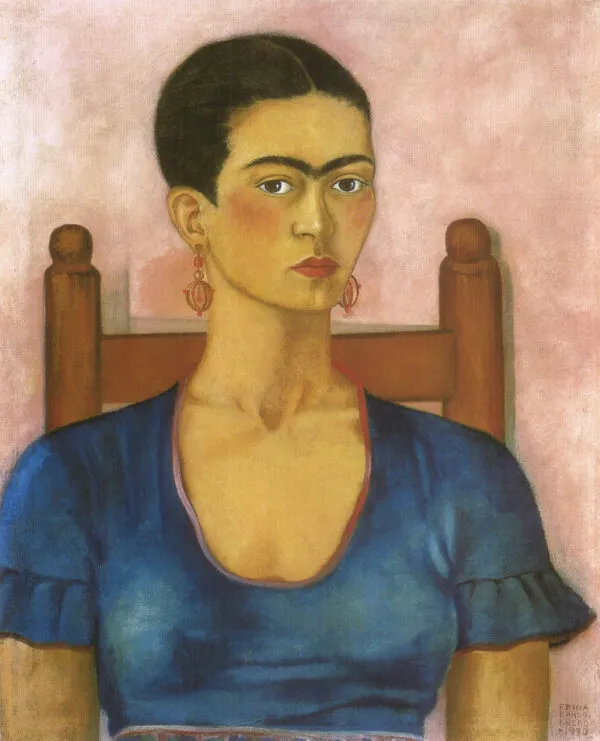
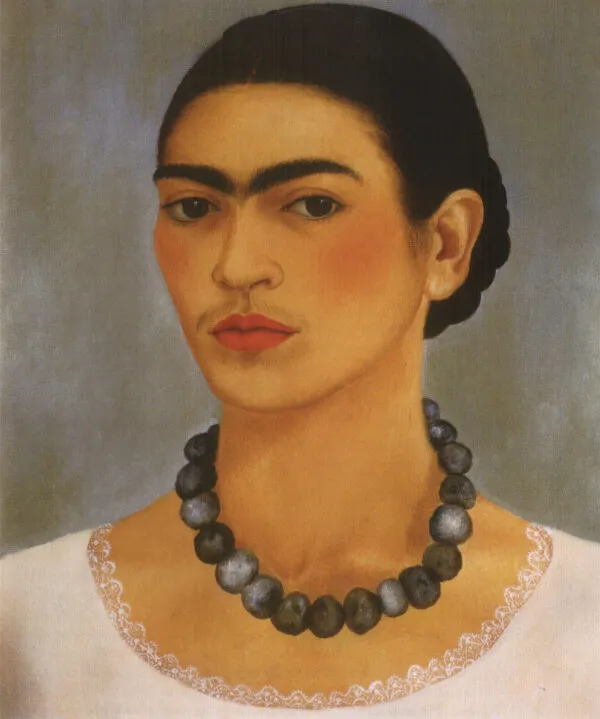
Kahlo wears the same white Tehuana lace headdress in Diego in My Thoughts from 1943. To see how she presented herself almost two decades earlier, look at Self-Portrait (1930).
From the same years, when illness was already marking her work deeply, comes The Wounded Deer (1946). All the famous Frida Kahlo paintings we paint to order are gathered under Frida Kahlo.
How does our painter paint the lace and the tears?
Masonite is smooth, so the original has no grainy canvas surface and the colours lie flat and clean. Our painter therefore first prepares a smooth ground, so that the weave does not interfere with the fine lines of the lace.
He begins with thin layers of cream white, sepia and the grey-brown shadows of the folds.
The flowers in the lace, the dots around their centres and the scalloped edges are set down with a fine brush, one after another; this part takes the longest. The face is built from warm ochre tones, the lips a solid red, the brows and hair sharply outlined.
Last of all the tears are shaped with white and a tiny bluish highlight so that they look wet,. The result is a Frida Kahlo reproduction with layers of real oil paint you can feel on the surface, an oil painting reproduction carried out with a brush for each order separately.
Which size is right for your wall?
Short answer: 40 x 49 or 48 x 60 cm for a hallway or a narrow wall, 55 x 70 cm above a chest of drawers or a desk, and 61 x 80 or 68 x 90 cm above a bed or a sofa.
We offer this work in only five portrait sizes (width x height): 40 x 49, 48 x 60, 55 x 70, 61 x 80 and 68 x 90 cm. The original is 39.5 cm wide and 50 cm high; the nearest size is 40 x 49 cm, which is 0.5 cm wider and 1 cm shorter, and all the others are larger.
As a painting for the living room, 68 x 90 cm works best: the lace wreath then commands the wall above the sofa.
Is another size or a frame possible?
If none of the five sizes suits you, send us the width and height you want through our paintings made to order page. We check whether we can paint it that way and let you know the price and the timing.
You can receive the painting rolled, stretched on a stretcher bar or ready framed. Our workshop in Slovenia stretches and frames this self-portrait for you.
You pick the frame in our 3D app, which is for choosing the frame and nothing else. Seeing the painting on a photo of your own wall is a different service, ordered separately.
When will it arrive, and how is it shipped?
From the confirmation of your order to dispatch takes 15 to 45 working days. When the painting is done we send you a photograph of it; if anything bothers you, the painter corrects it before we pack.
Shipments within Slovenia and to the other EU countries travel without customs, and our returns policy applies to every order.
This self-portrait makes a fitting gift for someone who loves Mexican dress, lace or quiet portraits. If you are unsure which size would suit, give a wall art voucher instead and leave the choice to the person receiving it.
Frequently asked questions
Who owns the original?
It is in the private collection of Dr. Samuel Fastlicht in Mexico City.
What is Kahlo wearing on her head?
A large white Tehuana lace headdress over a dark red band of cloth.
Will the painting be printed?
No. The painter paints it with a brush on canvas; you get a real oil painting made by hand, with no printing at all.
How large is the original?
It is 50 cm high and 39.5 cm wide, painted in oil on masonite.
Could this self-portrait be painted in a size off the list?
Ask us: we tell you whether the size you want is feasible and what it costs, before you order anything.
How long will I wait for the painting?
Allow 15 to 45 working days; a photograph of the finished lace portrait reaches you before we pack it.
Does it suit a bedroom?
Yes, the white lace and soft browns are calm and do not unsettle a room meant for rest.
What do the tears on her cheek mean?
Wikipedia gives no reading of them for this painting; we describe them and leave the meaning to you.
- Subject: Frida Kahlo’s face at the centre of a white Tehuana lace headdress, with tears beneath her eyes and an oval brooch at her throat.
- Original: 1948, oil on masonite, 50 x 39.5 cm, collection of Dr. Samuel Fastlicht, Mexico City.
- Ours: oil on canvas, hand-painted to order, in 5 portrait sizes from 40 x 49 to 68 x 90 cm.
- Worth knowing: 40 x 49 cm is the size nearest the original, but it is 0.5 cm wider and 1 cm shorter.