







































Description
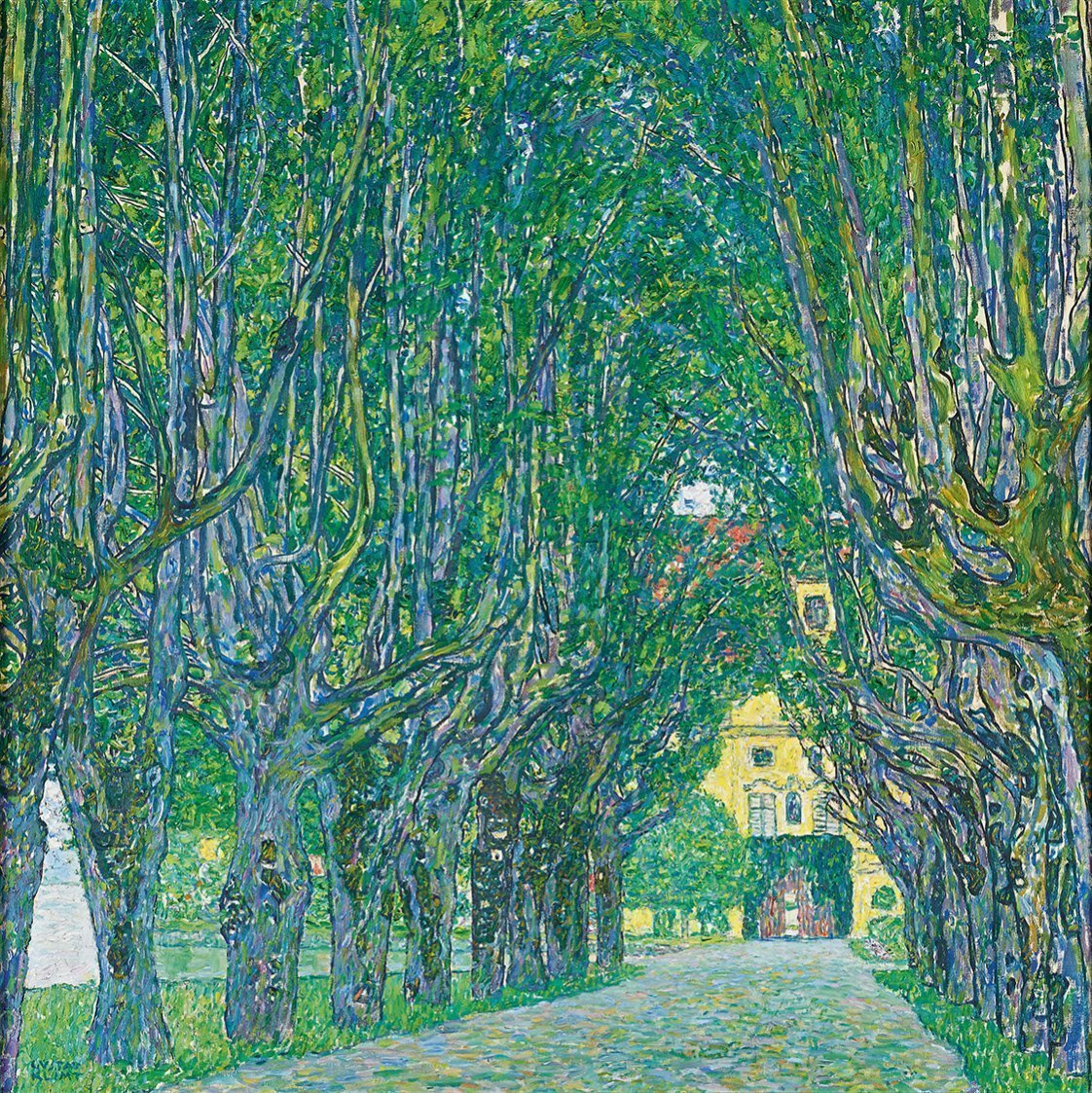
Avenue in the Park of Kammer Castle is the avenue of trees Gustav Klimt painted in 1912 on one of his summer stays at the Attersee: thick, gnarled trunks line a path that leads deep into the painting, and at its end the yellow facade and entrance of Kammer Castle light up in the sun. The original hangs in the Upper Belvedere in Vienna. We paint it by hand in oil on canvas, in eight square sizes from 60 x 60 to 150 x 150 cm or to your own measurement, and send you a photograph of the finished work for approval before dispatch.
| Title: | Avenue in the Park of Kammer Castle |
| Other titles: | Avenue to Schloss Kammer · Allee zum Schloss Kammer · Viale nel parco del castello di Kammer |
| Painter: | Gustav Klimt (1862–1918) |
| Year painted: | 1912 |
| Original size: | 110 cm x 110 cm |
| Original technique: | Oil on canvas |
| Painting style: | Vienna Secession, landscape |
| Located at: | Belvedere, Vienna (inv. 2892) |
| Our reproduction: | Hand-painted oil on canvas, eight square sizes or made to measure |
Avenue in the Park of Kammer Castle – Gustav Klimt
What does the painting show?
An avenue of old trees runs straight into the painting. On both sides stand thick, gnarled trunks in grey, blue and green, and above them the crowns close into a dense roof of green and blue-green leaves. Between the trunks the light falls in small patches onto the path and the grass, so the whole avenue seems to flicker in the summer sun.
At the far end, deep in the painting, a sunlit yellow facade appears: the entrance of Kammer Castle, seen through the tunnel of trees. It is the only building in the scene and it is small, yet it is the point the eye keeps returning to. There is nobody on the path. You stand where Klimt stood, at the start of the avenue, looking towards the castle.
Kammer Castle in five paintings
From 1900 to 1916 Klimt spent several weeks every summer at the Attersee in Austria. Kammer Castle, on the shore of the lake, became one of his subjects: according to the Belvedere he painted it five times in all. The castle once stood on an island in the Attersee, and in his paintings it appears from the water, through the trees and, as here, at the end of its avenue.
In Avenue in the Park of Kammer Castle the view does not cross the water; it runs along the avenue. Klimt turns away from the lake and walks into the park, so the trees become the real subject and the castle is only a flash of yellow at the end of the path.
Why does it recall Van Gogh?
Look closely at the trunks and the leaves. Klimt sets them down in short, vibrant dabs of colour and outlines the trunks with bold, dark contours. The Belvedere links this way of painting to Klimt’s engagement with the international avant-garde of his time, for example Vincent van Gogh and Paul Cézanne, whose work he could study at exhibitions in Vienna.
The result is a landscape that is calm and alive at once. The avenue is perfectly ordered, two rows of trees converging on one point, yet every trunk twists and every leaf seems to move. It is quieter than Klimt’s golden portraits but just as carefully composed, and on a wall it creates depth: the path draws your eye into the distance like an open door.
Where is the original?
The original, painted in oil on canvas and measuring 110 x 110 cm, is in the Upper Belvedere in Vienna, in the collection of the Belvedere, under inventory number 2892. It is signed at the lower left “GUSTAV KLIMT”. The museum’s online record is linked in the table at the top of this page.
If you visit Vienna, you can see it together with many other Klimt paintings in the Upper Belvedere; check the museum’s website before you go, because works are sometimes lent to exhibitions. A hand-painted version brings the same avenue into your home, in the size you choose – and our 110 x 110 cm size is exactly the size of Klimt’s canvas.
Avenue in the Park of Kammer Castle among Klimt’s landscapes
All of Klimt’s Attersee landscapes in our gallery share the square format and the summer light. On Lake Attersee and Island in Lake Attersee show the lake itself, almost nothing but water; The Park is a wall of foliage above a narrow strip of ground; and Apple Tree I is a single tree heavy with red apples. Klimt also painted the castle at the end of the avenue from the water: Schloss Kammer on the Attersee I shows it across the lake with the boathouse, Schloss Kammer on the Attersee III close up, its yellow facade above the water.
Choose the avenue if you want depth and the feeling of a walk: among these landscapes it is the one with a path leading into the distance and a building waiting at its end. Choose one of the lake views if you prefer calm water, or The Park if you want pure green. More about Klimt’s life and work is on Wikipedia’s Klimt page.
How do we paint the avenue by hand?
The painter first draws the main lines on the canvas: the two rows of trunks, the path between them and the small facade at the end. Then the large areas go on in thin layers – the dark greens and blues of the foliage, the lighter ground and the warm yellow of the castle.
After that come the details that give the painting its life: the short dabs of colour in the leaves, the patches of sunlight on the path and the dark contours that make every trunk twist. A printed oil painting reproduction flattens all of those strokes into one smooth surface; painted by hand, each dab keeps its own texture and catches the light. Every painting is a hand-painted copy made for your order, so no two are exactly alike.
There is no gold in this landscape, and none in our version: we use oil colours only, as Klimt did.
Which size for which wall?
In short: 60 x 60 or 70 x 70 cm for a small wall or a hallway; 80 x 80 or 90 x 90 cm above a chest of drawers or a bed; 100 x 100 or 110 x 110 cm above a sofa; 120 x 120 or 150 x 150 cm for a large wall or an open-plan room. The 110 x 110 cm size is the size of the original.
All eight sizes are square, like Klimt’s canvas, so nothing is cropped. Because the avenue leads the eye into the distance, it works especially well at the end of a corridor or on the wall you see as you walk into a room – it opens the space like a window onto a park. As a painting for the living room, 110 x 110 or 120 x 120 cm above a three-seat sofa gives the trees their full presence. With its cool greens and warm yellow it also suits a study or a home office.
Hang it with the centre of the canvas about 150 to 160 cm above the floor; above furniture, leave 20 to 30 cm between the top of the furniture and the lower edge of the canvas. As a rule of thumb, a painting above a sofa looks best at about two thirds of the sofa’s width.
Custom size, stretcher and frame
If none of the eight sizes fits, we paint it to measure; keep it square or close to square, so the avenue keeps its proportions. Send us the width and height you need and we will quote the price and delivery time. Every painting we make is stretched on a wooden stretcher frame and ready to hang.
To choose a moulding, use our 3D application: it shows all our frame profiles on this subject, so you can compare gold, silver, black, white and natural wood before you decide – the application is for choosing the frame only. To see the painting on your own wall, ask for our separate room placement service. A natural wood or dark brown frame suits the trees; a slim gold frame picks up the yellow facade.
Delivery and guarantee
We paint every painting to order in our studio in Slovenia, so allow 15 to 45 days depending on the size. It travels stretched and protected, framed if you chose a frame, across the EU with no customs. Before dispatch you receive a photograph of the finished work to approve; if something is not right, we correct it while the canvas is still in our workshop. Our returns policy applies to every order.
If you are giving it as a gift and are unsure of the size, choose our gift voucher. You will find more of Klimt’s work in our Gustav Klimt gallery, and more about the painter in our article 10 interesting facts about Gustav Klimt.
Frequently asked questions
Where is the original Avenue in the Park of Kammer Castle?
The original hangs in the Upper Belvedere in Vienna, in the museum’s Klimt collection, under inventory number 2892. It is painted in oil on canvas and measures 110 x 110 cm, exactly the size of our 110 x 110 cm version. If you plan a visit, check the museum’s website first, as works are sometimes lent to exhibitions.
When did Klimt paint the Avenue to Kammer Castle?
Klimt painted it in 1912. Between 1900 and 1916 he spent several weeks every summer at the Attersee, and Kammer Castle on the lake shore became one of his recurring subjects. He painted the castle five times in all; here he looks along the avenue of the park towards the entrance, not across the water at the building.
What does Klimt’s Avenue in the Park of Kammer Castle show?
It shows an avenue of thick, gnarled trees leading straight into the painting, with a roof of green and blue-green leaves above. At the far end the sunlit yellow facade and entrance of Kammer Castle can be seen. Patches of light fall on the path, and there is nobody in the scene.
Why does the Avenue to Kammer Castle look like Van Gogh?
Because of the short, vibrant dabs of colour and the bold, dark contours of the trunks. The Belvedere links this to Klimt’s engagement with the avant-garde of his time, such as Vincent van Gogh and Paul Cézanne, whose work he saw at exhibitions in Vienna. The square format and the calm order, however, are pure Klimt.
Did Klimt paint other views of the castle besides the Avenue?
Yes. According to the Belvedere, Klimt depicted Kammer Castle in five paintings in all, all from his summers at the Attersee. In the avenue he walks into the castle park and shows the building only at the end of the path. The castle once stood on an island in the Attersee, and here an avenue of gnarled trees leads to its entrance.
Is there gold in the Avenue in the Park of Kammer Castle?
No, there is no gold in this landscape. It is painted in greens, blues and greys with the warm yellow of the castle, and its brightness comes from the dabs of colour and the patches of sunlight. We therefore paint our version in oil colours only, without gold paint, just like the original.
Which size of Avenue in the Park of Kammer Castle suits my wall?
For a small wall or a hallway, 60 x 60 or 70 x 70 cm works well. Above a chest of drawers or a bed choose 80 x 80 or 90 x 90 cm, above a sofa 100 x 100 or 110 x 110 cm, and for a large wall 120 x 120 or 150 x 150 cm. The 110 x 110 cm size is the size of the original.
Which room suits the Avenue to Kammer Castle?
It suits a living room, a hallway, a study or a bedroom – anywhere you would like a view into a green park. As a canvas painting with a strong sense of depth, it makes a narrow or windowless room feel larger. It pairs well with white, beige, green or grey walls and with natural wood furniture.
Is the Avenue in the Park of Kammer Castle a good gift?
Yes, especially for someone who enjoys gardens, parks, Austria or Klimt’s landscapes more than his gold. The square format fits almost any wall, and the subject is calm and timeless. If you are unsure of the size, 80 x 80 cm fits most homes; otherwise give a voucher so the recipient can choose the size.
- Subject: an avenue of gnarled trees leading to the sunlit yellow facade of Kammer Castle at the Attersee.
- Original: 1912, oil on canvas, 110 x 110 cm, Belvedere, Vienna.
- Our version: a Klimt reproduction painted by hand in oil on canvas, in eight square sizes or made to measure.
- Good to know: before dispatch you receive a photograph of the finished work for approval.