Description
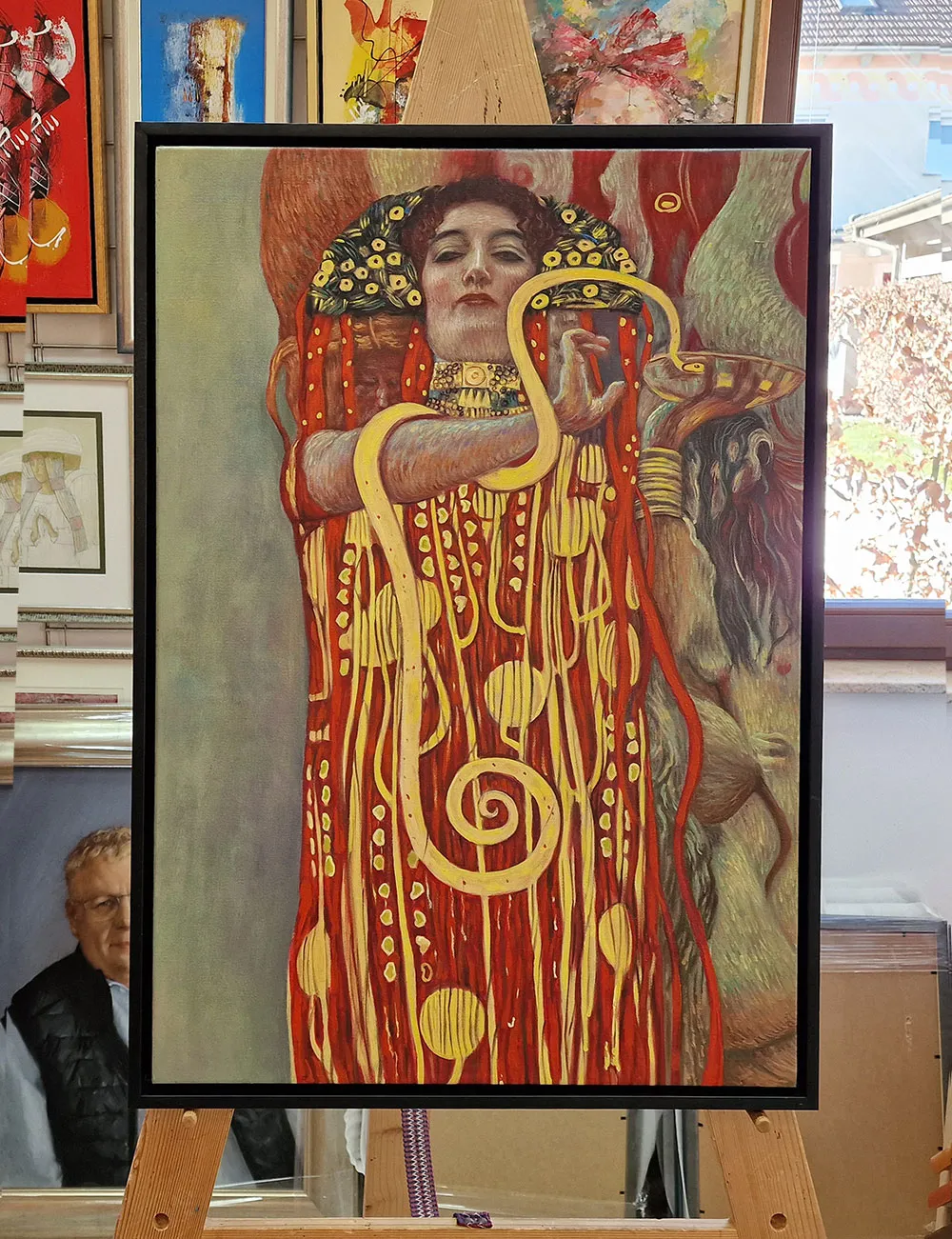
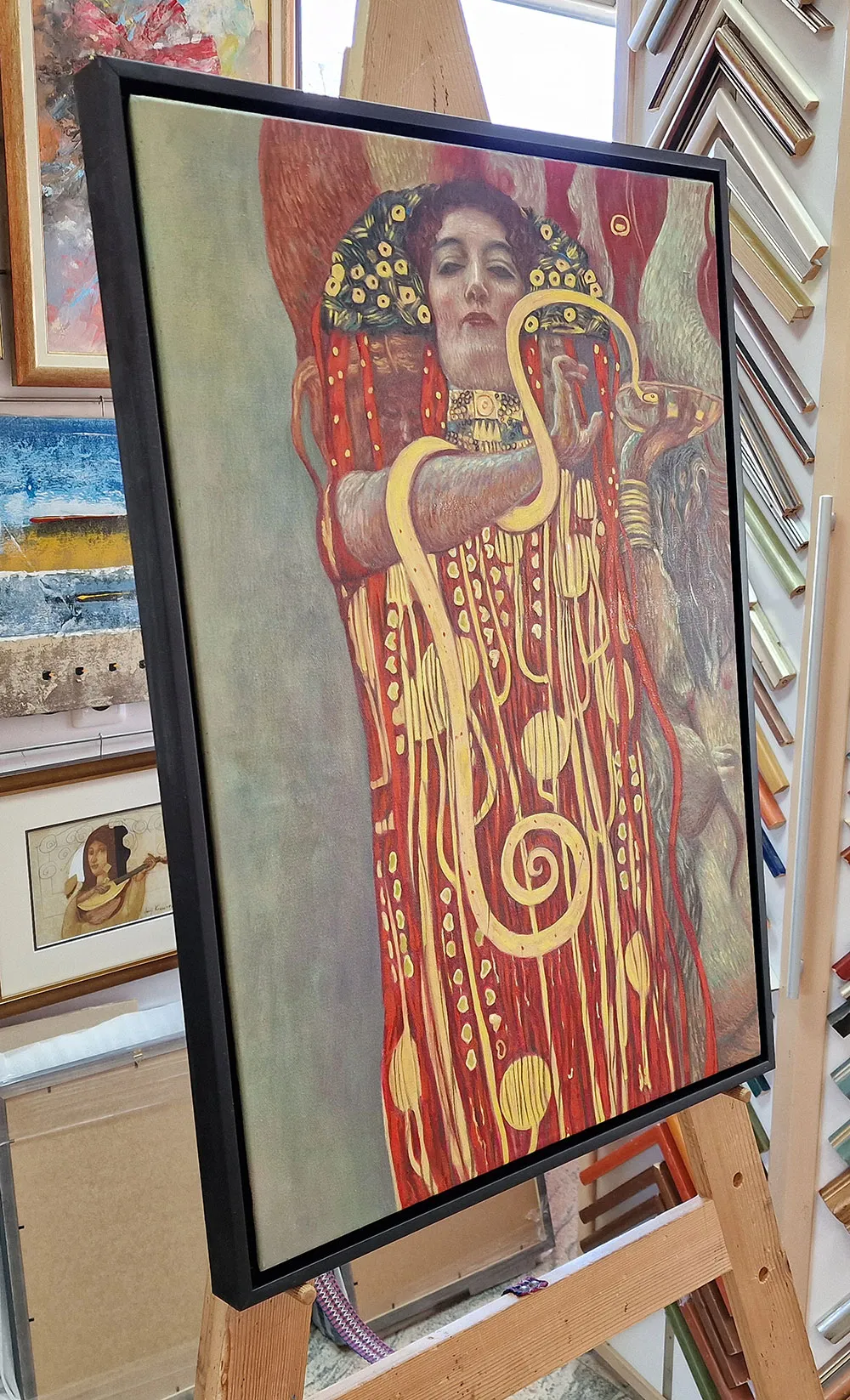
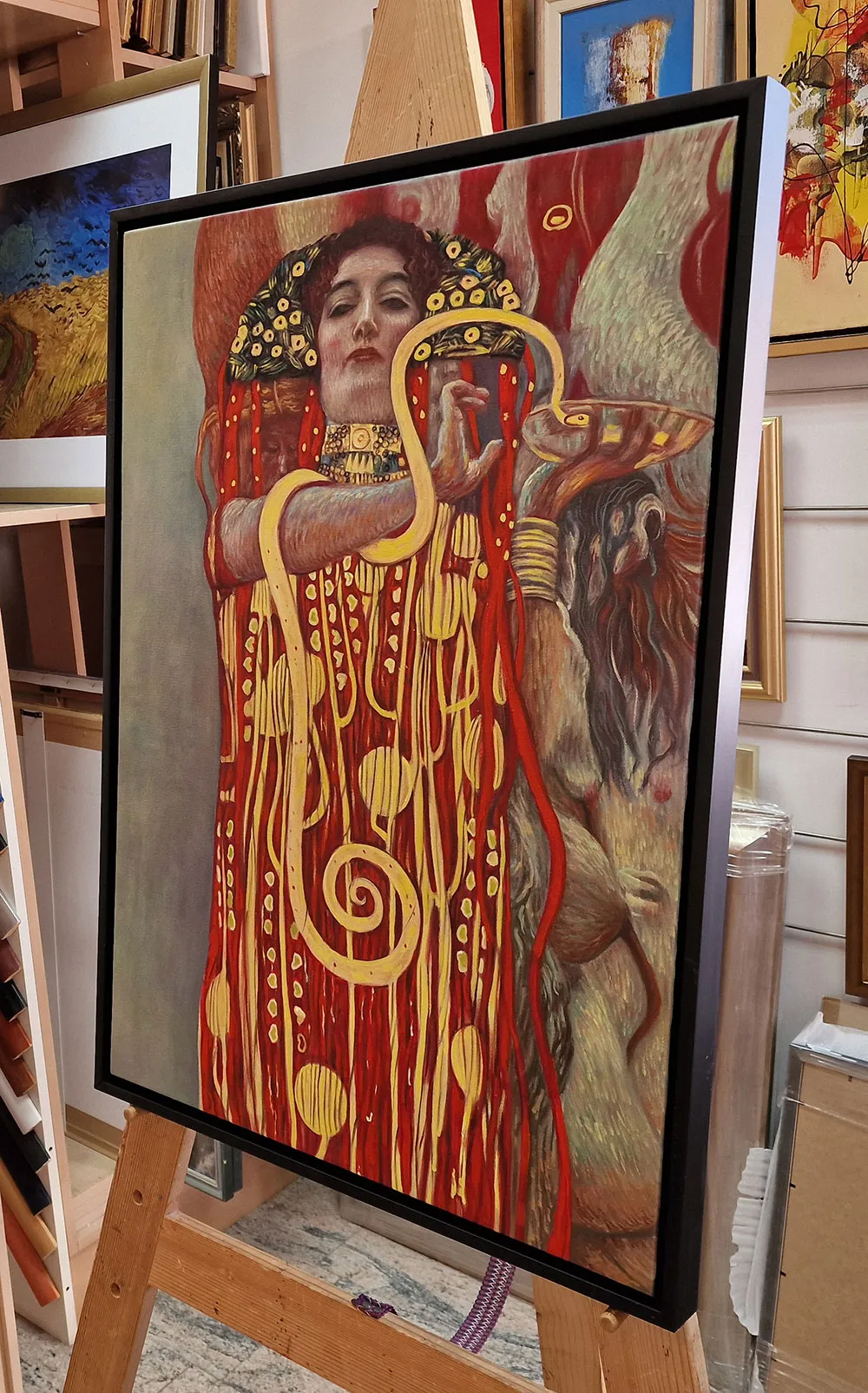
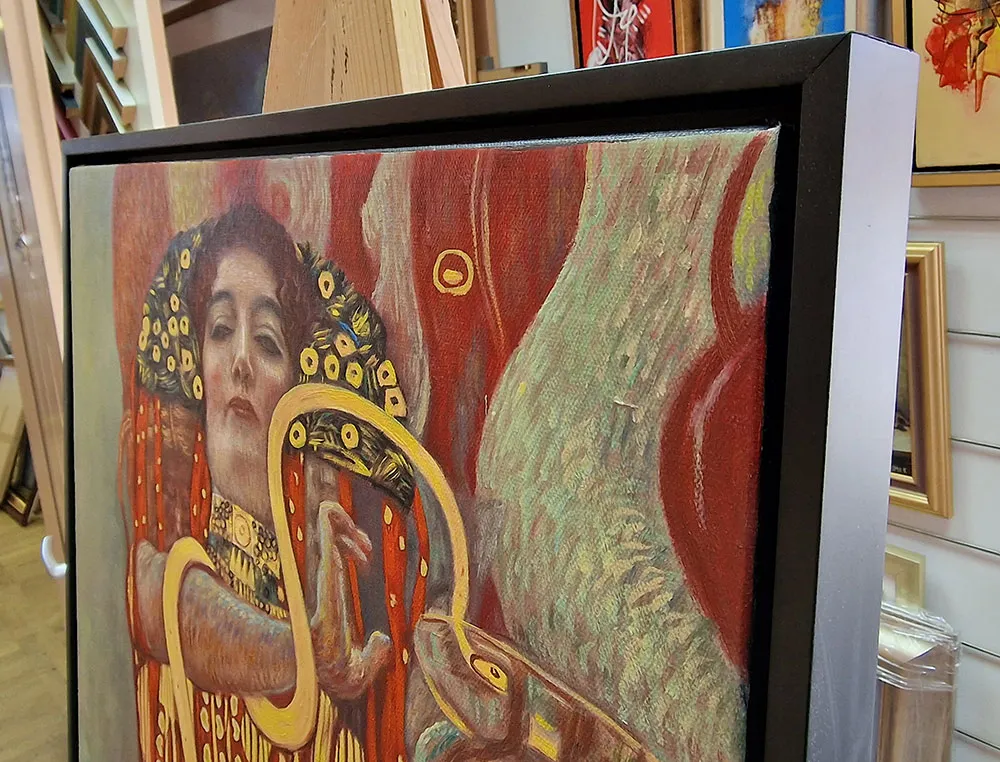
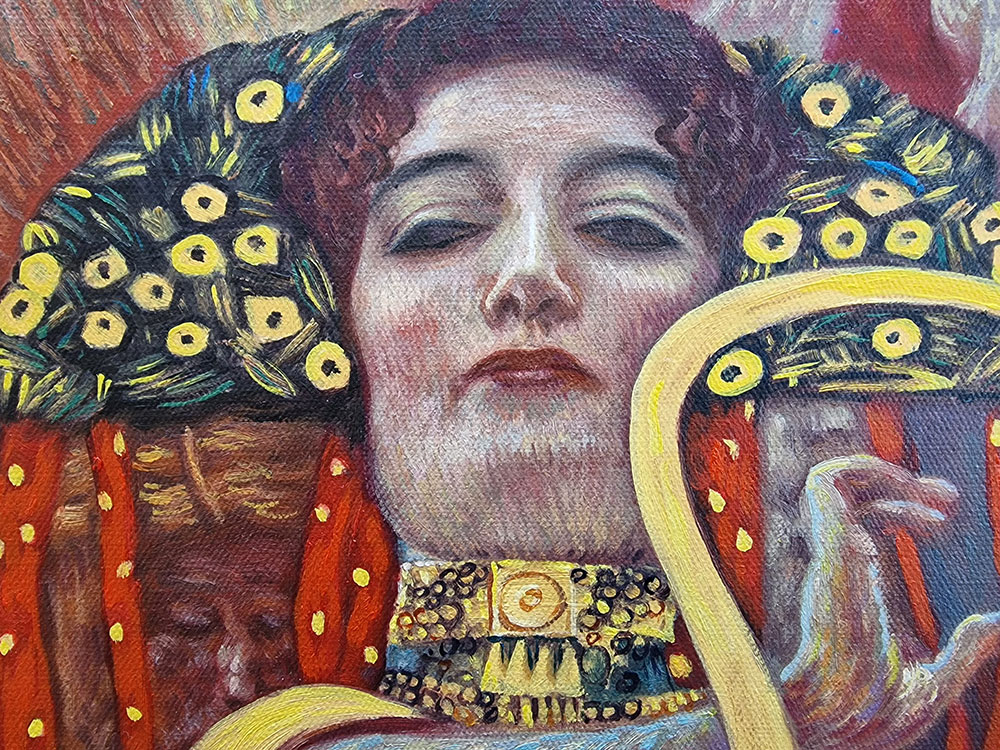
Hygieia is the Greek goddess of health whom Gustav Klimt painted at the foot of his great ceiling painting Medicine for the University of Vienna: chin raised, eyes half-closed, a golden headdress, a red robe with gold ornaments and a golden snake wound around her arm. The original burned in 1945, and only sketches and photographs survive. We paint her by hand in oil on canvas after the surviving colour reproduction, in upright sizes or to your own measurement, and send you a photograph of the finished work for approval before dispatch.
| Title: | Hygieia |
| Other titles: | Medicine (detail) · Higija · Igea · Hügieia |
| Painter: | Gustav Klimt (1862–1918) |
| Year painted: | 1900–1907 (Medicine) |
| Original size: | about 430 cm x 300 cm (the whole ceiling painting) |
| Original technique: | Oil on canvas (ceiling painting) |
| Painting style: | Vienna Secession |
| Located at: | destroyed in 1945 (Schloss Immendorf) |
| Our reproduction: | Hand-painted oil on canvas after the surviving colour reproduction, gold in gold paint |
Hygieia – Gustav Klimt
What does the painting show?
The painting is upright. A woman looks straight out of it, chin raised and eyes half-closed, as if gazing somewhere past us. She wears a golden headdress and a golden collar, and her body is covered by a red robe scattered with gold ornaments. Around her arm winds a golden snake, its head reaching towards a small cup that the goddess holds in her hand.
The background is grey-green and calm, and at the edge you can make out the outlines of other figures from the ceiling painting. It is this stillness around the figure that makes the red and the gold glow: on a wall the painting looks solemn, almost like an icon, and mysterious at the same time, because the goddess does not meet the viewer’s eye.
Who is Hygieia?
In Greek mythology Hygieia is the goddess of health, daughter of Asclepius, the god of healing. The word hygiene comes from her name. She is shown with a snake and a cup; these two signs, a snake wound around a cup, are still the emblem of pharmacies all over the world.
Klimt placed her at the very bottom edge of Medicine, as a figure standing between the viewer and everything happening above her. Around her arm is the Aesculapian snake, and in her hand a cup that descriptions of the painting call the cup of forgetting, the cup of the river Lethe.
What does the painting mean?
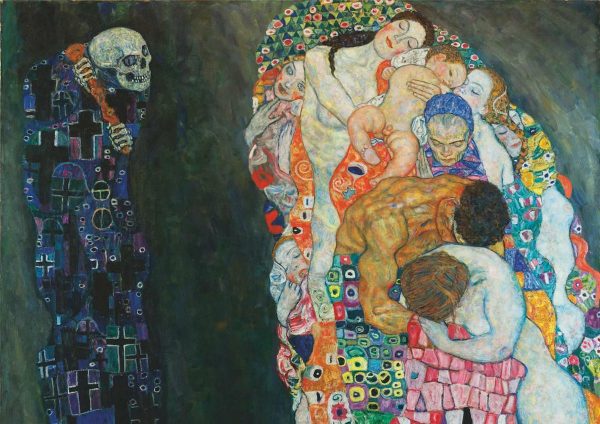
Above Hygieia, on the ceiling painting Medicine, flows a river of life: nude bodies, a young woman floating with an infant and a skeleton standing for death. Hygieia stands in front of this river but turns her back to it. Many therefore read Klimt’s idea as a bitter one: medicine cannot give mankind comfort in the face of birth, illness and death.
That is exactly why the figure is so appealing outside that setting too. On her own, without the river of bodies, she reads as a figure of strength and calm, a golden goddess watching over health. She suits a medical practice, a pharmacy or a gift for a doctor, and anywhere else she works simply through the red and the gold.
What happened to the original?
Medicine was one of the three Faculty Paintings that Klimt painted between 1900 and 1907 for the ceiling of the Great Hall of the University of Vienna; he completed Medicine in 1901. The painting measured about 430 x 300 cm. When it was exhibited it drew fierce criticism, especially from doctors, and it never reached the university ceiling.
In 1943 it was moved to Schloss Immendorf in Lower Austria. In May 1945 the castle burned down, allegedly set on fire by retreating SS units, and Medicine burned with it. Only sketches and photographs survive, among them a colour reproduction of Hygieia, which is how her colours are known today. You can read more about the painting on Wikipedia.
Hygieia among Klimt’s works
Strong female figures from myths and stories run through Klimt’s work. From the same year as Medicine comes Judith I, with gold and a self-assured gaze. Klimt also painted a Greek goddess with gold in Pallas Athena, with armour and a golden helmet. How to choose: for a calm, solemn figure choose Hygieia, for a bolder one Judith.
The flat gold and ornament you see on Hygieia Klimt developed further on the walls of the Secession building, as Beethoven Frieze I (detail) shows, and they reached their peak in The Kiss. There is more about the painter on his Wikipedia page.
How is our hand-painted version made?
The original is destroyed, so we paint Hygieia after the surviving colour reproduction, and we say so plainly. The painter first draws the figure, then paints the skin, the red robe and the grey-green background in thin layers of oil. The headdress, collar, ornaments and snake are painted by hand in gold paint with a brush; we do not use gold leaf. Each one is a hand-painted copy made for your order.
The photographs show one of our paintings in a dark floater frame; the frame is chosen separately. In the first photograph it stands on an easel in the studio, seen from the front. The second photograph shows it at an angle, and the third photograph from the other side. In the fourth photograph you see up close the corner of the frame, Hygieia’s face and the golden snake. The fifth photograph is a close-up of her face with half-closed eyes, the gold collar and the snake, where the canvas weave is visible too.
A printed oil painting reproduction cannot show the relief of the brushstrokes and the shine of gold paint that you can see and feel on the canvas.
Which size for which wall?
Short answer: for a medical practice, a hallway or a narrow wall choose 60 x 90 or 70 x 100 cm, above a chest of drawers or in a bedroom 80 x 120 cm, and for a tall wall 100 x 150 cm. The upright sizes 60 x 90, 70 x 100, 80 x 120 and 100 x 150 cm follow the proportion of the motif as you see it in the main product image.
The figure fills almost the whole canvas, so even a medium size has real presence. It brightens a waiting room, a study or an entrance. As a painting for the living room, hang it beside a sofa or above a sideboard, where you see it as you come in. The largest size suits a staircase or a tall room.
Hang it with the centre of the canvas about 150 cm above the floor; above furniture, keep the lower edge 20 to 30 cm higher.
Custom size, stretcher and frame
If you need a different size, we paint it to measure. Send us the width and height you want and we will quote a price and a lead time. Every painting we make is stretched over a wooden stretcher and ready to hang.
For the moulding, use our 3D application: it shows every one of our frame profiles on this subject, so you can compare gold, silver, black, white and natural wood before deciding – the application is for choosing the frame only. If you would like to see how the painting will look on your own wall, that is our separate room placement service. A dark floater frame, as in the photographs, makes the red and gold glow, while a gold frame adds ceremony.
Delivery and guarantee
Every painting is made to order in our studio in Slovenia, so allow 15 to 45 days depending on the size you choose. We ship it stretched and protected for transport, framed if you chose a frame, across the EU with no customs. Before dispatch you receive a photograph of the finished work to approve; if anything is not right, we correct it while the canvas is still in our workshop. Our returns policy applies to every order.
Every other Klimt work we paint is in the Gustav Klimt gallery, and there is more about the painter in our ten facts about Klimt. If the painting is a gift and you are unsure of the size, there is a wall art voucher: the recipient chooses the size and the subject.
Frequently asked questions
Where is the original Hygieia by Klimt?
The original Hygieia no longer exists. She was part of Klimt’s ceiling painting Medicine, which was moved in 1943 to Schloss Immendorf in Austria; in May 1945 the castle burned down and the painting with it. Only sketches and photographs survive, among them the colour reproduction after which we paint our copy.
Which Klimt painting is Hygieia from?
Hygieia is the figure at the foot of Medicine, one of the three Faculty Paintings Klimt made for the ceiling of the Great Hall of the University of Vienna. Above her flowed a river of life with nude bodies and a skeleton. Hygieia stands below, in red and gold, and is the best-known part of that destroyed painting.
What do the snake and the cup of Hygieia mean?
The snake and the cup are the ancient signs of Hygieia: the Aesculapian snake wound around her arm and a cup that descriptions of Klimt’s painting call the cup of forgetting, of the river Lethe. The snake with the cup is still the emblem of pharmacies. That makes the painting a fitting choice for medical practices, pharmacies and as a gift for doctors.
Why was Medicine with Hygieia so controversial?
Medicine with Hygieia drew fierce criticism when it was exhibited, especially from doctors. Instead of a triumph of science Klimt painted a river of bodies between birth and death, and Hygieia turns her back to it. Many read this as saying that medicine offers no comfort, and the painting never reached the university ceiling.
What is our Hygieia painted from if the original is destroyed?
We paint our Hygieia after the surviving colour reproduction, made before Medicine burned; we say so openly. The colours of the red robe, the gold ornaments and the grey-green background therefore follow the only colour source that exists. Before dispatch you receive a photograph of the finished work and can compare it.
Is the gold on Hygieia real gold?
On our Hygieia the headdress, collar, ornaments and snake are painted by hand in gold paint with a brush, not laid on as gold leaf. That way the gold bonds well with the oil and stays stable over the years. In the fourth and fifth photographs above you can see up close how the gold paint shines beside the red robe.
Which size of Hygieia should I choose?
For a medical practice or a narrow wall choose Hygieia in 60 x 90 or 70 x 100 cm, above a chest of drawers or in a bedroom 80 x 120 cm, and for a tall wall 100 x 150 cm. As a canvas painting it comes alive where you see it on entering: in a waiting room, a hallway or at the way into the living room.
Is Hygieia a good gift?
Yes, Hygieia is an especially fine gift for a doctor, a pharmacist, a nurse or the opening of a practice, since she is the goddess of health. Because we paint every painting individually, we can match the size to the recipient’s room, and you receive a photograph of the finished work for approval before dispatch.
Who was Hygieia in Greek mythology?
Hygieia was the Greek goddess of health and the daughter of Asclepius, the god of healing. The word hygiene comes from her name. She was shown with a snake and a cup, which became the emblem of pharmacies. Klimt painted her as a solemn, almost unapproachable figure in red and gold.
- Subject: the goddess of health with raised chin and half-closed eyes, in a red robe with gold ornaments, a golden snake around her arm.
- Original: part of the ceiling painting Medicine for the University of Vienna, completed 1901, destroyed in 1945.
- Ours: a Klimt reproduction painted by hand in oil on canvas after the surviving colour reproduction, gold in gold paint.
- Worth knowing: you receive a photograph of the finished work for approval before dispatch.