







































Description
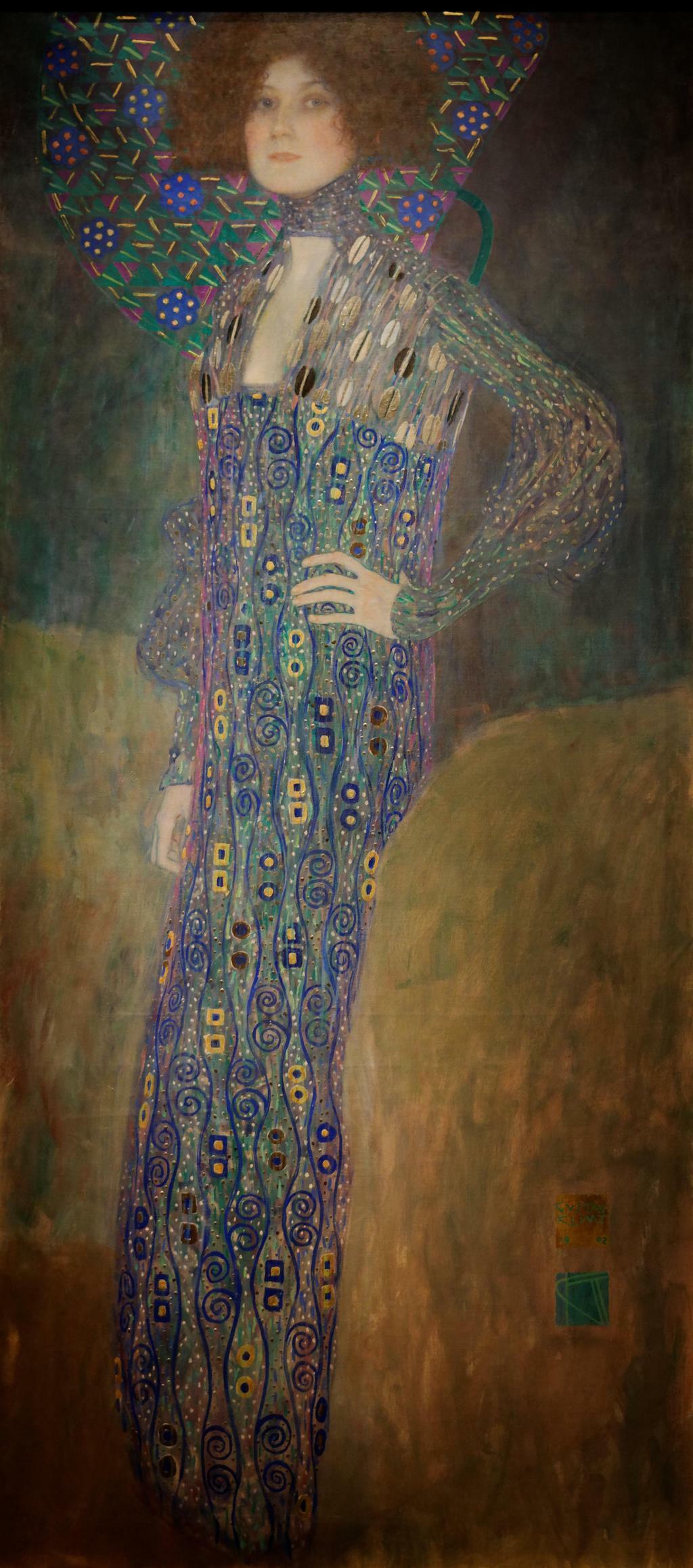
Emilie Flöge is Klimt’s portrait of 1902: a tall, slim woman in a long blue-violet dress covered in gold and green spirals, one hand on her hip, a dark ornamental wreath around her reddish hair. The life-size original, oil on canvas, belongs to the Wien Museum in Vienna. We paint it by hand in oil on canvas, in several tall sizes or made to measure, and before dispatch you receive a photograph of the finished work to approve.
| Title: | Emilie Flöge |
| Other titles: | Portrait of Emilie Flöge · Bildnis Emilie Flöge |
| Painter: | Gustav Klimt (1862–1918) |
| Year painted: | 1902, signed lower right, with the square monogram beside it |
| Original size: | 178 cm x 80 cm |
| Original technique: | Oil on canvas |
| Painting style: | Vienna Secession |
| Located at: | Wien Museum, Vienna |
| Our reproduction: | Hand-painted oil on canvas, gold accents in gold paint, tall sizes or made to measure |
Emilie Flöge – Gustav Klimt
What does the painting show?
Against a dark blue-green ground stands a tall, slim young woman, painted life-size and full-length. One hand rests on her hip, her body is turned slightly, her head is upright and her gaze rests calmly on the viewer. Her reddish-brown curly hair is pinned up high, and around her head a dark ornamental wreath opens like a halo, lifting the face away from the background and giving it an almost ceremonial air.
Most of the canvas belongs to the dress: long, close-fitting, blue-violet, scattered with gold and green spirals, circles and eye-shaped patterns. The ornament is so dense that the body beneath it almost dissolves; only the face, the hands and a narrow strip of skin at the neck stay alive. The painting is signed lower right, and beside the signature stands Klimt’s square monogram, which he liked to use as a decorative seal.
Who is the woman in the portrait?
Emilie Flöge (1874–1952) was Klimt’s close friend and lifelong companion, and one of the leading Viennese fashion designers of her day. With her sisters she ran the Schwestern Flöge fashion salon, where the ladies of Vienna’s bourgeoisie had their clothes made. Klimt never married, yet he stayed bound to Emilie all his life; he often spent his summers with the Flöge family at Lake Attersee, where many of his landscapes were painted.
Two details link this portrait to other works we paint. In 1903 Klimt gave her his painting of a pear tree, and he painted the young Mäda Primavesi in a dress designed by Emilie Flöge herself. Anyone who loves Klimt therefore sees in her not just a model but the woman who helped shape how Viennese fashion looked around 1900.
Why is the dress in the painting so special?
The portrait shows a woman and a piece of fashion at the same time. Emilie was a designer, and Klimt painted her in a dress that is more artwork than tailoring: the ornament copies no real fabric but is the painter’s own invention, a play of spirals and eyes that returns in ever richer forms during his golden period. The dress becomes a surface that holds the face and hands like a precious setting.
The tall, narrow format recalls the Japanese hanging scrolls that fascinated Viennese artists at the time. Space is almost abolished: no floor, no furniture, only the dark ground and the upright figure. That is why the portrait reads differently on a wall from the classic lady in an armchair. It tells no story; it presents a confident, modern woman who stands on her own and looks at us without shyness.
Where is the painting today, and when was it painted?
The original belongs to the Wien Museum, the museum of the city of Vienna. It hangs in the permanent exhibition Vienna. My History, on the second floor, in the section on fin-de-siècle Vienna. A word of warning when searching: some sources place it in the Kunsthistorisches Museum, the Museum of Art History, and that is wrong. To see it in person, visit the Wien Museum on Karlsplatz.
The portrait was painted in 1902, when Klimt was forty and one of the leading figures of the Vienna Secession. He was already painting in the flat planes and ornament that made him famous, but not yet with the wealth of gold that marks his best-known works a few years later. Emilie Flöge is therefore often seen as a bridge between his early, realistic portraits and the golden period.
How does this portrait differ from Klimt’s other portraits of women?
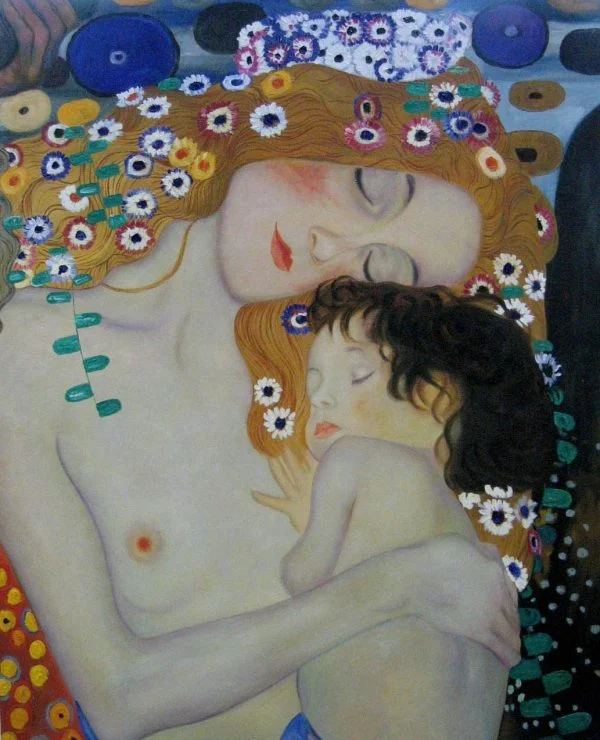
Klimt painted women above all, and on our shelf you can follow how his style changed. The Portrait of Sonja Knips is earlier and more realistic: the young woman sits in a pink dress against a soft, dark ground. The portrait of Emilie Flöge is already stylised, with a dress that turns into ornament and a strictly upright figure.
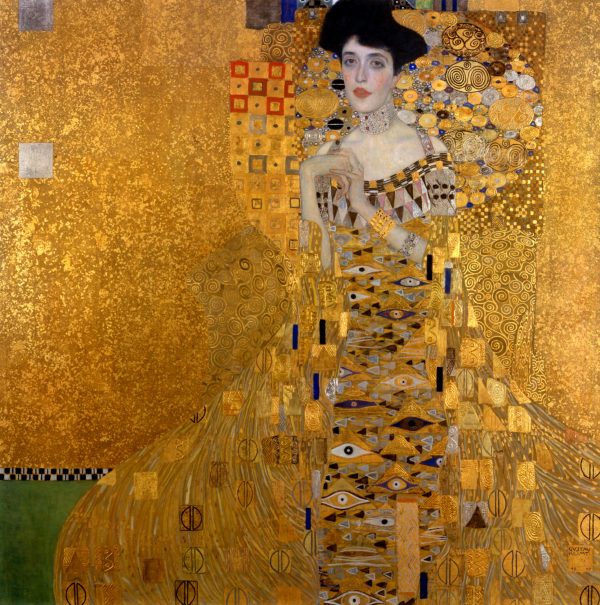
A few years later, in the Portrait of Adele Bloch-Bauer I, Klimt fused ornament with gold, and in the Portrait of Adele Bloch-Bauer II he turned back to colour. The late Portrait of Johanna Staude shows a woman in a bright blouse against a vividly coloured ground. If you are looking for a tall, elegant portrait that is not too golden, Emilie Flöge is the calmest choice among them.
How is our hand-painted version made?
The painter first draws in the figure, the face, the hands and the outline of the dress with a fine line. Face and hands are then painted softly in several layers so the skin gains warmth, and only after that come the reddish hair, the dark wreath and the deep blue-green ground. The pattern of the dress comes last: spirals, circles and eyes, one after another, with a fine brush, so the ornament stays alive and never looks mechanical.
The gold accents on the dress are not printed on our painting. We use gold paint, which the painter applies by hand with a brush, layer by layer, so the spirals and patterns catch the light softly each time it changes.
Every painting is a hand-painted copy made for your order, so no two are ever quite the same. A printed oil painting reproduction cannot show the relief of the brushstrokes and the shine of the gold paint that you can see and feel on the canvas.
Which size for which wall?
Short answer: 50 x 130 cm for most walls, 40 x 110 cm for a narrow wall between doors, beside a wardrobe or in a hallway, and 30 x 80 cm for the smallest space. With high ceilings or on the wall beside a staircase, choose 67 x 181 cm, almost the height of the original, or the larger 80 x 220 and 100 x 270 cm.
Worth knowing: the original is a little wider than our sizes, so our tall versions are slightly slimmer. On a portrait that is already tall and narrow this is hardly noticeable, but if you want the exact proportion of the original, choose made to measure in the next section. With its deep blue the painting works well in a bedroom, an entrance hall or a study. A painting for the living room should take up about two thirds of the width of the furniture below it, while a tall format fills the wall beside a window or between two cupboards nicely.
Hang it with the centre of the canvas about 150 cm above the floor, and 20 to 30 cm above a chest of drawers or a sofa.
Custom size, stretcher and frame
If you want Emilie Flöge in the proportion of the original, we paint it to measure, for example 40 x 89, 60 x 134 or 80 x 178 cm, the size of the original. Send us the width and height you want and we will quote a price and a lead time. Every painting we make is stretched over a wooden stretcher and ready to hang.
For the moulding, use our 3D application: it shows every one of our frame profiles on this subject, so you can compare gold, silver, black, white and natural wood before deciding – the application is for choosing the frame only. If you would like to see how the painting will look on your own wall, that is our separate room placement service. A slim gold or a dark wooden frame suits the deep blue well.
Delivery and guarantee
Every painting is made to order in our studio in Slovenia, so allow 15 to 45 days depending on the size you choose. We ship it stretched and protected for transport, framed if you chose a frame, across the EU with no customs. Before dispatch you receive a photograph of the finished work to approve; if anything is not right, we correct it while the canvas is still in our workshop. Our returns policy applies to every order.
Every other Klimt work we paint is in the Gustav Klimt gallery, and there is more about the painter in our ten facts about Klimt. If the painting is a gift and you are unsure of the size, there is a wall art voucher: the recipient chooses the size and the subject.
Frequently asked questions
Where does the portrait of Emilie Flöge hang?
The original belongs to the Wien Museum, the city museum of Vienna on Karlsplatz. It hangs in the permanent exhibition Vienna. My History, on the second floor, in the section on Vienna around 1900. It is not in the Kunsthistorisches Museum, as you sometimes read. On a trip to Vienna you can see it on the same day as Klimt’s works in the Belvedere.
Who was Emilie Flöge?
Emilie Flöge (1874–1952) was a Viennese fashion designer who ran the Schwestern Flöge salon with her sisters, and Klimt’s close friend and lifelong companion. Klimt spent his summers with her and her family at Lake Attersee. You can read more about the portrait and her story on Wikipedia.
When was the Emilie Flöge painting made?
The portrait dates from 1902 and is signed lower right, with Klimt’s square monogram beside the signature. Klimt was forty at the time and already painting in flat planes and ornament, but before his most golden works. The painting therefore shows the step from his early, realistic portraits to the golden period that followed a few years later.
Were Klimt and Emilie Flöge a couple?
They were close all their lives but never married, and nobody knows for certain what exactly their relationship was. Many of the letters and postcards Klimt sent her have survived. It is often said that the lovers in Klimt’s The Kiss are he and Emilie, but that has never been confirmed.
Is the gold on your Emilie Flöge real gold?
The original is oil on canvas, and the gold accents are part of the pattern on the dress. On ours we paint those accents in gold paint, which the painter applies by hand with a brush, layer by layer, so the spirals catch the light softly as it changes. That way the whole canvas painting, from the face to the last spiral on the dress, is painted by hand.
What sizes can I order Emilie Flöge in?
There are tall sizes from 30 x 80 to 100 x 270 cm, among them 40 x 110, 50 x 130 and 67 x 181 cm, which is almost the height of the original. Our sizes are a little slimmer than the original. If you want its exact proportion, we paint it to measure, for example 60 x 134 cm, and quote the price and lead time in advance.
Which room suits Emilie Flöge?
Because the painting is tall and narrow, it looks best on a narrow wall: by the entrance, in a hallway, beside the stairs or between two cupboards. In a bedroom or living room it feels elegant and calm, since the dark blue dominates. A larger size such as 67 x 181 cm beside a staircase gives the impression that a real person is standing in the room.
Is Emilie Flöge a good gift?
Yes, especially for people who love fashion, design and Vienna around 1900, since the woman in it is a fashion designer. The tall format also suits smaller homes. If you are unsure of the size, choose a wall art voucher, with which the recipient picks the size and the subject. Before dispatch you always receive a photograph of the finished painting to approve.
How long does it take to paint Emilie Flöge?
Allow 15 to 45 days depending on the size. Smaller sizes are ready sooner; the largest take the painter longer, because the pattern of the dress and the gold accents are painted by hand, layer by layer, and each layer has to dry. When the painting is finished you receive a photograph to approve, and then we ship it well protected.
- Subject: Emilie Flöge life-size, in a blue-violet dress with gold and green spirals.
- Original: 1902, 178 x 80 cm, Wien Museum, Vienna.
- Ours: a Klimt reproduction painted by hand in oil on canvas, gold accents in gold paint, in tall sizes or made to measure.
- Worth knowing: you receive a photograph of the finished work for approval before dispatch.