Description
Gold Cavalier is Klimt’s painting of 1903, also known as Life is a Struggle or The Golden Knight: a knight in golden armour and a decorated golden helmet rides a large black horse to the left, lance upright, against a dark green ground scattered with gold dots, with a band of small flowers along the bottom. The original measures 100 x 100 cm and belongs to the Aichi Prefectural Museum of Art in Nagoya, Japan. We paint it for you by hand in oil on canvas, the gold parts in gold paint, in eight square sizes from 40 x 40 to 120 x 120 cm or made to measure.
| Title: | Gold Cavalier |
| Other titles: | Life is a Struggle · The Golden Knight · Das Leben ein Kampf |
| Painter: | Gustav Klimt (1862–1918) |
| Year painted: | 1903 |
| Original size: | 100 cm x 100 cm |
| Original technique: | Oil, tempera and gold leaf on canvas |
| Painting style: | Vienna Secession, golden period |
| Located at: | Aichi Prefectural Museum of Art, Nagoya (Japan) |
| Our reproduction: | Hand-painted oil on canvas with gold paint, eight square sizes from 40 x 40 to 120 x 120 cm or made to measure |
Gold Cavalier – Gustav Klimt
What does the painting show?
The painting shows a knight riding a large black horse to the left. He is clad entirely in golden armour, wears a decorated golden helmet and holds his lance upright. The horse is powerful and dark, its mane and tail painted to look like real hair, which makes the rider in gold stand out all the more.
The background is dark green, scattered with gold dots and ornaments, and a band of small bright flowers runs along the bottom. From the left a snake peeks into the knight’s path, as if to challenge him. The square format and the dark ground give the golden rider great force: on a wall, you notice him from the doorway.
What does Dürer have to do with Gold Cavalier?
According to the museum that owns it, Klimt’s knight riding to the left is based on Albrecht Dürer’s famous print Knight, Death and the Devil. Klimt took over the upright figure of the rider and the steady horse and carried the German Renaissance scene into his own ornamental world of gold and flowers.
In Dürer’s print the knight rides past Death and the Devil; in Klimt’s painting only a snake challenges him from the edge of the canvas. That is why many people read it as the scene of a hero who rides on calmly even though something threatens him from the roadside.
What does the painting mean?
Klimt’s title, Life is a Struggle, says a lot. The knight in golden armour does not flee and does not attack; he rides calmly on, and the snake stays at the margin. Many see perseverance and courage in it, and some see Klimt himself, who in those years was often the target of critics.
So the painting is more than decoration; it is a quiet message of strength. It suits a study, an office or a living room where you want a painting with character, and it makes a fine gift for someone who is just starting something new.
Where is Gold Cavalier today, and what is its story?
Klimt first showed the painting in 1903 at the 18th exhibition of the Vienna Secession, which was a solo exhibition of his work. He painted it in oil, tempera and gold leaf on canvas, in the square size of 100 x 100 cm. It once belonged to Karl Wittgenstein, father of the philosopher Ludwig Wittgenstein.
Today it belongs to the Aichi Prefectural Museum of Art in Nagoya and is the first Klimt oil painting held by a public art museum in Japan. Older descriptions give a smaller size and oil only; the correct size is 100 x 100 cm. There is more on the painter on Wikipedia.
Gold Cavalier among Klimt’s works
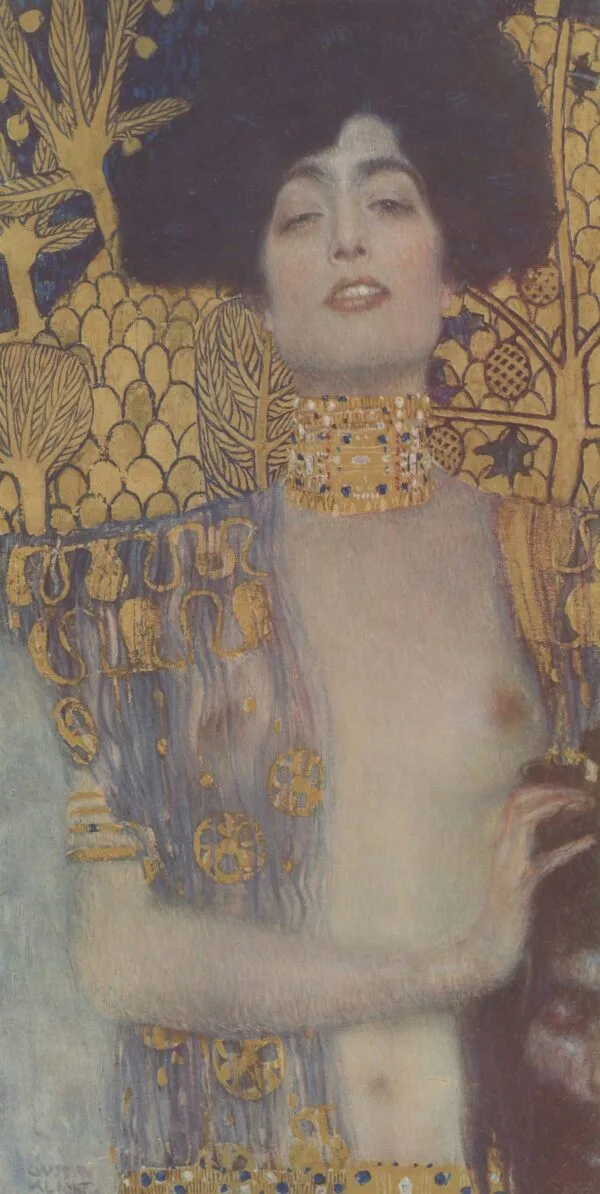
A knight in armour appears in Klimt’s work once more: in the Beethoven Frieze, which you will find with us as Beethoven Frieze I (detail). Armour and gold are also worn by the goddess in Pallas Athena, and the golden period is marked above all by Judith I and, of course, The Kiss.
Which one should you choose? Choose Gold Cavalier if you want a calm, powerful painting with gold and no love scene; The Kiss is tender and romantic, Judith I more provocative. Gold Cavalier also hangs well beside Pallas Athena, since both wear golden armour.
How is our hand-painted Gold Cavalier made?
Klimt painted the original in oil, tempera and gold leaf. Our Gold Cavalier is painted by hand in oil on canvas, and the gold parts are painted with gold paint and a brush, not laid on as leaf. The painter first draws the rider, the horse and the lance, then builds up the dark green ground and the black horse in several layers so that they gain depth.
The armour, the helmet and the gold dots come last, in a gold paint that catches the light every time you walk past. The band of flowers at the bottom is made of small dabs of red, white and blue. Every painting is a hand-painted copy made for your order, so no two are ever quite the same. A printed oil painting reproduction cannot show that glow.
Which size for which wall?
Short answer: 90 x 90, 100 x 100 or 120 x 120 cm above a sofa or bed, 60 x 60 or 70 x 70 cm above a chest of drawers or in a smaller room, and 40 x 40 or 50 x 50 cm for a narrow spot. The 100 x 100 cm size is exactly the size of the original.
There are eight square sizes: 40 x 40, 50 x 50, 60 x 60, 70 x 70, 80 x 80, 90 x 90, 100 x 100 and 120 x 120 cm. Because the rider is large and clear, even a small size works. A painting for the living room should take up about two thirds of the width of the furniture below it; above a sofa 150 cm wide, that is 100 x 100 cm.
Hang it with the centre of the canvas about 150 cm above the floor, and 20 to 30 cm above a sofa or a headboard. The dark green ground goes well with dark wood, leather and light walls.
Custom size, stretcher and frame
If none of the eight sizes fits your wall, we paint it to measure; it works best kept square, like the original. Send us the width and height you want and we will quote a price and a lead time. Every painting we make is stretched over a wooden stretcher and ready to hang.
For the moulding, use our 3D application: it shows every one of our frame profiles on this subject, so you can compare gold, silver, black, white and natural wood before deciding – the application is for choosing the frame only. If you would like to see how the painting will look on your own wall, that is our separate room placement service. Gold Cavalier looks best in a gold or dark profile that brings out the gold of the armour.
Delivery and guarantee
Every painting is made to order in our studio in Slovenia, so allow 15 to 45 days depending on the size you choose. We ship it stretched and protected for transport, framed if you chose a frame, across the EU with no customs. Before dispatch you receive a photograph of the finished work to approve; if anything is not right, we correct it while the canvas is still in our workshop. Our returns policy applies to every order.
If it is a present and you do not know the right size, there is a wall art voucher. Every other Klimt work we paint is in the Gustav Klimt gallery, and there is more on the painter in our article ten interesting facts about Gustav Klimt.
Frequently asked questions
Where is Klimt’s Gold Cavalier today?
Gold Cavalier belongs to the Aichi Prefectural Museum of Art in Nagoya, Japan. It is the first Klimt oil painting held by a public art museum in Japan. Before that it was owned, among others, by Karl Wittgenstein, father of the philosopher Ludwig Wittgenstein. If you would like it at home, we paint it for you by hand in oil.
What does Gold Cavalier (Life is a Struggle) show?
It shows a knight in golden armour and a decorated golden helmet riding a large black horse to the left, his lance upright. The ground is dark green with gold dots, a band of small flowers runs along the bottom, and a snake peeks in from the left. Klimt called the painting Life is a Struggle.
Is Klimt’s Gold Cavalier based on Dürer?
Yes, according to the museum the knight riding to the left is based on Albrecht Dürer’s famous print Knight, Death and the Devil. Klimt took over the figure of the rider and carried the scene into his ornamental style, with gold, a dark ground and a band of flowers. Instead of Death and the Devil, only a snake challenges him from the edge.
How big is the original Gold Cavalier?
The original measures 100 x 100 cm, even though some older descriptions give a smaller size. It is painted in oil, tempera and gold leaf on canvas. With us the 100 x 100 cm size matches the original, and there are smaller sizes from 40 x 40 cm as well as a larger one of 120 x 120 cm.
Is the gold on your Gold Cavalier real gold?
No, we paint the gold parts of our cavalier with gold paint and a brush, not with gold leaf as Klimt did. Gold paint bonds well with the oil, and its sheen catches the light as you move around the room. That way the painting keeps the effect of gold, stays stable and never flakes.
Is your Gold Cavalier really painted by hand?
Yes. Every cavalier we send is a canvas painting made by hand in oil, from the first drawing of the rider to the last gold dot. The brushstrokes show on the horse and in the band of flowers at the bottom. Before dispatch we send you a photograph of the finished painting so you can approve it or ask for a correction.
Which frame suits Gold Cavalier?
A gold frame suits it best, carrying on the gold of the armour, or a dark, almost black profile that brings out the dark green ground and the black horse. For a modern room a thin black frame is also handsome. You can compare every profile in our 3D application, and without a frame the canvas arrives stretched and ready to hang.
Which room suits Gold Cavalier?
It looks best in a study, an office, a living room or a hallway with enough light for the gold to shine. The dark ground sits well with dark wood, leather and light walls. Because the subject is strong and clear, hang it on a wall without too much competition, since it draws the eye on its own.
Is Gold Cavalier a good gift?
Yes, this cavalier makes an excellent gift for someone starting a new business, getting through a hard time or simply fond of history and knights. The message Life is a Struggle gives the present meaning. If you do not know the size of the wall, a voucher is the better choice. We paint to order, so order in good time.
- Subject: a knight in golden armour on a black horse, lance upright, against a dark green ground scattered with gold dots.
- Original: 1903, oil, tempera and gold leaf on canvas, 100 x 100 cm, Aichi Prefectural Museum of Art, Nagoya.
- Ours: a Klimt reproduction painted by hand in oil on canvas with gold paint, in eight square sizes or made to measure.
- Worth knowing: the 100 x 100 cm size is the size of the original, and you approve a photograph before dispatch.