







































Description
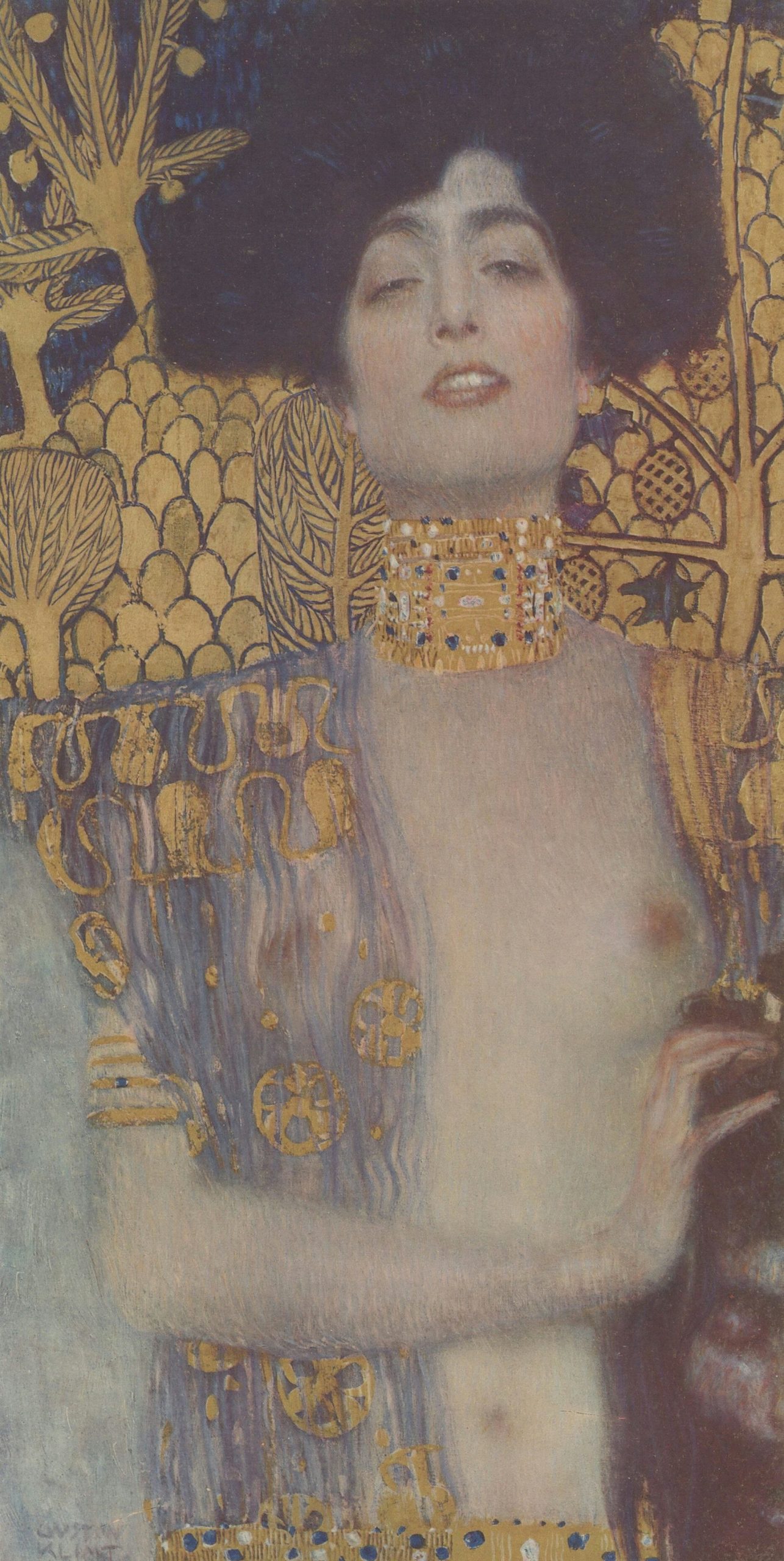
Judith I is Klimt’s painting of 1901: the biblical heroine with half-closed eyes and a broad golden choker, and at the very edge of the canvas the severed head of Holofernes. The original, oil and gold leaf on canvas, hangs in the Upper Belvedere in Vienna. We paint it by hand in oil on canvas, in three sizes or to your own measurement, and send you a photograph of the finished work for approval before dispatch.
| Title: | Judith I |
| Other titles: | Judith und Holofernes · Judith and Holofernes · Giuditta I |
| Painter: | Gustav Klimt (1862–1918) |
| Year painted: | 1901, signed lower left Gustav Klimt |
| Original size: | 84 cm x 42 cm |
| Original technique: | Oil and gold leaf on canvas |
| Painting style: | Vienna Secession, Golden Period |
| Located at: | Österreichische Galerie Belvedere, Upper Belvedere, Vienna (inv. 4737) |
| Our reproduction: | Hand-painted oil on canvas, gold in gold paint, three sizes or made to measure |
Judith I – Gustav Klimt
What is shown?
A young woman with thick dark hair looks straight at us. Her head is tilted slightly back, her eyes half closed, her lips just parted. Around her neck sits a broad golden choker set with stones, a sheer fabric with gold patterns falls over her shoulders and one breast is bare. Only on a second look do we notice, in the lower right corner and right at the edge of the canvas, a man’s head with closed eyes: Holofernes. The Belvedere notes that she holds it almost tenderly, as if to push it out of the painting.
The background is flat gold, with trees and vines reduced to ornament. Face and body are painted soft and lifelike, while everything around them is surface, pattern and metal. The original frame carries the words JUDITH UND HOLOFERNES across the top, so Klimt left no doubt about whose story he was telling.
Who was Judith, and why is she holding a head?
Judith is the heroine of a biblical story: a devout, chaste widow who, when an enemy army besieged her town, went into the enemy camp, made the commander Holofernes drunk with divine help and then cut off his head to save her people. The Belvedere points out that the story had been painted many times before.
Klimt turned it upside down. His Judith is no pious saviour but a seductive, dangerous woman looking at the viewer through half-closed eyes, while the defeated man is pushed to the edge of the canvas. The museum writes that there is no room left for the male aggressor: Klimt turned a story of resistance in a political conflict into a battle of the sexes, and Judith’s triumph into a dangerously tantalising icon of femininity.
What does the painting mean?
Most readings see Judith I as one of the first and strongest of Klimt’s femmes fatales, the fatal women who marked Viennese art around 1900. The power is no longer in the sword but in the gaze: she looks at us as the victor, and the man is little more than part of the frame. The gold is not mere decoration either; it lifts the scene out of everyday space into something almost sacred.
His contemporaries read it their own way. One critic wrote that this worldly Viennese Judith was much more Salome than Judith, which is why the painting is still often mistaken for Salome, who asked for the head of John the Baptist as her reward for dancing. The critic Ludwig Hevesi described it in 1903 as a gilded nutshell into which the artist had pressed all his imagination, like a concentrated poison in a precious ring.
Where was Judith I first shown?
Klimt first showed it in March 1901 at the tenth exhibition of the Vienna Secession, the artists’ association he had co-founded. A first description appeared only days after the opening, writing of a half-bared, delicate body strewn with gold jewellery and precious stones. The painting came just before Klimt’s Golden Period and announces it in many ways.
Today it belongs to the Österreichische Galerie Belvedere, inventory number 4737, and hangs in the Upper Belvedere, in the same building as The Kiss. It is signed lower left, Gustav Klimt.
Judith I or Judith II – what is the difference?
Klimt painted Judith twice. This painting, Judith I of 1901, is a half-length figure before a gold ground, the woman looking straight out at us, the head tucked into a corner. The other version, Judith II (Salome), followed in 1909: tall and narrow, with a completely different composition, and many people know it simply as Salome.
If you want Klimt’s gold in its most recognisable form and a face that meets your eye, choose Judith I. From the same years we also paint The Kiss, Portrait of Adele Bloch-Bauer I and Hope II.
How is our hand-painted version made?
The painter first draws in the figure, the face, the hands and the place of the head at the edge. Face and body are then painted softly in several layers so the skin gains warmth, and only after that come the dark hair, the sheer fabric and the background. The ornament comes last: the jewelled choker, the patterns of the fabric and the trees behind her.
The gold in our painting is not printed, and it is not leaf as in the original. We use gold paint, which the painter applies by hand with a brush, layer by layer, so the background and the jewellery glow in a warm gold tone.
Every painting is a hand-painted copy made for your order, so no two are ever quite the same. A printed oil painting reproduction cannot show the relief of the brushstrokes and the shine of the gold paint that you can see and feel on the canvas.
Which size for which wall?
Short answer: 70 x 80 cm for most walls, 50 x 60 cm for a narrow wall between doors or a hallway, and 60 x 70 cm in between. These are the three sizes: 50 x 60, 60 x 70 and 70 x 80 cm.
Worth knowing: the original is twice as tall as it is wide, and our three sizes are wider than that proportion, so their shape differs from the original. If you want Judith in the format Klimt painted, choose made to measure in the next section. With its gold ground the painting works well in a bedroom, a study or a well-lit hallway. A painting for the living room should take up about two thirds of the width of the furniture below it.
Hang it with the centre of the canvas about 150 cm above the floor, and 20 to 30 cm above a chest of drawers or a sofa.
Custom size, stretcher and frame
If you want Judith in the proportion of the original, one to two, we paint it to measure, for example 40 x 80 or 50 x 100 cm. Send us the width and height you want and we will quote a price and a lead time. Every painting we make is stretched over a wooden stretcher and ready to hang.
For the moulding, use our 3D application: it shows every one of our frame profiles on this subject, so you can compare gold, silver, black, white and natural wood before deciding – the application is for choosing the frame only. If you would like to see how the painting will look on your own wall, that is our separate room placement service. A warm gold or a dark wooden frame suits the gold ground well.
Delivery and guarantee
Every painting is made to order in our studio in Slovenia, so allow 15 to 45 days depending on the size you choose. We ship it stretched and protected for transport, framed if you chose a frame, across the EU with no customs. Before dispatch you receive a photograph of the finished work to approve, and our returns policy applies to every order.
Every other Klimt work we paint is in the Gustav Klimt gallery, and there is more about the painter in our ten facts about Klimt. If the painting is a gift and you are unsure of the size, there is a wall art voucher: the recipient chooses the size and the subject.
Frequently asked questions
Where does Judith I hang – in the Upper or the Lower Belvedere?
In the Upper Belvedere in Vienna, where the Österreichische Galerie Belvedere holds it under inventory number 4737. It hangs in the same palace as Klimt’s The Kiss, so you can see both in one visit. Klimt first showed it in March 1901 at the tenth exhibition of the Vienna Secession, the association he had helped to found.
What does Judith I mean?
Judith I is Klimt’s version of the biblical heroine who beheaded the enemy commander Holofernes to save her people. He turned the devout widow into a femme fatale who looks at us in triumph through half-closed eyes. The Belvedere writes that he made a story of resistance into a battle of the sexes and pushed the defeated man’s head to the very edge. More on Wikipedia.
What year is Judith I from?
Judith I dates from 1901. That is how the Belvedere dates it, and it is signed lower left, Gustav Klimt. In the same year he first exhibited it at the tenth exhibition of the Vienna Secession. It was painted several years before The Kiss and is seen as one of the first steps into his Golden Period, when he began to build real gold leaf into his canvases.
Who was the model for Judith I?
Nobody knows for certain. Older literature often names Adele Bloch-Bauer, whom Klimt later painted in his famous golden portrait, but the Belvedere points out that this idea is disputed and has never been confirmed. His contemporaries above all recognised a Viennese woman of their own day in her, not least because of a hairstyle that was in fashion at the time.
Is Judith I really Salome?
No, the painting shows Judith, as the words JUDITH UND HOLOFERNES across the top of the original frame confirm. The mix-up is old: one of the first critics wrote that this Viennese Judith was much more Salome than Judith. In the Bible, Salome asked for the head of John the Baptist as a reward for her dance, while Judith cut off the head of Holofernes herself.
Why is there so much gold in Judith I, and is the gold on your painting real?
In the original Klimt built in real gold leaf, because in his Golden Period gold lifted a painting out of the everyday into something almost sacred. On ours the gold is not leaf: we paint it with gold paint, which the painter applies by hand with a brush, layer by layer. So the whole canvas painting, including the gold ground and the jewellery, is painted by hand.
What is the difference between Judith I and Judith II?
Judith I of 1901 is a half-length figure before a gold ground, the woman looking straight at us and the head of Holofernes at the lower right edge. Judith II followed in 1909; it is tall and narrow, with a different composition, and is often called Salome. You can order both from us; choose Judith I if you want the Golden Period at its most recognisable.
In which sizes can I order Judith I?
There are three sizes: 50 x 60, 60 x 70 and 70 x 80 cm. These are wider than the proportion of the original, which is twice as tall as it is wide. If you want the shape Klimt painted, we will paint it to measure for you, for example 40 x 80 or 50 x 100 cm, and quote the price and the lead time in advance.
Which room suits Judith I?
Judith I shows best in a room with good, warm light where the gold can glow, such as a bedroom, a study or a hallway. As an upright painting it fits nicely on a narrow wall, between doors or beside a cupboard. Her gaze is strong, so give her some space around her rather than surrounding her with other paintings.
- Subject: the biblical Judith with golden jewellery and the head of Holofernes at the edge of the canvas.
- Original: 1901, 84 x 42 cm, Upper Belvedere, Vienna.
- Ours: a Klimt reproduction painted by hand in oil on canvas, gold in gold paint, in three sizes or made to measure.
- Worth knowing: you receive a photograph of the finished work for approval before dispatch.