







































Description
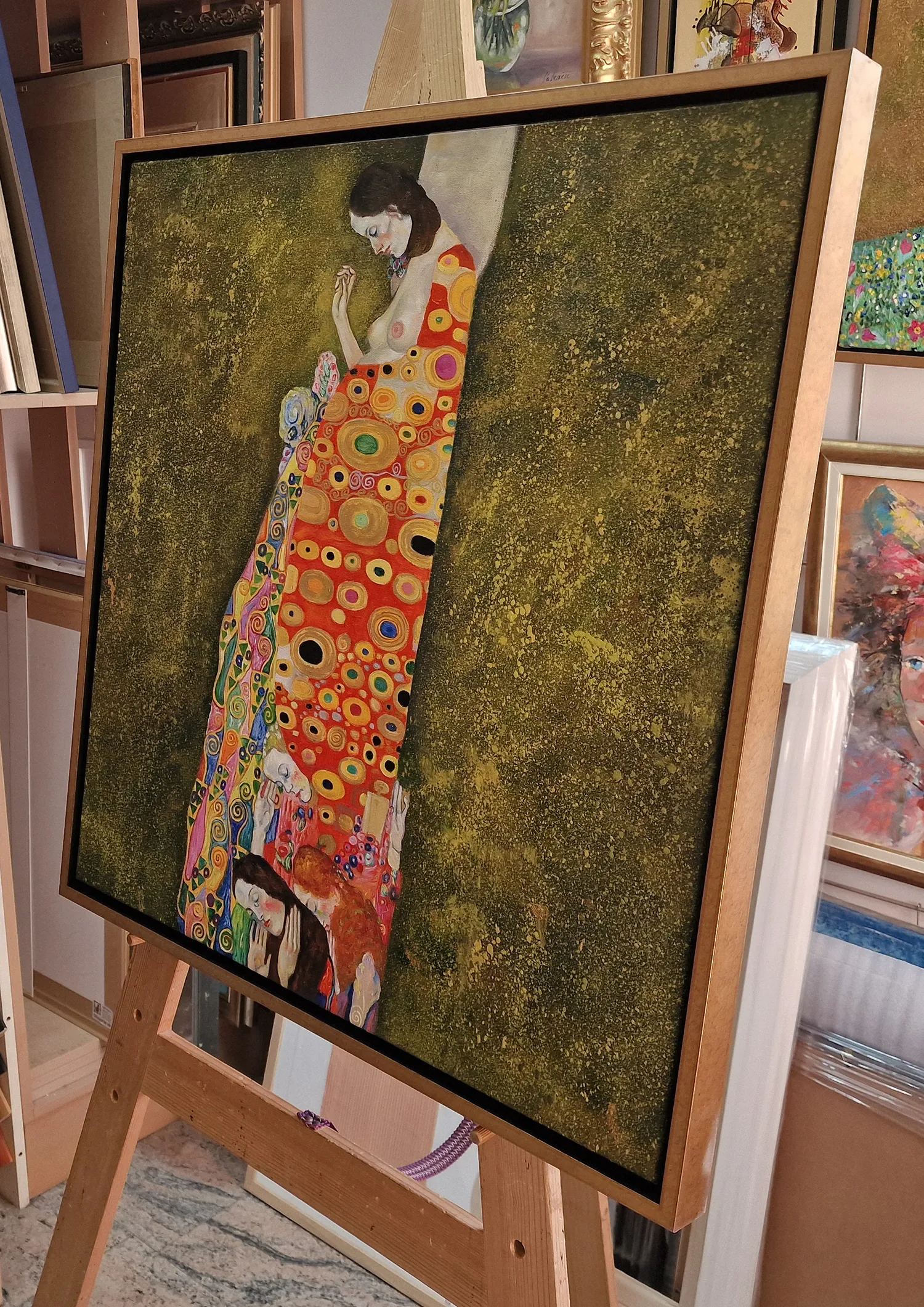
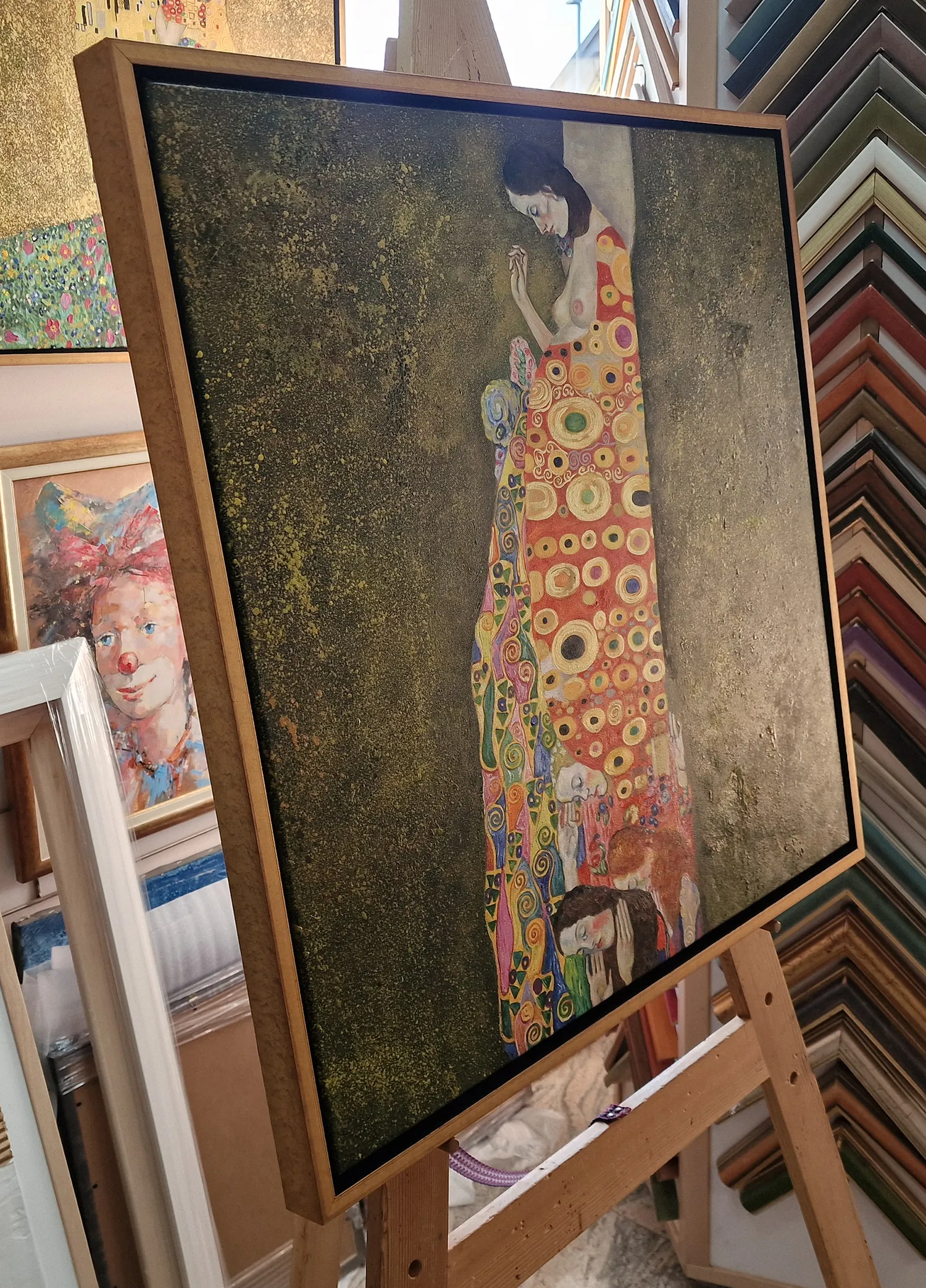
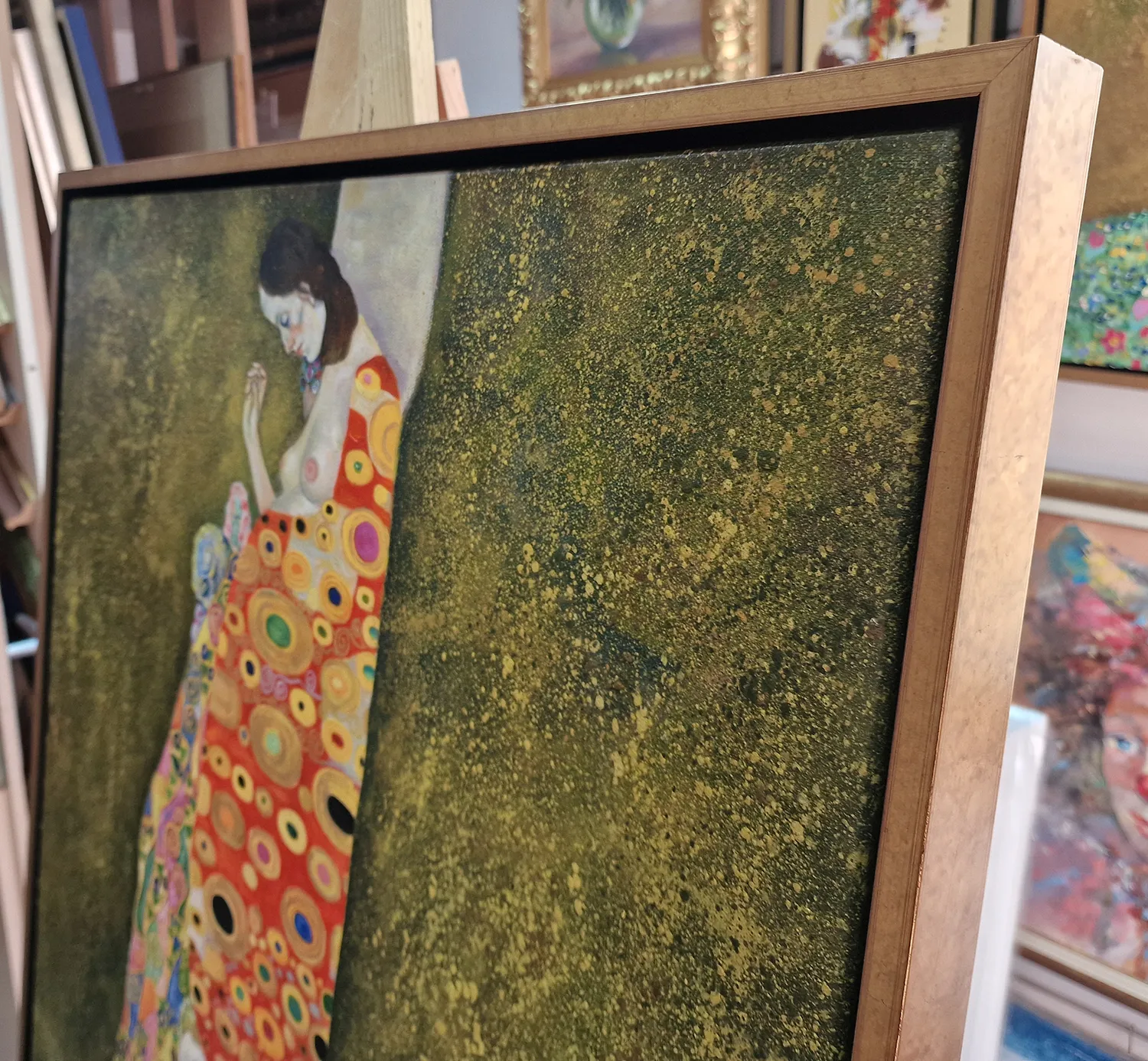
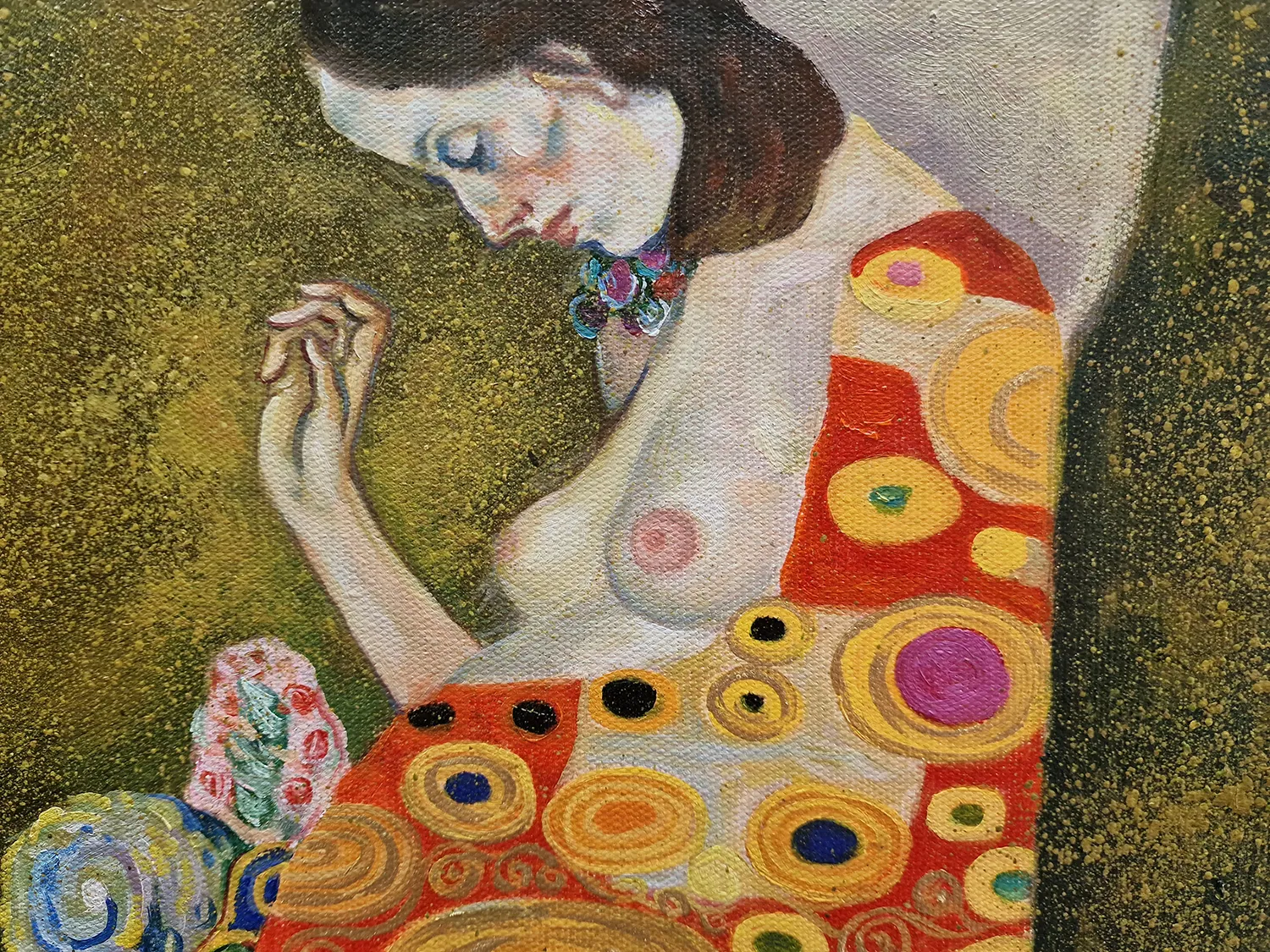
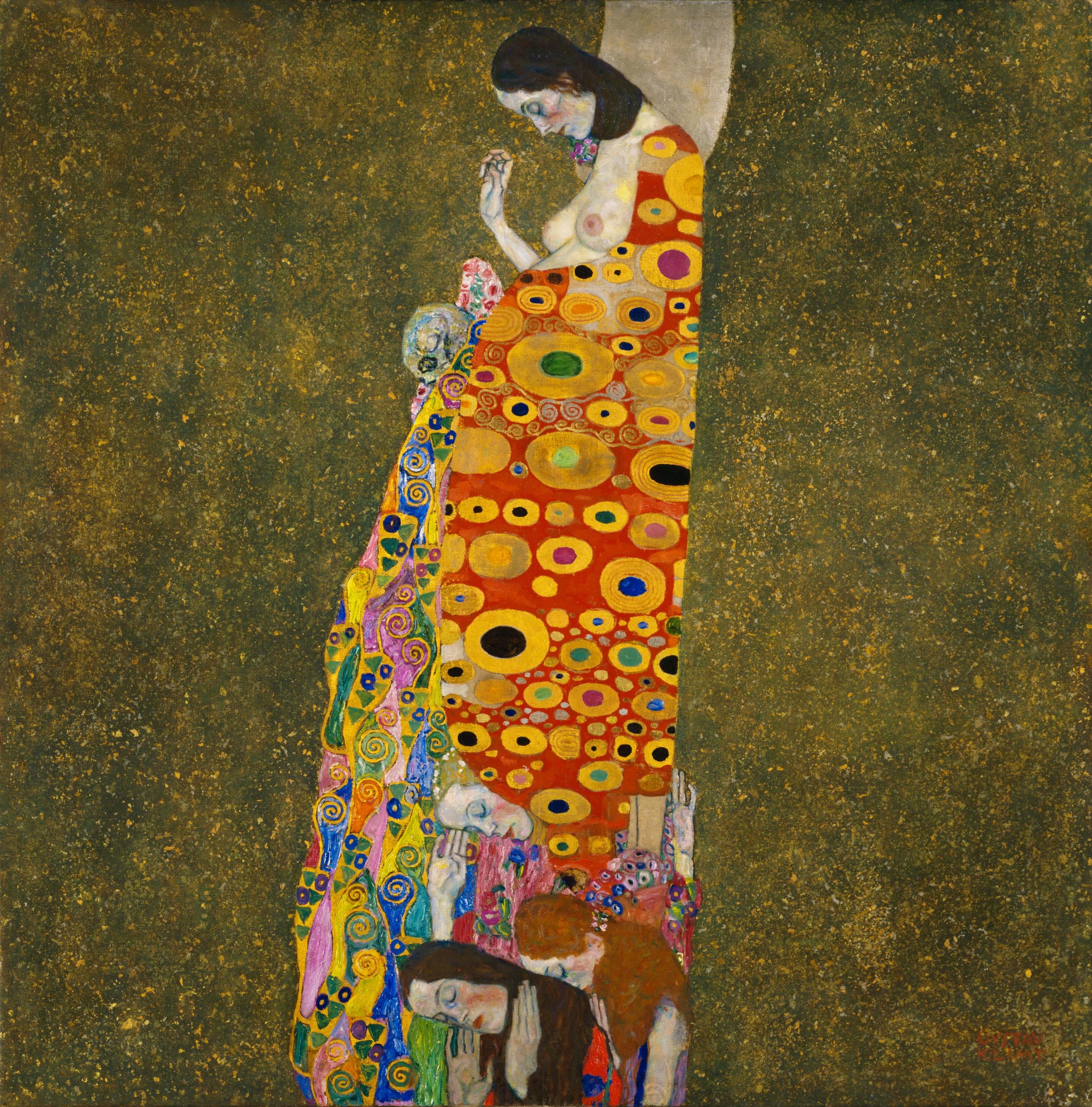
Hope II is Klimt’s painting of 1907–1908: a pregnant woman in profile, her eyes closed and head bowed, wrapped in a long robe of red, gold and coloured circles, while a death’s head peeks out from behind her belly. The original, oil, gold and platinum on canvas, belongs to The Museum of Modern Art (MoMA) in New York. We paint it by hand in oil on canvas, in eight square sizes or to your own measurement, and send you a photograph of the finished work for approval before dispatch.
| Title: | Hope II |
| Other titles: | Vision · Hoffnung II · Speranza II · Nada II |
| Painter: | Gustav Klimt (1862–1918) |
| Year painted: | 1907–1908 |
| Original size: | 110.5 cm x 110.5 cm |
| Original technique: | Oil, gold and platinum on canvas |
| Painting style: | Vienna Secession, Golden Period |
| Located at: | The Museum of Modern Art (MoMA), New York |
| Our reproduction: | Hand-painted oil on canvas with gold paint, eight sizes or made to measure |
Hope II – Gustav Klimt
What does the painting show?
In the middle of the square canvas stands a pregnant woman, seen in profile. Her eyes are closed and her head is bowed, as if she were lost in herself or in prayer. She wears a long, narrow robe that falls to the ground like a column, scattered with red, gold, blue and green circles. Beside her belly, almost hidden in the robe, a death’s head peeks out.
At her feet are three women with lowered heads who raise their hands, as if praying or mourning. Everything stands against a dark olive-green background sprinkled with tiny gold dots, so the colourful robe and the pale skin glow all the more. The canvas is square, 110.5 cm on each side.
Why is it called Hope II when Klimt called it Vision?
Klimt himself called the painting Vision. The name Hope II took hold later, through its link with his earlier painting Hope I of 1903, which also shows a pregnant woman. That is why both paintings carry the same name today and only the number tells them apart.
It is worth knowing that these are two different paintings. Hope II is square, full of gold and colourful patterns, and the woman is clothed and seen in profile. Hope I is tall and narrow, and the woman is nude and looks at us. You can order either from us.
What does the painting mean?
The painting sets life and death side by side. The pregnant woman carries a new life, while the death’s head beside her belly recalls the danger that comes with it. The three women at her feet, heads lowered and hands raised, can be read as prayer or as mourning, and Klimt does not say which.
That is exactly why the painting is called Hope: the woman with closed eyes does not look at the danger, she is absorbed in the child she is expecting. Many see in it the tenderness of motherhood, others a quiet fear of childbirth. Both are there at once, which is why people enjoy looking at it again and again.
Where is the painting today, and how did it get there?
Hope II is today in The Museum of Modern Art (MoMA) in New York. The museum acquired it with funds from Jo Carole and Ronald S. Lauder, the Helen Acheson Funds and Serge Sabarsky. It is one of the best-known works by Klimt in American museums.
It was painted in 1907 and 1908, in the same years as The Kiss, at the height of Klimt’s Golden Period. Klimt then applied gold and platinum directly to the canvas, which is why the original shines differently from ordinary oil paint.
Hope II among Klimt’s works
Klimt had painted a pregnant woman before, in Hope I of 1903. How do you choose between them? Choose Hope II if you want a square painting with gold and colourful patterns for the wall above a sofa or a bed; choose Hope I if you are looking for a tall, narrow painting of a nude pregnant woman for a narrow wall.
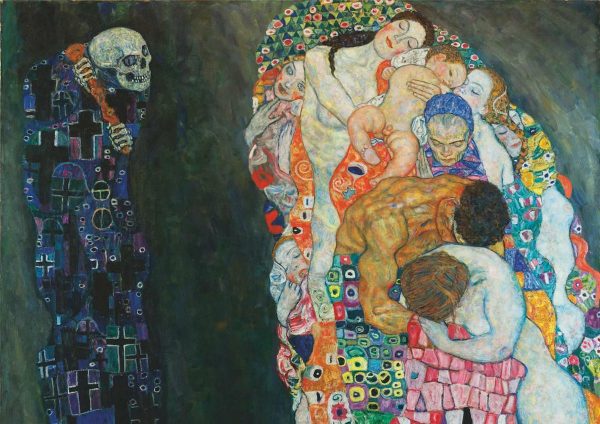
Motherhood and the stages of life are a constant theme for Klimt. In The Three Ages of Woman a child, a mother and an old woman stand side by side, and the mother with her child is also a painting of its own in our gallery, Mother and Child (detail). For a comparison with the best-known work of the Golden Period, see The Kiss as well.
How is our hand-painted version made?
The painter first draws the figure of the woman, her face, her hands and the three women at her feet in thin lines. Then he paints the skin, softly and in several layers, then the robe with its hundreds of circles, and only at the end the dark ground with its small dots.
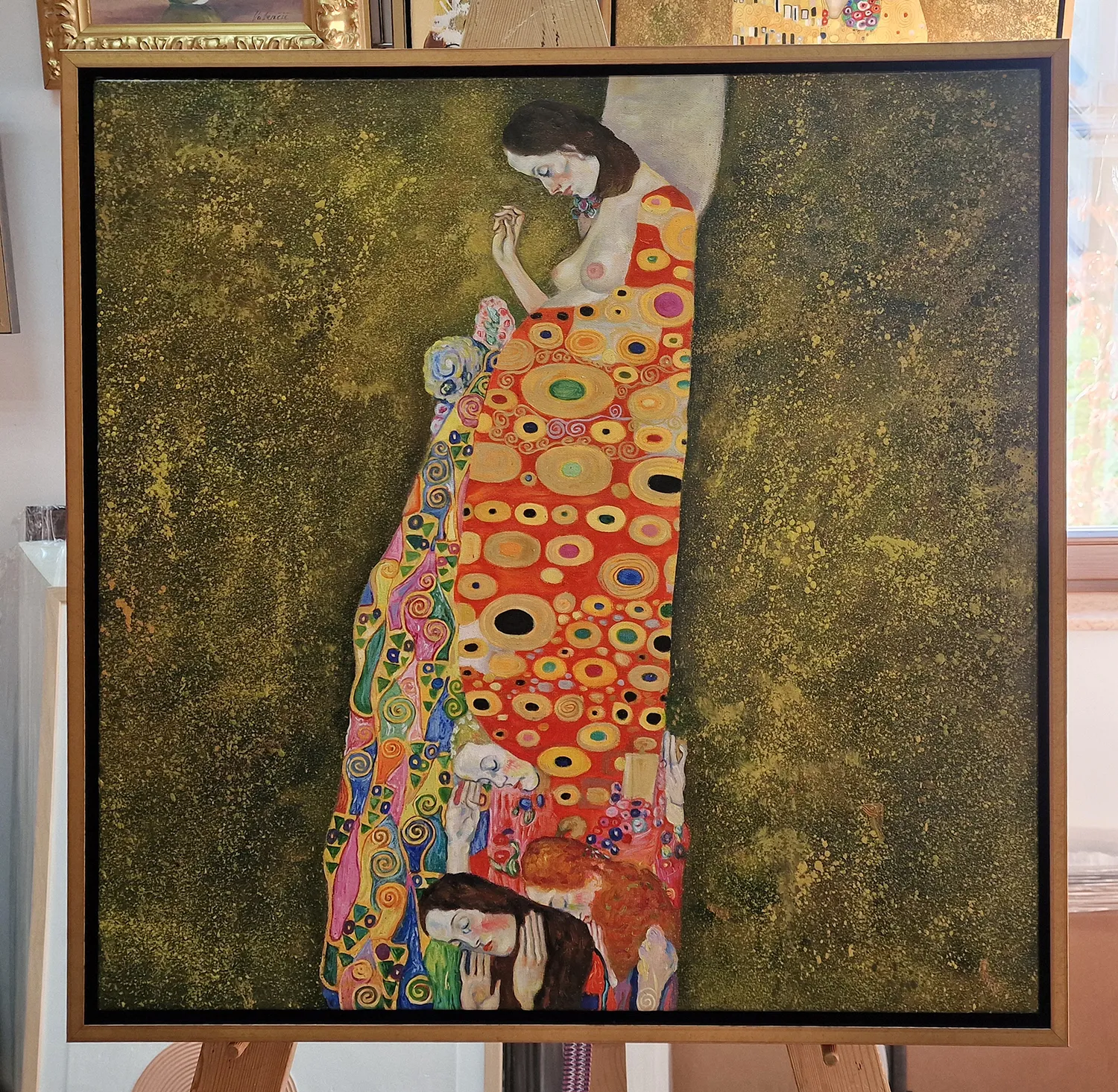
The gold on our painting is not printed and is not gold leaf as on the original. We use gold paint that the painter applies by hand with a brush, circle by circle and dot by dot, so the robe and the background glow in a warm golden tone.
The photographs at the top of the page show a copy we have painted. The first photograph shows the copy in a light wooden floater frame on an easel in our studio, from the front. The second photograph shows it at an angle, and the third photograph from the other side, among frame samples. The fourth photograph is a close view of the frame corner and the woman’s bowed head. The fifth photograph shows her face up close, with closed eyes, her hands and the patterned robe; the canvas weave is visible too.
Every painting is a hand-painted copy made for your order, so no two are ever quite the same. A printed oil painting reproduction cannot show the relief of the brushstrokes and the shine of the gold paint that you can see and feel on the canvas.
Which size for which wall?
Short answer: 100 x 100 cm for most walls, 120 x 120 or 150 x 150 cm above a large sofa or a double bed, and 60 x 60 or 70 x 70 cm for a smaller wall. There are eight square sizes: 50 x 50, 60 x 60, 70 x 70, 80 x 80, 90 x 90, 100 x 100, 120 x 120 and 150 x 150 cm.
All of them are square, like the original, which measures 110.5 cm on each side. It looks lovely in a bedroom, where it is quiet, and in a living room with warm light. A painting for the living room should take up about two thirds of the width of the furniture below it.
Hang it with the centre of the canvas about 150 cm above the floor, and 20 to 30 cm above a bed, a chest of drawers or a sofa.
Custom size, stretcher and frame
If you need a different size, for example one that fits a particular wall exactly, we paint it to measure. Send us the width and height you want and we will quote a price and a lead time. Every painting we make is stretched over a wooden stretcher and ready to hang.
For the moulding, use our 3D application: it shows every one of our frame profiles on this subject, so you can compare gold, silver, black, white and natural wood before deciding – the application is for choosing the frame only. If you would like to see how the painting will look on your own wall, that is our separate room placement service. A light wooden frame, like the one in the photographs above, brings out the gold, but the painting also looks good unframed.
Delivery and guarantee
Every painting is made to order in our studio in Slovenia, so allow 15 to 45 days depending on the size you choose. We ship it stretched and protected for transport, framed if you chose a frame, across the EU with no customs. Before dispatch you receive a photograph of the finished work to approve, and our returns policy applies to every order.
Every other Klimt work we paint is in the Gustav Klimt gallery, and there is more about the painter in our ten facts about Klimt. If the painting is a gift and you are unsure of the size, there is a wall art voucher: the recipient chooses the size and the subject.
Frequently asked questions
Where is Klimt’s Hope II today?
Klimt’s Hope II is in The Museum of Modern Art (MoMA) in New York. The museum acquired it with funds from Jo Carole and Ronald S. Lauder, the Helen Acheson Funds and Serge Sabarsky. If you visit New York, you can see it in person. We paint it by hand in oil on canvas, in eight square sizes or to your own measurement.
What does Hope II by Klimt mean?
Hope II sets life and death side by side. The pregnant woman with closed eyes carries a new life, the death’s head beside her belly recalls the danger, and the three women at her feet pray or mourn. The name Hope tells you what wins: trust in the child that is coming. More about the painting on Wikipedia.
Why is it called Hope II if Klimt called it Vision?
Klimt himself called Hope II Vision. The name Hope II took hold because the painting was linked with his earlier work Hope I of 1903, which also shows a pregnant woman. That is why both carry the same name today, told apart by the number and by their very different look.
What is the difference between Hope I and Hope II?
Hope II is a square painting of 1907–1908, full of gold, with a clothed woman in profile and three women at her feet. Hope I dates from 1903, is tall and narrow, and shows a nude pregnant woman who looks at us, with dark figures behind her. Hope II is calmer and more ornamental, Hope I more direct.
Who are the three women at the feet in Hope II?
The three women at the feet in Hope II have lowered heads and raised hands. They can be read as women in prayer or as women in mourning, and Klimt does not explain it. That ambiguity gives the painting its tension: beside the pregnant woman, hope and fear are present at the same time, underlined by the death’s head at her belly.
Is the gold on your Hope II real gold?
The gold on our Hope II is gold paint that the painter applies by hand with a brush, not real gold leaf. The original has gold and platinum applied to the canvas. The gold paint captures the warm shine of the original well and does not flake over the years. You see the shine best in warm light or in daylight from the side.
In which sizes can I order Hope II?
You can order Hope II in eight square sizes, from 50 x 50 to 150 x 150 cm. The original measures 110.5 cm on each side, so 120 x 120 cm comes closest to it. If you need a size for a particular wall, we paint it to measure and quote the price and the lead time in advance.
Which room suits Hope II?
Hope II suits a bedroom well, where its calm subject and the woman’s closed eyes create a quiet mood. As a canvas painting with gold it also works in a living room or a study with warm light. Because of its dark background it likes a lighter wall, on which the colourful robe and the gold dots glow even more.
Is Hope II a good gift?
Yes, Hope II makes a lovely gift, for example for a couple expecting a child or for someone who loves Klimt’s Golden Period. The subject is tender and calm, and the gold gives it a festive touch. Because we paint every painting individually, we can match the size to the recipient’s wall, and you receive a photograph of the finished work before dispatch.
- Subject: a pregnant woman in profile in a robe of gold and coloured circles, three women at her feet.
- Original: 1907–1908, 110.5 x 110.5 cm, MoMA, New York.
- Ours: a Klimt reproduction painted by hand in oil on canvas with gold paint, in eight sizes or made to measure.
- Worth knowing: you receive a photograph of the finished work for approval before dispatch.