







































Description
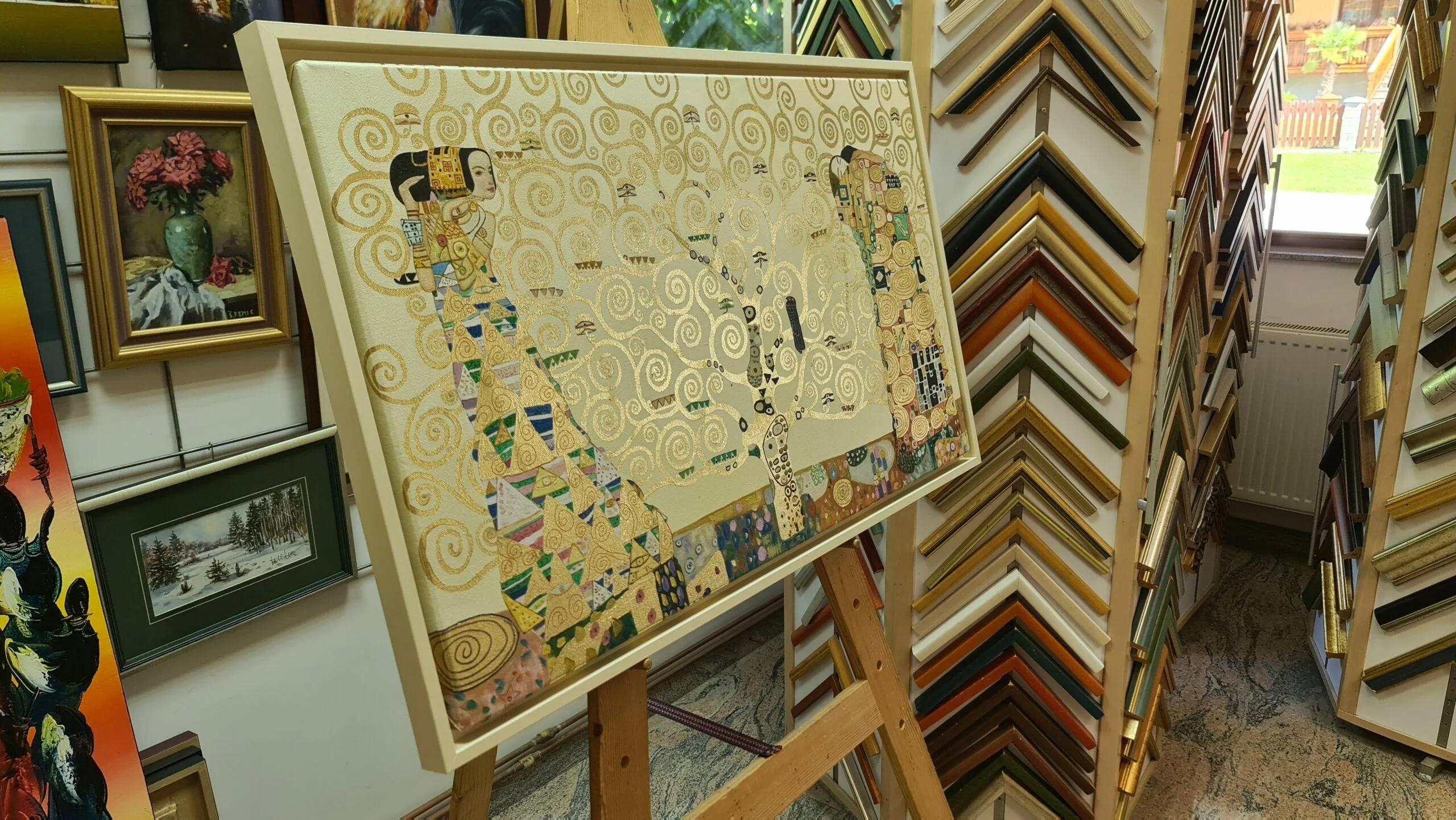


Tree of Life is the best-known motif of Gustav Klimt’s Stoclet Frieze: a tree whose branches roll into golden spirals, with the figure of Expectation on the left and the embracing couple of Fulfilment on the right. Klimt drew it in 1910–1911 for a mosaic in the dining room of the Palais Stoclet in Brussels, and his working drawings are kept by the MAK in Vienna. We paint the whole design by hand in oil on canvas, the spirals in gold paint, in eight wide sizes from 90 x 50 to 250 x 130 cm or to your own measurement, and send you a photograph of the finished work for approval before dispatch.
| Title: | Tree of Life |
| Other titles: | The Tree of Life · Stoclet Frieze · Expectation and Fulfilment · L’albero della vita |
| Painter: | Gustav Klimt (1862–1918) |
| Year painted: | 1905–1911 (working drawings 1910–1911) |
| Original size: | 195.2 cm x 93.8 cm (one working drawing, part 7) |
| Original technique: | Working drawings on tracing paper: graphite, gold, pastel, metal, platinum, silver, bronze, appliqué and gouache |
| Painting style: | Vienna Secession, Golden Period |
| Located at: | MAK – Museum of Applied Arts, Vienna (working drawings) · mosaic: Palais Stoclet, Brussels |
| Our reproduction: | Hand-painted oil on canvas after the working drawings, the spirals in gold paint applied by hand, eight wide sizes or made to measure |
Tree of Life – Gustav Klimt
What does the painting show?
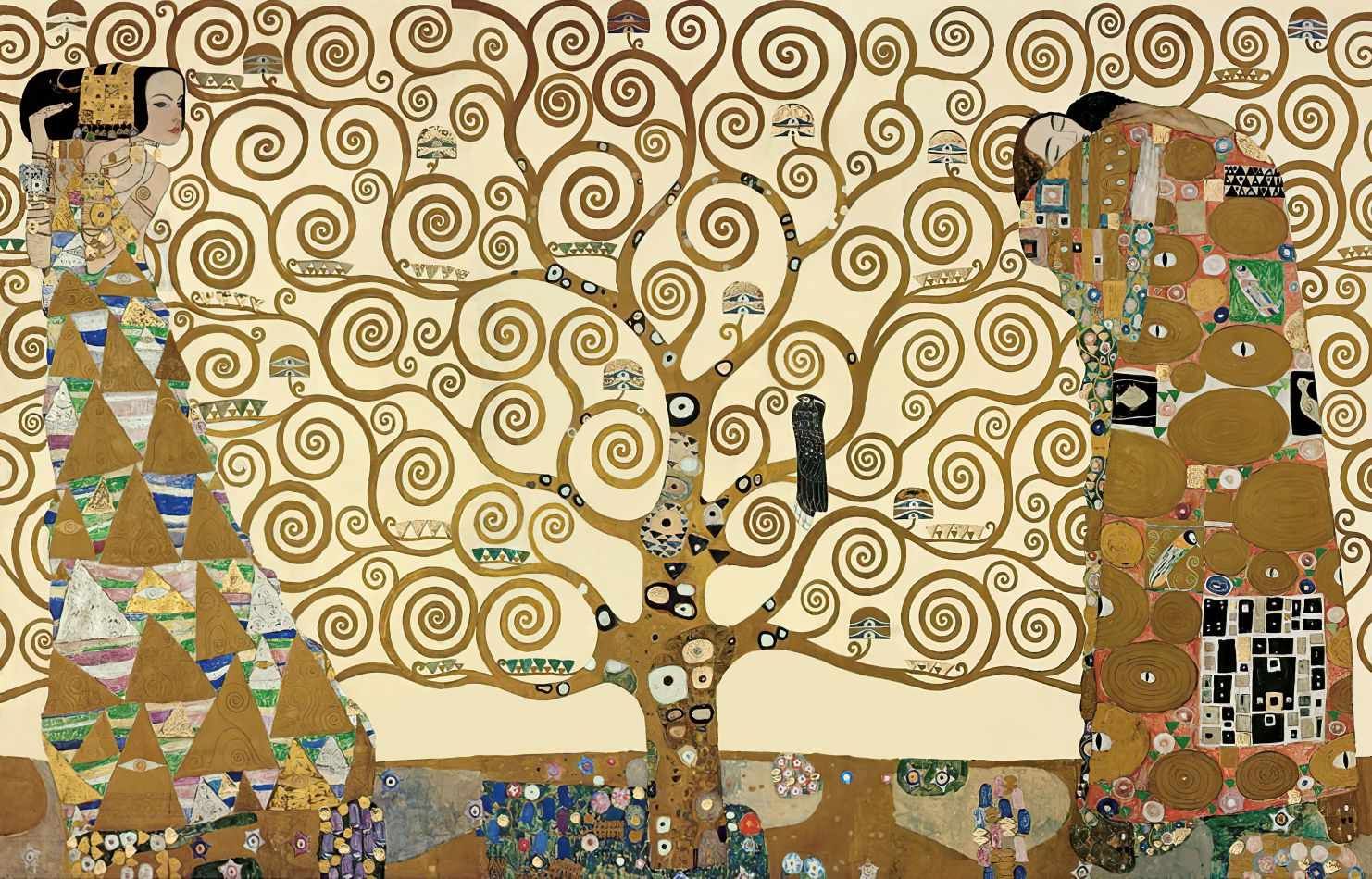
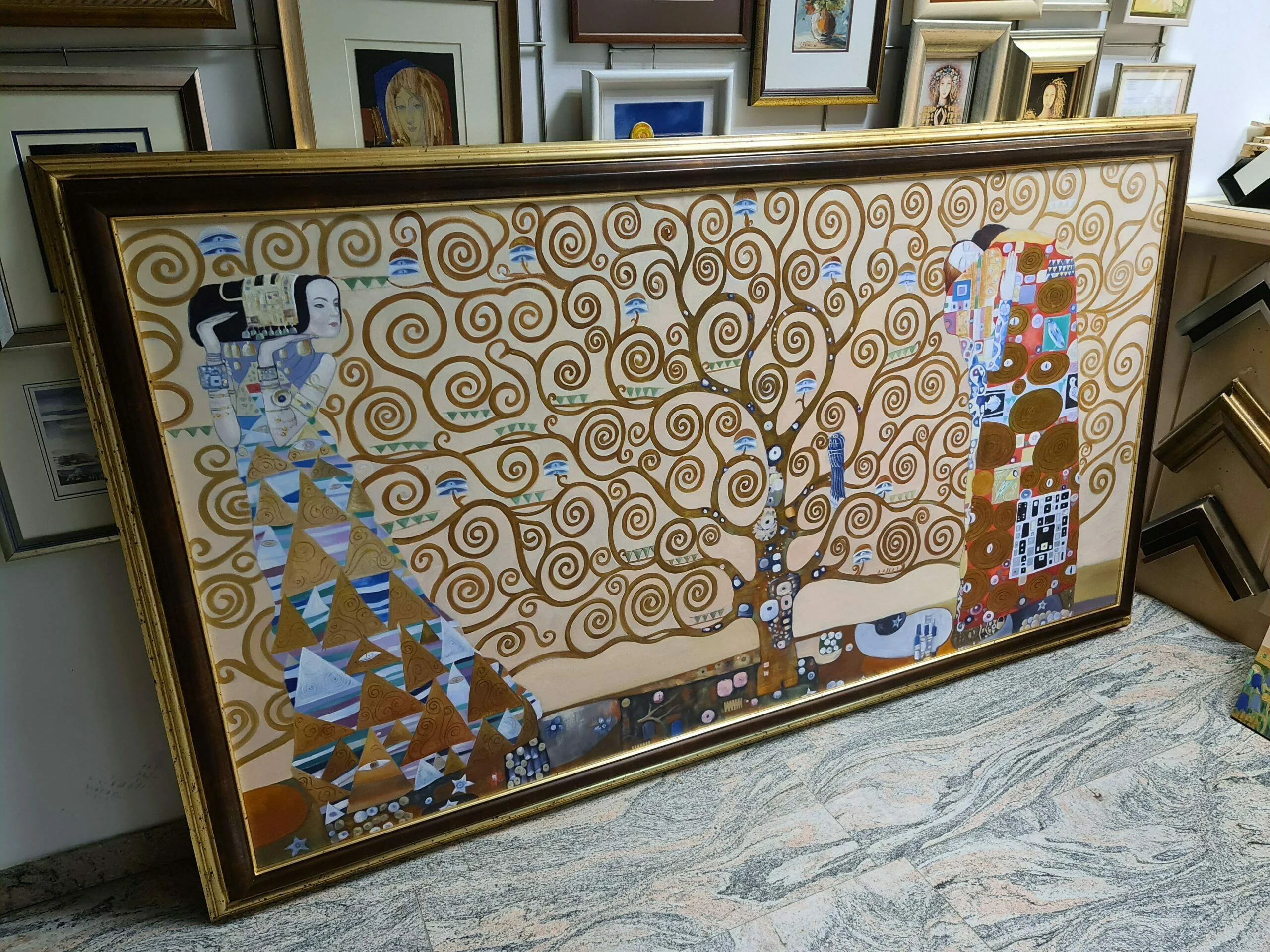
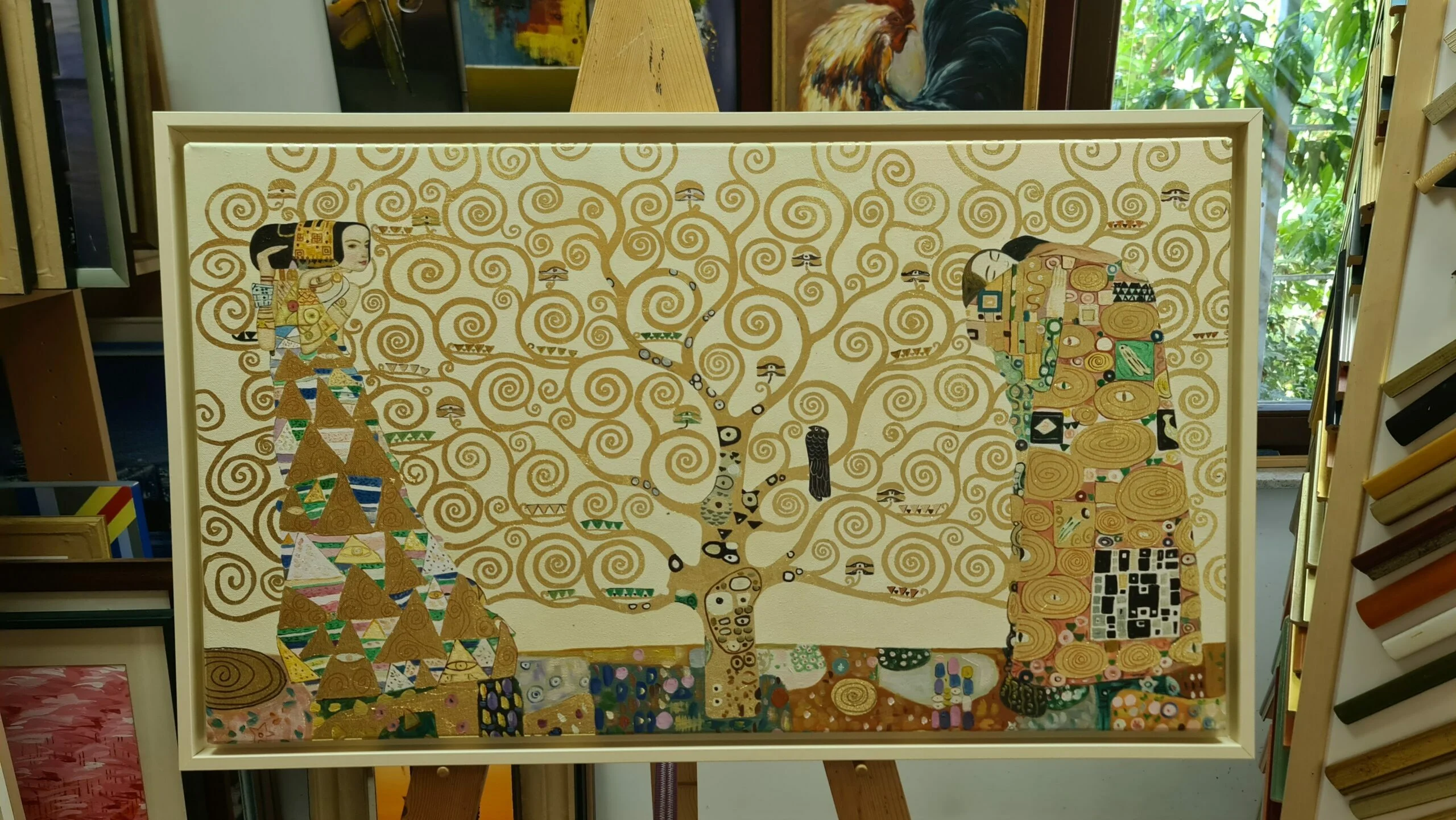
A single tree stands on a pale golden ground. Its trunk is short and thick, and its branches do not end in leaves: they roll up into dozens of spirals that fill the whole width of the canvas. Eye-shaped and triangular ornaments sit on the trunk, small green leaves grow between the curls, and a band of flowers runs along the foot of the tree. High in the branches on the right sits a black bird.
On the left stands a slender woman in profile, her arms raised and bent at sharp angles, wrapped in a long robe covered with triangles: this is Expectation, also called the Dancer. On the right a couple stands in a close embrace; the man is seen from behind in a patterned cloak, and the woman rests her face on his shoulder: this is Fulfilment. The tree joins them, and the spirals carry the eye from one side to the other.
Where is the original: Brussels or Vienna?
Both. The finished work is a mosaic on the walls of the dining room of the Palais Stoclet in Brussels, a house the architect Josef Hoffmann built between 1905 and 1911 for the industrialist Adolphe Stoclet. The house is still privately owned and is not open to visitors; it was inscribed on the UNESCO World Heritage list in 2009.
The drawings from which the mosaic was made are in Vienna. Klimt drew nine full-size working drawings, or cartoons, for the walls, and today they belong to the MAK, Vienna’s Museum of Applied Arts. One of them, part 7 of the tree of life, is 195.2 cm high and 93.8 cm wide, drawn on tracing paper with graphite, gold, pastel, metal, platinum, silver, bronze, appliqué and gouache; the museum bought it in 1961. It is on show in the permanent collection “Vienna 1900”.
What do the tree, the spirals and the two figures mean?
The tree of life is one of the oldest symbols: roots in the earth, branches in the sky, joining the two, and life with death. Klimt keeps that meaning but turns it into ornament. The spirals are branches that never stop growing, turning inwards and then out again, so the whole wall seems to move.
The black bird among the spirals is often read as a sign of death. The two figures complete the story. Expectation waits alone; Fulfilment is two people so close that their bodies merge into one shape. In the dining room in Brussels they face each other across the room.
How did the Stoclet Frieze come about?
Adolphe Stoclet wanted a complete work of art: Josef Hoffmann designed the house, the Wiener Werkstätte made its furnishings, and Klimt was given the dining room. Between 1905 and 1911 he developed a frieze in three parts: a tree of life on each long wall, Expectation and Fulfilment facing each other, and an abstract figure, the Knight, on the narrow end wall.
Klimt did not set a single stone himself. He drew the cartoons at full size and wrote instructions on them for the craftsmen, who were to carry out the mosaic in the finest materials, such as enamel, mother-of-pearl and gold leaf. The frieze is often called the high point and the end of his golden period.
The whole tree or the detail – which to choose?
Choose this painting if you want the whole story: the tree with both figures, on a long canvas about twice as wide as it is high. It suits a long wall above a sofa, sideboard or bed. If your wall is narrow and tall, Tree of Life (Detail) is the better choice: it shows only the trunk, the spirals and the black bird, in an upright format, without the figures.
The same gold and the same years are in The Kiss, whose embracing couple is close to Fulfilment, and in Portrait of Adele Bloch-Bauer I. For the stages of life, see The Three Ages of Woman.
How is our hand-painted Tree of Life made?
Our painting is a hand-painted copy after Klimt’s working drawings, not after the mosaic, made in oil on canvas. The painter first draws the trunk, the main spirals and the outlines of the two figures, because in this design everything depends on the rhythm of the curls. Then come the ground, the patterned robes and, last, the gold.
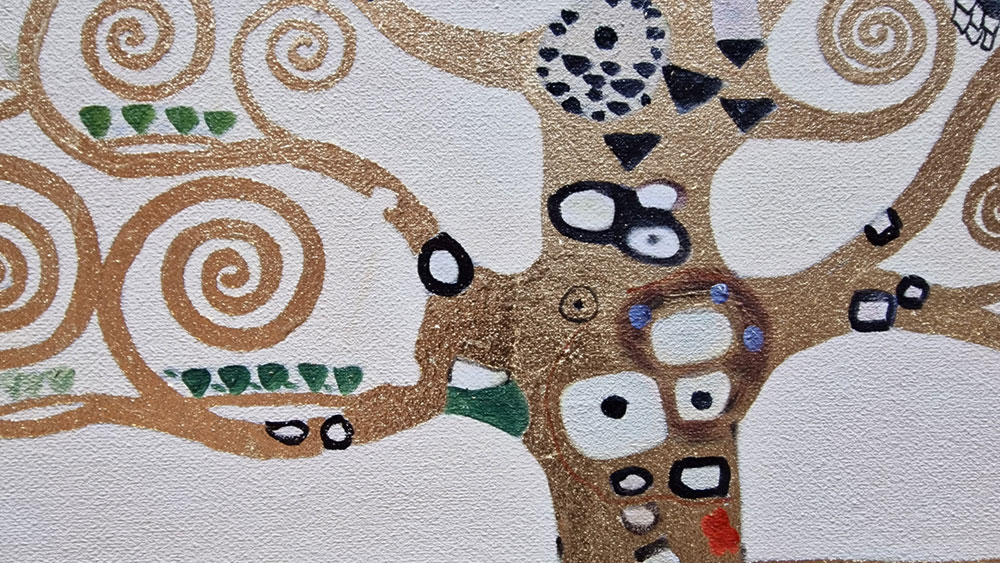
The gold is gold paint, never gold leaf: the painter applies it by hand with a fine brush along every spiral, in several layers, so that the lines stand slightly raised and catch the light. A printed oil painting reproduction cannot show that relief. You can see it in the fourth photograph, a close-up of the trunk with its eye shapes and the canvas weave, and in the eleventh, with the black bird among the spirals.
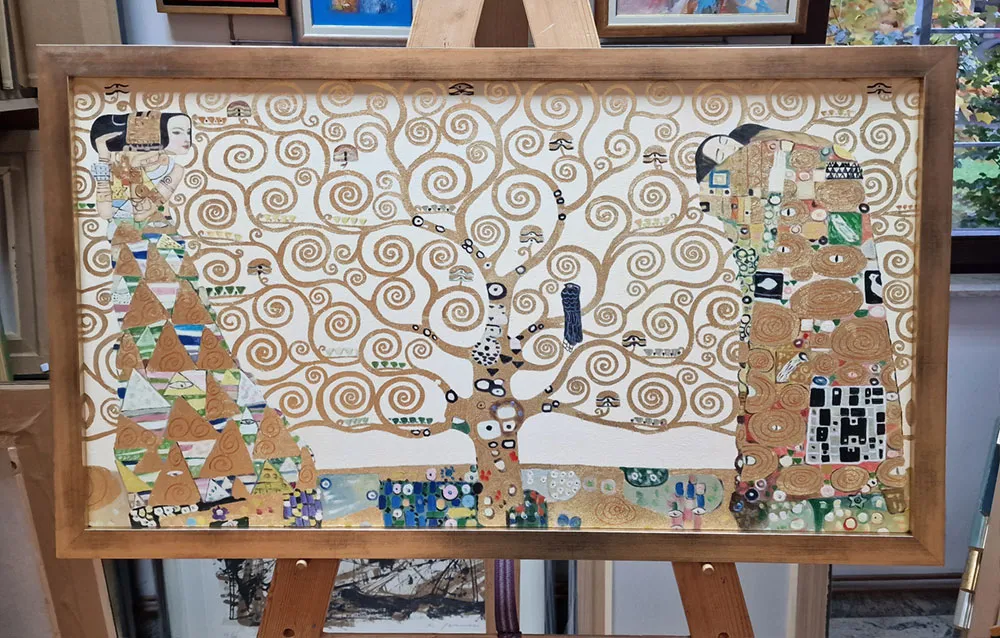
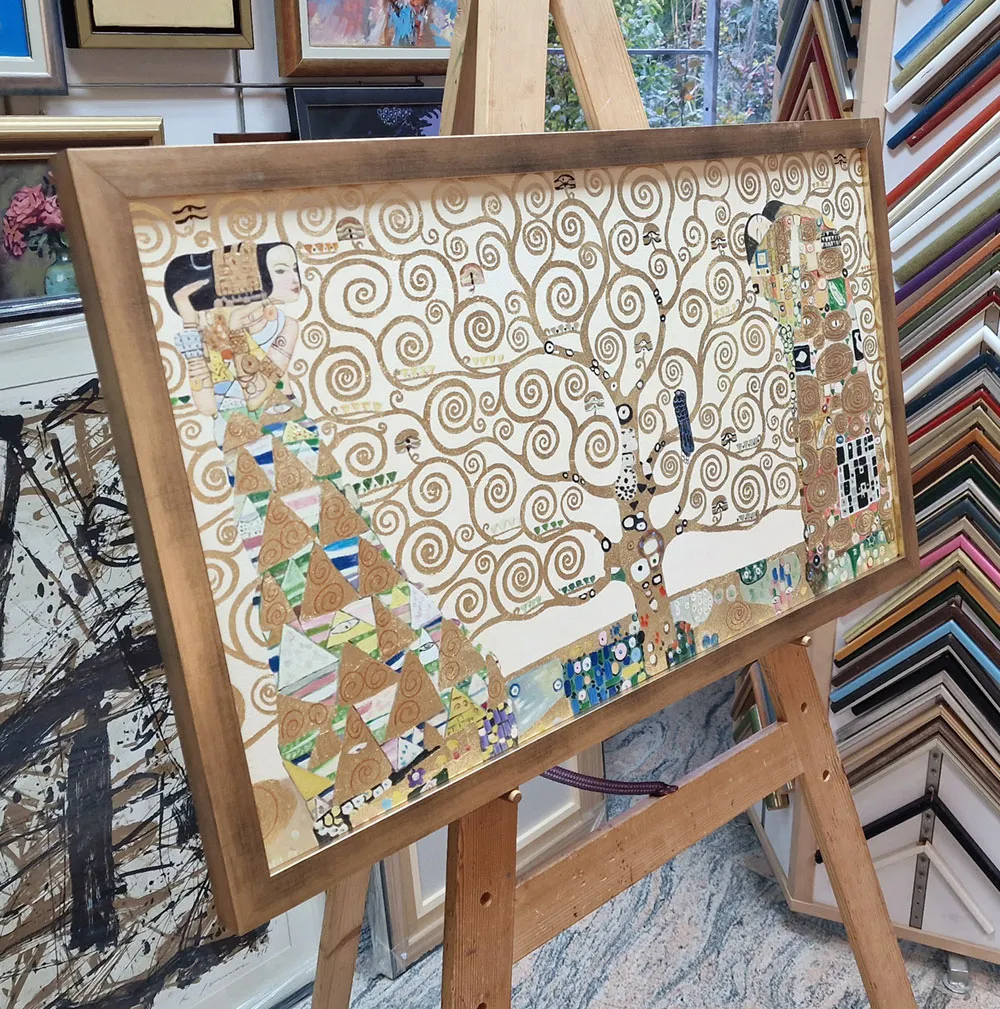
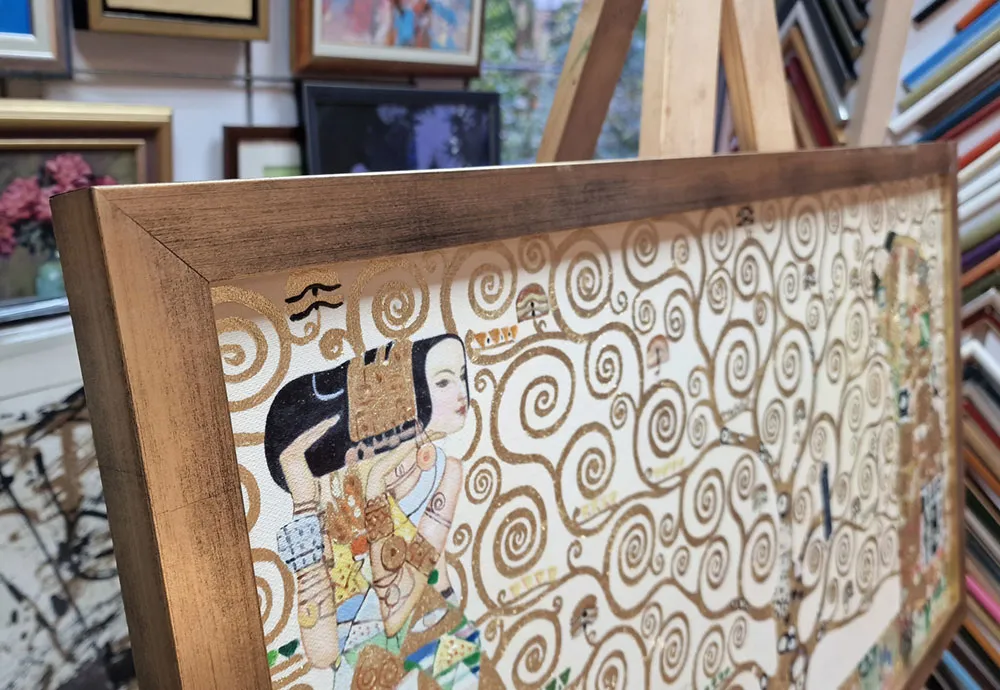
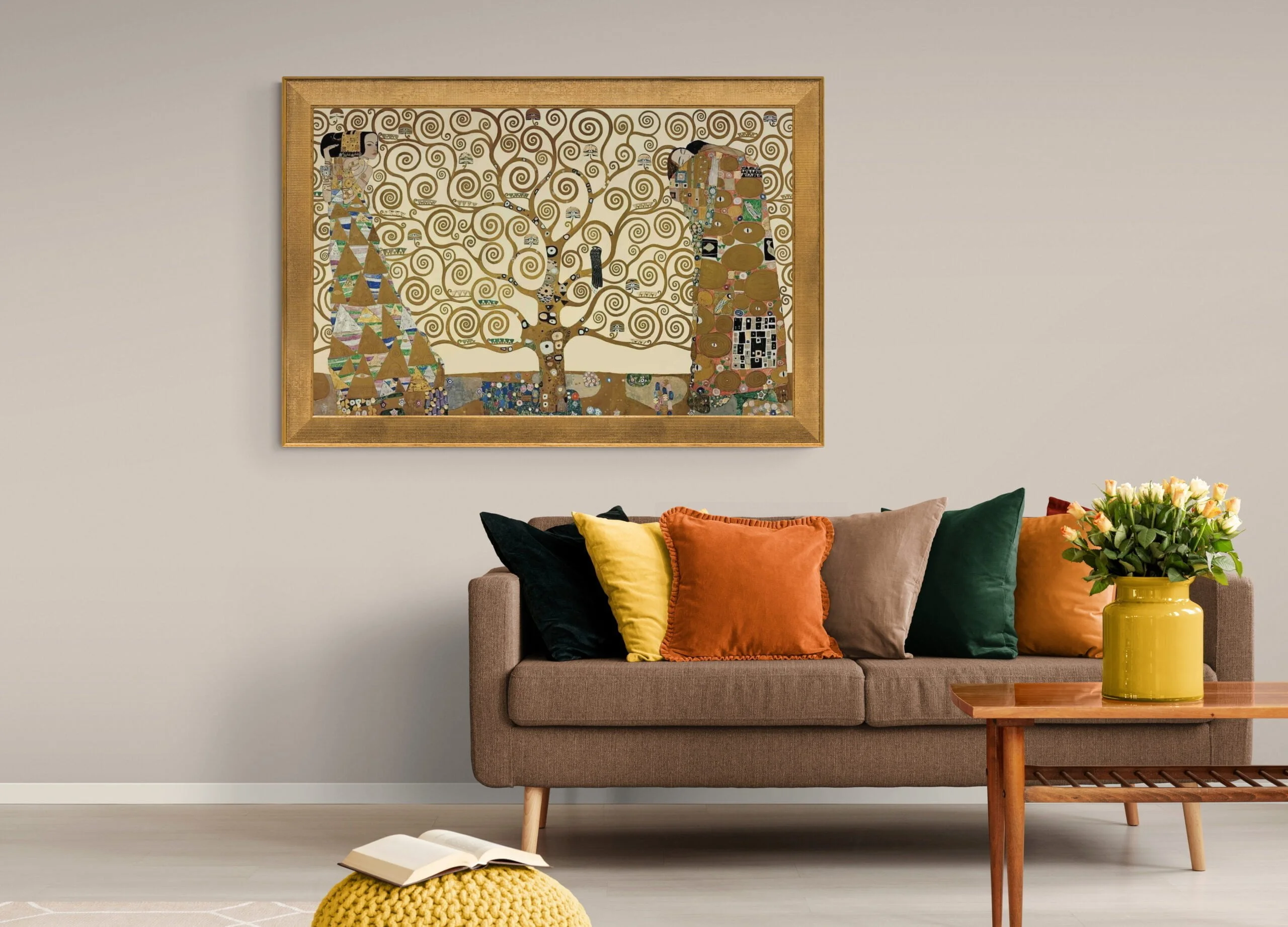
The photographs show three different copies we have painted. The first photograph shows one in a dark bronze-brown frame on an easel in our workshop, the second the same painting at an angle, and the third its left end close up, with Expectation. The sixth photograph shows a second copy in a dark frame with a thin gold edge, in cooler colours, and the seventh to ninth a third copy in an almost white frame. The tenth is a close-up of Expectation, and the fifth a visualisation of a framed copy above a brown sofa. The video at the top of the page shows our copy, painted by hand.
Which size for which wall?
Short answer: 150 x 80 cm above a three-seat sofa or a double bed, 120 x 60 cm above a sideboard, and 180 x 90 cm or more for a long dining-room wall. The design needs width more than height.
There are eight sizes, width by height: 90 x 50, 110 x 60, 120 x 60, 150 x 80, 180 x 90, 195 x 102, 210 x 110 and 250 x 130 cm. A painting for the living room should take up about two thirds of the width of the furniture below it; above a sofa 220 cm wide, that is 150 x 80 cm. The smallest, 90 x 50 cm, suits the wall above a desk.
Hang it with the centre about 150 cm above the floor, and 20 to 30 cm above the back of the sofa.
Custom size, stretcher and frame
If none of the eight sizes fits your wall, we paint the Tree of Life to measure, for example exactly the width of your sofa or sideboard; keep it at about two to one, so the spirals keep their shape. Send us the width and height you want and we will quote a price and a lead time. Every painting we make is stretched over a wooden stretcher and ready to hang.
For the moulding, use our 3D application: it shows every one of our frame profiles on this subject, so you can compare gold, silver, black, white and natural wood before deciding – the application is for choosing the frame only. If you would like to see how the painting will look on your own wall, that is our separate room placement service. A dark frame, as in the first photograph, makes it warmer; a light one, as in the seventh, makes it airy.
Delivery and guarantee
Every painting is made to order in our studio in Slovenia, so allow 15 to 45 days depending on the size you choose. We ship it stretched and protected for transport, framed if you chose a frame, across the EU with no customs. Before dispatch you receive a photograph of the finished work to approve; if anything is not right, we correct it while the canvas is still in our workshop. Our returns policy applies to every order.
Every other Klimt work we paint is in the Gustav Klimt gallery, and more about the painter himself is in our ten facts about Gustav Klimt.
Frequently asked questions
Where is the original Tree of Life by Klimt?
The finished work is a mosaic in the dining room of the Palais Stoclet in Brussels, a private house that cannot be visited. Klimt’s full-size working drawings for it are in Vienna, in the MAK, the Museum of Applied Arts, where at least one of them, part 7 of the tree, is on show in the permanent collection “Vienna 1900”. The history of the frieze is told on Wikipedia.
Is there an original Tree of Life painting on canvas?
No. Klimt never painted the Tree of Life as a single canvas. The design exists as a mosaic on the walls in Brussels and as nine full-size working drawings on paper, drawn in 1910–1911 with graphite, pastel, gouache, gold and other metals. Every Tree of Life you see on canvas, ours included, is painted after those drawings.
What do the spirals in the Tree of Life mean?
The spirals are the branches of the tree, rolled up instead of ending in leaves. They suggest growth that never stops, life turning back on itself and starting again, and they lead the eye across the whole width of the frieze. Klimt repeated the same curl dozens of times, which is why the design works as a pattern as well as a painting.
What does the Tree of Life symbolise in Klimt’s work?
It stands for the link between earth and sky and between life and death. The roots reach down, the branches reach up, and the tree joins the two worlds, an idea found in many cultures. Klimt adds a black bird in the branches, often read as a sign of death, and places the tree between Expectation and Fulfilment, between longing and love.
Who are the two figures beside the Tree of Life?
The woman on the left is Expectation, also called the Dancer: she stands alone in profile, her arms bent at sharp angles, in a robe covered with triangles. The couple on the right is Fulfilment, two lovers in a tight embrace. In the dining room in Brussels they face each other across the room; the usual reproduction brings them together beside one tree, as our painting does.
Can you visit the Palais Stoclet to see the Tree of Life?
Not inside. The Palais Stoclet in Brussels is still privately owned and is not open to visitors, so the mosaic itself cannot be seen. You can look at the house from the street, and in Vienna the MAK, the Museum of Applied Arts, shows Klimt’s working drawings for the frieze, which show the design at its full size.
Is the gold on your Tree of Life real gold?
No. Klimt’s instructions for the mosaic asked for gold leaf, enamel and mother-of-pearl, but we paint the spirals with gold paint, applied by hand with a brush, layer after layer. So the whole canvas painting, gold included, is painted by hand. In the fourth and eleventh photographs you can see how the raised gold lines catch the light.
Which size of Tree of Life suits the wall above a sofa?
For most living rooms 150 x 80 cm above a three-seat sofa is right; 120 x 60 cm suits a smaller sofa or a sideboard, and 180 x 90 cm or larger a long wall. The design is twice as wide as it is high, so measure the width of the furniture below and take about two thirds of it.
Is the Tree of Life a good gift?
Yes, especially for a wedding, a new home or an anniversary, because it joins the tree of life with a couple in love. We paint it to order in 15 to 45 days, so order in good time; before dispatch you receive a photograph of the finished work to approve. If you are unsure of the size, a wall art voucher lets the recipient choose the size and the subject.
- Subject: the tree of life with golden spirals between Expectation and Fulfilment, from Klimt’s Stoclet Frieze.
- Original: mosaic in the Palais Stoclet, Brussels; working drawings of 1910–1911 in the MAK, Vienna.
- Ours: a Klimt reproduction painted by hand in oil on canvas with gold paint, in eight wide sizes or made to measure.
- Worth knowing: you receive a photograph of the finished work for approval before dispatch.