







































Description

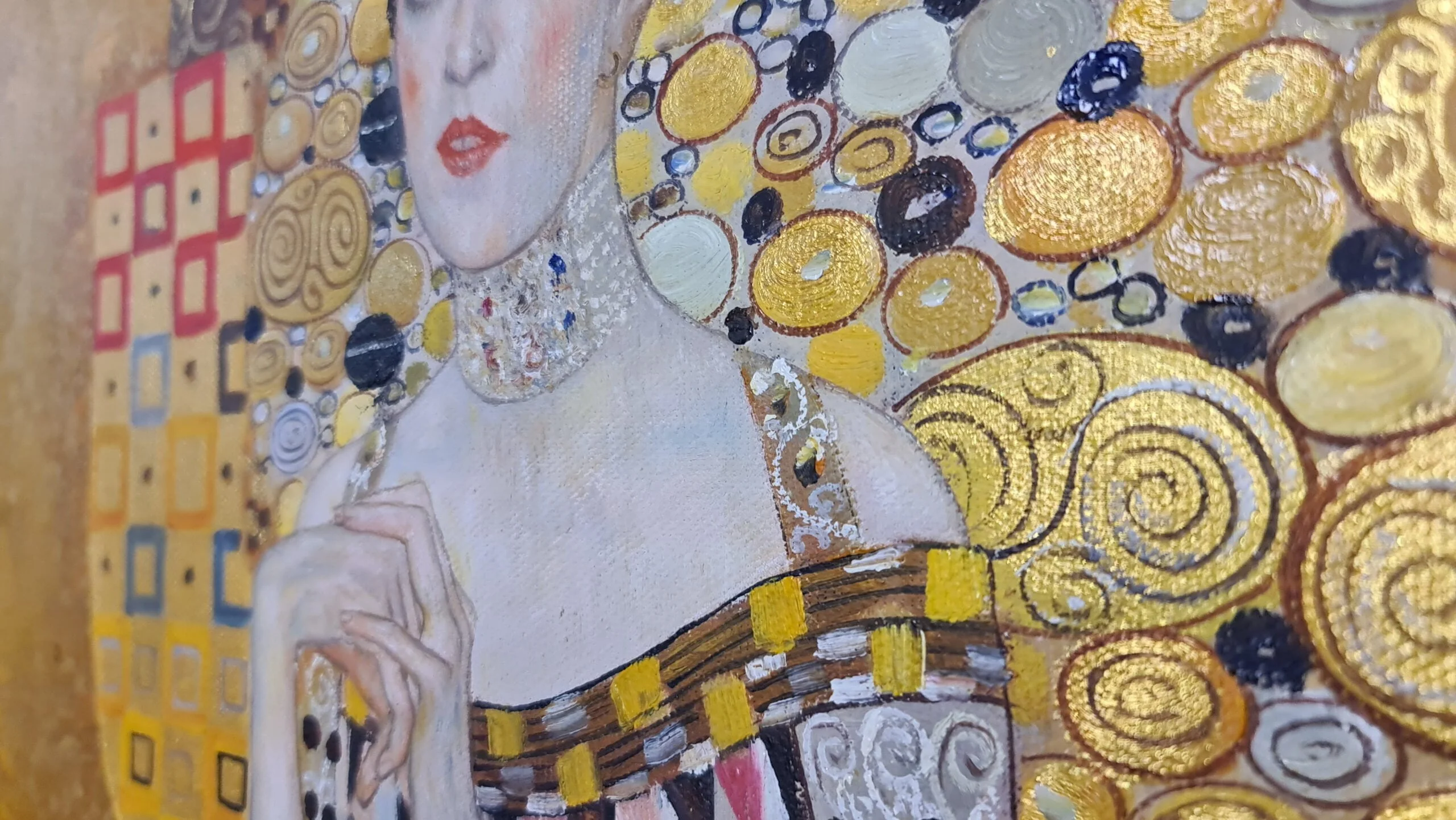
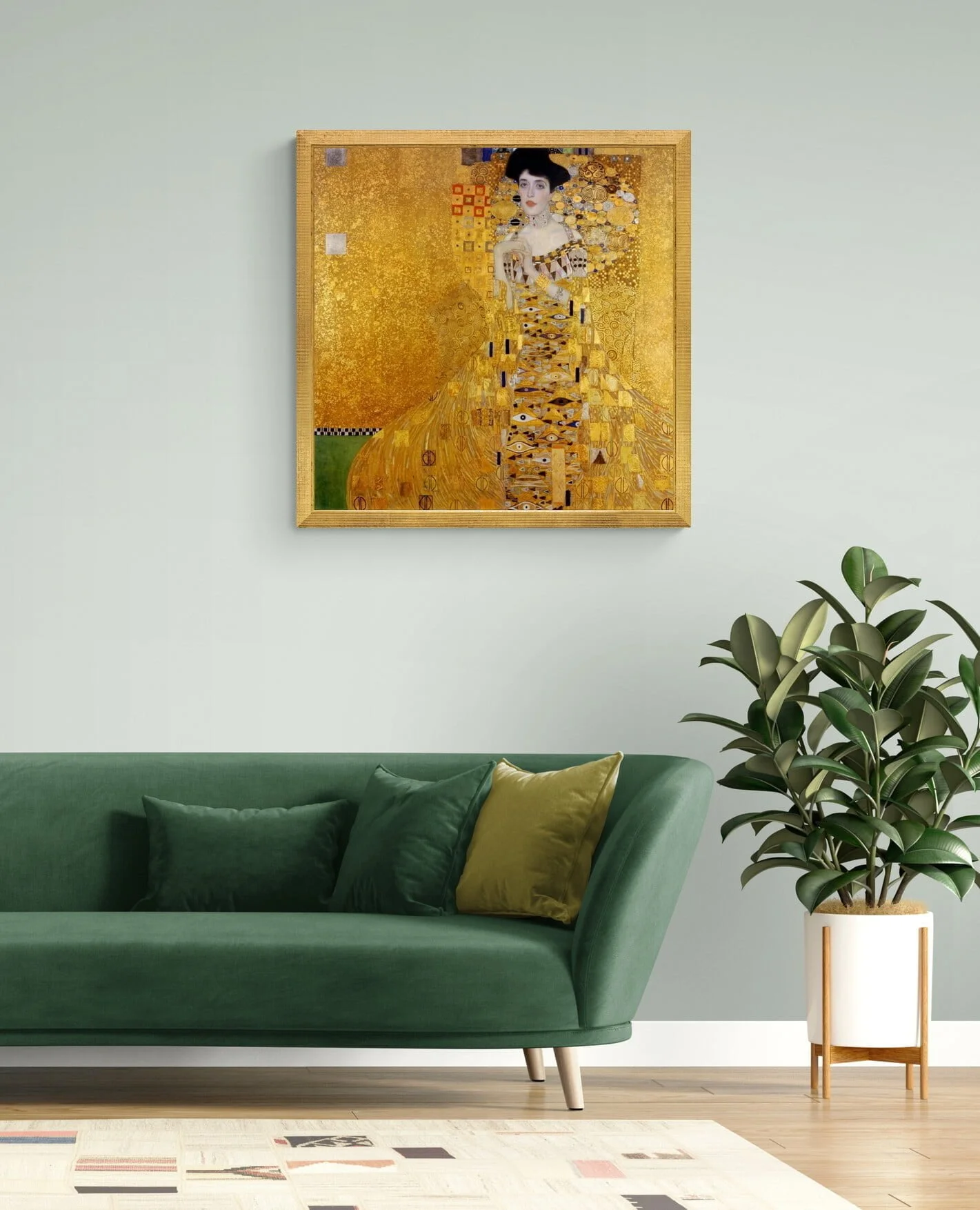
Portrait of Adele Bloch-Bauer I is Gustav Klimt’s most famous portrait: a Viennese woman seated in a sea of gold, painted in 1907 and known around the world as the “Woman in Gold”. The original hangs in the Neue Galerie in New York. We paint it by hand in oil on canvas, with the gold in gold paint, in eight square sizes from 50 x 50 to 150 x 150 cm or to your own measurement, and send you a photograph of the finished work for approval before dispatch.
| Title: | Portrait of Adele Bloch-Bauer I |
| Other titles: | Woman in Gold · Lady in Gold · Golden Adele · Ritratto di Adele Bloch-Bauer I |
| Painter: | Gustav Klimt (1862–1918) |
| Year painted: | 1907 |
| Original size: | 140 cm x 140 cm (often given as 138 x 138 cm) |
| Original technique: | Oil, silver and gold leaf on canvas |
| Painting style: | Vienna Secession, Golden Period |
| Located at: | Neue Galerie, Fifth Avenue, New York |
| Our reproduction: | Hand-painted oil on canvas, the gold in gold paint applied by hand, eight square sizes or made to measure |
Portrait of Adele Bloch-Bauer I – Gustav Klimt
What does the painting show?
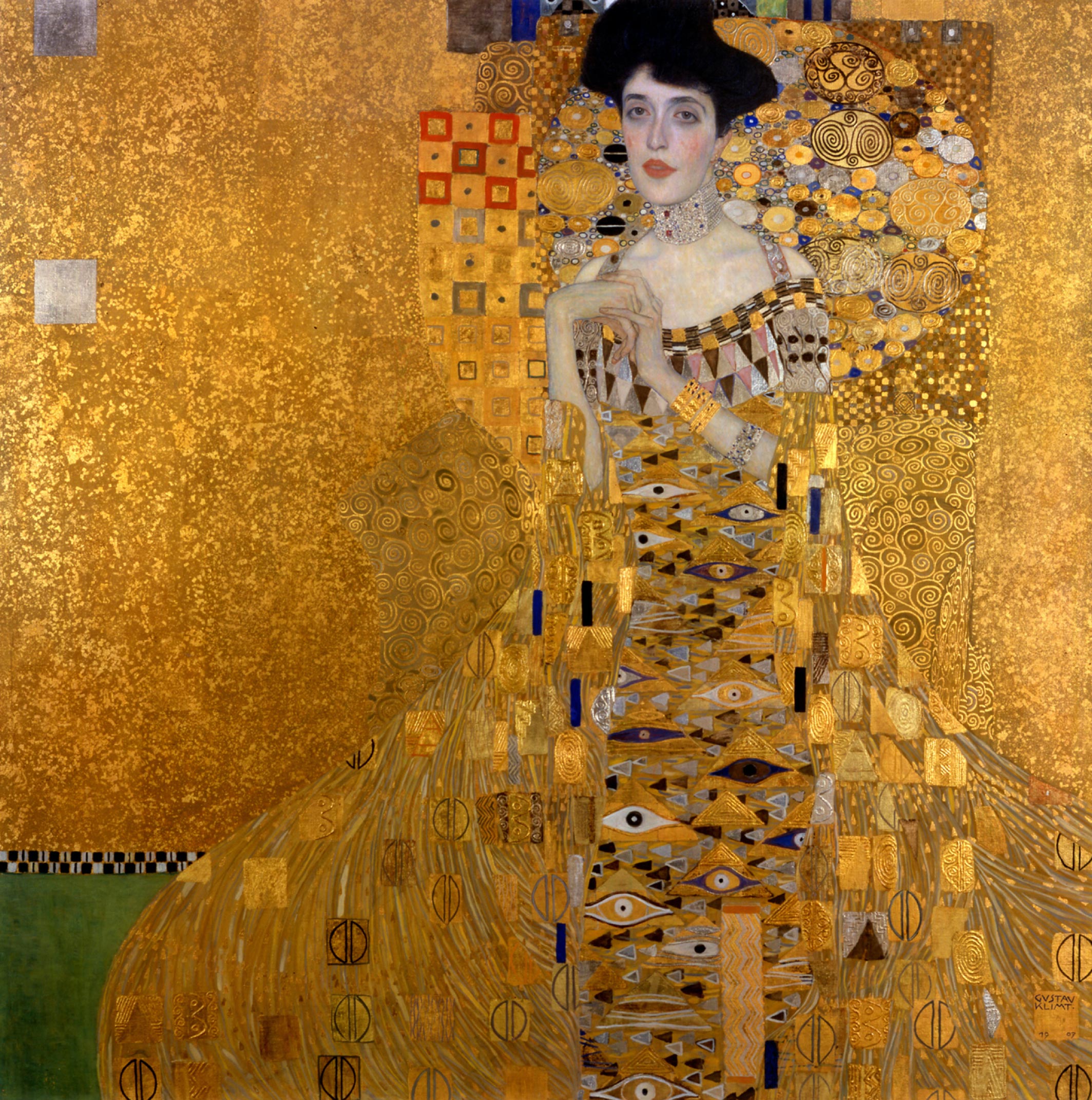
Adele Bloch-Bauer sits facing us, her pale face framed by dark piled-up hair. Her lips are red, her hands are clasped at her chest with the fingers twisted together, and around her neck she wears a wide jewelled choker. Only her face, shoulders and hands are painted as living skin; everything else becomes ornament.
Her dress dissolves into the gold background, so that it is hard to say where the woman ends and the chair or the wall begins. The gown is covered with eye-shaped motifs inside triangles, the space behind her with spirals and circles, and on the left there is a panel of red and blue squares. Two small silver squares sit high on the left, and a narrow strip of green at the lower left is the only colour that is not gold, silver or skin.
Why is the portrait covered in gold?
The portrait is the high point of Klimt’s Golden Period. In 1903 he saw the Byzantine mosaics of Ravenna, with their saints and empresses set against shining gold, and Adele is painted in the same spirit, like a modern icon. Gold also ran in the family: his father was a gold engraver.
In the original Klimt did not only paint the gold. He laid real silver and gold leaf onto the canvas and worked oil paint around it, so the surface changes as the light moves through the room. That is why the painting looks different in every photograph of it you will ever see.
Who was Adele Bloch-Bauer?
Adele Bloch-Bauer (1881–1925) was a Viennese salon hostess, married to the sugar industrialist Ferdinand Bloch-Bauer. It was Ferdinand who commissioned the portrait. Klimt took his time: his first studies of her date from about 1903, and the painting was finished in 1907.
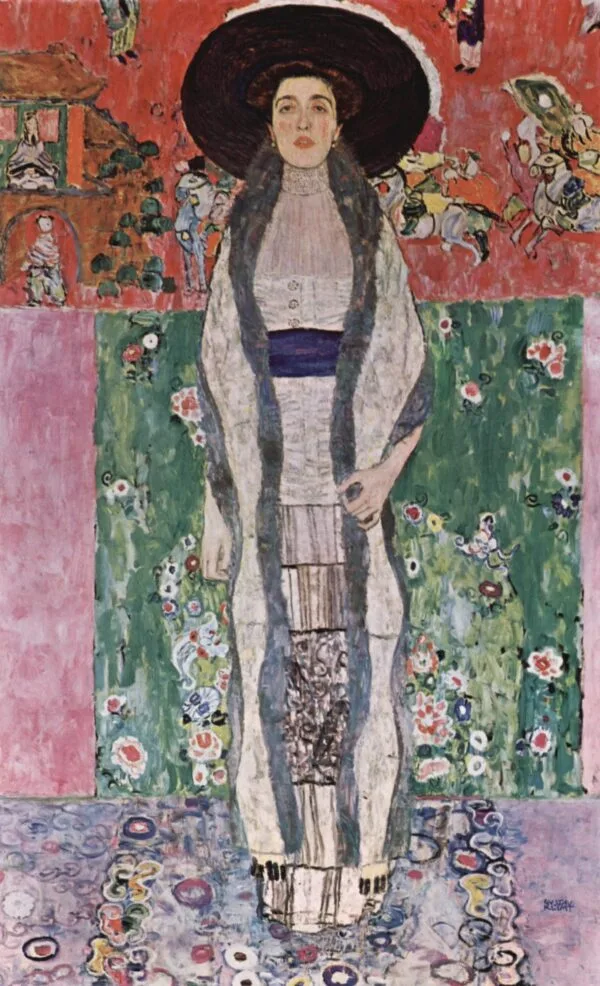
She is the only person Klimt painted in two full-length portraits. The second one, from 1912, looks completely different, colourful and without the gold. Adele died in 1925, and in her will she asked her husband to leave the Klimt paintings to the Austrian state gallery after his own death. That one sentence became the centre of a dispute that lasted more than half a century.
From Vienna to New York: the story of the restitution
In 1938 the Nazis seized Ferdinand Bloch-Bauer’s property in Vienna, and in 1941 the portrait reached the Austrian Gallery in the Belvedere. It hung there for decades as the “Lady in Gold”, a title that hid the name of its Jewish sitter. Ferdinand died in exile in Zurich in 1945 and left his estate to his nephews and nieces.
His niece Maria Altmann, who lived in Los Angeles, sued the Republic of Austria. In 2004 the US Supreme Court allowed her case to go ahead, and in January 2006 an Austrian arbitration court ruled that the paintings must be returned to the heirs. The same year Ronald S. Lauder bought the portrait for the Neue Galerie for a reported 135 million US dollars, then the highest price known for a painting. It has hung on Fifth Avenue since July 2006.
Adele I, Adele II or another golden Klimt – which to choose?
Choose this portrait if you want the gold: it is the painting people mean when they say “Woman in Gold”, and it fills a room with warm light. Portrait of Adele Bloch-Bauer II shows the same woman five years later, standing, surrounded by colour instead of gold, which makes it a calmer choice for a cooler interior.
If you love the gold but would rather not have a portrait, look at The Kiss, painted in the same years, or at the golden spirals of Tree of Life. Judith I is another golden woman, painted six years earlier and far more provocative.
How is our hand-painted portrait made?
The painter starts with a fine drawing of the face, the hands and the outline of the dress, because in a portrait the likeness depends on a few millimetres around the eyes and the mouth. The face and hands are painted first, in thin layers of oil, then the patterns of the dress, the spirals and the eyes, one by one.
The gold is not printed, and it is not leaf as in the original. We use gold paint, which the painter applies by hand with a brush, layer by layer, so the raised strokes catch the light. A printed oil painting reproduction cannot show that relief.
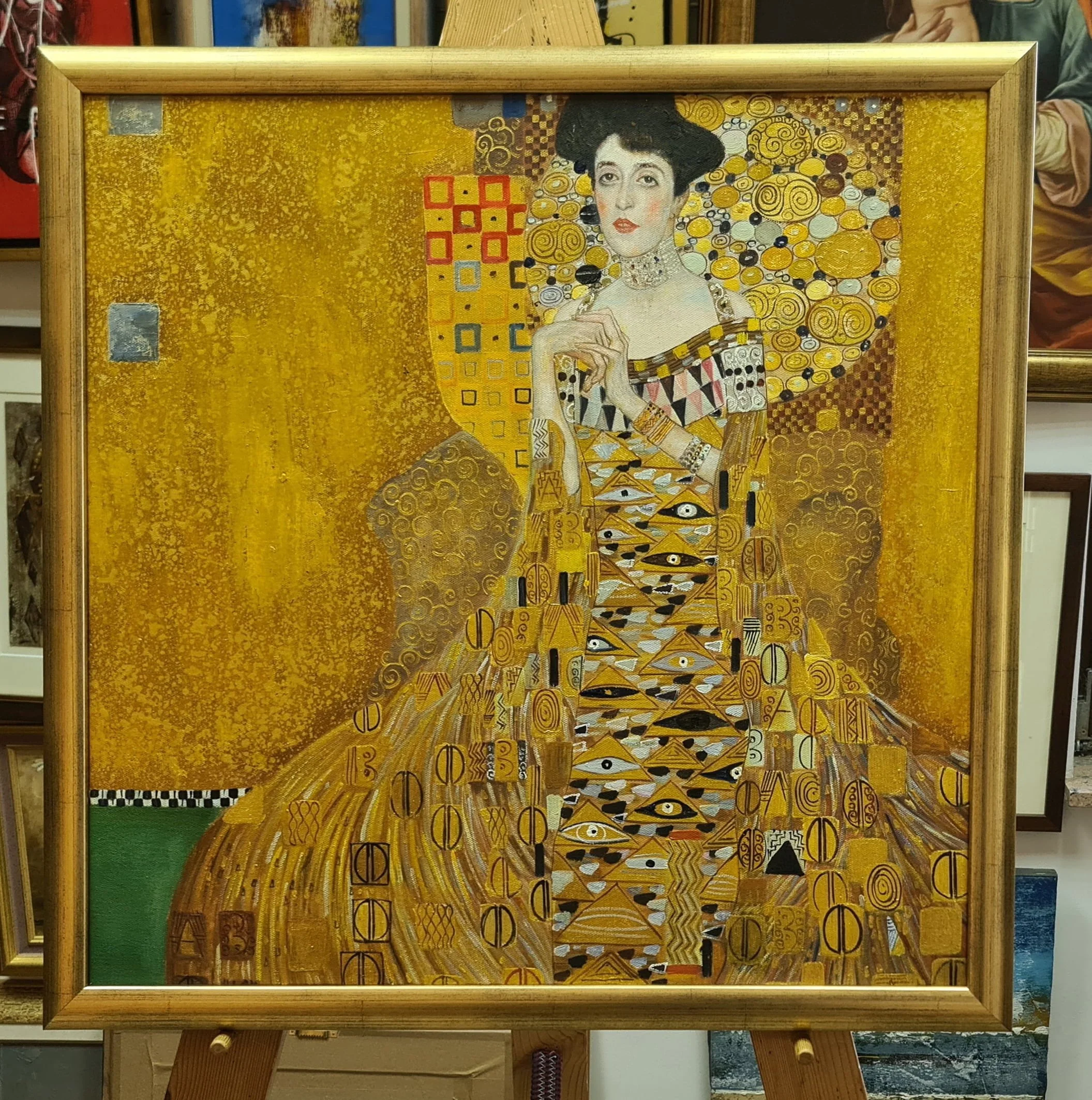
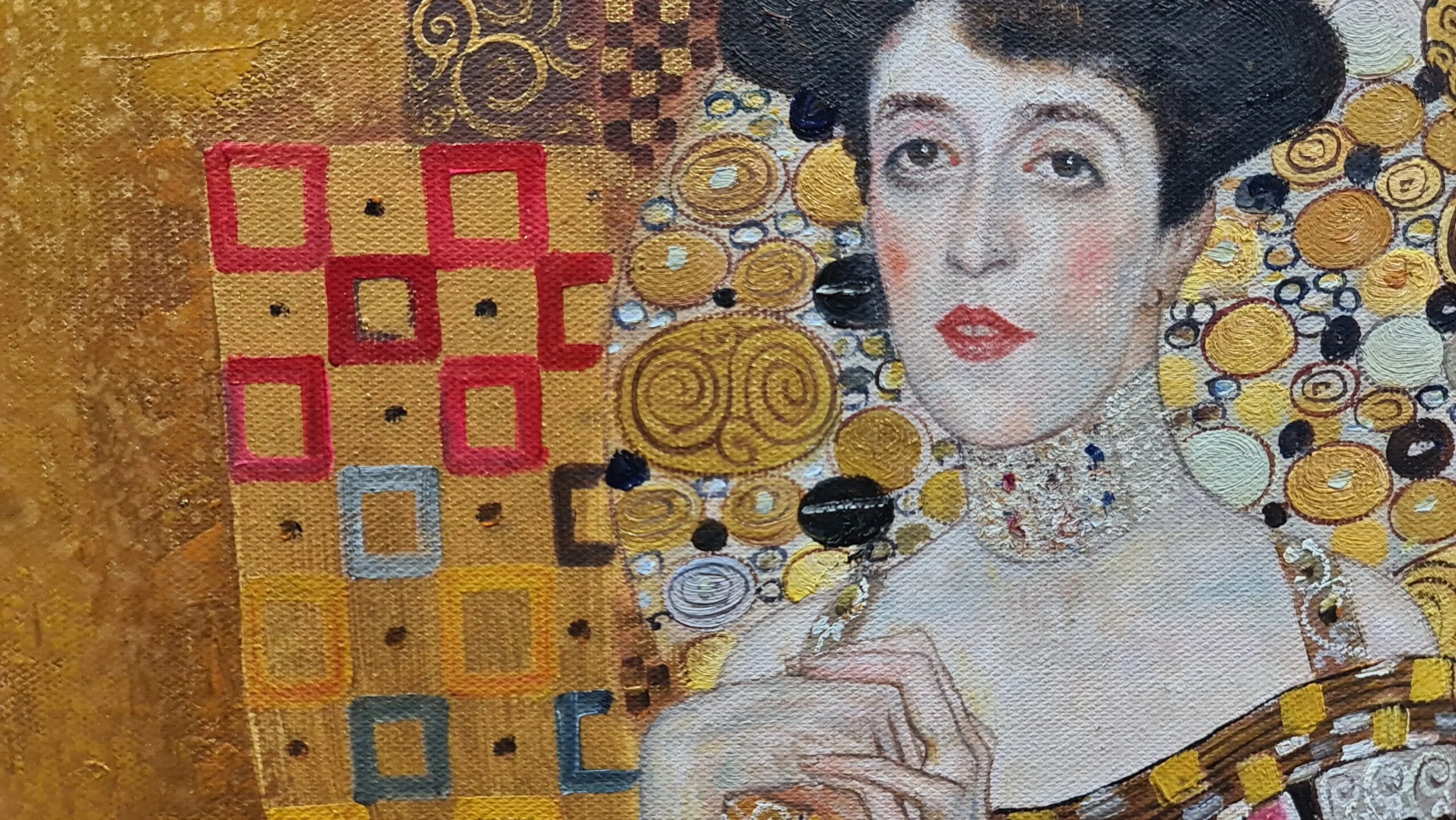
The first photograph shows the finished painting in a gold-coloured frame on an easel in our workshop, among other paintings. The second photograph shows the same painting at an angle, so you can see the frame from the side. The third photograph is a close-up of her face: the red lips, the jewelled choker, her twisted fingers and, behind her, the red and blue squares and the gold circles, with the weave of the canvas showing through. The fourth photograph shows the gold spirals beside her shoulder at an angle, where the relief of the gold paint catches the light. The fifth photograph is a visualisation of the framed painting on a light green wall above a dark green sofa.
The video at the top of the page shows our copy, painted by hand. Every painting is a hand-painted copy made for your order, so no two are exactly alike.
Which size for which wall?
Short answer: 90 x 90 cm above a sofa or bed, 60 x 60 cm above a chest of drawers or in a smaller room, and 120 x 120 cm or larger for a big wall. The portrait is full of detail, so it rewards a size at which her face can be read from across the room.
There are eight square sizes: 50 x 50, 60 x 60, 80 x 80, 90 x 90, 100 x 100, 120 x 120, 138 x 138 and 150 x 150 cm. The 138 x 138 cm size is practically the size of the original. A painting for the living room should take up about two thirds of the width of the furniture below it; above a sofa 140 cm wide, that is 90 x 90 cm.
Hang it with the centre of the canvas about 150 cm above the floor, and 20 to 30 cm above a sofa or a headboard. Gold reflects light, so a wall lit from the side shows it at its best.
Custom size, stretcher and frame
If none of the eight sizes fits your wall, we paint the portrait to measure; it works best kept square, like the original. Send us the width and height you want and we will quote a price and a lead time. Every painting we make is stretched over a wooden stretcher and ready to hang.
For the moulding, use our 3D application: it shows every one of our frame profiles on this subject, so you can compare gold, silver, black, white and natural wood before deciding – the application is for choosing the frame only. If you would like to see how the painting will look on your own wall, that is our separate room placement service. A gold-coloured frame, like the one in the first photograph, carries the gold of the painting out to its edge.
Delivery and guarantee
Every painting is made to order in our studio in Slovenia, so allow 15 to 45 days depending on the size you choose. We ship it stretched and protected for transport, framed if you chose a frame, across the EU with no customs. Before dispatch you receive a photograph of the finished work to approve; if anything is not right, we correct it while the canvas is still in our workshop. Our returns policy applies to every order.
Every other Klimt work we paint is in the Gustav Klimt gallery, and more about the painter himself is in our ten facts about Gustav Klimt.
Frequently asked questions
Where is Portrait of Adele Bloch-Bauer I today?
The original hangs in the Neue Galerie on Fifth Avenue in New York, a museum of German and Austrian art. It has been on view there since July 2006, after Austria returned it to the heirs of the Bloch-Bauer family. Before that it hung for decades in the Belvedere in Vienna. The whole story of the painting is on Wikipedia.
Is the film Woman in Gold about Adele Bloch-Bauer I?
Yes. Woman in Gold (2015) tells how Maria Altmann, Ferdinand Bloch-Bauer’s niece, fought the Republic of Austria to get the portrait back. Helen Mirren plays Maria Altmann and Ryan Reynolds her lawyer, Randol Schoenberg. The film follows the case from Los Angeles to the US Supreme Court and the arbitration in Austria. More about it is on Wikipedia.
How much was Adele Bloch-Bauer I sold for?
In 2006 Ronald S. Lauder bought it for the Neue Galerie for a reported 135 million US dollars. At the time that was the highest price known to have been paid for a painting. The sale followed the ruling of an Austrian arbitration court in January 2006, which returned the portrait to the heirs of Ferdinand Bloch-Bauer, among them his niece Maria Altmann.
Who was the woman in Portrait of Adele Bloch-Bauer I?
She was Adele Bloch-Bauer (1881–1925), a Viennese salon hostess and the wife of the sugar industrialist Ferdinand Bloch-Bauer, who commissioned the portrait. Klimt studied her for years before he finished it in 1907. She is the only person he painted in two full-length portraits; the second, more colourful one followed in 1912, and we paint that one too.
Why was Adele Bloch-Bauer I returned to Maria Altmann?
Because it had been taken from the family. In 1938 the Nazis seized Ferdinand Bloch-Bauer’s property, and the portrait reached the Belvedere in 1941. Ferdinand left his estate to his nephews and nieces, while Austria relied on Adele’s will, which had asked him to leave the paintings to the state. In January 2006 an Austrian arbitration court ruled in favour of the heirs.
What is the difference between Adele Bloch-Bauer I and II?
Adele Bloch-Bauer I, from 1907, shows her seated in a sea of gold, with eye-shaped motifs on her dress. Adele Bloch-Bauer II, from 1912, shows her standing, surrounded by colour and patterns instead of gold. The first is the golden icon, the second a later and calmer portrait. We paint both, so you can choose the one that suits your room.
Is the gold on your Portrait of Adele Bloch-Bauer I real gold?
No. In the original Klimt used real silver and gold leaf together with oil paint; we paint the gold with gold paint, which the painter applies by hand with a brush, layer by layer. So the whole canvas painting, gold included, is painted by hand. You can see the gold close up in the third and fourth photographs, where the relief of the brushstrokes catches the light.
Which size of Adele Bloch-Bauer I is right for my wall?
For most living rooms 90 x 90 cm above a sofa is right, 60 x 60 cm suits a smaller room or the wall above a chest of drawers, and 120 x 120 cm or larger a big empty wall. If you want the portrait at almost the size of the original, choose 138 x 138 cm. A useful rule is about two thirds of the width of the furniture below.
Is Adele Bloch-Bauer I a good present?
Yes, especially for someone who loves Klimt, Vienna or the story told in the film Woman in Gold. Because we paint it to order in 15 to 45 days, order in good time; before dispatch you receive a photograph of the finished work to approve. If you are unsure of the size, a wall art voucher lets the recipient choose the size and the subject.
- Subject: Adele Bloch-Bauer seated in a sea of gold, Klimt’s most famous portrait.
- Original: 1907, about 140 x 140 cm, Neue Galerie, New York.
- Ours: a Klimt reproduction painted by hand in oil on canvas with gold paint, in eight square sizes or made to measure.
- Worth knowing: you receive a photograph of the finished work for approval before dispatch.