







































Description
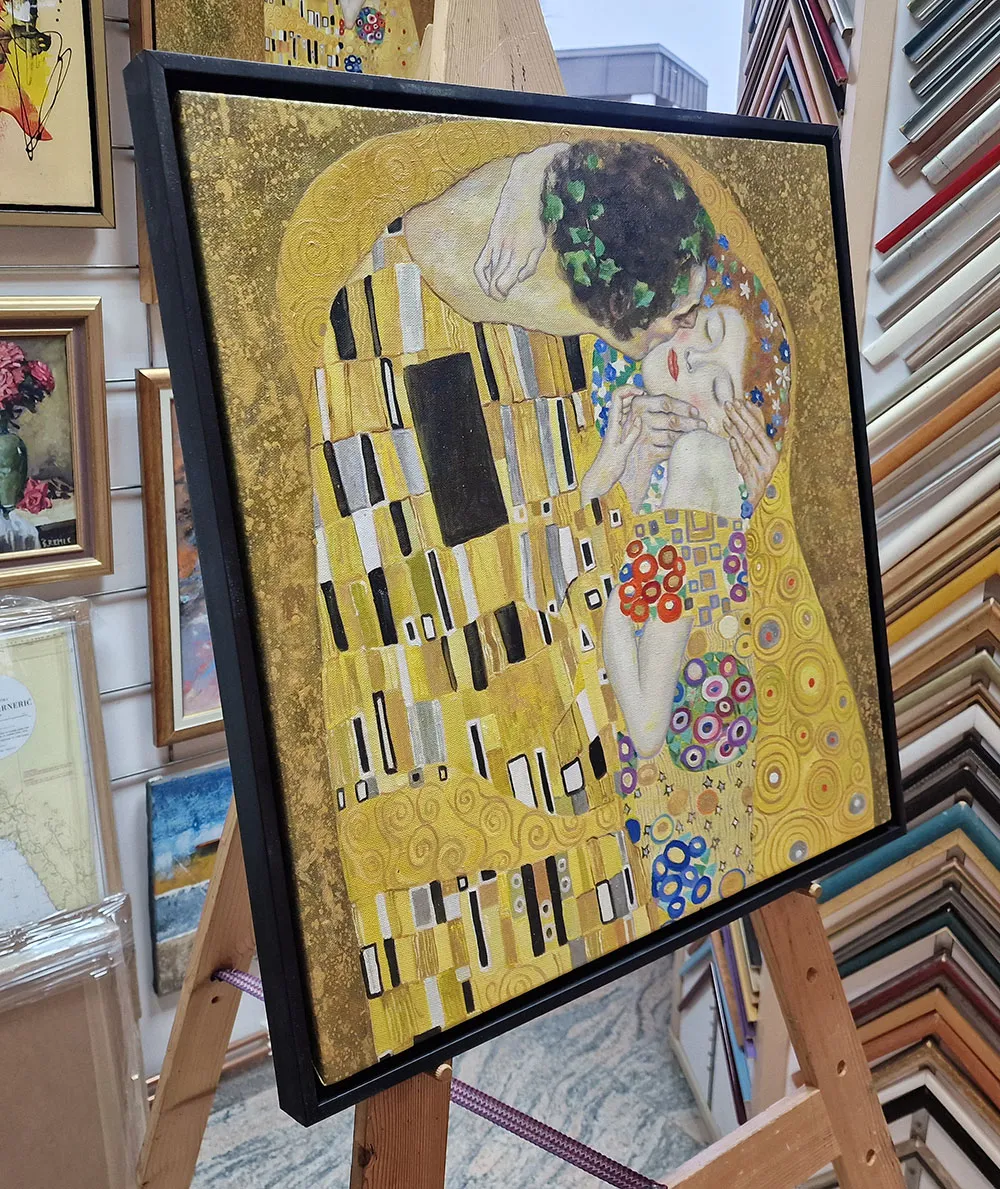

The Kiss (detail) is a close crop of Gustav Klimt’s most famous painting: only the lovers’ faces, their hands and the upper part of the golden cloaks, with no meadow and no feet. Klimt painted the whole canvas around 1907–1909, and the original hangs in the Upper Belvedere in Vienna. We paint the detail by hand in oil on canvas, in eight sizes from 40 x 40 to 150 x 150 cm or to your own measurement, and send you a photograph of the finished work for approval before dispatch.
| Title: | The Kiss (detail) |
| Other titles: | Der Kuss (Detail) · Il bacio (dettaglio) · Poljub (podrobnost) |
| Painter: | Gustav Klimt (1862–1918) |
| Year painted: | c. 1907–1909 (the whole painting) |
| Original size: | 180 cm x 180 cm (the whole painting) |
| Original technique: | Oil and gold leaf on canvas |
| Painting style: | Vienna Secession, Golden Period |
| Located at: | Österreichische Galerie Belvedere, Upper Belvedere, Vienna (inv. 912) |
| Our reproduction: | Detail with the faces close up, hand-painted oil on canvas, gold in gold paint, eight sizes or made to measure |
The Kiss (detail) – Gustav Klimt
What does the detail show?
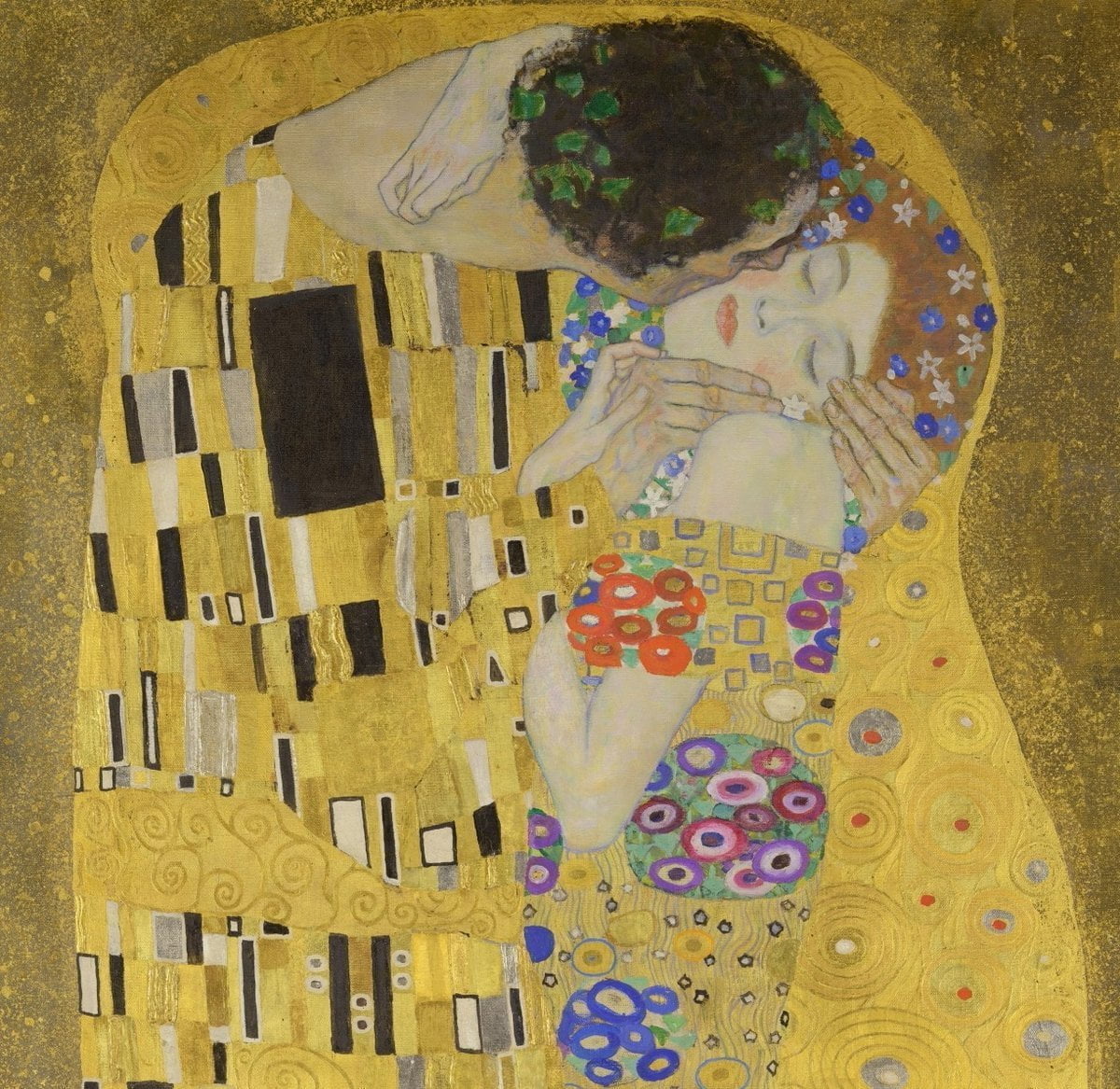
The detail moves in on the thing people know the painting for: the moment of the kiss. The man bends towards the woman, holds her face in both hands and kisses her cheek; of him we see mostly dark hair with a wreath of green leaves and part of his cheek. She has her eyes closed and red lips, her head tilted, small white and blue flowers in her hair, and her hand resting on his.
Below the faces the two cloaks begin: black, white and grey rectangles on his, circles and flowers in red, blue and violet on her dress. The background is gold and scattered with tiny flakes of metal. With no meadow and no feet, the faces are much larger at the same size than on the whole painting, so this version is more intimate and rewards being seen up close.
Why is there so much gold?
The Kiss comes from the height of Klimt’s Golden Period, when he built real metals into his paintings. According to the Belvedere, he painted the figures with gold, silver and platinum leaf together with oil colours, and covered the background in thin brass leaf, glazed it with a dark varnish and scattered fine flakes of metal leaf into it.
In the detail the effect is even stronger than in the whole painting. Gold fills almost the entire surface around the faces, so the skin looks softer and warmer beside it.
What does the kiss in this painting mean?
Klimt tells no story here; he catches the moment two people become one. The rectangles on the man’s cloak are usually read as the masculine, the circles and flowers on the woman as the feminine, and the golden cloak around them both as the love that joins them. In the detail that meaning rests on the faces: his is almost hidden, while hers, with closed eyes, shows complete surrender.
The Belvedere points out that the symbolic character of the scene argues against identifying the couple with real people. So the detail is not a portrait of two individuals but a painting about tenderness and trust that everyone reads in their own way.
From Lovers to The Kiss: how did the painting get its name?
Klimt probably began the whole painting in 1907 and painted it without a direct commission. He first showed it in June 1908 at the Kunstschau Wien under the title Liebespaar, Lovers. On 10 July 1908 the committee of Vienna’s Modern Gallery, today’s Belvedere, decided to buy it, with the ministry paying for the purchase.
In the autumn of 1909 the museum’s catalogue listed it for the first time as The Kiss. It has been in the Belvedere’s collection ever since, today in the Upper Belvedere, and is probably Klimt’s most famous work. The detail we paint is a crop of that same canvas, not a separate work.
The detail or the whole painting – which to choose?
We offer two versions of this subject. The whole painting, with the couple, the flowering meadow and the feet at its edge, is The Kiss. This page is the detail: the faces close up, a smaller square and a more concentrated scene.
Choose the detail if it is the kiss itself that draws you, if your wall is smaller, or if you want the faces to read clearly from the doorway. Choose the whole painting if you want the full story on the wall, the golden cloak down to the edge of the meadow and the square format of the original. From the same Golden Period we also paint Tree of Life, Judith I and Portrait of Adele Bloch-Bauer I.
How is our hand-painted detail made?
The painter starts with a fine drawing of both faces and the hands, because in the detail every stroke has to sit exactly right: the faces are large and any slip would show. Then come the gold areas of the cloaks and the background, the rectangles and circles of the robes, and only at the very end, with a fine brush, the flowers in her hair and the red lips.
The gold is not printed, and it is not leaf as in the original. We use gold paint, which the painter applies by hand with a brush, layer by layer, and then scatters small gold dots across the background.
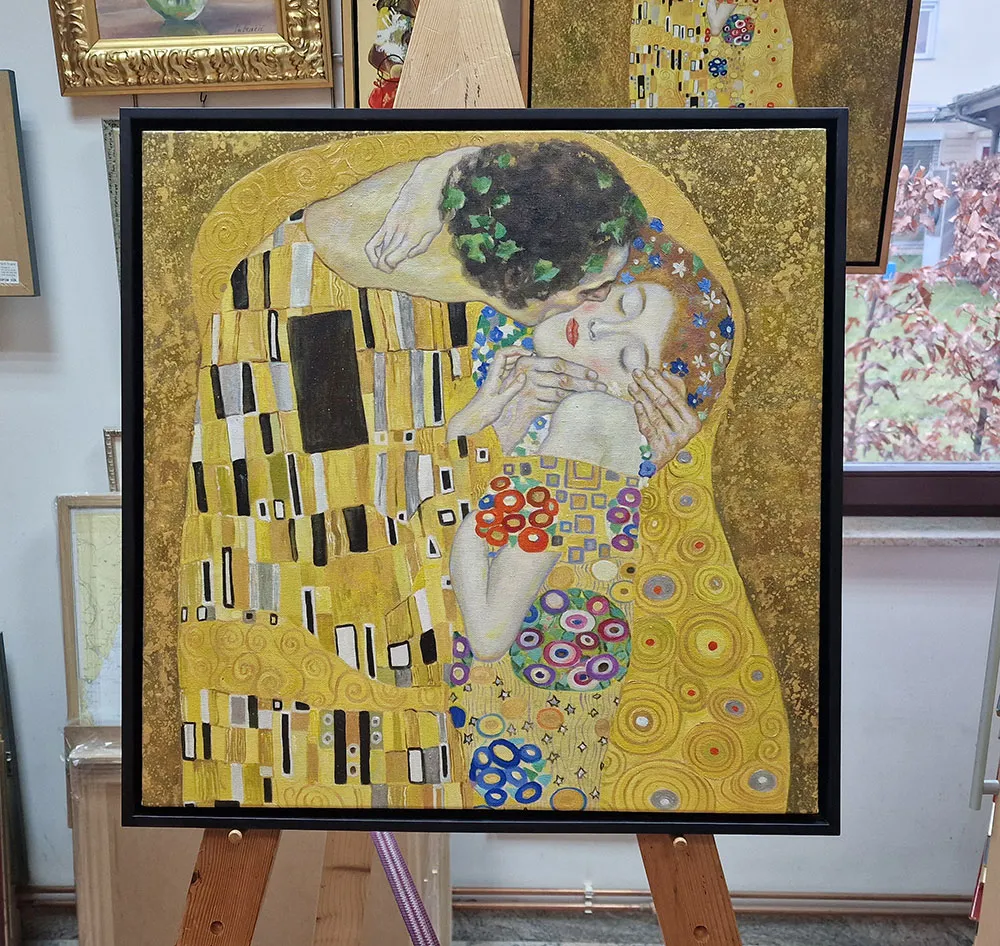
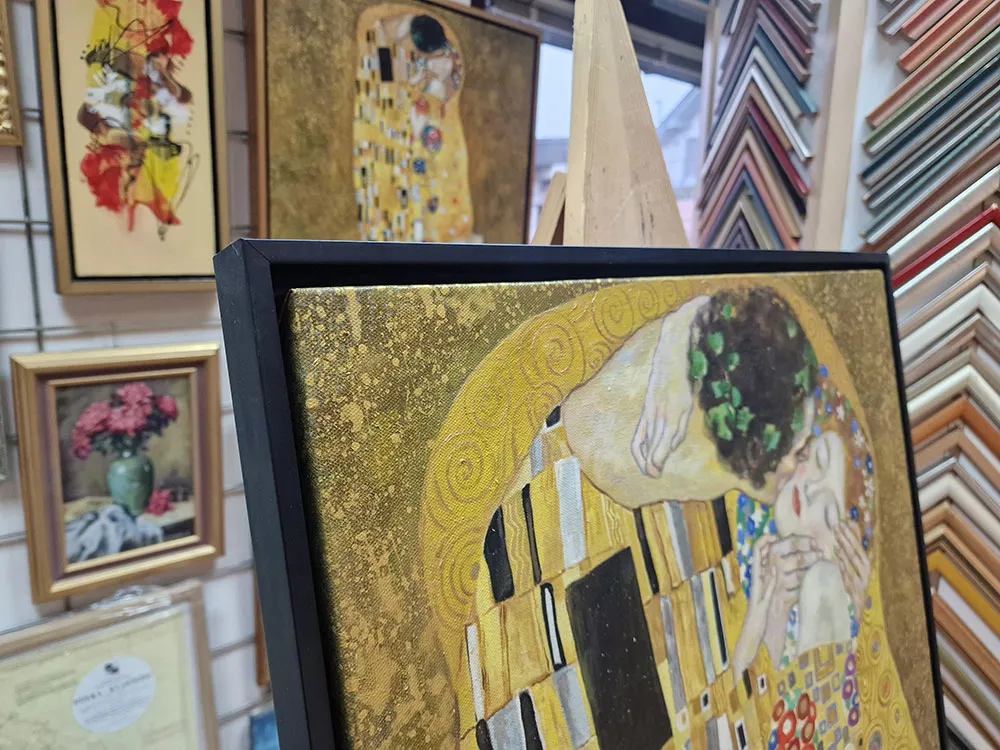
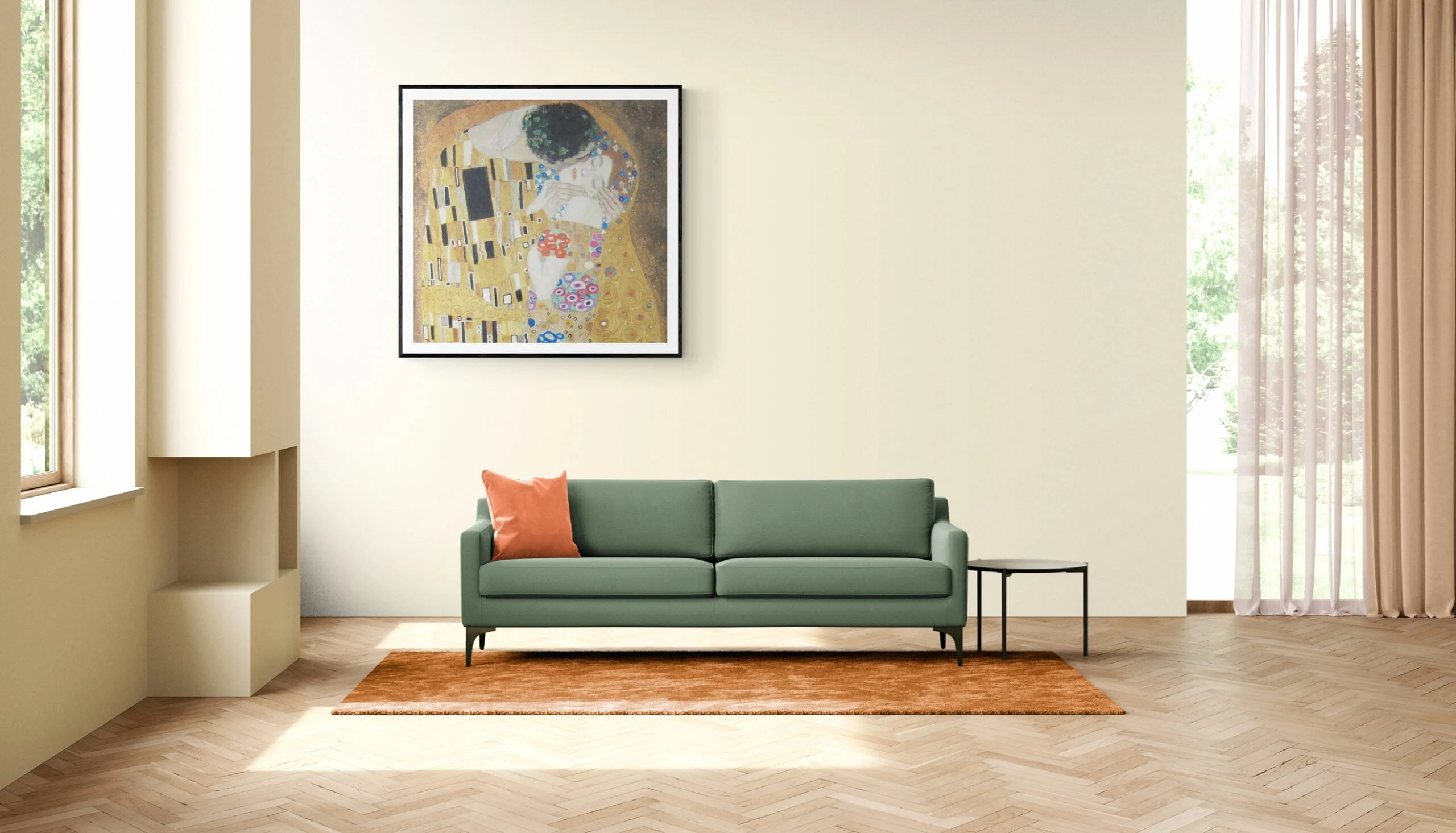
The first photograph shows the finished detail in a black floater frame on an easel, exactly as you receive it. The second photograph shows it from the side in our framing workshop, among the moulding samples. The third photograph is a close-up of the framed top corner, where the gold dots on the background show. The fourth photograph shows the faces close up: her closed eyes and red lips, his hands and the small white and blue flowers in her hair, with the weave of the canvas visible through the paint. The fifth photograph is a visualisation of the framed painting above a green sofa in a light room.
Every painting is a hand-painted copy made for your order, so no two are ever quite the same. A printed oil painting reproduction cannot show the relief of the brushstrokes and the shine of the gold paint you see in the fourth photograph.
Which size for which wall?
Short answer: 90 x 90 cm above a sofa or bed, 70 x 70 cm above a chest of drawers or in a smaller room, and 120 x 120 cm for a large wall. Because the detail is already a crop, the faces are big enough at the middle sizes to read well from across the room.
There are eight sizes: 40 x 40, 50 x 50, 60 x 70, 70 x 70, 80 x 80, 90 x 90, 120 x 120 and 150 x 150 cm. The 60 x 70 cm size is the only upright one; all the others are square. The two smallest suit a hallway, a study or the wall above a desk, the middle ones go above furniture, and the largest belong on a big empty wall or a staircase. A painting for the living room should take up about two thirds of the width of the furniture below it; above a sofa 140 cm wide, that is 90 x 90 cm.
Hang it with the centre of the canvas about 150 cm above the floor, and 20 to 30 cm above a sofa or a headboard.
Custom size, stretcher and frame
If none of the eight sizes fits your wall, we paint the detail to measure; it works best kept square. Send us the width and height you want and we will quote a price and a lead time. Every painting we make is stretched over a wooden stretcher and ready to hang.
For the moulding, use our 3D application: it shows every one of our frame profiles on this subject, so you can compare gold, silver, black, white and natural wood before deciding – the application is for choosing the frame only. If you would like to see how the painting will look on your own wall, that is our separate room placement service. A narrow black frame suits the gold background too, like the one in the first photograph.
Delivery and guarantee
Every painting is made to order in our studio in Slovenia, so allow 15 to 45 days depending on the size you choose. We ship it stretched and protected for transport, framed if you chose a frame, across the EU with no customs. Before dispatch you receive a photograph of the finished work to approve; if anything is not right, we correct it while the canvas is still in our workshop. Our returns policy applies to every order.
Every other Klimt work we paint is in the Gustav Klimt gallery, and the story of the whole painting is in our article on The Kiss.
Frequently asked questions
Where does the original of The Kiss (detail) hang – in the Upper or the Lower Belvedere?
The original hangs in the Upper Belvedere in Vienna, where the Österreichische Galerie Belvedere holds it under inventory number 912. The detail is not a separate painting but a crop of the whole Kiss, so it shares that original. At first the painting hung in the Lower Belvedere, where the Modern Gallery was housed from 1903. There is more on it on Wikipedia.
What exactly does The Kiss (detail) show, and what is missing?
It shows the lovers’ heads, their hands and the upper part of the golden cloaks at the moment of the kiss on the cheek. Missing are the flowering meadow and the woman’s feet at its edge, which you only see on the whole painting. That makes the detail more concentrated: the eye goes straight to the faces, to her closed eyes and red lips and to his hands holding her face.
What does The Kiss (detail) mean?
It means the same as the whole painting: the moment two people become one. The detail concentrates that meaning in the faces, because hers, with closed eyes, is the only one we see in full, while his is almost hidden. Most readings see the masculine in the rectangles on his cloak and the feminine in her circles and flowers, with the gold joining them.
Who are the lovers in The Kiss (detail)?
Nobody knows for certain. It is often suggested that they are Klimt and Emilie Flöge, a fashion designer who ran her own salon in Vienna, and in some preparatory drawings the man has a full beard. The Belvedere, however, writes that the question cannot be clearly decided, since the symbolic character of the scene argues against tying it to real people.
When was The Kiss (detail) painted?
The Belvedere dates the original that the detail comes from to around 1907–1909. Klimt probably began it in 1907 and first exhibited it in June 1908 at the Kunstschau Wien, then under the title Liebespaar. The name The Kiss first appears in the museum’s catalogue in the autumn of 1909, when the painting was already in the collection of Vienna’s Modern Gallery.
Is the gold on your copy of The Kiss (detail) real gold?
No. In the original Klimt used real gold, silver and platinum leaf; we paint with gold paint, which the painter applies by hand with a brush, layer by layer. So the whole canvas painting, gold included, is painted by hand. You can see the gold dots on the background close up in the third photograph, and the shine of the gold beside the faces in the fourth.
Which size of The Kiss (detail) is right for my wall?
For most walls a middle size is right. Above a sofa or bed 90 x 90 cm is a good choice, in a smaller room or above a chest of drawers 70 x 70 cm, and for a large wall 120 x 120 cm. Because the detail is already a crop, you do not need the largest size for the faces to read well. A useful rule is about two thirds of the width of the furniture below.
Which frame suits The Kiss (detail)?
A narrow black frame suits the gold background well, and so does a warm gold or a dark wooden one. In the first and second photographs you see the detail in a black floater frame, which sets off the gold and leaves the painting room to breathe. You can compare every profile on this subject in our 3D application, and without a frame the canvas comes stretched and ready to hang.
Is The Kiss (detail) a good wedding or anniversary present?
Yes, The Kiss (detail) is a painting about love and tenderness, which makes it a natural choice for a wedding, an anniversary or Valentine’s Day. Because we paint it to order in 15 to 45 days, order in good time; before dispatch you receive a photograph of the finished work to approve. If you are unsure of the size, a wall art voucher lets the recipient choose the size and the subject.
- Subject: the lovers’ faces and golden cloaks close up, a crop of Klimt’s The Kiss.
- Original: the whole painting, c. 1907–1909, 180 x 180 cm, Upper Belvedere, Vienna.
- Ours: a Klimt reproduction painted by hand in oil on canvas with gold paint, in eight sizes or made to measure.
- Worth knowing: you receive a photograph of the finished work for approval before dispatch.