







































Description
Christ in the Garden of Olives – a red-haired Christ and the figures walking away
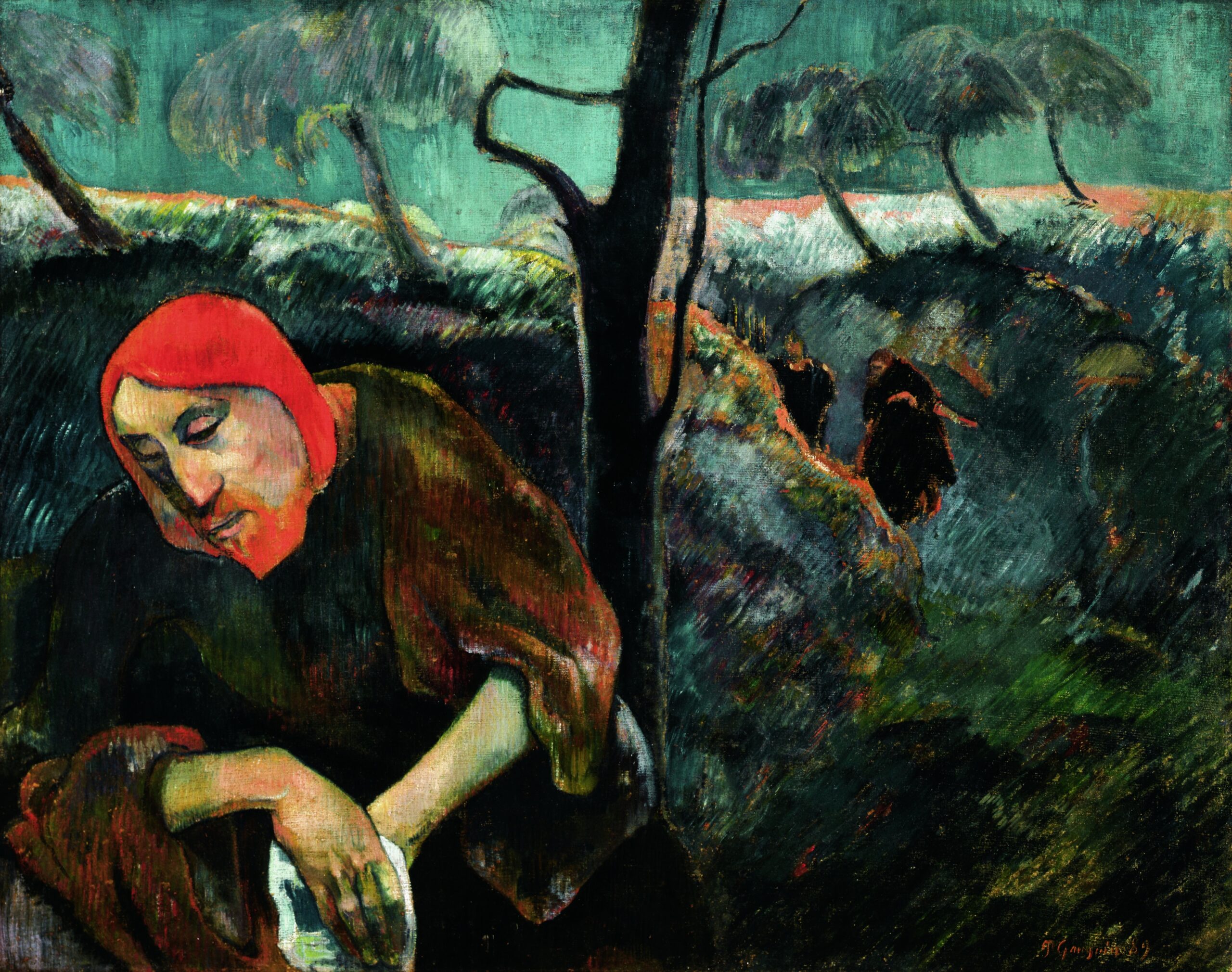
In 1889 Paul Gauguin painted Christ in the garden, in the moment just before the arrest. The figure sits at the lower left of the canvas, bowed forward, in a dark olive cloak, hands laid on a pale cloth in the lap. The hair is painted a bright vermilion red of a kind nature does not provide. Behind the figure a bare dark trunk rises, and at the right in the background two dark figures are walking away among the trees, one in a broad-brimmed hat. The sky is blue-green, and below it run a band of pale foliage and a narrow salmon stripe. The work is held by the Norton Museum of Art under accession number 46.5. The format is landscape – the museum states height first and width second, so 72.4 x 91.4 cm.
Who leaves and who stays
The whole content of the work lies in the relation between foreground and background. In front sits a single figure, bowed and motionless; behind, two others are moving off and no longer face towards it. Gauguin did not paint the event but the moment after it: here the abandonment is spatial, not narrative. That is exactly why the scene stays quiet, although it is one of the most dramatic moments of the story.
The red hair
The strongest colour on the canvas is not in the sky and not in the robe but in the hair. Gauguin laid it on in a flat vermilion, without transitions, so that the head springs out of the dark ground as a sign of colour. That red is also the only warm area in the upper half: if a reproduction softens it, the whole colour balance collapses.
Where the original is
The original is at the Norton Museum of Art, accession number 46.5, oil on canvas, measuring 72.4 x 91.4 cm. The museum record dates the work to 1889 and lists it as the gift of Elizabeth C. Norton. The museum record and the public art database agree on the measurement, the year and the accession number.
The signature on the canvas
In the lower right corner the signature P. Gauguin with the year 89 is painted in red. That corner is paint, not a label added later, and nothing was stamped on once the picture was finished. Because it belongs to the picture, our painter lays it in with the same brush as everything else.
How a hand-painted reproduction is made
Our hand-painted canvas art is made brushstroke by brushstroke, painted by hand in oils, with no printing at any stage. On this subject the face is the hardest part: the bowed head has to stay quiet and heavy, or the scene loses its silence and becomes merely a dark landscape. Before dispatch you receive a photograph of the finished piece for approval.
- Subject: a bowed, red-haired figure in the foreground, a bare trunk at the centre, two figures walking away at the right.
- Technique: oil on canvas, dark planes and a single decisive red.
- Sizes: landscape format, from 40 x 32 cm to 200 x 160 cm; the most frequently chosen are 80 x 64 cm and 100 x 80 cm.
- Of note: the red hair is painted flat and without shadow – the colour here is a sign, not a description of appearance.
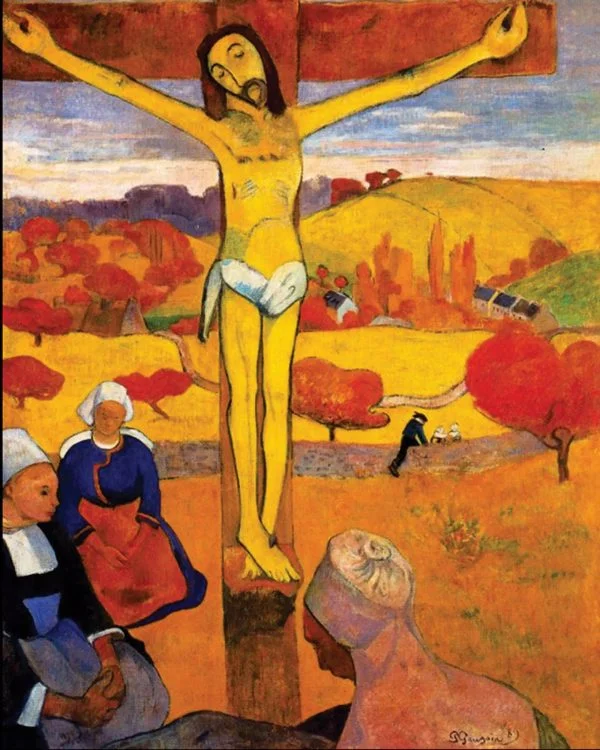
If the same period interests you, look also at The Green Christ, The Yellow Christ and Portrait of the Artist with the Yellow Christ, where Gauguin likewise paints a religious subject in Breton colour.