Description
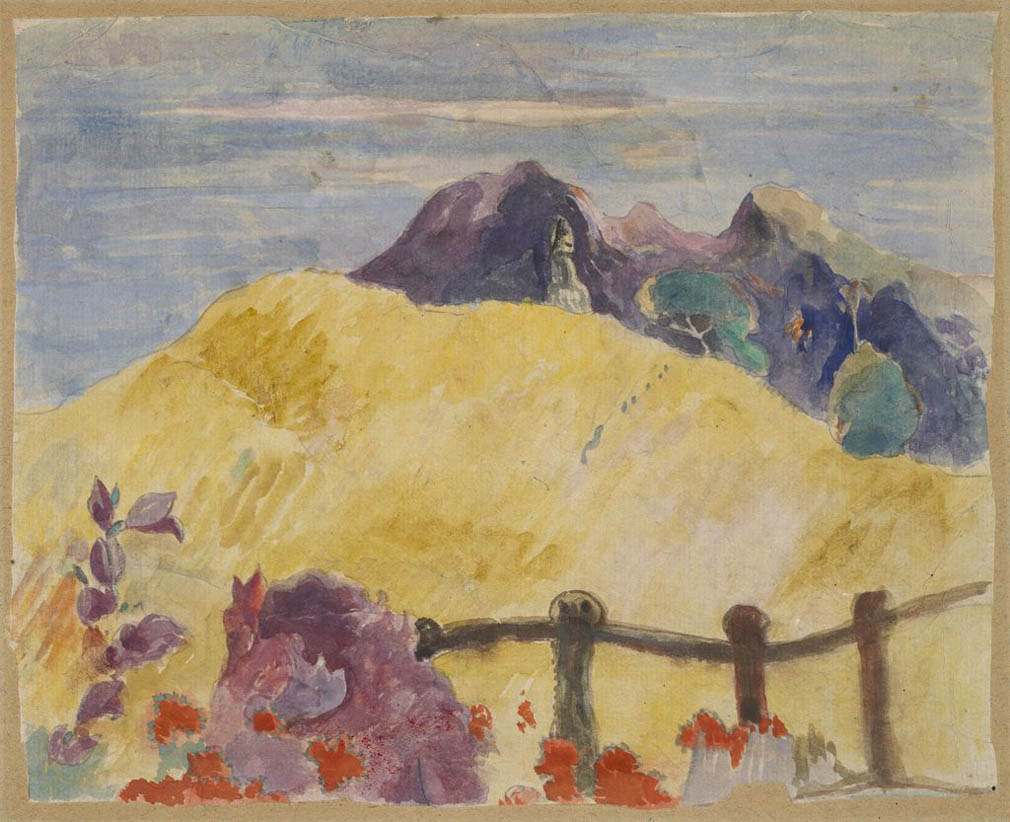
Paul Gauguin – There is the Temple (Parahi te marae) – hand-painted oil painting reproduction
This motif exists twice, and ours is the smaller of the two. Our source is a watercolour over graphite on Japanese paper, made in Tahiti around 1892, only 22.9 × 18.5 cm, held by the Harvard Art Museums / Fogg Museum. We paint the scene again by hand: a hand-painted oil painting reproduction, oil on canvas, never a print. The museum gives the measurement as height by width: 18.5 × 22.9 cm.
Sheet and canvas: two versions of one scene
Two works by Gauguin carry the name Parahi te marae. The better known is the large oil on canvas in the Philadelphia Museum of Art, catalogued there as The Sacred Mountain. Ours is not that canvas. Ours is the Harvard sheet — a transparent watercolour on Japanese paper, smaller than a sheet of writing paper, with the bare paper margins visible on all four sides. Anyone who knows the oil will spot the difference at once: there is no dark, almost black foreground here, and no richly carved fence.
What is on the sheet
A broad yellow hillside runs across the middle, laid in thin quick strokes that let the paper and the graphite show through in places. Behind it rises a violet-blue mountain, and in its cleft stands a pale upright figure — the idol that gives the picture its title. Green bushes sit on the right-hand slope; the sky is no more than a thinned blue wash pulled across in horizontal strokes. Along the bottom runs a plain timber post-and-rail fence, with purple foliage and red flowers beside it. The whole thing is made like a study: fast, transparent, with nothing corrected.
A scene that never existed
A marae is a Polynesian sacred enclosure. By the time Gauguin reached Tahiti in 1891 most of them were already in ruins, and this particular scene existed nowhere — he assembled it himself from different sources and from objects belonging to several parts of Polynesia. It is not a landscape you could find on a map but a setting he invented. That is exactly what makes the watercolour interesting: the same invented place exists on the large canvas too, but here we see it in its thin, quick form, in colour you can look straight through.
A hand-painted reproduction for your home
The yellow, violet and blue are soft and transparent here, so the picture does not shout — it works in a bedroom, in a study corner, or in a row of smaller pictures on a wall. The original sheet measures 22.9 × 18.5 cm; we paint it in eight sizes, which you choose in the selector above this text, and always as oil on canvas. From the same Tahitian years come Ia Orana Maria, where Gauguin sets a Christian scene among Tahitian women, and Spirit of the Dead Watching; where that road ended is told by Where Do We Come From? What Are We? Where Are We Going?
- Subject: Parahi te marae — There is the Temple, Paul Gauguin, around 1892, Tahiti
- Technique: hand-painted canvas, oil on canvas, a reproduction — never a print
- Original: watercolour over graphite on Japanese paper, 22.9 × 18.5 cm, Harvard Art Museums / Fogg Museum, acc. no. 1962.42, Bequest of Marian H. Phinney
- Detail worth knowing: a large oil on canvas in the Philadelphia Museum of Art carries the same title — our source is the Harvard sheet, not that canvas