







































Description
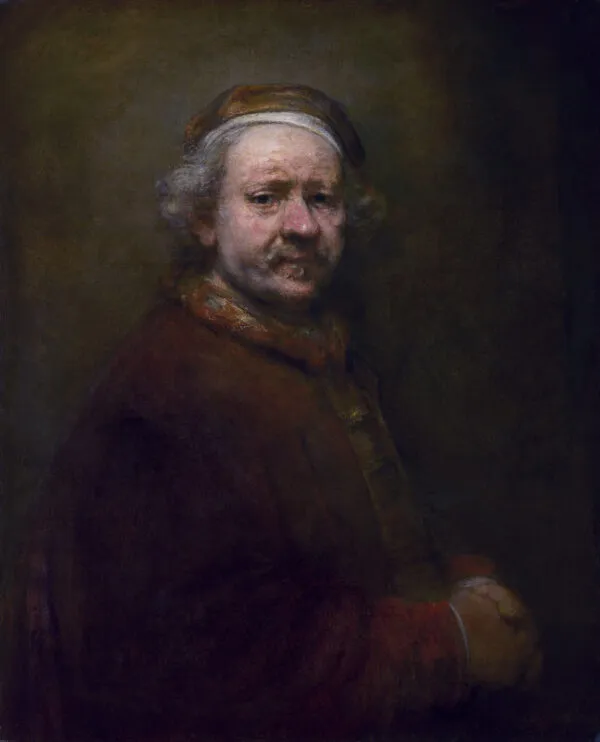
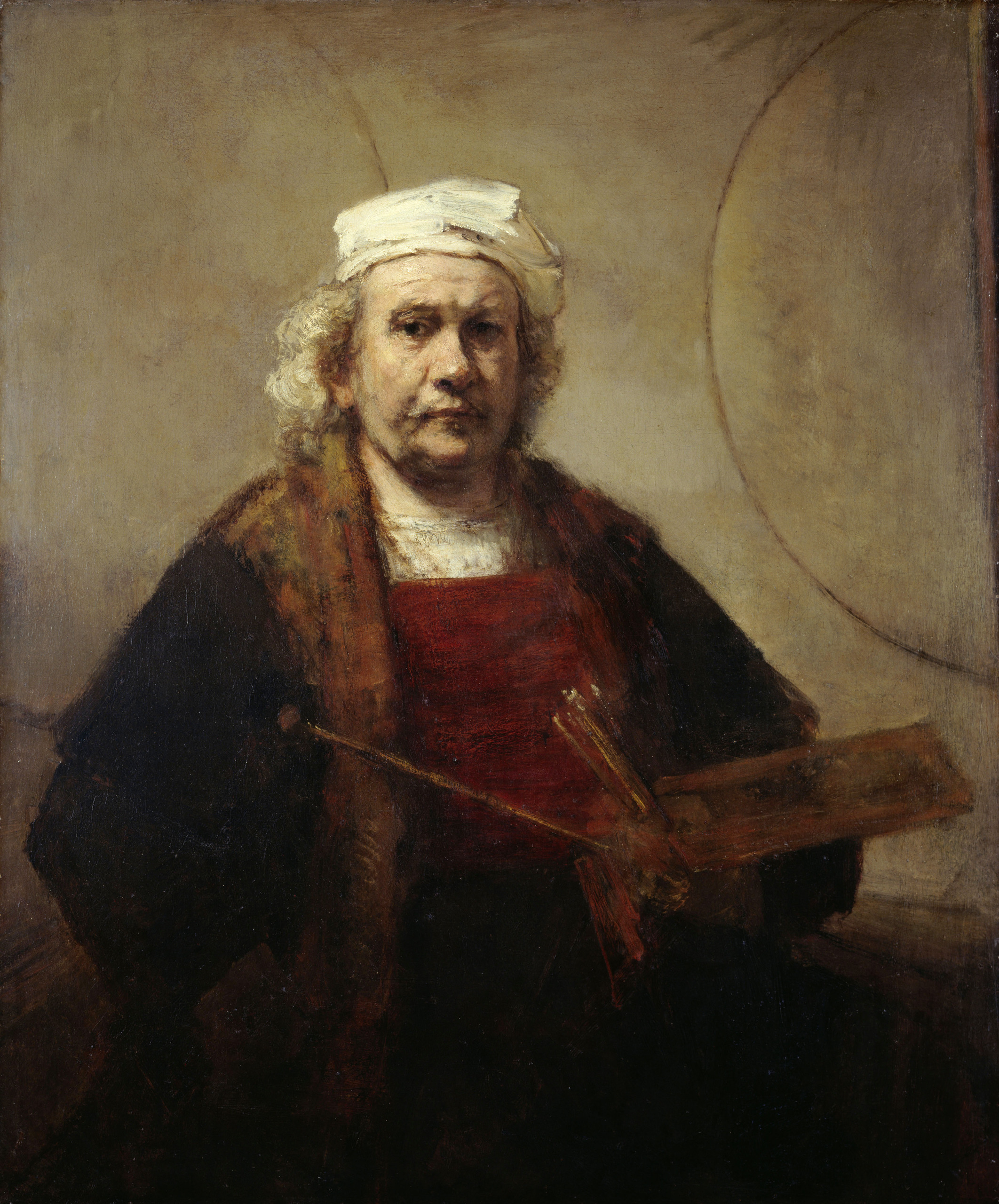
Self-Portrait with Two Circles is a late painting by Rembrandt from about 1665–1669: the painter stands before a pale wall with two large, unfinished circles, in a fur-lined robe and a white cap, one hand on his hip, holding his palette, brushes and maulstick. The original, oil on canvas, is 114.3 cm high and 94 cm wide and hangs at Kenwood House in London. We paint it by hand in oil on canvas in 8 portrait sizes, from 40 x 49 to 150 x 190 cm, or to your own measurement, and show it to you in a photograph before dispatch.
| Title: | Self-Portrait with Two Circles |
| Other titles: | Self Portrait with Two Circles · Zelfportret met twee cirkels |
| Painter: | Rembrandt van Rijn (1606–1669) |
| Year painted: | c. 1665–1669, Amsterdam |
| Original size: | 114.3 cm x 94 cm (height x width) |
| Original technique: | Oil on canvas |
| Painting style: | Baroque, Dutch Golden Age |
| Located at: | Kenwood House (English Heritage), London |
| Our reproduction: | Hand-painted oil on canvas, 8 sizes or made to measure |
Self-Portrait with Two Circles – Rembrandt
What does Self-Portrait with Two Circles show?
Rembrandt stands almost square-on and looks straight at us. On his head is a white cap like the one he wears in several late self-portraits; he wears a fur-lined robe over a red garment, with his left hand on his hip.
In the other hand he holds his palette, brushes and the maulstick on which a painter rests his hand for fine work. Behind him is a flat, pale surface on which the arcs of two large circles are drawn.
What do the circles mean?
Nobody knows, and that is exactly what makes the painting so compelling. One reading sees the two hemispheres of a world map, of the kind that hung in Dutch homes, but the circles are too far apart for that and carry no geographical marks.
Other readings recall the story of Giotto, who proved his skill to the pope by drawing a perfect circle in one stroke, or see in them a sign of perfection in art. The Wikipedia article reviews the theories.
Why is this self-portrait so powerful?
Because Rembrandt does not show himself as a tired old man here, but as a master standing confidently by his work. According to Wikipedia he looks almost defiant, hand on hip, as if asserting his worth.
X-rays show that he first painted himself at work on a canvas at the right-hand edge; later he changed the arm and body, making the figure calmer and more monumental. The painting is unsigned, which is unusual for one of his self-portraits.
Where is the original today?
At Kenwood House, on the edge of Hampstead Heath in north London, cared for by English Heritage. Admission, according to English Heritage, is free.
The painting was admired as early as the eighteenth century: Joshua Reynolds praised its colour and effect, and Jean-Honoré Fragonard painted a copy of it.
This self-portrait or another Rembrandt?
Self-Portrait with Two Circles suits a study, an office or a library, for anyone who likes to see work and self-confidence on the wall. Its quieter, final companion is the Self-Portrait at the Age of 63, from the year of Rembrandt’s death.
For a thoughtful male gaze there is Aristotle with a Bust of Homer, and for a great story The Return of the Prodigal Son and The Night Watch. Other self-portraits and famous Rembrandt paintings of every kind are on the Rembrandt page.
How does our painter paint your self-portrait?
This Rembrandt reproduction has to capture two things: the densely painted, many-coloured face and the quick, almost sketched hands with the palette. In oil on canvas the painter first builds up the face in thick layers, then the cap and the fur.
The background with the circles is painted calm and light, as in the original, the hands and palette with rapid strokes, so that the sense of the unfinished remains. An oil painting reproduction like this has a relief of paint that a paper print does not.
Which size is right for your room?
In short: 40 x 49 or 46 x 55 cm for a shelf, a table or a narrow wall, 60 x 70 or 73 x 92 cm above a desk or chest of drawers, 82 x 104 and 110 x 130 cm for the living room or office, and 120 x 150 and 150 x 190 cm for large walls.
There are 8 portrait sizes (width x height): 40 x 49, 46 x 55, 60 x 70, 73 x 92, 82 x 104, 110 x 130, 120 x 150 and 150 x 190 cm. The original is 94 cm wide and 114.3 cm high, so 82 x 104 cm is a little smaller and 110 x 130 cm a little larger. As a painting for the living room above a sofa, 82 x 104 cm works well.
Keep the face at the eye level of someone standing, with the centre of the painting about 150 to 155 cm from the floor.
Is another size or a frame possible?
Yes. The original is roughly 5 : 6 in proportion; in that ratio both circles and the palette stay on the canvas. Send us your size and we will reply with a price and a date.
You receive it rolled, on a stretcher bar or framed; our workshop in Slovenia handles the stretching and framing, as for every canvas painting. The 3D application is for comparing frames alone; seeing the self-portrait on your own wall is a service of its own. Dark wood brings out the fur and the cap, a gold frame the warmth of the face.
When will the painting be with me?
We paint the self-portrait when you order and dispatch it within 15 to 45 working days. It travels customs-free to every EU country. A photograph of the finished self-portrait reaches you before it leaves; we correct anything you want changed, and our returns policy covers every order.
For a painter celebrating an exhibition, a teacher retiring or a confident boss who should choose the size, there is the wall art voucher.
Frequently asked questions
Where is the original Self-Portrait with Two Circles?
At Kenwood House in London, cared for by English Heritage.
What is Rembrandt holding?
His palette, brushes and maulstick, the tools of a painter at work.
What do the circles in the background mean?
It is not known. Readings range from a world map to Giotto’s perfect circle.
How many self-portraits did Rembrandt paint?
According to Wikipedia more than 40 paintings, and about as many drawings and etchings.
Is it a print?
No, a hand-painted copy; the painter paints it with a brush in oil on canvas.
How big is the original?
It is 114.3 cm high and 94 cm wide. Our sizes run from 40 x 49 to 150 x 190 cm.
Which size suits an office?
For the wall behind a desk choose 73 x 92 or 82 x 104 cm.
Why is the painting unsigned?
Perhaps Rembrandt did not consider it finished; for one of his self-portraits the missing signature is unusual.
- Subject: Rembrandt with palette and brushes, hand on hip, before a wall with two large circles.
- Original: c. 1665–1669, oil on canvas, 114.3 x 94 cm, Kenwood House, London.
- Ours: painted by hand in oil on canvas, in 8 portrait sizes from 40 x 49 to 150 x 190 cm or made to measure.
- Worth knowing: Fragonard copied this painting, and Reynolds praised its colour.