







































Description
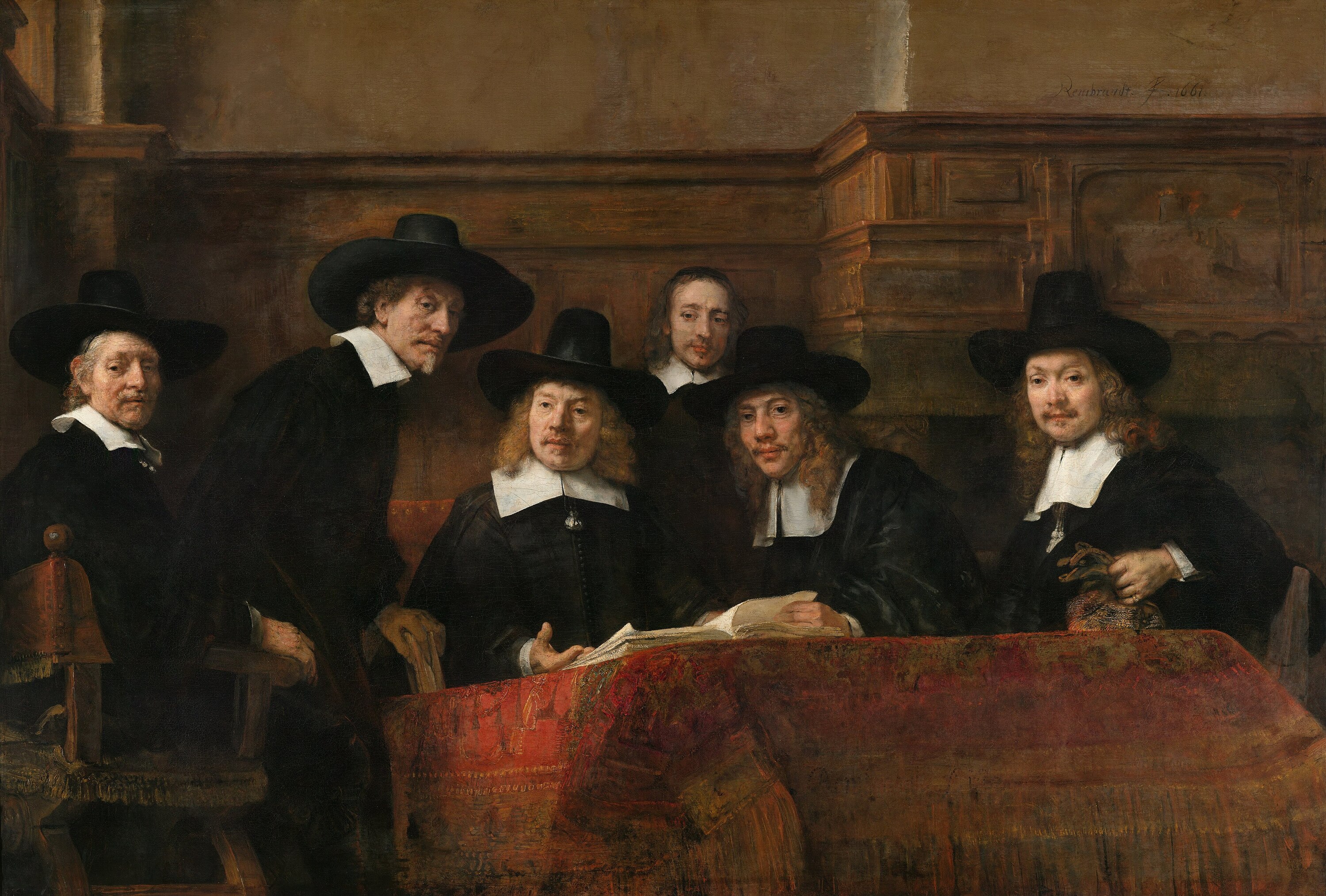
Syndics of the Drapers’ Guild is Rembrandt’s group portrait from 1662: five sampling officials of the Amsterdam drapers’ guild, in black with broad hats, sit at a table covered with a red Persian rug and an open book of samples, their servant stands behind them, and all of them look up as if we had interrupted them. The original, oil on canvas, is 191.5 cm high and 279 cm wide and hangs in the Rijksmuseum in Amsterdam. We paint it by hand in oil on canvas in 6 sizes, from 130 x 90 to 240 x 165 cm, or to your own measurement, and show it to you in a photograph before dispatch.
| Title: | Syndics of the Drapers’ Guild |
| Other titles: | The Sampling Officials of the Amsterdam Drapers’ Guild · De Staalmeesters |
| Painter: | Rembrandt van Rijn (1606–1669) |
| Year painted: | 1662, Amsterdam |
| Original size: | 191.5 cm x 279 cm (height x width) |
| Original technique: | Oil on canvas |
| Painting style: | Baroque, Dutch Golden Age |
| Located at: | Rijksmuseum, Amsterdam (acc. no. SK-C-6) |
| Our reproduction: | Hand-painted oil on canvas, 6 sizes or made to measure |
Syndics of the Drapers’ Guild – Rembrandt
What does Syndics of the Drapers’ Guild show?
Six men are gathered at a long table covered with a heavy red Persian rug. Five wear black with white collars and broad black hats; the sixth, standing at the back without a hat, is the servant. An open book of cloth samples lies on the table, and one of the men has just half risen from his chair.
The Rijksmuseum names them all, from left to right: Jacob van Loon, Volckert Jansz, Willem van Doeyenburg, the servant Frans Hendricksz Bel, Aernout van der Mye and Jochem de Neve. Behind them is the wooden panelling of the room, and on the right, above the fireplace, a painting of a burning beacon.
Why is this painting so well known?
Because Rembrandt turned an official portrait into a moment. The Rijksmuseum writes that he painted the officials looking up from their work as if interrupted by our arrival. That is why we feel they are looking at us.
He painted it in hard times: after financial difficulties in the 1650s he moved to a rented house on the Rozengracht, and the Amsterdam elite no longer knocked on his door as often. Yet he remained popular, and this important guild entrusted him with its portrait. The painting is also known far beyond museums, because it appears on the packaging of Dutch Masters cigars.
What does the painting mean, and who were the syndics?
The staalmeesters were inspectors of cloth quality. According to Wikipedia they compared cloth against samples and awarded one to four quality seals; the post was honorary and unpaid, for a one-year term that began on Good Friday. Among them were two Catholics, a Mennonite, a Remonstrant and a Reformed Protestant.
So the painting is a portrait of men who kept trade honest, and an image of trust. They look at us not sternly but attentively, as if assessing us too. There is more about them in the Wikipedia article on the painting.
Where is the original today?
In the Rijksmuseum in Amsterdam, under accession number SK-C-6. It is signed Rembrandt f. 1662; the museum also records a second, false signature dated 1661.
The guild commissioned it for itself, and according to Wikipedia it hung in the guild’s hall, the Staalhof, until 1771.
The Syndics or another Rembrandt – which should you choose?
The Syndics is a painting for a boardroom, an office or the long wall of a dining room, wherever people gather round a table. Its younger sister from the same museum is The Night Watch, and a group portrait from thirty years earlier is The Anatomy Lesson of Dr. Nicolaes Tulp.
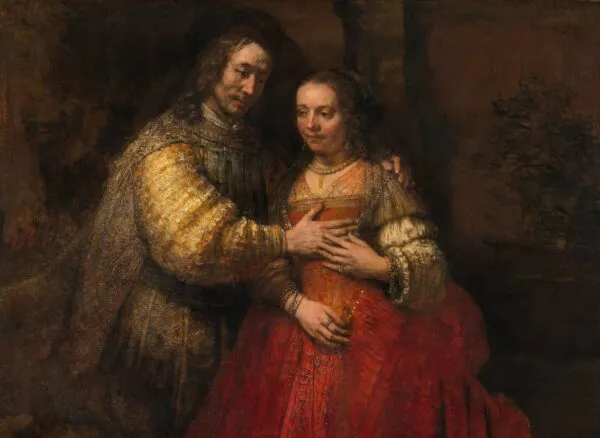
From the same late years come The Jewish Bride and the Self-Portrait at the Age of 63, Rembrandt’s last look at himself. The Rembrandt page brings all the famous Rembrandt paintings we make together.
How are our hand-painted Syndics made?
It is painted by hand by one of our painters, with brushes in oil on canvas. Because six faces sit in a row, the heads and eyes are placed precisely first, since every gaze has to meet the viewer; then come the wooden panelling and the black clothes.
The red Persian rug is a task of its own: its pattern and folds must look rich without drawing attention away from the faces. The result is an oil painting reproduction with layers of paint that a flat printed copy does not have.
Which size for which wall?
Short answer: 130 x 90 or 150 x 100 cm above a chest of drawers, a sofa or in an office, 163 x 116 or 190 x 130 cm for a large living-room or boardroom wall, and 210 x 148 and 240 x 165 cm for entrance halls, restaurants and large workplaces.
There are 6 landscape sizes (width x height): 130 x 90, 150 x 100, 163 x 116, 190 x 130, 210 x 148 and 240 x 165 cm. The original is 279 cm wide and 191.5 cm high; our largest size is 39 cm narrower and 26.5 cm lower. As a painting for the living room above a 2 m sofa, 150 x 100 cm works well, leaving enough space at the sides.
Hang it so that the faces are at about the eye level of a seated person, with the centre of the painting around 145 to 150 cm above the floor.
What if I need a custom size or a frame?
We can paint the Syndics in another size; because the painting is very wide, we suggest the proportions of the original, about 3 : 2, so that all six men stay on the canvas. Send us your width and height and we will give you a price and a date.
We send this canvas painting rolled, stretched on a wooden stretcher bar or framed; the stretching and framing are done by our workshop in Slovenia. Try the frames in the 3D application, which is only for choosing the frame; viewing it on your own wall is a separate service. A dark wooden moulding echoes the panelling behind the men, while a gold one brings out the red rug.
How does delivery work, and what is the guarantee?
We start painting when you order, so allow 15 to 45 working days. Delivery is customs-free to any EU country. You receive the photograph of the finished painting before dispatch; whatever you are not happy with we correct, and our returns policy applies to every order.
As a gift for a company, a business partner’s anniversary or the opening of an office, when the size is not yet settled, there is a wall art voucher.
Frequently asked questions
Where is the original Syndics of the Drapers’ Guild?
In the Rijksmuseum in Amsterdam, accession number SK-C-6. The guild kept it in its own hall until 1771.
Who are the men in the painting?
Five cloth-quality inspectors of the Amsterdam drapers’ guild and their servant: Jacob van Loon, Volckert Jansz, Willem van Doeyenburg, the servant Frans Hendricksz Bel, Aernout van der Mye and Jochem de Neve.
Why are they called staalmeesters?
After the cloth samples (staal) they compared fabrics against. They marked the quality with one to four seals, Wikipedia says.
Is your Syndics a print?
No. It is a hand-painted copy in oil on canvas, made by a painter for you, with real brushstrokes.
Why is the painting on Dutch Masters cigars?
Because it became a symbol of the Dutch trading tradition; Wikipedia notes that it appears on the packaging of that cigar brand.
How big is the original?
It is 191.5 cm high and 279 cm wide. Our sizes run from 130 x 90 to 240 x 165 cm, and larger ones we paint to measure.
Which size suits a boardroom?
On the long wall of a boardroom, choose 190 x 130 or 210 x 148 cm so that the faces are clear from the table. For a smaller office, 150 x 100 cm is enough.
Does it make a good corporate gift?
Yes, it shows respected men who looked after quality and honesty, which makes it a popular gift for a company anniversary. If you do not know the size, choose the wall art voucher.
- Subject: five sampling officials of the Amsterdam drapers’ guild and their servant look up at us from a table with a red Persian rug.
- Original: 1662, oil on canvas, 191.5 x 279 cm, Rijksmuseum, Amsterdam.
- Ours: a Rembrandt reproduction painted by hand in oil on canvas, in 6 landscape sizes from 130 x 90 to 240 x 165 cm or made to measure.
- Worth knowing: the officials served for one year and worked without pay.