







































Description
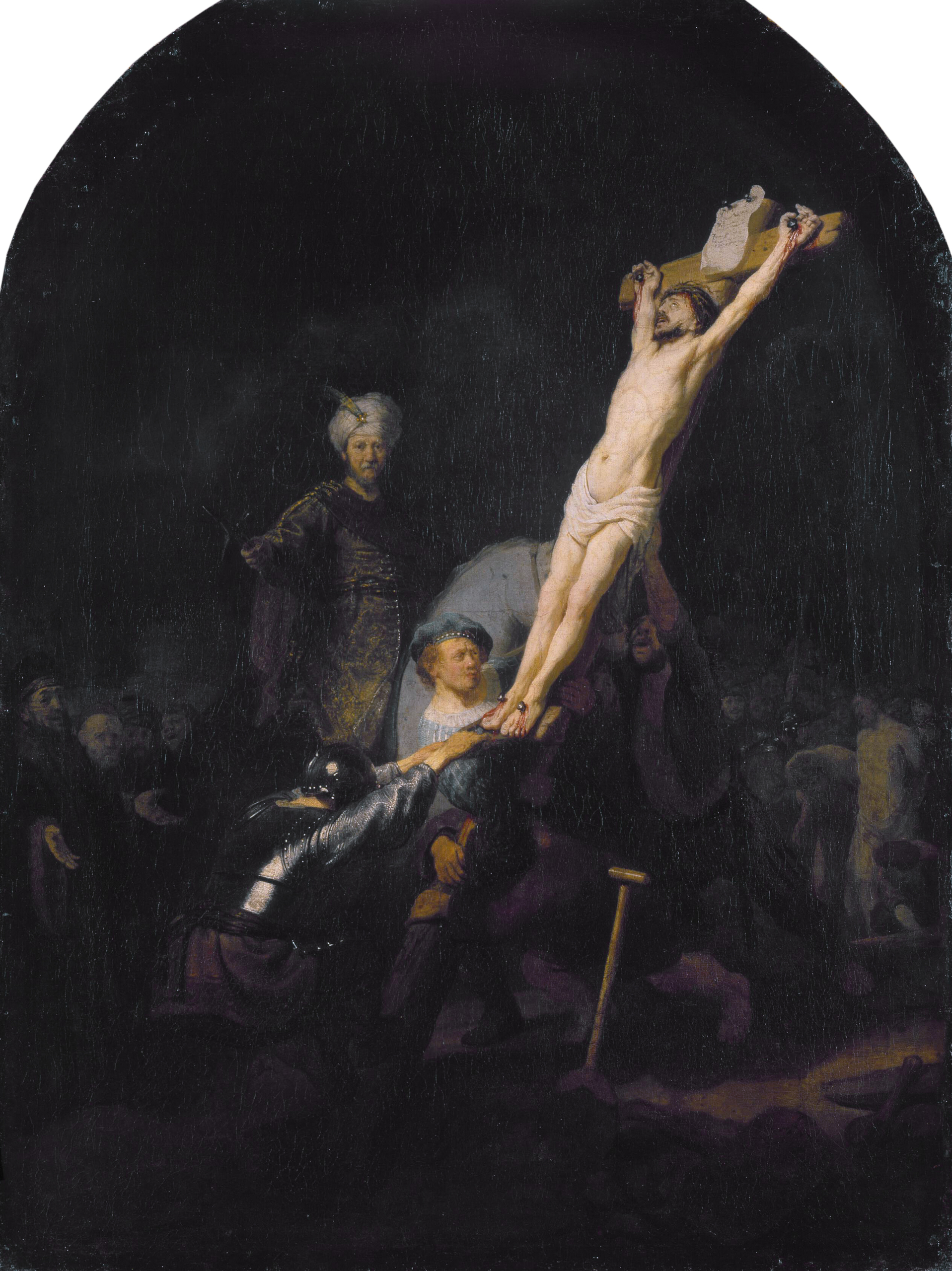
The Raising of the Cross is Rembrandt’s painting from about 1633: in the darkness of night executioners raise the cross with Christ, on whom all the light falls, and a man in a blue beret has, according to old descriptions, Rembrandt’s own features. The original, oil on canvas with a rounded top, is 96.2 cm high and 72.2 cm wide and belongs to the Alte Pinakothek in Munich. We paint it by hand in oil on canvas in 8 portrait sizes, from 40 x 55 to 156 x 200 cm, or to your own measurement, and show it to you in a photograph before dispatch.
| Title: | The Raising of the Cross |
| Other titles: | Die Kreuzaufrichtung · The Elevation of the Cross |
| Painter: | Rembrandt van Rijn (1606–1669) |
| Year painted: | c. 1633, Amsterdam |
| Original size: | 96.2 cm x 72.2 cm (height x width) |
| Original technique: | Oil on canvas |
| Painting style: | Baroque, Dutch Golden Age |
| Located at: | Alte Pinakothek, Munich (inv. 394) |
| Our reproduction: | Hand-painted oil on canvas, 8 sizes or made to measure |
The Raising of the Cross – Rembrandt
What does The Raising of the Cross show?
In the centre the cross with Christ rises, his eyes turned upward, the only bright body in the dark. Four men lift it: on the left one in armour and helmet, in the middle a man in light blue with a blue beret, and two in shadow support it from behind.
Behind them a Roman centurion on horseback wears rich Eastern dress with a turban and gold brocade, Pharisees watch from the half-shadow on the left, and far off on the right soldiers bring up the two thieves. A spade stands in the ground in front.
Why is Rembrandt himself in the painting?
Because the man in the blue beret in the centre, straining with all his strength against the cross, has, according to Hofstede de Groot’s description of 1915, the features and familiar blue cap of the painter. Wikipedia gives this reading.
So Rembrandt placed himself among those who raise the cross: not as an onlooker but as a participant. It is one of the most personal touches in his biblical paintings.
Who was the painting made for?
For Prince Frederick Henry of Orange, stadtholder of the United Provinces, as part of the so-called Passion cycle of six paintings. The Alte Pinakothek writes that the cycle is not a closed whole, because central events of Christ’s life are missing.
The Raising of the Cross was painted around 1633 together with its pendant, The Descent from the Cross. According to Wikipedia they are rare Rembrandt paintings with an unbroken provenance from completion to today. The history of both pendants is told in the Wikipedia article on The Raising of the Cross.
Where is the original, and how did it reach Munich?
In the Alte Pinakothek in Munich, inventory number 394, in Room IX. The Raising of the Cross came to Munich in 1806 from the Düsseldorf gallery.
Before that it belonged to the Elector Palatine Johann Wilhelm, and before him to the House of Orange, for whom Rembrandt painted it.
How do we paint the rounded top of the original?
The original has a round-arched top, which is why the upper corners are white in the photograph of the original. On the rectangular canvas we paint the arch as in the original and fill both upper corners with the dark tone of the background, so that the painting is neatly finished.
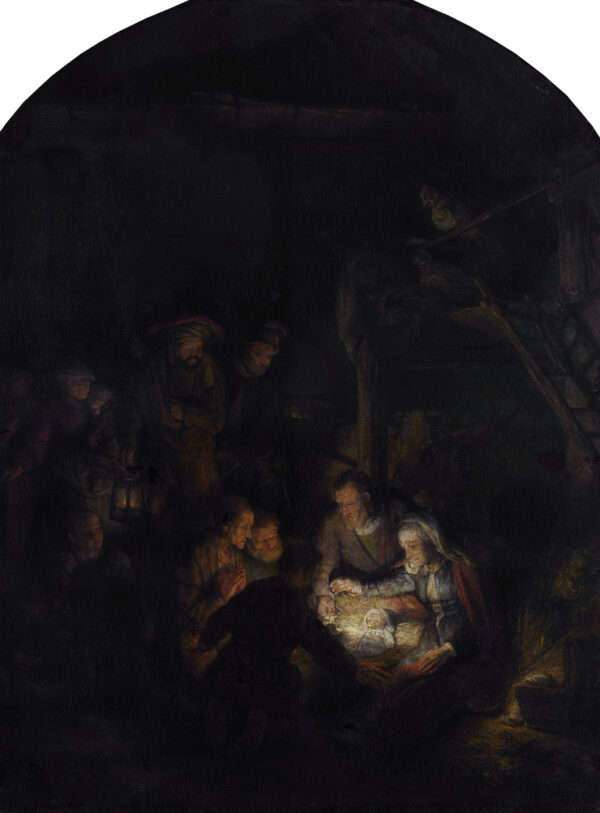
The Raising of the Cross suits a place of prayer, a chapel, a parish hall or a collector of biblical scenes. Its companion from the same cycle is The Adoration of the Shepherds, a biblical miracle in the dark is The Raising of Lazarus, and forgiveness The Return of the Prodigal Son. The Blinding of Samson is linked to the delay of this cycle too; all the famous Rembrandt paintings we paint are on the Rembrandt page.
How does our painter paint your Raising of the Cross?
This Rembrandt reproduction begins with the darkness: in oil on canvas the painter first lays in the dark ground and the clouds, and only then the bright body on which all the light falls.
Next come the metallic glints of the armour, the centurion’s gold brocade and the blue of Rembrandt’s clothes. An oil painting reproduction like this has a depth of darkness that a paper print does not reach.
Which size is right for your room?
In short: 40 x 55 or 47 x 62 cm for a narrow wall or a prayer corner, 60 x 81 or 68 x 90 cm above a chest of drawers, 84 x 115 and 105 x 145 cm for a larger wall, and 120 x 160 and 156 x 200 cm for chapels and church spaces.
There are 8 portrait sizes (width x height): 40 x 55, 47 x 62, 60 x 81, 68 x 90, 84 x 115, 105 x 145, 120 x 160 and 156 x 200 cm. The original is 72.2 cm wide and 96.2 cm high, so 68 x 90 cm is almost its size. As a painting for the living room, 84 x 115 cm works well.
Because the painting is very dark, hang it under a light or near a window, with its centre about 155 cm from the floor.
Can I choose another size or a frame?
Yes. The original is roughly 3 : 4 in proportion; in that ratio the cross, the centurion and the arch at the top all stay. Tell us the size you want for The Raising of the Cross and we will quote a price and a delivery date.
We send The Raising of the Cross rolled, on a stretcher bar or framed; our workshop in Slovenia prepares every canvas painting. You compare frames for The Raising of the Cross in the 3D application, which is only for that; seeing it on your own wall is a separate service. Dark wood stresses the night, a gold frame the light on Christ’s body.
When will the painting be with me?
We paint The Raising of the Cross to order and dispatch it within 15 to 45 working days; the parcel with it travels customs-free across the EU. Once it is painted you receive a photograph; whatever you would like different, we correct, and our returns policy applies to every order.
For a parish, for Easter or for someone who should choose the size, there is the wall art voucher.
Frequently asked questions
Where is the original Raising of the Cross?
In the Alte Pinakothek in Munich, inventory number 394.
Is Rembrandt in the painting?
The man in the blue beret in the centre has, according to a description of 1915, the painter’s features.
Who did Rembrandt paint it for?
For Prince Frederick Henry of Orange, as part of the Passion cycle.
Why are the top corners white in the museum photograph?
Because the original has a rounded top; in our painting we fill the corners with the dark tone of the background.
Is your Raising of the Cross a print?
No, it is a hand-painted copy: the painter brushes the cross, the executioners and the centurion in oil on canvas.
How big is the original?
It is 96.2 cm high and 72.2 cm wide. Our sizes run from 40 x 55 to 156 x 200 cm.
Which size suits a chapel?
For a chapel or a parish hall choose 120 x 160 or 156 x 200 cm.
Who would like it as a gift?
Parishes, religious communities and anyone close to the Passion.
- Subject: executioners raise the cross with Christ in the darkness of night, Rembrandt among them in a blue beret.
- Original: c. 1633, oil on canvas with a rounded top, 96.2 x 72.2 cm, Alte Pinakothek, Munich.
- Ours: painted by hand in oil on canvas, in 8 portrait sizes from 40 x 55 to 156 x 200 cm or made to measure.
- Worth knowing: the painting was commissioned by Prince Frederick Henry of Orange.