







































Description
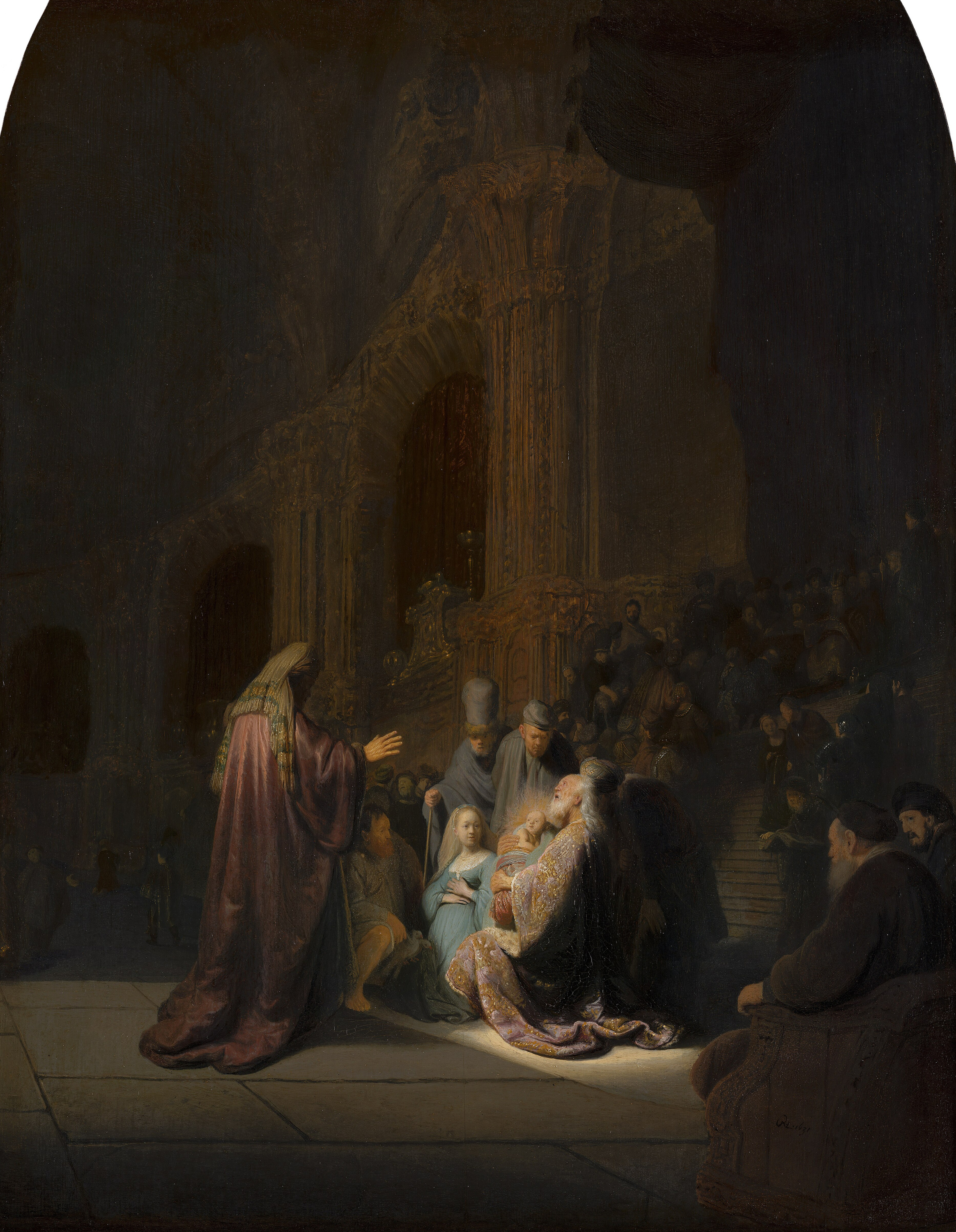
Simeon’s Song of Praise is Rembrandt’s painting of 1631: in a vast dark church old Simeon kneels with the infant Jesus in his arms, a shaft of light falls on them both, and Mary and Joseph listen to him. The original, oil on panel, is 60.9 cm high and 47.9 cm wide and belongs to the Mauritshuis in The Hague. We paint it by hand in oil on canvas in 7 portrait sizes, from 97 x 122 to 205 x 249 cm, or to your own measurement, and send you a photograph of it before dispatch.
| Title: | Simeon’s Song of Praise |
| Other titles: | Het loflied van Simeon · Simeons Lobgesang |
| Painter: | Rembrandt van Rijn (1606–1669) |
| Year painted: | 1631, Leiden |
| Original size: | 60.9 cm x 47.9 cm (height x width) |
| Original technique: | Oil on wood panel |
| Painting style: | Baroque, Dutch Golden Age |
| Located at: | Mauritshuis, The Hague (inv. 145) |
| Our reproduction: | Hand-painted oil on canvas, 7 sizes or made to measure |
Simeon’s Song of Praise – Rembrandt
What does Simeon’s Song of Praise show?
A scene from the Gospel of Luke (2:25–33): Mary and Joseph bring the newborn Jesus to the temple in Jerusalem, where the old man Simeon recognises him as the promised Messiah, takes him in his arms and bursts into a song of praise. In the painting Simeon, in a gold-embroidered cloak, kneels right of centre, lifts his head into the shaft of light and holds the child.
To his left kneels Mary in blue, looking up in surprise, and behind her sits Joseph with two turtle-doves for the offering. At the front left stands a tall figure in a red-violet cloak with an outstretched arm, a bearded man sits in an armchair at the lower right, and worshippers crowd the steps in the darkness on the right.
Why are the people so small in the great space?
Because Rembrandt set the group in a vast Gothic church which, the Mauritshuis says, recalls the Hooglandse Kerk or the Pieterskerk in Leiden. The bright little group below looks tiny against the pillars and vaults that disappear into the dark.
Only as the eye adjusts does it find the details in the shadow: the worshippers on the steps to the right and the high priest seated under a large canopy at the top of the steps.
How old was Rembrandt when he painted it?
Twenty-five. The Mauritshuis writes that it is one of the last paintings he made in his home town of Leiden before he moved to Amsterdam the same year, where he began to paint much larger works and his first portraits.
The story of Simeon stayed with him all his life: according to the museum he returned to it in paintings, drawings and prints. The monogram RHL and the date 1631 are at the lower right, on the side of the armchair.
Why are the upper corners cut off?
Rembrandt painted it on a rectangular panel. In 1733 Prince William IV of Orange acquired it; it hung as a pendant to a painting by Gerrit Dou with rounded upper corners, so its corners were sawn off and a rounded piece was added.
The 1989 restoration returned the painting to its original size, but the sawn-off corners still show in the photograph of the original. On our canvas we complete them in the dark tone of the church interior, so you receive the whole rectangle as Rembrandt laid it out.
How did the painting reach the Mauritshuis?
According to the museum it probably belonged first to the stadtholder Frederick Henry, then to the Hague collector Adriaan Bout, at whose sale in 1733 it went to Prince William IV. The French took it to the Louvre in 1795, it came back in 1815, and it has been in the Mauritshuis since 1822.
More about the painting and its provenance is on the museum’s page, which we link above with the details of the original.
How does the painter paint your Simeon’s Song of Praise?
The painter who makes this Rembrandt reproduction first builds up the dark pillars and vaults in oil on canvas, then the stone floor with the bright patch under the group, and only at the end the tiny faces and the gold pattern of Simeon’s cloak.
Because the original is so small, he has to keep the small figures crisp as he enlarges them. An oil painting reproduction like this shines under a lamp differently from a paper print.
Which size is right for your home?
The original measures only 47.9 x 60.9 cm, and all our sizes are larger. You choose from 7 portrait sizes (width x height): 97 x 122, 110 x 135, 120 x 155, 137 x 170, 150 x 195, 180 x 220 and 205 x 249 cm.
97 x 122 or 110 x 135 cm suits the wall above a sofa or a chest of drawers; as a painting for the living room with a higher ceiling, 120 x 155 cm is right. 137 x 170 and 150 x 195 cm fill a large wall or a stairwell, and 180 x 220 and 205 x 249 cm are for halls, chapels and churches.
In a larger size the small worshippers on the steps come into their own; in the small original you hardly see them.
Can I order another size or a frame?
Yes. Simeon’s Song of Praise is about 4 : 5 in proportion, which we keep in every size so that the group below and the dark vaults above stay. Write to us with the size of Simeon’s Song of Praise you want and we will prepare an offer.
We deliver Simeon’s Song of Praise rolled, on a stretcher bar or framed; our workshop in Slovenia prepares every canvas painting for the journey. Try frames for it in the 3D application, which is only for choosing a frame; seeing it on your own wall is a separate service. A rich gold frame goes with the golden cloak, a plain dark one with the dusk of the church.
How long until I receive the painting?
We begin painting Simeon’s Song of Praise as soon as you order and dispatch it within 15 to 45 working days; the parcel with Simeon’s Song of Praise goes customs-free across the EU. When it is painted you receive a photograph and can ask for a correction; our returns policy applies to every order.
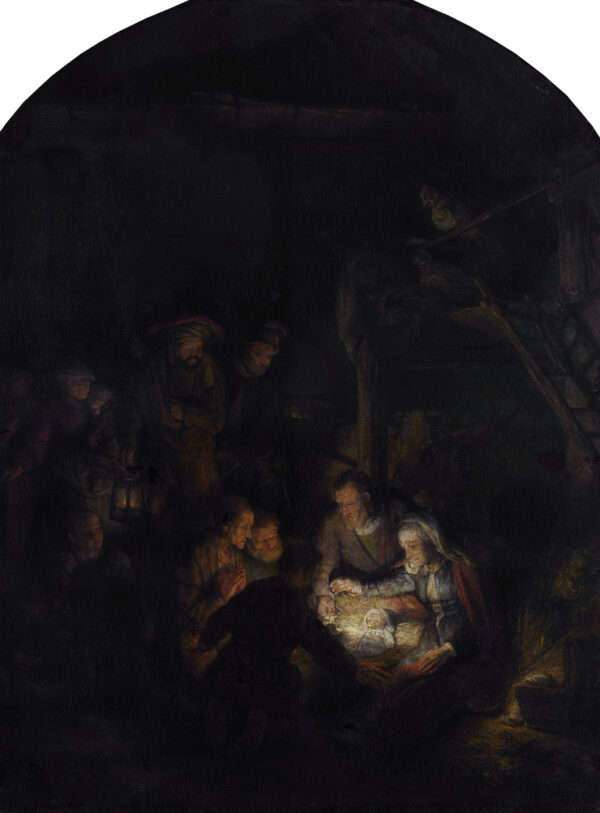
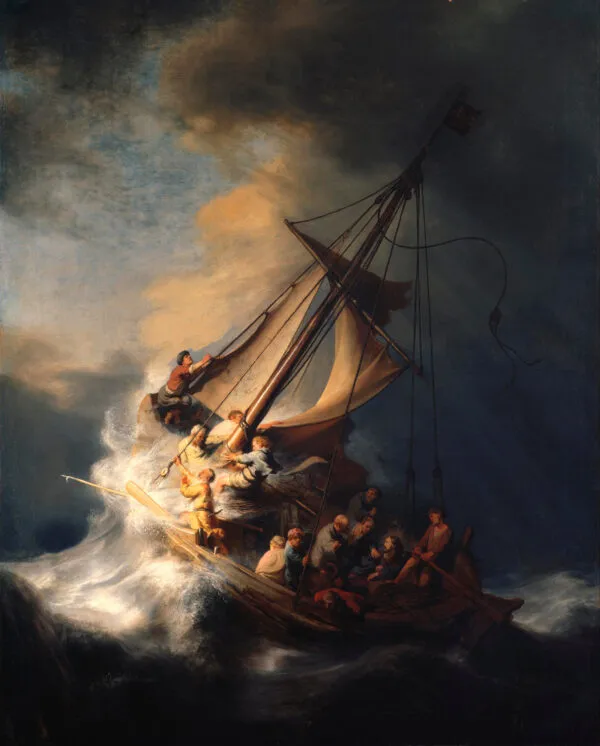
More biblical paintings: The Adoration of the Shepherds, The Visitation, and from the same Leiden years Jeremiah Lamenting the Destruction of Jerusalem and The Storm on the Sea of Galilee. All the famous Rembrandt paintings we paint are on the Rembrandt page, and for a christening or confirmation gift there is the wall art voucher.
Frequently asked questions
Where is the original Simeon’s Song of Praise?
In the Mauritshuis in The Hague, inventory number 145.
Which biblical scene does it show?
Simeon takes the infant Jesus in his arms in the temple and sings his song of praise (Luke 2:25–33).
How old was Rembrandt?
Twenty-five; the painting is one of the last of his Leiden years.
Why are the corners cut off in the photograph?
They were sawn off in the 18th century; in our painting we complete them so the rectangle is whole.
Is your Simeon’s Song of Praise printed?
No, it is a hand-painted copy; the painter paints it with a brush in oil on canvas.
How small is the original?
Only 60.9 x 47.9 cm; our smallest size is 97 x 122 cm.
Which size for a church or a hall?
Best 180 x 220 or 205 x 249 cm.
Who would like Simeon’s Song of Praise as a gift?
Parents at the birth or christening of a child, and parishes.
- Subject: old Simeon holds the infant Jesus in a shaft of light in the temple, with Mary and Joseph beside him.
- Original: 1631, oil on panel, 60.9 x 47.9 cm, Mauritshuis, The Hague.
- Ours: painted by hand in oil on canvas, in 7 portrait sizes from 97 x 122 to 205 x 249 cm or made to measure.
- Worth knowing: Rembrandt was 25 when he painted it.