















Description
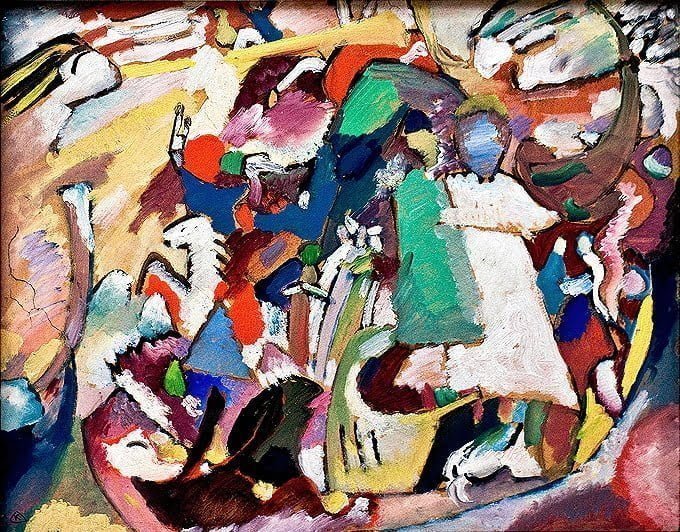
All Saints I is a painting by Wassily Kandinsky from the summer of 1911: a horizontal composition in which green, white, red, blue and yellow patches interlock in dense, short strokes, while a long golden band reaches in from the upper left. The original is held by the Lenbachhaus in Munich. We make it as a hand-painted reproduction in oil on canvas, in eight sizes or made to measure, and before dispatch you receive a photograph of the finished work to approve.
| Title: | All Saints I |
| Other titles: | Allerheiligen I · Jüngster Tag |
| Painter: | Wassily Kandinsky (1866–1944) |
| Year: | 1911 |
| Original size: | 64.8 cm x 50 cm |
| Original technique: | Oil and gouache on cardboard |
| Style: | Expressionism (Der Blaue Reiter) |
| Location: | Lenbachhaus, Munich (inv. no. GMS 71) |
| Our reproduction: | hand-painted oil on canvas, 8 sizes from 40 x 30 cm to 150 x 120 cm, made to measure on request |
All Saints I – Wassily Kandinsky
What is the painting about?
The museum reads it as two subjects at once. According to its record, Kandinsky combined the feast of All Saints with the Last Judgement in his own way and set the work at the end of time; he also called it Jüngster Tag, the Last Day. The starting point was a painting on glass: in two letters to Gabriele Münter in the summer of 1911, Kandinsky himself names it as the origin. On the cardboard, the museum says, he repeats the scene from the glass in a veiled and partly altered form, so the figures have to be searched for. The museum adds, cautiously, that with such veiled forms he may have wanted to express the last truth of the work.
What can be seen in the painting?
At first sight it looks like an abstract painting: the surface is almost entirely covered in short, thick strokes, with no empty ground. At the upper left a long yellow-gold band runs from the corner across the work towards the centre; by the edge sits a dark form with yellow and white stripes. At the upper right a large olive-brown arc curves. The centre is taken up by a large green area and a white one, with a bluish-grey head above the white. Left of centre stands a white jagged form, above it an orange-red circle and a blue patch, lower down a small blue triangle. At the bottom a dark brown, almost black mass winds along, with a yellow form to its right. Along the right edge run a yellow strip and red and pink patches; in the bottom left corner is the monogram K in a triangle. In these forms the museum recognises two large embracing saints in the middle, smaller groups of people beside them, below a female half-figure in a yellow cowl stretching out her arm, on the left the armed St George on a white horse with a walnut-sized boat with a blue sail before him, and above everything the collapsing towers of the city on the hill.
Why two angels with trumpets?
According to the museum two angels with huge instruments frame the scene from above, and the golden trumpet of the one on the left reaches far into the work. That is the long golden band at the upper left. The museum calls this motif decisive for the whole group of subjects, because it links All Saints with the trumpets of the Last Judgement. The large arc at the upper right can be read as the second angel’s instrument.
When and where was it painted?
The museum dates the work to July or August 1911. It belongs to Kandinsky’s fruitful years in Murnau, and in the museum’s words Christian motifs entered his work from 1910: St George, the Apocalypse and the Last Judgement. These motifs then passed, in veiled form, into his great abstract works before the First World War, first into Composition V, later into Compositions VI and VII. The museum also sees them as a key to the Der Blaue Reiter movement, which was looking for a new, spiritual era of art.
Who has owned the painting?
The museum publishes the provenance. Kandinsky passed it to Gabriele Münter, who kept it in Murnau from 1926 to 1957. In 1957 she gave it to the Städtische Galerie im Lenbachhaus in Munich, where it is registered under inventory number GMS 71. The same museum also owns All Saints II, a larger oil on canvas from the same year.
How is our hand-painted version made?
The original is painted in oil and gouache on cardboard; we paint it in oil on canvas, so the surface differs a little while the colours and proportions stay. The painter works from a high-resolution reference and builds the painting up in layers. With this subject what matters is the dense, impetuous stroke: almost nowhere is there a calm area, every patch has to keep the direction of the brush, and the golden band must stay the lightest part at the top. An oil painting reproduction keeps its colours for many years, because oil does not fade the way a print does. Since every reproduction is made individually, no two copies match down to the last detail; the subject, the proportions and the colours do.
Which size for which wall?
The original measures 64.8 x 50 cm; at our 65 x 50 cm size the width is 2 mm greater and the height the same. As a painting for the living room it works best at 80 x 60 or 90 x 70 cm, where the strokes read well from a distance. The 40 x 30 and 50 x 40 cm sizes suit a desk or a hallway, 65 x 50 and 70 x 50 cm a bedroom, and 120 x 90 and 150 x 120 cm large walls. Because the work is so colourful, it wants a calm wall with no other works beside it.
Custom sizes, stretcher and frame
If none of the eight sizes fits your wall, we paint this Kandinsky reproduction to your measurements; that is our painting made to measure, and we tell you how the scene adapts to the new proportions. Every canvas is stretched on a wooden stretcher. A frame is optional and not included in the base price.
Delivery and guarantee
Because every painting on canvas is painted only after the order, in our studio in Slovenia, allow 15 to 45 days depending on the size you choose. We ship protected, insured and tracked, within the EU without customs. If anything is wrong on arrival, get in touch and we will put it right. All our works by Kandinsky are collected in the Wassily Kandinsky gallery, and the painter is introduced in our article about Wassily Kandinsky. Related works we paint include Composition V, Composition VI and Composition VII.
Frequently asked questions
Where is the original?
It belongs to the Städtische Galerie im Lenbachhaus in Munich, inventory number GMS 71, as part of Gabriele Münter’s gift of 1957. The museum’s record is on the Lenbachhaus website.
How big is the original?
It measures 64.8 x 50 cm. We give the width first; the museum puts the height first, 50 x 64.8 cm. At our 65 x 50 cm size the width is 2 mm greater and the height the same.
When was the painting made?
In July or August 1911, during his Murnau years. It is signed at the lower left with the monogram K in a triangle.
What does the painting show?
According to the museum, All Saints and the Last Judgement at once: two embracing saints, St George on a white horse, a boat with a blue sail, falling towers and two angels with trumpets, hidden in dense strokes of colour.
Is this a print?
No. It is a canvas painting, painted by hand in oil; the brushstrokes show in raking light and can be felt with the fingertips.
Which size should I choose?
For a living room 80 x 60 and 90 x 70 cm work best, for a desk or hallway 40 x 30 or 50 x 40 cm. Before deciding, tape a sheet of paper of the chosen size to the wall and leave it there for a day.
Can I have a size that is not on the list?
Yes. We also paint sizes outside the list and tell you how the forms will be arranged.
How is it delivered?
Insured and tracked, within the EU without customs. Before dispatch you receive a photograph of the finished painting to approve.
Why is the original on cardboard and yours on canvas?
Kandinsky painted this work in oil and gouache on cardboard. We paint in oil on stretched canvas, which is more durable and can be framed without glass.
Is the original for sale, and what is it worth?
It is not for sale and has no market price. It belongs to a public museum collection and stays there; what we offer is a hand-painted copy, not the original, and we never confuse the two.
Is the painting suitable as a gift?
Yes, especially for someone who loves vivid colour and works that tell a story. If you are unsure about the subject or the size, there is a gift voucher, and the choice stays with the person who receives it.
- Subject: All Saints and the Last Judgement: embracing saints, St George on a white horse, angels with trumpets, in dense strokes of colour
- Original: Lenbachhaus, Munich, inv. no. GMS 71, 1911, oil and gouache on cardboard, 64.8 x 50 cm
- Our version: hand-painted oil on canvas, eight sizes from 40 x 30 to 150 x 120 cm, on a wooden stretcher, framed on request
- Worth knowing: Kandinsky also called it the Last Day; it grew out of his own painting on glass