






Description
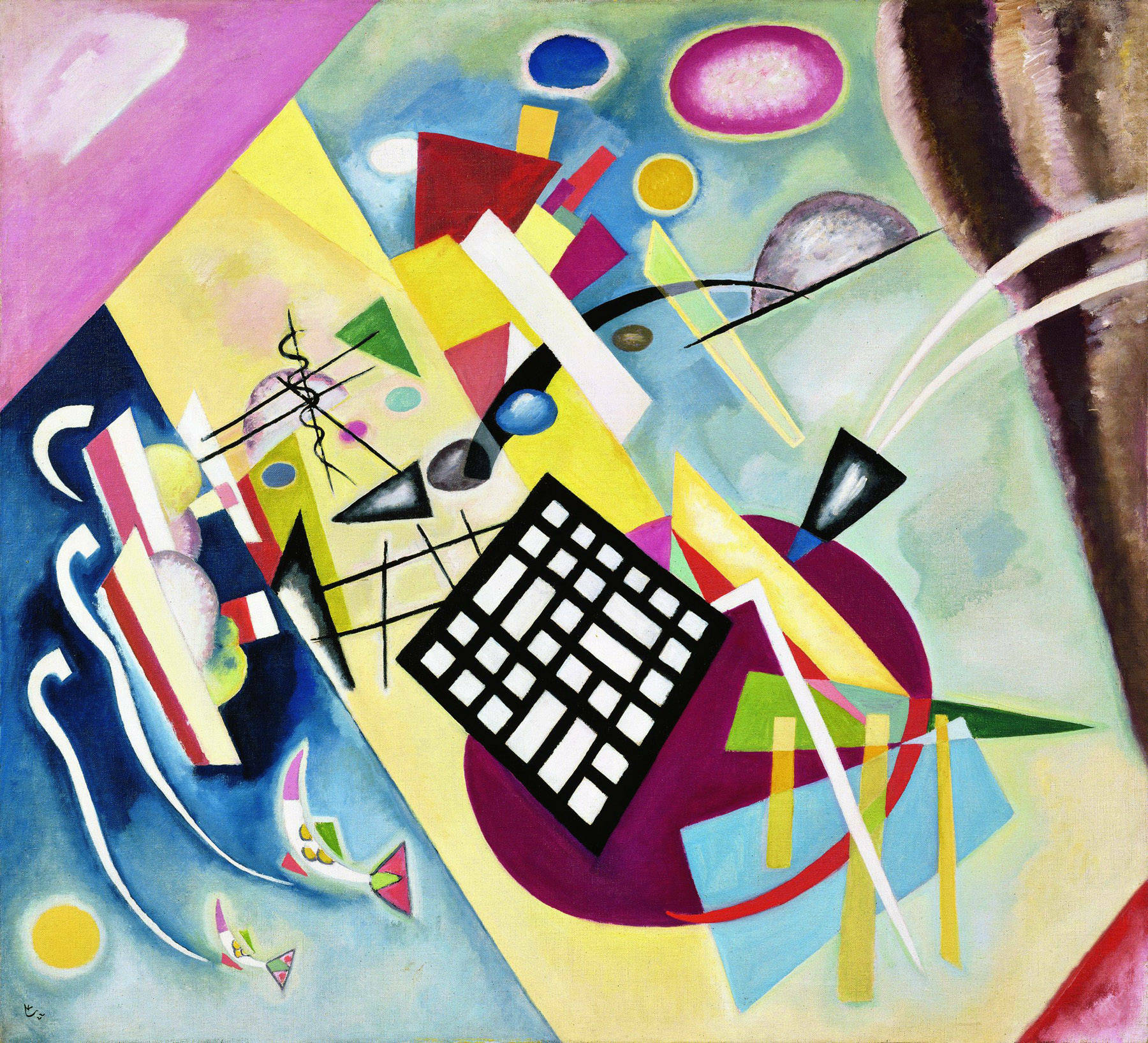
Black Grid is a painting by Wassily Kandinsky from 1922: a nearly square canvas on which, among coloured fields, circles and triangles, a black grid with white cells lies at a slant, with a large dark wine-red disc beneath it. The original belongs to the collection of the Centre Pompidou in Paris and has been on deposit at the Musée d’arts de Nantes since 1986. We make it as a hand-painted reproduction in oil on canvas, in eight sizes or to your measurements, and before dispatch you receive a photograph of the finished work for approval.
| Title: | Black Grid |
| Other titles: | Schwarzer Raster · Trame noire |
| Painter: | Wassily Kandinsky (1866–1944) |
| Year: | 1922 |
| Original size: | 106 cm x 96 cm |
| Original technique: | Oil on canvas |
| Painting style: | Abstract art |
| Location: | Centre Pompidou, Paris, on deposit at the Musée d’arts de Nantes (inv. AM 81-65-44) |
| Our reproduction: | hand-painted oil on canvas, 8 sizes from 50 x 40 cm to 150 x 140 cm, made to measure on request |
Black Grid – Wassily Kandinsky
What is the black grid?
The central sign of the painting, which gives it its name. The museum records it under the German title Schwarzer Raster and the French Trame noire; both mean a black grid or screen. It is a dense lattice of thick black bars, with small white rectangular cells opening between them in rows. The grid is not level but turned, as if set down at an angle, and covers the upper left part of a large dark wine-red disc. It is the most regular form on the canvas: everything around it is coloured, rounded or pointed, while the grid alone stays black and white.
What is on the canvas?
The canvas is nearly square, slightly wider than tall. A pink triangle with a pale, whitish cloud fills the upper left corner. A broad pale yellow band runs diagonally from the top edge towards the lower middle, and to its right opens a blue-green ground. At the lower left lies a deep blue field: along the left edge three white curling forms wind through it, further down two small white elongated forms float with pink and green triangles, and in the corner are a yellow circle and the monogram. In the middle lies the slanted black grid with its white cells. On the disc beneath it are yellow vertical bars, a green field, a light blue parallelogram, a red arc along the lower edge, a thin white angled line and a long dark green spike pointing to the right. Above the middle stand a red triangle pointing down, a small yellow rectangle and a slanted white slat, and higher up a dark blue oval and a pink oval with a yellow rim. At the upper right are a yellow circle and a grey half-disc crossed by a thin black line, and a long black arc stretches from the middle to the right. Along the right edge runs a broad brown and violet band, from which two white curved lines sweep to the left and end at a black cone pointing down. To the left of the grid thin black lines cross with a small black squiggle, and around them lie a green triangle, small pastel circles and a black triangle.
Where was it painted?
In Weimar, in 1922. The museum’s record says so: painted in Weimar, with the monogram and the year at the lower left, VK 22. In its accompanying text the museum relates that after the war Kandinsky left Moscow, arrived in Berlin and in June 1922 began teaching at the Bauhaus in Weimar. Black Grid was painted in the year he arrived.
Why is the painting so geometric?
Because his language changed in these years. The museum describes how, between 1922 and 1923, Kandinsky moved away from the lyrical levitation of free lines and the mannerist forms of his early years towards a more geometric world. In the smaller paintings and watercolours of the time, in the museum’s words, the triangle and the circle dominate, the lines are firm and straight, and the fields of colour are less motley and without impasto. The museum links this radical change to the influence of the Russian Constructivists, whose criticism Kandinsky was often exposed to – during his years of withdrawal to Russia and then the Soviet Union, but also at group exhibitions in Germany in 1923.
Why does this painting matter?
Because it belongs to the moment when Kandinsky took up a new language at the Bauhaus. The museum relates that he painted Black Grid at the Bauhaus – the catalogue raisonné lists it as number 687 – and that he also made the models for the panels of the Juryfrei exhibition there, today on deposit at the Museum of Modern and Contemporary Art in Strasbourg; the school’s new line, in the museum’s words, called for exactly this new, universal language. As an abstract painting it has no subject to recognise: only colour, line and form in relation. The same museum also holds Gelb-Rot-Blau, painted three years later at the Bauhaus, which we paint as Yellow Red Blue.
How is our hand-painted version made?
The painter works from a high-resolution reference and builds the painting up in layers, with brush and oil colours. With this subject precision decides everything: the grid has to stay regular, the bars equally thick and the white cells clean, or the order of the canvas falls apart. We lay the fields of colour on smoothly and without thick paint, as the museum describes the paintings of those years. An oil painting reproduction keeps its colour for many years, because oil does not fade the way the colour of a print does. We have no studio photographs of this work yet; once the next copy is painted, we will add them here. Because every hand-painted copy is made on its own, no two are alike in every detail; what they share is the subject, the proportions and the range of colour.
Which size for which wall?
At 106 x 96 cm the canvas is exactly the size of the original. As a painting for the living room it works best at 106 x 96 or 130 x 120 cm, where grid and disc read from a few metres away. The 50 x 40 and 60 x 50 cm sizes suit a desk or a hallway, 70 x 60 and 80 x 70 cm a bedroom, and 90 x 80 cm a smaller sitting room. The largest size, 150 x 140 cm, is for large walls in open spaces and stairwells.
Custom sizes, stretcher and frame
If none of the eight sizes fits your wall, we paint the work to your measurements; that is our painting made to measure, and we tell you where the subject is cropped. Every canvas is stretched on a wooden stretcher. A frame is optional and not included in the base price.
Delivery and guarantee
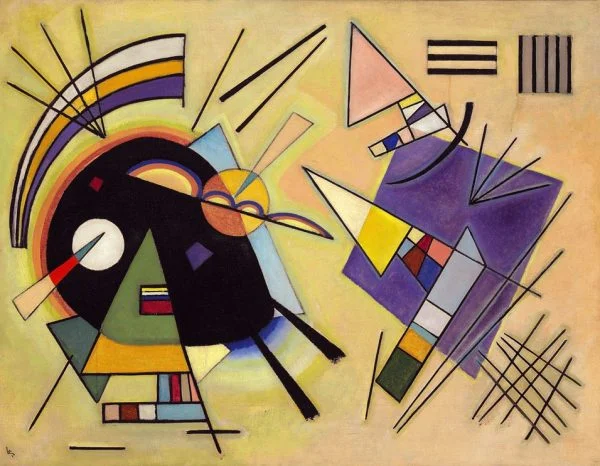
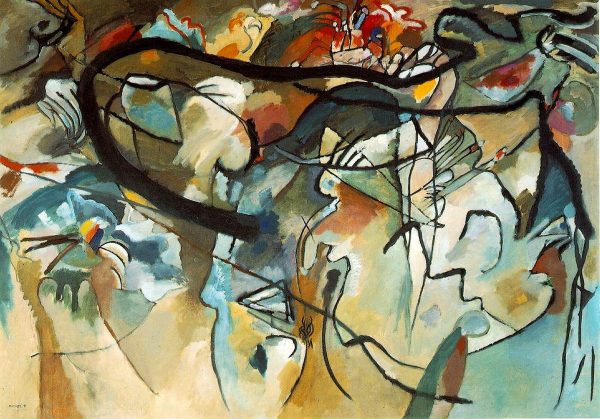
Every canvas here is painted only after it is ordered, in our studio in Slovenia, so allow 15 to 45 days depending on the size. We send it protected, insured and tracked, across the EU without customs. If something is wrong on arrival, write to us and we will put it right. All of Kandinsky’s works here are gathered in our Wassily Kandinsky gallery, and the painter is introduced in our article about Wassily Kandinsky. From the Bauhaus years we also paint Transverse Lines and Several Circles, and for comparison with the earlier period Composition VII of 1913.
Frequently asked questions
Where is the original?
It belongs to the collection of the Musée national d’art moderne at the Centre Pompidou in Paris, inventory number AM 81-65-44; the painter’s widow, Nina Kandinsky, bequeathed it to the museum in 1981. Since 2 December 1986 it has been on deposit at the Musée d’arts de Nantes, so it is in Nantes rather than in Paris. The museum’s record is on the Centre Pompidou page, though without a photograph of the work.
How large is the original?
It measures 106 x 96 cm. We give the width first; the museum gives the height first, as 96 x 106 cm. Our 106 x 96 cm is therefore exactly the size of the original.
When was it painted?
In 1922 in Weimar, in the first year that Kandinsky taught at the Bauhaus. The monogram and the year, VK 22, are at the lower left.
What is shown in the painting?
Nothing figurative: a black grid on a wine-red disc, with triangles, circles and lines around it.
Is this a print?
No. This is a canvas painting: it is painted by hand in oil, and the brushstrokes are visible in raking light and can be felt.
Which size should I choose?
If you want the painting at the size of the original, choose 106 x 96 cm. For a living room 90 x 80 and 130 x 120 cm also work well, for a desk or a hallway 50 x 40 or 60 x 50 cm. Before deciding, tape paper of that size to the wall for a day.
Can I have a size that is not on the list?
Yes. We also paint sizes outside the range, in the proportion your wall needs, and tell you where the subject is cropped.
How is it delivered?
Insured and tracked, across the EU without customs. Before dispatch you receive a photograph of the finished Kandinsky reproduction for approval.
What did Kandinsky teach at the Bauhaus?
According to the museum he ran the mural-painting workshop on an interim basis and taught the colour-theory courses. As his starting point he took the three primary colours – red, yellow and blue – and the three basic forms: circle, triangle and square.
Is the original for sale, and what is it worth?
It is not for sale, so it has no market price. It belongs to a public museum collection and stays there; what we offer is a copy painted by hand, not the original, and we never confuse the two.
Does it make a good gift?
It does, especially for someone who likes order and colour at the same time. If you are unsure about the subject or the size there is a gift voucher, and the decision stays with them.
- Subject: a slanted black grid with white cells on a dark wine-red disc, with triangles, circles and arcs around it
- Original: Centre Pompidou, Paris, inv. AM 81-65-44, 1922, 106 x 96 cm, bequest of Nina Kandinsky 1981, on deposit in Nantes since 1986
- Our version: hand-painted oil on canvas, eight sizes from 50 x 40 to 150 x 140 cm, on a wooden stretcher, framed on request
- Worth knowing: the museum’s record carries no photograph of the work; the painting was made in Weimar in the year Kandinsky began teaching at the Bauhaus