



Description
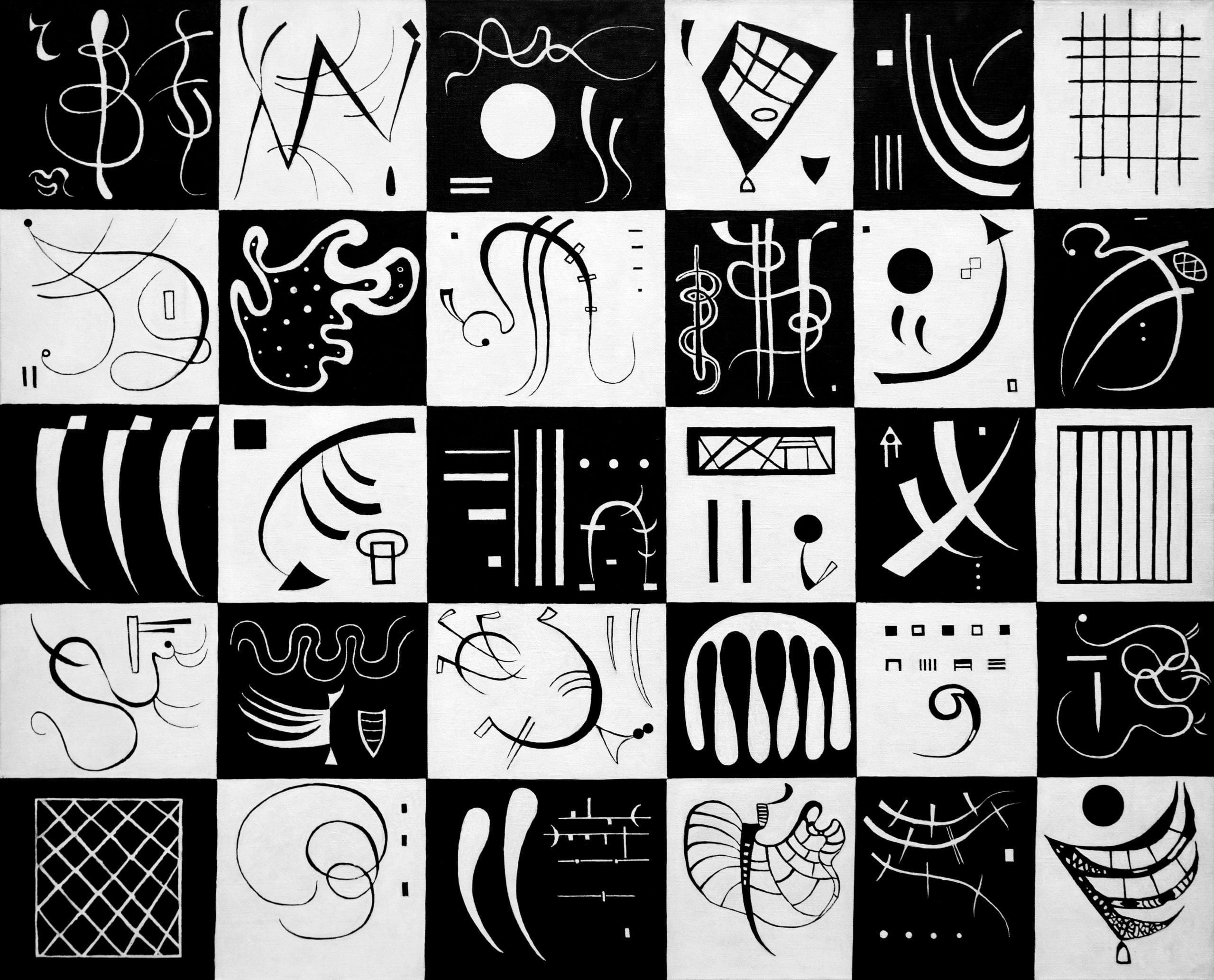
Thirty is a painting by Wassily Kandinsky from 1937: a landscape-format canvas divided into thirty panels in five rows, alternating black and white, each holding a different small sign. The original belongs to the collection of the Centre Pompidou in Paris and until 14 February 2027 is on loan to the Kandinsky exhibition at Palazzo Bonaparte in Rome. We make it as a hand-painted reproduction in oil on canvas, in eight sizes or to your measurements, and before dispatch you receive a photograph of the finished work for approval.
| Title: | Thirty |
| Other titles: | Trente |
| Painter: | Wassily Kandinsky (1866–1944) |
| Year: | 1937 |
| Original size: | 100 cm x 81 cm |
| Original technique: | Oil on canvas |
| Painting style: | Abstract art |
| Location: | Centre Pompidou, Paris (inv. AM 1976-860) |
| Our reproduction: | hand-painted oil on canvas, 8 sizes from 50 x 40 cm to 150 x 120 cm, made to measure on request |
Thirty – Wassily Kandinsky
How is the painting built?
Like a chessboard. The canvas is divided into thirty rectangular panels, five rows of six, and the colours alternate as on a chessboard: the top left panel is black, the bottom right one white. Black panels carry white signs, white panels black ones. The museum calls it an irregular chequerboard; the colours do alternate regularly, but no sign is ever repeated. The title gives the number: Trente means thirty, and that is how many panels the canvas holds.
What is on the canvas?
There is no colour on the canvas, only black and white. In the top left panel a white vertical line with loops winds over the black ground, with small curls around it. Two panels to the right a white circle stands on black, with a wavy line above it and two short horizontal strokes below. The top right panel holds a black grid of straight lines on white. In the second row, on a black panel, a broad white wavy line encloses a black patch scattered with tiny white dots. At the far right of the third row stands a black rectangle filled with vertical stripes. In the fourth row a white form like a comb with long, rounded teeth hangs on a black panel. In the first row the second, white panel carries a black zigzag, the fourth a black kite shape with a white grid and a small bell beneath it. In the second row white spirals wind round upright stems on the fourth, black panel. In the third row three white teeth tapering downwards hang on the first, black panel, and on the fourth, white one stands a black rectangle of crossing lines with two upright bars below it. In the fourth row the fifth, white panel holds a row of small black squares, with letter-like signs and a black spiral beneath. In the fifth row the third, black panel carries two white teardrop shapes, the fourth, white one a fan divided by stripes. The bottom left panel is filled with a white diagonal lattice on black, the bottom right with a black disc above a large sickle shape crossed by lines, on white. In between are arcs, spirals, hooks, small squares, dots and interlaced loops, all drawn with a clean line, now hair-thin, now bold.
Where and when was it painted?
In Paris. The museum records that, according to the artist’s fourth handwritten list, it was painted between December 1936 and January 1937. The back of the canvas carries the monogram VK, the number 636 and the year 1937. The painter’s widow, Nina Kandinsky, gave it to the museum in 1976.
Where do the signs come from?
The museum describes them as an astonishing inventory of Kandinsky’s plastic alphabet. In the museum’s words he drew on ancient writing, biomorphic forms and scientific diagrams, and from them put together a joyful repertoire of miniature abstractions. On the irregular chequerboard, the museum writes, they stand out against a black or a white ground, and the alternation of positive and negative forms adds to the playful character of the composition. A sign on this canvas is therefore like a letter: each stands in its own panel, unlike all the others.
Why does this painting matter?
Because it gathers thirty different signs in a single painting. The museum says the composition subtly questions the distinction between painting and drawing. As an abstract painting it has no subject to recognise, but it has a clear order. The same museum also holds Bleu de ciel of 1940, of which it notes that the division into compartments has disappeared; we paint it as Sky Blue.
How is our hand-painted version made?
The painter works from a high-resolution reference and builds the painting up in layers, with brush and oil colours. With this subject precision decides everything: the borders between panels have to be straight, the black deep and the white clean, and every sign has to keep the weight of its line. An oil painting reproduction keeps its colour for many years, because oil does not fade the way the colour of a print does. We have no studio photographs of this work yet; once the next copy is painted, we will add them here. Because every hand-painted copy is made on its own, no two are alike in every detail; what they share is the subject, the proportions and the signs.
Which size for which wall?
At 100 x 81 cm the canvas is exactly the size of the original. As a painting for the living room it works best at 100 x 81 or 130 x 110 cm, where the small signs stay legible from a few metres away. The 50 x 40 and 60 x 50 cm sizes suit a desk or a hallway, 70 x 60 and 90 x 70 cm a bedroom, and 110 x 90 cm a larger wall. The largest size, 150 x 120 cm, is for open spaces. Because every panel carries its own sign, the thin lines are the first thing lost at the smallest sizes.
Custom sizes, stretcher and frame
If none of the eight sizes fits your wall, we paint the work to your measurements; that is our painting made to measure, and we tell you whether the panels still work out in the new proportion. Every canvas is stretched on a wooden stretcher. A frame is optional and not included in the base price.
Delivery and guarantee
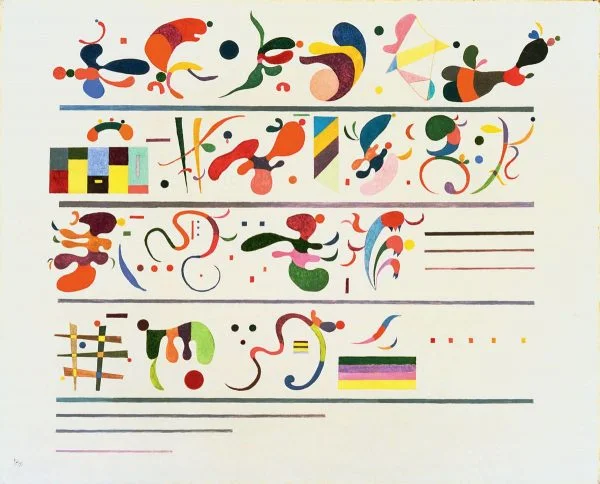
Every canvas here is painted only after it is ordered, in our studio in Slovenia, so allow 15 to 45 days depending on the size. We send it protected, insured and tracked, across the EU without customs. If something is wrong on arrival, write to us and we will put it right. All of Kandinsky’s works here are gathered in our Wassily Kandinsky gallery, and the painter is introduced in our article about Wassily Kandinsky. From the same period we also paint Dominant Curve, Succession and Composition X.
Frequently asked questions
Where is the original?
It belongs to the collection of the Musée national d’art moderne at the Centre Pompidou in Paris, inventory number AM 1976-860. Until 14 February 2027 it is on loan to the Kandinsky exhibition at Palazzo Bonaparte in Rome. The museum’s record is on the Centre Pompidou page.
How large is the original?
It measures 100 x 81 cm. We give the width first; the museum gives the height first, as 81 x 100 cm. Our 100 x 81 cm is therefore exactly the size of the original.
When was it painted?
According to the museum between December 1936 and January 1937, in Paris; it is dated 1937 on the back of the canvas.
What is shown in the painting?
Nothing figurative: thirty black and white panels, each with a different sign – a circle, a grid, a loop, an arc or a small form like writing.
Is this a print?
No. This is a canvas painting: it is painted by hand in oil, and the brushstrokes are visible in raking light and can be felt.
Which size should I choose?
If you want the painting at the size of the original, choose 100 x 81 cm. For a living room 130 x 110 cm also works well, for a desk or a hallway 50 x 40 or 60 x 50 cm. Before deciding, tape paper of that size to the wall for a day.
Can I have a size that is not on the list?
Yes. We also paint sizes that are not on the list, in the proportion your wall needs, and tell you how the panels will fall.
How is it delivered?
Insured and tracked, across the EU without customs. Before dispatch you receive a photograph of the finished Kandinsky reproduction for approval.
Why is the painting only black and white?
The museum sees in it the alternation of positive and negative forms: the signs stand white on the black panels and black on the white ones, which, the museum writes, adds to the playful character of the composition.
Is the original for sale, and what is it worth?
It is not for sale, so it has no market price. It belongs to a public museum collection and stays there; what we offer is a copy painted by hand, not the original, and we never confuse the two.
Does it make a good gift?
It does, especially for someone who likes writing, signs or graphic design. If you are unsure about the subject or the size there is a gift voucher, and the decision stays with them.
- Subject: thirty panels in five rows, alternately black and white, each with a different sign
- Original: Centre Pompidou, Paris, inv. AM 1976-860, 1937, 100 x 81 cm, gift of Nina Kandinsky 1976; in Rome until 14 February 2027
- Our version: hand-painted oil on canvas, eight sizes from 50 x 40 to 150 x 120 cm, on a wooden stretcher, framed on request
- Worth knowing: according to the museum, on this chequerboard Kandinsky made an inventory of his plastic alphabet