


Description
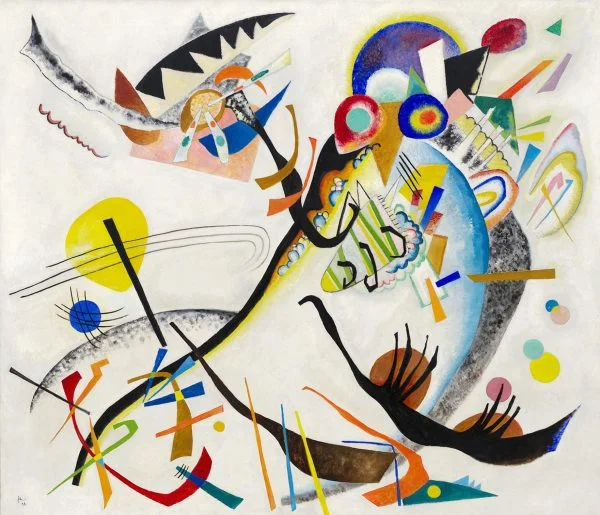
Impression V (Park) was made on 12 March 1911 and is one of the six canvases Kandinsky himself named Impressions: a landscape canvas of 157.5 x 106 cm on which a large brick-red triangle rises from a light ground, crossed by black lines. The original is held by the Centre Pompidou in Paris under the number AM 1976-851, the gift of Nina Kandinsky in 1976. We paint it by hand in oil on canvas — an oil painting reproduction in eight sizes or to your own measurement — and before dispatch you receive a photograph of the finished work for approval.
| Title: | Impression V (Park) |
| Other titles: | Impression V (Parc) · Impressione V (Parco) · Impresija V (Park) |
| Painter: | Wassily Kandinsky (1866–1944) |
| Year: | 12 March 1911 |
| Original size: | 157.5 cm x 106 cm |
| Original technique: | Oil on canvas |
| Painting style: | Abstract art |
| Location: | Centre Pompidou, Paris (inv. AM 1976-851) |
| Our reproduction: | hand-painted oil on canvas, 8 sizes from 60 x 40 cm to 200 x 140 cm, custom size on request |
Impression V (Park) – Wassily Kandinsky
Is there anything recognisable on the canvas?
Yes, and with this work that is the point. The museum’s entry says plainly what can still be made out: two riders and their mounts, reduced to black lines, superimposed on a large red triangle. The riders are to the right of centre, two tiny figures with dark hats above yellow bodies, and beneath them the black lines unravel into legs and reins. Everything else – the red triangle, the green and pink masses, the blue block at the lower right – is colour and shape, not object.
What is on the canvas?
The ground is light, cream-coloured and washed over with white, so that everything else floats on it. At the upper left sits a small red-brown ellipse, and from the left edge a long black wavy line winds across the surface. The upper middle is taken by a large brick-red triangle that rises almost to the top edge; across its lower third runs a heavy black line that breaks like the back of an animal. At the upper right stand yellow rays and grey-green cloud masses, and from the top right corner a black diagonal descends. The lower middle is held by a muted pink mass with a green-blue wedge; from it a long black slant falls towards the lower left corner. At the lower left lie blue-green, grey-blue and greyish violet fields. At the lower right stands a deep blue block, and along the right edge a small yellow building with a thin figure. At the lower right is the signature with the year.
Why does this painting matter?
By the museum’s entry, forms and colours here move away for good from any descriptive function and render above all rhythms and cadences. In Concerning the Spiritual in Art, published in 1912, Kandinsky called six of his 1911 paintings Impressions: still inspired, as the museum puts it, by external nature, and it is precisely for that reason that individual recognisable parts show through in them. The museum adds that the large red triangle carries a symbolic meaning, and that the painter showed this canvas at the Salon des Indépendants in Paris in the very year it was made. It entered the collection in 1976 as the gift of Nina Kandinsky.
What does the work mean?
The museum offers a reading and we keep to it: rhythms and cadences instead of description, two riders as the last remnant of the visible world, the red triangle as a sign. That reading can be followed across the canvas step by step: the light ground is the silence, the red triangle a single firm stroke, and the black lines are the rhythm running across it all. What exactly the riders are supposed to mean, the museum does not say, and we do not add it.
Where does this work sit among the others?
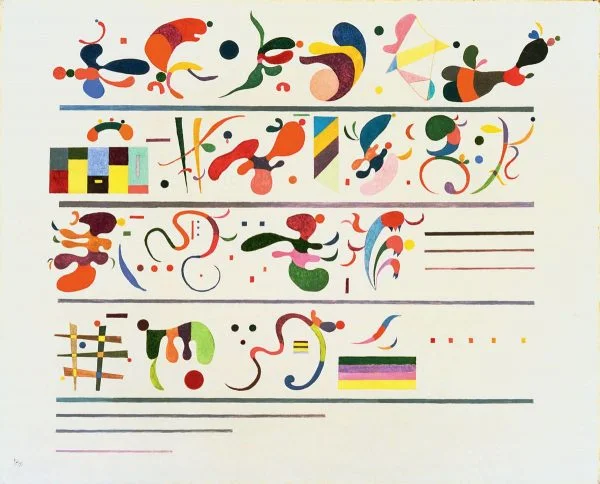
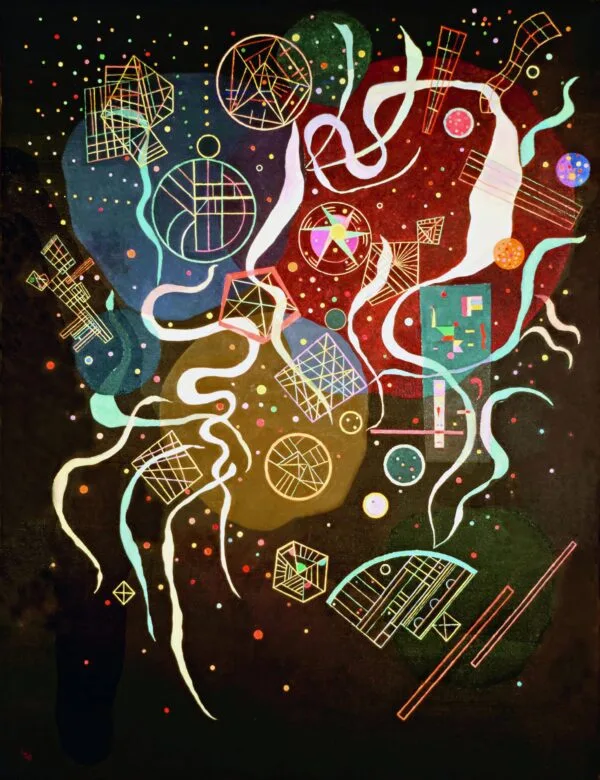
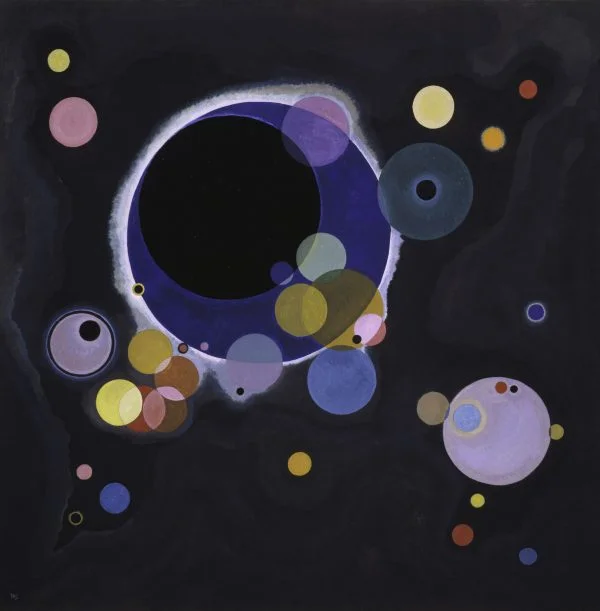
The year 1911 is a turning point for Kandinsky, and our range represents it with Composition IV as well, made in the same year, where riders and lances are larger and more fully worked out. Where that road leads is shown by Composition X of 1939, in which nothing recognisable is left, and by Various Parts of 1940. There is also a study for this canvas, held by the same museum.
How is our hand-painted version made?
This is a painting made with a brush and oil paint, not with a printer. The light ground comes first, because how deep the colours laid over it will look depends on it; then the large masses, the red triangle and the blue block, and only at the end the black lines. Those lines are the hardest part of this work: each is a single stroke that cannot be corrected, and whether the riders stay recognisable or fall apart into mere lines depends on their tension. An abstract painting stands or falls with the relation between its colours, so we do not leave it to chance; an oil painting keeps that relation over the years, because paint does not fade the way a print does. For this work we do not yet have studio photographs of our own, so you will not find any on this page – once the next copy is painted we photograph it and the shots come here. Before dispatch every customer receives a photograph of their own finished canvas for approval. Because everything is done by hand, every hand-painted copy is one of a kind and no two are quite alike.
Which size for which wall?
If you are unsure: 120 x 80 cm. The 158 x 106 cm size matches the original almost one to one and makes a fine painting for the living room, above a sofa or a sideboard. The smaller sizes 60 x 40, 80 x 50 and 100 x 70 cm suit a hallway, bedroom or office; 120 x 80 and 140 x 90 cm suit an ordinary wall. The largest sizes 180 x 120 and 200 x 140 cm are for open living spaces and dining rooms. Because the ground is light, the work carries on a darker wall too, against which the cream stands out.
Custom sizes, stretcher and frame
If none of the eight sizes fits your wall, we paint the work to your measurements and keep the original’s proportions, so the triangle and the lines stay in the same relation; that is our painting to order. Like every canvas painting we make, this copy is delivered stretched on a wooden stretcher and ready to hang. For the frame use our 3D application: it shows every one of our frame profiles on this motif, so you can compare gold, silver, black, white and natural wood before deciding – the application is for choosing a frame and nothing else. If you want to see how the painting will look on your own wall, that is our separate room-placement service.
Delivery and guarantee
Every Kandinsky reproduction we paint is made to order in our studio in Slovenia, so allow 15 to 45 days depending on the size chosen. We send it stretched and protected for transport, framed if you chose a frame, across the EU without customs. Before dispatch you receive a photograph of the finished work for approval, and our returns policy applies to every order. The whole range is in the Wassily Kandinsky gallery, and the painter’s path is described in our article about Wassily Kandinsky.
Frequently asked questions
Where is the original?
In the Centre Pompidou in Paris, inv. AM 1976-851. By the museum’s entry it is currently on loan to the Palazzo Bonaparte in Rome, for the exhibition Kandinsky from 15 September 2026 to 14 February 2027.
How large is the original?
157.5 cm wide and 106 cm high, oil on canvas; the museum gives the measurement as 106 x 157.5 cm.
What is depicted?
By the museum’s entry, two riders and their mounts reduced to black lines, over a large red triangle; everything else is colour and shape.
Is this a print?
No. It is a reproduction hand-painted in oil on canvas; the brush strokes can be seen and felt.
Which size should I choose?
For a living room 120 x 80 or 158 x 106 cm, which is almost exactly the size of the original; for other walls see the size guide above.
Can I have a size that is not listed?
Yes, we paint to measure and keep the original’s proportions.
How is it delivered?
Stretched on a stretcher and framed if you chose that, in 15 to 45 days after you approve the photograph of the finished work.
Why is it called an Impression?
Because Kandinsky himself gave that name to six of his 1911 paintings – the ones that, by the museum’s entry, were still inspired by external nature.
How do you read Kandinsky’s Impression V (Park)?
Start from the subject that is still there: a park with riders, the impression of a scene Kandinsky had seen. The riders and their horses are reduced to black lines over a large red triangle, while the rest of the park dissolves into colour and shape. Painted in 1911, it belongs to the six Impressions that still begin in nature, the step just before his fully abstract Compositions. Look for the black lines first, then let the colour of the painting carry the rest.
Is the original for sale, and what is it worth?
No. The canvas belongs to a public collection in Paris and is not for sale; a hand-painted canvas is the only way to have it at home.
How high should it hang?
The centre at eye level, about 145-150 cm from the floor; above a sofa, 15-25 cm above the back.
Does it work as a gift?
Yes, for someone who likes modern art it is a fine choice. If you would rather leave the choice to them, there is a gift voucher.
- Subject: two riders as black lines over a large red triangle – 12 March 1911
- Original: 157.5 x 106 cm, oil on canvas, Centre Pompidou, Paris (inv. AM 1976-851)
- Our version: hand-painted oil on canvas, eight sizes from 60 x 40 to 200 x 140 cm, stretched and framed on request
- Worth knowing: the painter showed it at the Salon des Indépendants in Paris in the same year