




Description
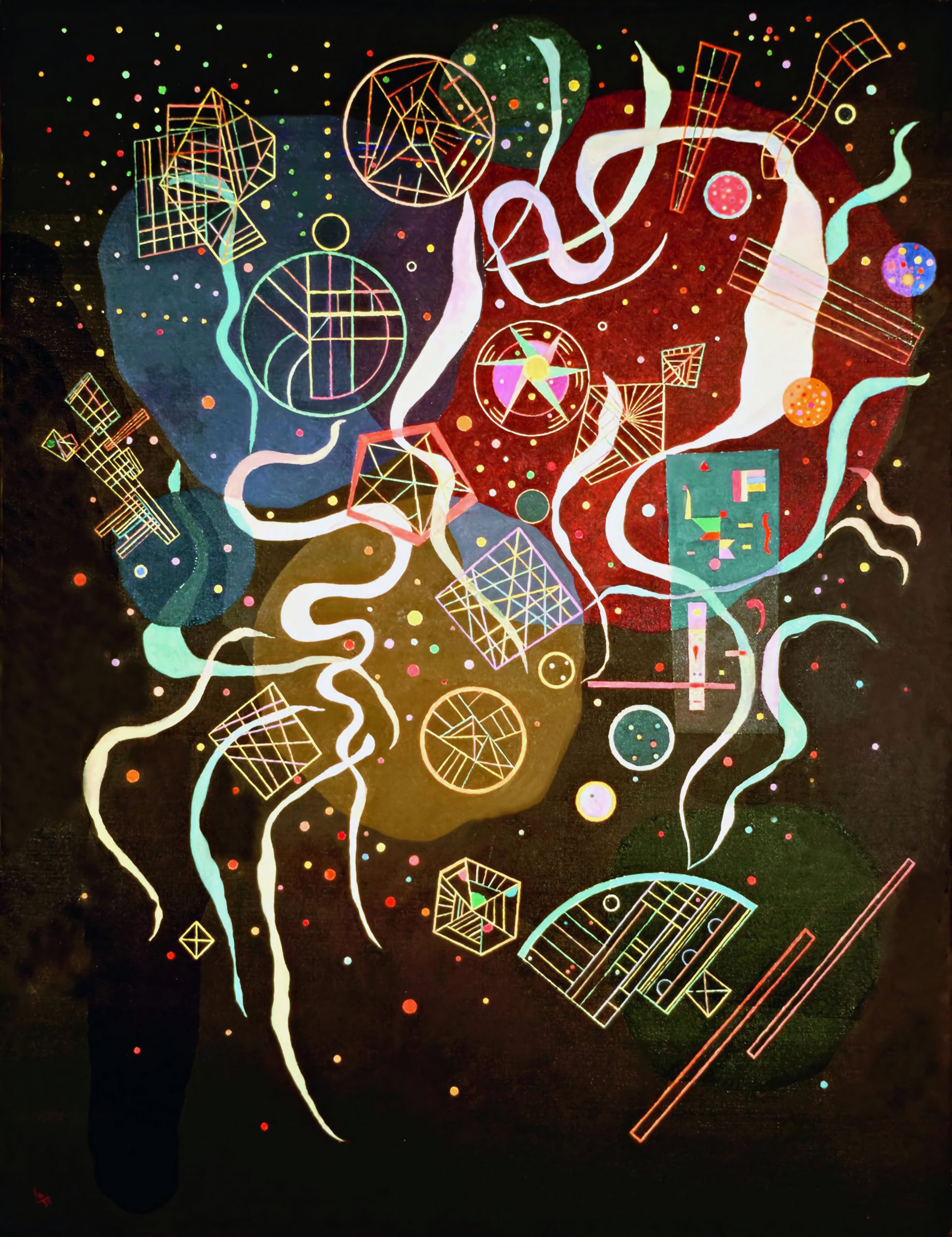
Movement I is an abstract painting by Wassily Kandinsky: an upright canvas with an almost black ground down which pale cream and soft green ribbons descend, and between them soft fields of colour and tiny drawn signs float – grids, circles and polygons. We make it as a hand-painted reproduction in oil on canvas, in eight sizes or to your measurements; before dispatch you receive a photograph of the finished work for approval.
| Title: | Movement I |
| Painter: | Wassily Kandinsky |
| Original technique: | not confirmed – without an institution’s record we claim nothing about the original |
| Our reproduction: | hand-painted oil on canvas, 8 sizes from 40 x 50 cm to 120 x 160 cm, custom sizes on request |
Movement I – Wassily Kandinsky
What do we deliberately not state here?
This canvas is not held by any public collection that has catalogued it, so there is no published object record, no measured dimensions and no inventory number. That is why you will not find a year of execution, a collection name or an accession number on this page. We say what can be checked against an institution, and nothing else.
Is anything recognisable in the painting?
Not in the sense of a scene you could name. The canvas is upright and almost entirely dark, and the shapes across it never come together into an object, a face or a landscape. Some come close to a hint: the circle in the upper left third, crossed by arcs and meridians, recalls a globe; the pale bands twist like ribbons on the air; at lower right a form of dark and light fields opens like a fan. None of these likenesses appears in any institution’s catalogue, so we give them here as what they are: the viewer’s impression, not the meaning of the work. What is actually on the canvas are relationships – between the dark ground, four fields of colour and a crowd of tiny, precisely drawn signs.
What is on the canvas?
The ground is almost black and uneven: towards the lower left corner it turns a warm brown, elsewhere it stays deep and smooth, so everything laid on it comes forward. Four large soft fields without sharp edges rest on it – blue-grey upper left, dark red upper right, ochre yellow in the middle, dark green along the lower right edge. Pale ribbons descend across them, cream white and soft green, twisting and folding back as they run from the top edge down towards the left; they are the brightest part of the painting and lead the eye across it. Between and on them are tiny drawn signs: rectangular grids, squares in perspective, circles with arcs and lines inscribed, a small pink pentagon with a grid at its centre, a green rectangle with pale marks, and little fans of radiating lines. Along the lower right edge run two long thin orange lines, parallel and set at a slant. Hundreds of small dots in red, yellow, blue, green and white lie scattered over the dark ground, denser above, so the whole surface seems barely to move.
Why is the painting called Movement I?
The title describes what the eye notices first. Nothing stands still: the pale ribbons twist from top to bottom, the fields of colour have no edges and seem to swim, and the tiny signs are placed so a direction reads between them – from the upper right towards the lower left. The scattered dots are uneven too: denser above, sparser below, which tips the surface and gives it a current. The Roman numeral I means the work is the first in a series with this title. More about when and how it was made is not here, because no institution’s record of it can be checked.
Why does this painting matter?
Because on one canvas it brings together two things Kandinsky long developed separately: strict, almost geometric drawing, and free, flowing form. The grids, circles and squares in perspective are drawn precisely with a ruler, the ribbons freely, from the whole arm; on the dark ground they stand side by side without contradicting one another. This coexistence makes the canvas interesting even to a viewer who does not otherwise care for abstraction: it is ordered like a plan and at the same time soft as smoke. We add no historical claims about its place in the painter’s work here, because we cannot rest them on a catalogue.
What does the painting mean?
We do not claim it means anything in particular. Without a published record from an institution every interpretation would be our invention, and we do not do that here. What we can say is how it works on the eye: the dark ground takes all the depth onto itself, the pale ribbons open it again, the tiny signs hold the gaze in places, so that looking divides in two – a quick view of the whole, then a slow reading of detail. Anyone who steps close goes on finding small shapes long after the general impression has settled, which is why a work like this carries a large size and a near wall well.
How is our hand-painted version made?
This is a canvas painting made with a brush and oil colours, not with a printer. The painter works from a high-resolution reference, building the surface in layers. The dark ground comes first, and must be deep without being dead – that is where a good rendering parts from a poor one, because a black field quickly goes flat and grey. Then the large fields of colour with their soft transitions, the pale ribbons over them, which must be pulled in one stroke or they lose their tension, and last of all the tiny signs and scattered dots, set down one by one with a fine brush. An oil painting reproduction holds that balance over years, because the colour does not fade the way a print does. We have no studio photographs of this work yet, so you will find none on this page – once the next copy is painted we photograph it and the images come here. Because everything is done by hand, every hand-painted copy is its own and two copies are never quite the same.
Which size for which wall?
If you are unsure: 80 x 110 cm. The canvas is upright, so it asks for height rather than width and works well on a narrow wall, between two windows or beside a door, where a landscape format would have no room. The 40 x 50 and 50 x 60 cm sizes belong above a chest of drawers, a desk or in a hallway; 60 x 80 and 70 x 90 cm suit a bedroom or small sitting room. At 80 x 110 cm this is the natural painting for the living room beside the sofa or above a chest of drawers; 89 x 116 cm suits a larger wall. The largest, 110 x 140 and 120 x 160 cm, are for open living spaces, halls and stairwells. Because the subject is dark and full of tiny signs, it deserves room to step close to it; the details you cannot see from across the room are half the pleasure here.
Custom sizes, stretcher and frame
If none of the eight sizes fits your wall, we paint the work to your measurements; that is our painting made to measure. Like all our paintings on canvas, this copy is delivered stretched on a wooden stretcher and ready to hang. For the frame use our 3D application: it shows every frame profile on this subject, so you can compare gold, silver, black, white and natural wood before deciding – it is for choosing a frame, nothing else. With a ground this dark, pale or natural wood usually does more than a black profile, which merges into the ground.
Delivery and guarantee
Every copy is made to order in our studio in Slovenia: allow 15 to 45 days by size. We send it stretched and protected, framed if you have chosen a frame, across the EU without customs. Before dispatch you receive a photograph of the finished work for approval, and our returns policy applies. The whole range is in the Wassily Kandinsky gallery, and the painter’s path is described in our article about Wassily Kandinsky. Related works from the same range are Transverse Lines, Various Parts and Dominant Curve.
Frequently asked questions
Where is the original?
We cannot confirm that: no public collection that has catalogued it holds the canvas, so we make no claim about where it is.
What is shown in the painting?
Nothing representational: a dark ground, four fields of colour, pale ribbons across them, and a crowd of tiny drawn signs and scattered dots.
Why is there no year on this page?
Because no institution confirms one. We could copy a year from reproduction portals, but that is not a checkable source, so we do not state it.
Is Mouvement I the same work as Movement I?
Yes. Mouvement I, Movement I and Bewegung I are titles of the same canvas.
Is this a print?
No. This is a reproduction painted by hand in oil on canvas; the brushstrokes are visible and can be felt.
Which size should I choose?
For a living room 80 x 110 cm; for really large walls 120 x 160 cm, and for other walls see the size guide above.
Can I have a size that is not on the list?
Yes, we paint to measure and keep the proportions of the subject.
How is it delivered?
Stretched and framed if you chose that, in 15 to 45 days after you approve the photograph of the finished work.
What is the painting about, in short?
Movement itself: pale ribbons run downwards, fields of colour swim without edges, and tiny signs give the direction.
Is the original for sale, and what is it worth?
We do not know and do not guess: without a collection that has catalogued the work, nothing about its value or availability can be checked.
Does it make a good gift?
Yes, for anyone who loves modern art. If you would rather leave the choice to them, there is a gift voucher.
- Subject: a dark ground, four soft fields of colour and pale ribbons, strewn with tiny signs
- Original: not in a public collection that has catalogued it – so no year, no collection and no accession number
- Our version: a hand-painted Kandinsky reproduction in oil, eight sizes from 40 x 50 to 120 x 160 cm, stretched and framed on request
- Worth knowing: a ruled grid and a freely drawn ribbon stand on the same canvas without contradicting one another