



Description
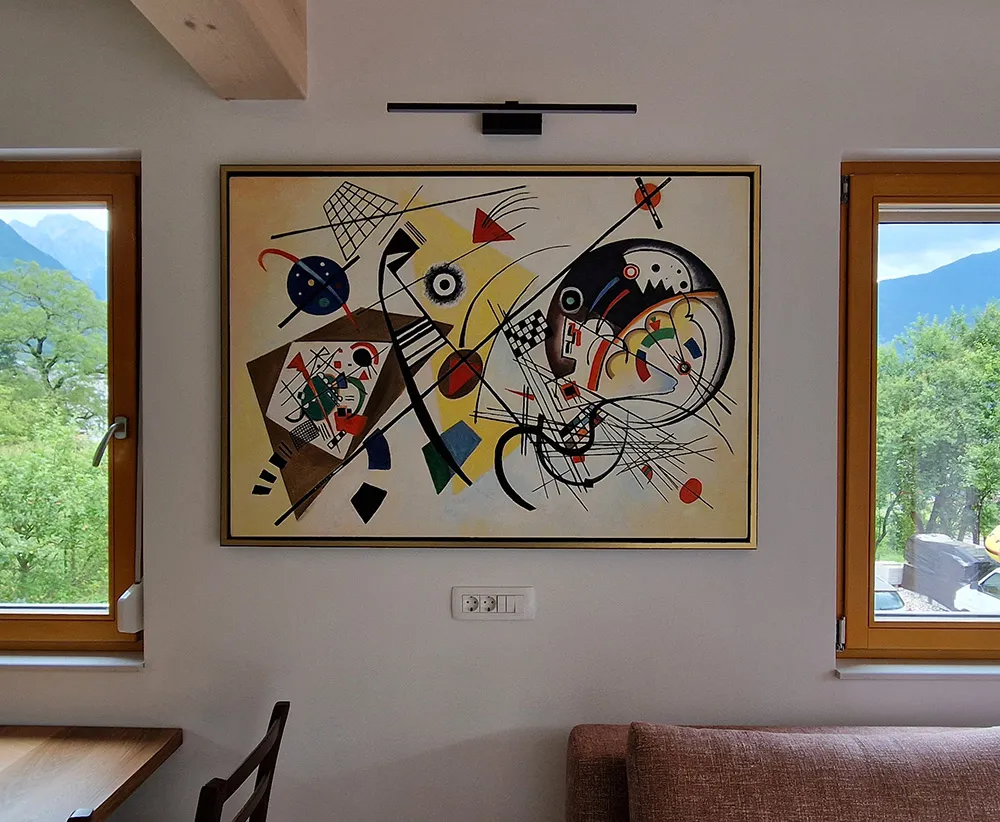
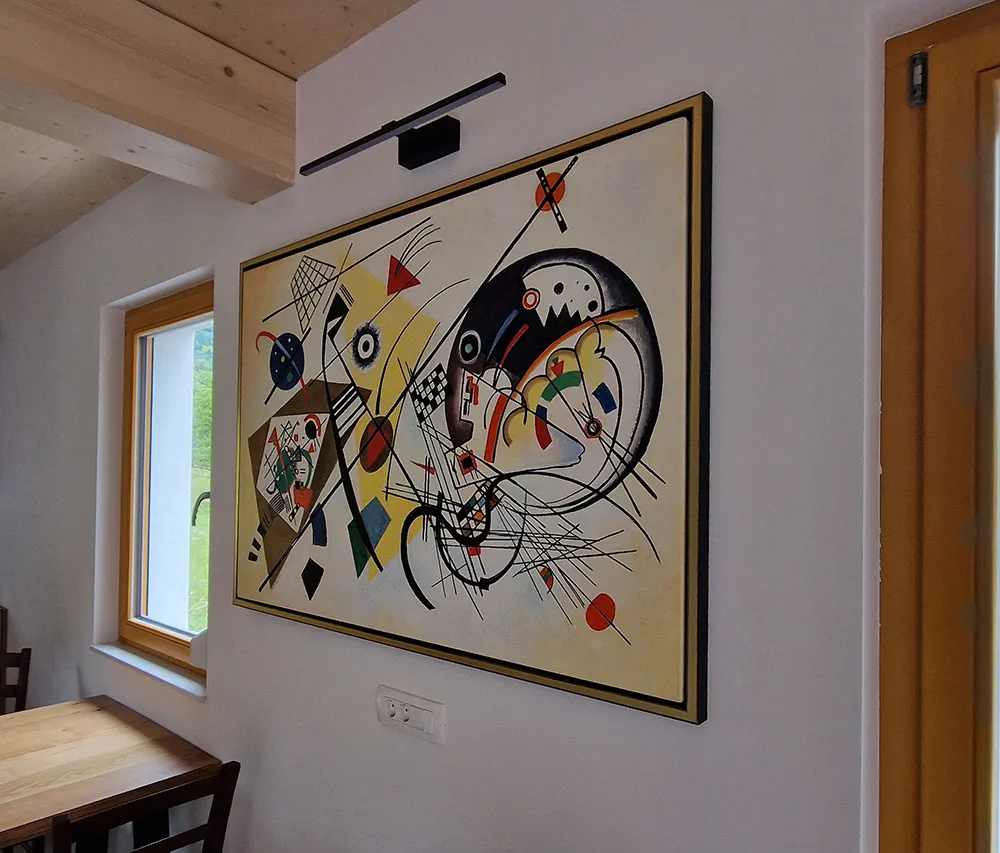
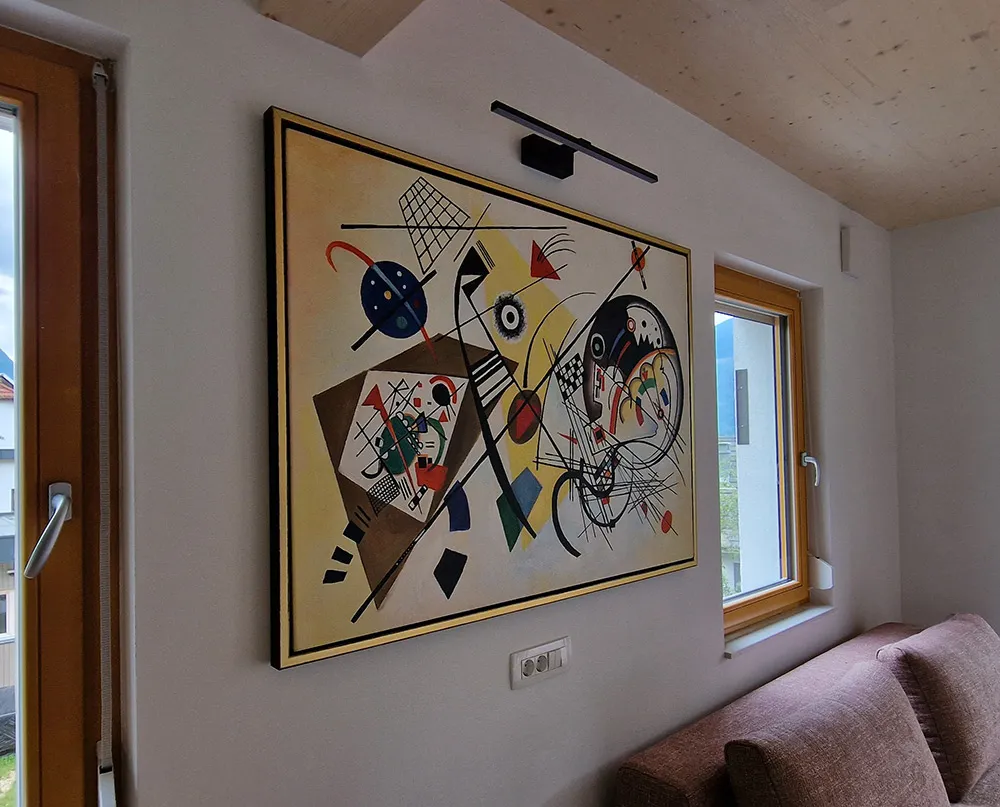
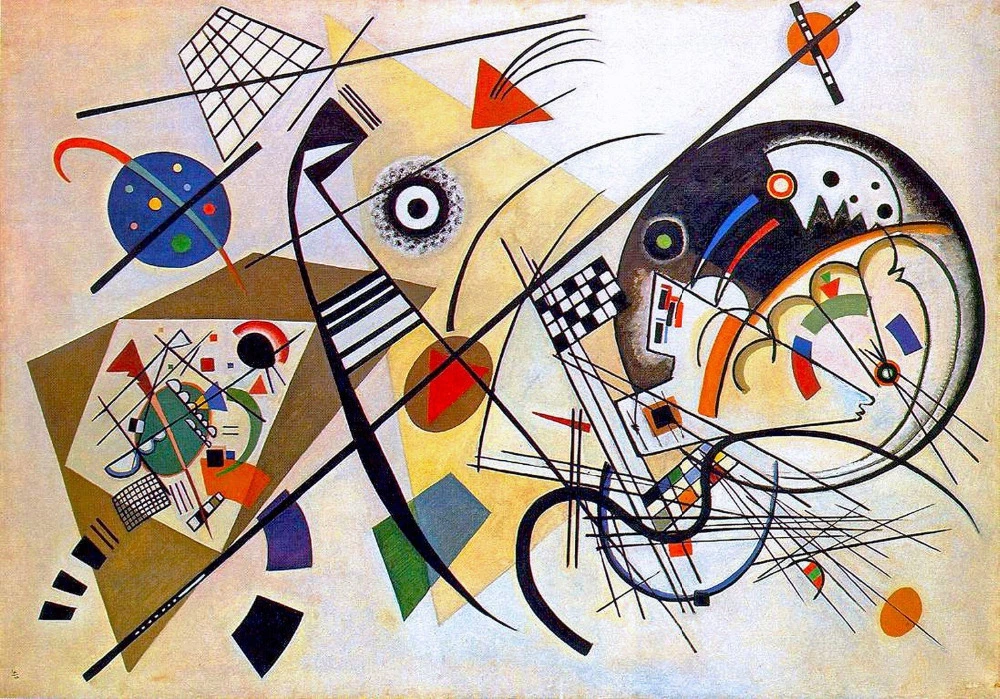
Transverse Lines is a large canvas by Kandinsky from 1923, painted in the Bauhaus years: 202 x 140.8 cm, across whose pale grey-cream ground a single unbroken black line runs from the upper right corner to the lower left. The original is held by the Kunstsammlung Nordrhein-Westfalen in Düsseldorf under accession number 1040, and the museum records the work under the title Durchgehender Strich — the continuous stroke. We paint it by hand in oil on canvas — an oil painting reproduction in eight sizes or to your own measurement — and before dispatch you receive a photograph of the finished work for approval.
| Title: | Transverse Lines |
| Other titles: | Durchgehender Strich · Linee trasversali · Prečne črte |
| Painter: | Wassily Kandinsky (1866–1944) |
| Year: | 1923 |
| Original size: | 202 cm x 140.8 cm |
| Original technique: | Oil on canvas |
| Painting style: | Abstract art |
| Location: | Kunstsammlung Nordrhein-Westfalen, Düsseldorf (inv. 1040) |
| Our reproduction: | hand-painted oil on canvas, 8 sizes from 70 x 50 cm to 200 x 140 cm, custom size on request |
Transverse Lines – Wassily Kandinsky
Is there anything recognisable on the canvas?
No. No people, no landscape and no object you could name — but there are shapes that can be counted and described: circles, triangles, nets, chequerboards, arcs, and one long black line that goes across everything. The museum publishes no interpretation of this work; its entry carries data, the signature, the catalogue number and the exhibitions. So we attribute no meaning to the shapes either, and instead describe where they sit on the canvas and what they do.
What is on the canvas?
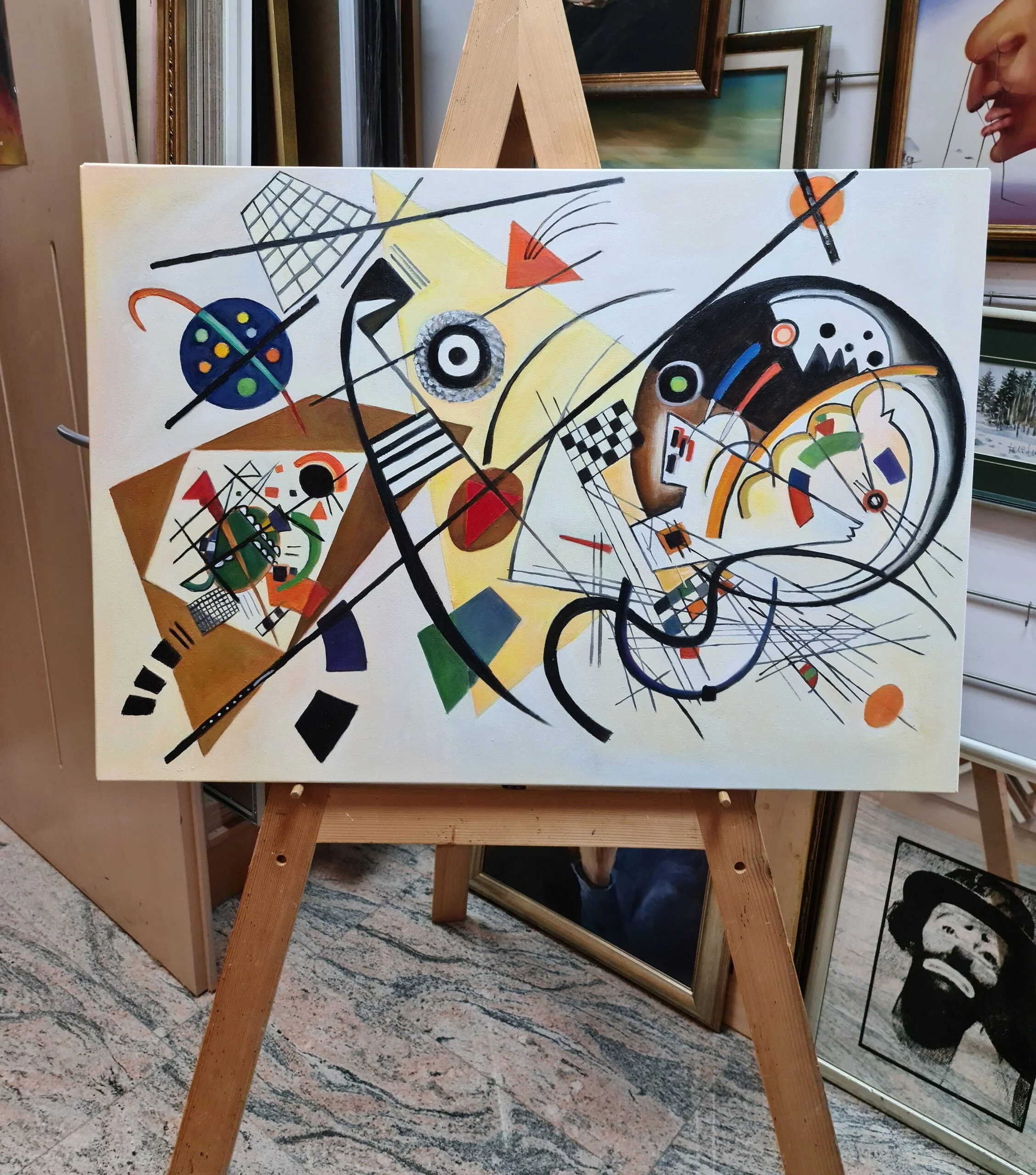
The ground is pale, grey-cream, and almost empty towards the edges. Across the whole canvas runs a single black line from the upper right corner diagonally to the lower left; it is exactly this that the title names. At the upper left stands a tilted black net like a lattice window, below it a dark blue disc dotted yellow, red, green and white, crossed by a pale green band and by the black diagonal; above it an orange hook curls. The left middle is taken by a large brown quadrilateral, and on it a white pentagon carrying a small painting of its own: a dark red pointed form, a blue-green circle quartered and edged with a row of little arcs, a small net, orange fields and a black circle with a red arc. The centre is held by a pale yellow wedge, on which sit a black-and-white target with a soft speckled rim and a strong black arc laid over with a ladder of white rungs. Below it is a brown circle with a red triangle. To the right of centre stands a black-and-white chequerboard like a small flag, beneath it a sheaf of thin straight lines and a blue wavy line with a black hook. The right side is taken by a large black form like a comma, enclosing a white field with black dots and a serrated edge; beside it a brown-black mass, a large white arc with blue, red and green bars, and two tiny orange-rimmed rings. Below sit a green quadrilateral, a blue-grey square, a black diamond and a violet segment of a circle, and at the lower left black rungs like steps. At the lower left is also the painter’s signature with the year.
Why does this painting matter?
It was made in 1923, in Kandinsky’s Bauhaus years, when his painting settled into clear geometric shapes — circle, triangle, straight line —; his Point and Line to Plane appeared three years later, in 1926. The museum entry gives the signature at the lower left as “VK 23” and on the reverse as “VK 1923. „Durchgehender Strich.“ No. 255.”, the catalogue number Roethel/Benjamin 696, and the acquisition year 1967, when the work entered the collection from a donation by Westdeutscher Rundfunk. The same collection also holds Im Blau of 1925, a work from two years later, of the same period.
What does the work mean?
The museum does not say, and we are not going to invent it. The title the museum itself uses does say something, though: continuous stroke. One line goes across everything — across the net, across the blue disc, across the brown quadrilateral, across the yellow wedge — and nothing stops it. Kandinsky wrote in Concerning the Spiritual in Art (1911) that colour is the keyboard, the eye the hammer, the soul the piano with many strings. He wrote that about colour, and in 1911; neither we nor the museum carry it over to this canvas.
Where does this work sit among Kandinsky’s others?
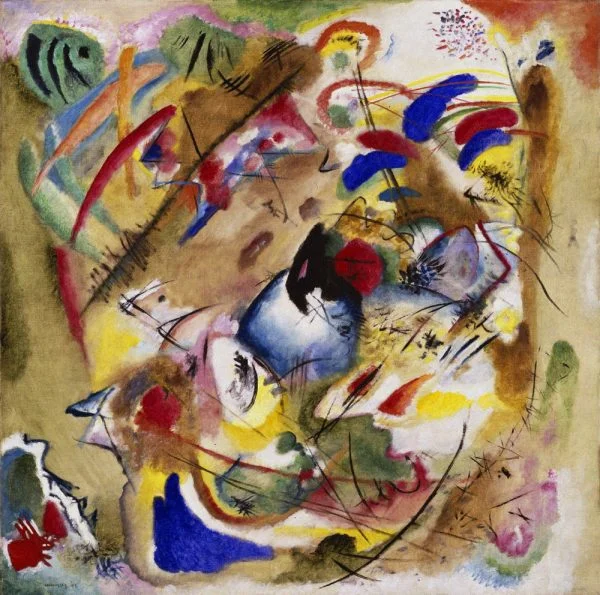
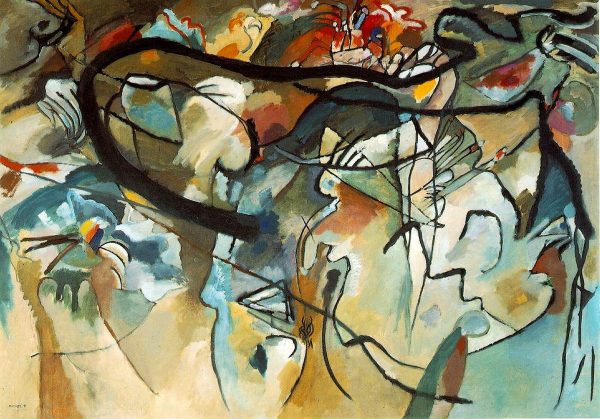
The year 1923 is the middle of the Bauhaus period, and the distance from the early years is wide: Impression V (Park) of 1911 still has riders, and Composition IV of the same year a mountain and lances. Here there is none of that, but there are shapes that can be measured. Where the road leads next is shown by Composition X of 1939 and Various Parts of 1940, where the geometry has gone and soft organic shapes take its place.
How is our hand-painted version made?
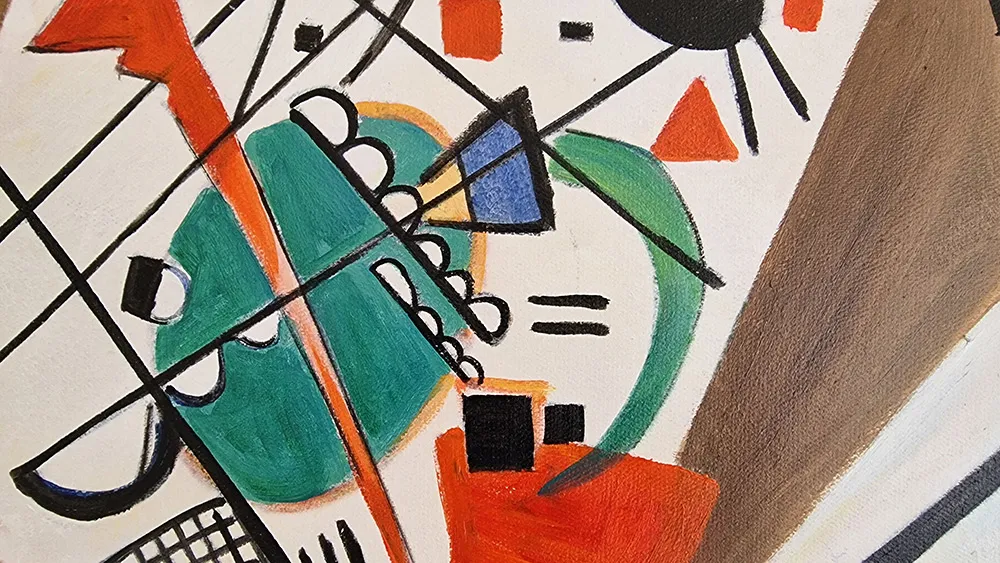
A Kandinsky reproduction is a painting made with a brush and oil paint, not with a printer. The light ground comes first, then the large fields — the brown quadrilateral, the yellow wedge, the blue disc — and only at the end the black lines. The long unbroken line is the hardest part of the whole work: it runs across the entire canvas and has to be drawn in one movement, because every correction shows on it. An abstract painting stands or falls with the relation between its colours, so we do not leave it to chance; an oil painting keeps that relation over the years, because paint does not fade the way a print does. The fifth photograph is a close-up: in it you can make out the small painting inside the white pentagon, the weave of the canvas and the track of the brush, which a print does not have. The sixth photograph was taken in the studio, where the canvas stands on a wooden easel before the frame. Before dispatch every customer receives a photograph of their own finished canvas for approval. Because everything is done by hand, every hand-painted copy is one of a kind and no two are quite alike.
Which size for which wall?
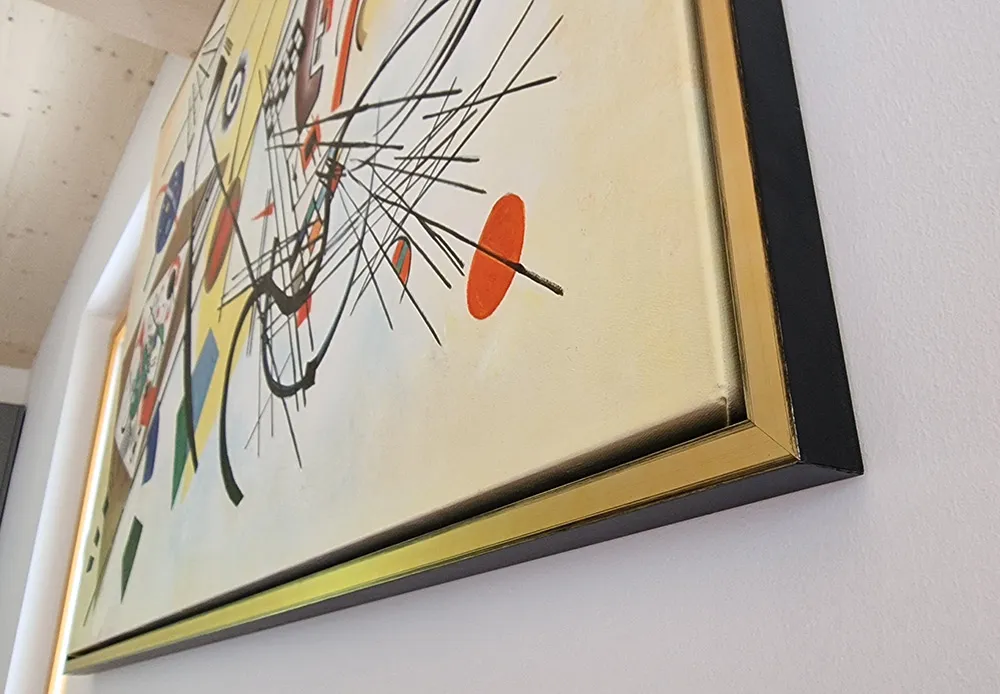
If you are unsure: 120 x 80 cm. The first photograph on this page shows our framed copy on a pale wall between two windows, with a light above it and a sofa below, so the relation to the room is plain at once. The largest size, 200 x 140 cm, matches the original almost one to one and is a painting for the living room in the full sense — it wants a broad, quiet wall and the distance from which it can be taken in at a single glance. The smaller sizes 70 x 50 and 90 x 60 cm suit a hallway, bedroom or office; 100 x 70 and 120 x 80 cm suit an ordinary wall above a sofa or a sideboard. The sizes 140 x 100, 160 x 110 and 180 x 130 cm are for open living spaces and dining rooms; only at those sizes does the small painting in the pentagon open out enough to be read. Because the ground is light, the work holds its own on a darker wall too.
Custom sizes, stretcher and frame
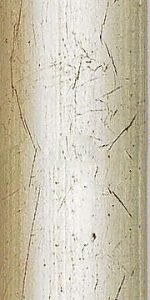
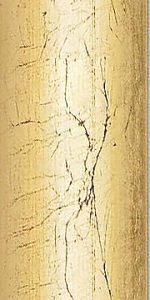
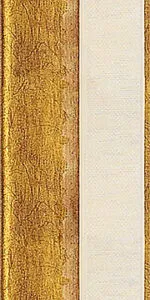
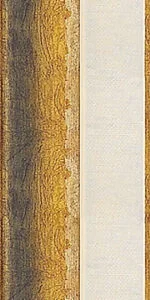
If none of the eight sizes fits your wall, we paint to your measurements and keep the original’s proportions, so the long line keeps its slant; that is our painting to order. Like every canvas painting we make, this copy is delivered stretched on a wooden stretcher and ready to hang. For the frame use our 3D application: it shows every one of our frame profiles on this motif, so you can compare gold, silver, black, white and natural wood — it is for choosing a frame and nothing else. If you want to see how the painting will look on your own wall, that is our separate room-placement service.
Delivery and guarantee
Every copy is made to order in our studio in Slovenia, so allow 15 to 45 days by size. We send it stretched and protected for transport, framed if you chose one, across the EU without customs. Before dispatch you receive a photograph of the finished work for approval, and our returns policy applies. The whole range is in the Wassily Kandinsky gallery, and his path is described in our article about Wassily Kandinsky.
Frequently asked questions
Where is the original?
In the Kunstsammlung Nordrhein-Westfalen in Düsseldorf, accession number 1040; it entered the collection in 1967 from a donation by Westdeutscher Rundfunk.
How large is the original?
202 cm wide and 140.8 cm high, oil on canvas; the museum gives the measurement as 140.8 x 202.0 x 2.7 cm.
Why does the museum call it something else?
The museum’s title is Durchgehender Strich, the continuous stroke, and it names the long line that crosses the whole canvas; with us the work is established as Transverse Lines.
What is depicted?
Nothing representational: geometric shapes — circles, triangles, nets and chequerboards — and one long black line that goes across everything.
Is this a print?
No. It is a reproduction hand-painted in oil on canvas; the brush strokes can be seen and felt, as the fifth photograph above shows.
Which size should I choose?
For an ordinary wall 120 x 80 cm, for a broad one 200 x 140 cm, which is almost exactly the size of the original; for other walls see the size guide above.
Can I have a size that is not listed?
Yes, we paint to measure and keep the original’s proportions.
How is it delivered?
Stretched on a stretcher and framed if you chose that, in 15 to 45 days after you approve the photograph of the finished work.
Is the original for sale, and what is it worth?
No. The canvas belongs to a public collection in Düsseldorf and is not for sale; a hand-painted canvas is the only way to have it at home.
How high should it hang?
The centre at eye level, about 145-150 cm from the floor; above a sofa, 15-25 cm above the back.
Does it work as a gift?
Yes, for someone who likes modern art it is an excellent choice. If you would rather leave the choice to them, there is a gift voucher.
- Subject: one unbroken black line across geometric shapes – 1923
- Original: 202 x 140.8 cm, oil on canvas, Kunstsammlung Nordrhein-Westfalen, Düsseldorf (inv. 1040)
- Our version: hand-painted oil on canvas, eight sizes from 70 x 50 to 200 x 140 cm, stretched and framed on request
- Worth knowing: the museum’s title, Durchgehender Strich, names that one line