Description
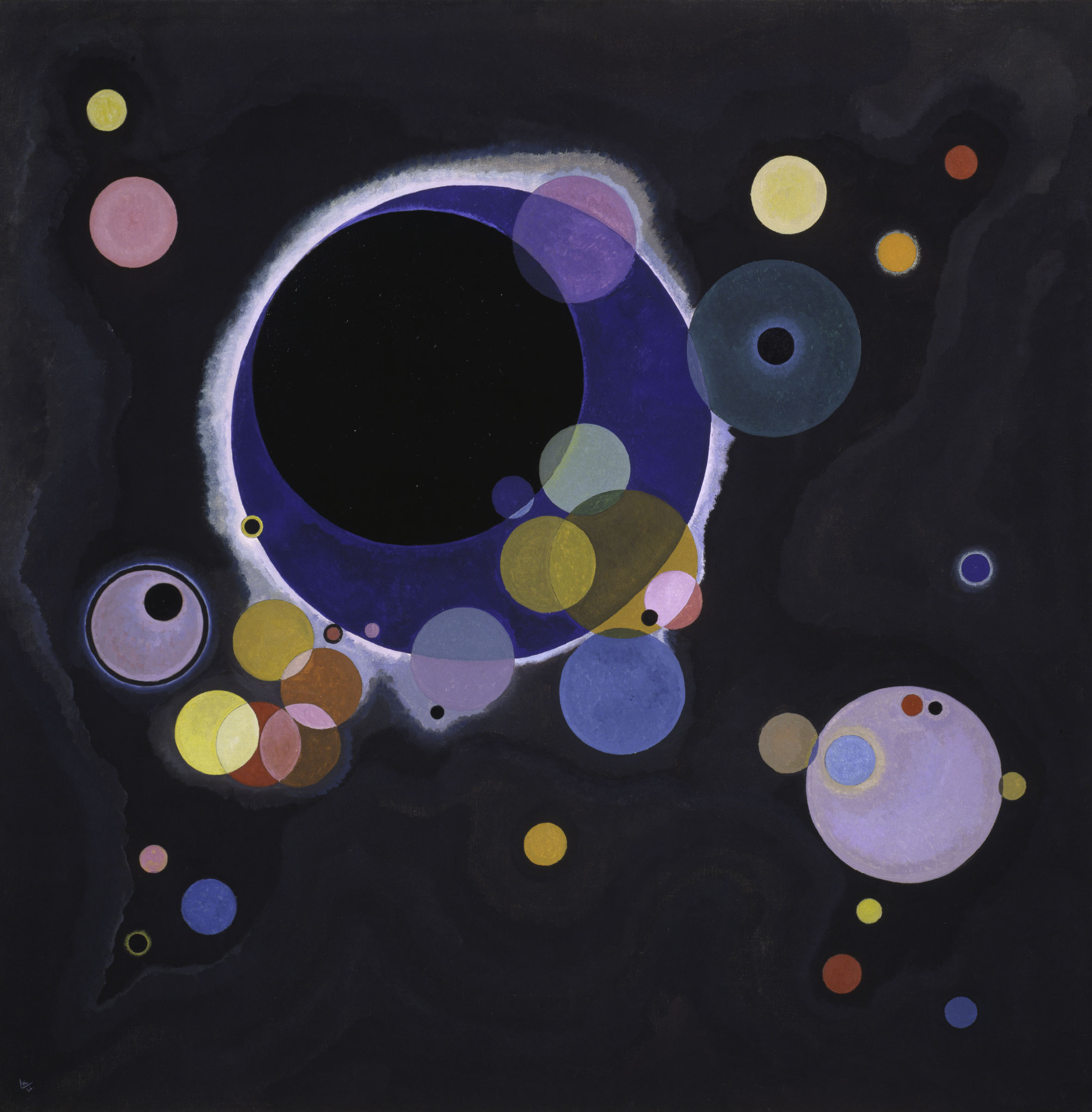
Several Circles is an abstract painting by Wassily Kandinsky from 1926: circles of varying size and colour float across an almost black canvas, among them a large dark blue one with a deep black core and a pale glow around it. It is held by the Solomon R. Guggenheim Museum in New York. We make it as a hand-painted reproduction in oil on canvas, in eight sizes or to your measurements; before dispatch you receive a photograph of the finished work for approval.
| Title: | Several Circles |
| Other titles: | Einige Kreise · Alcuni cerchi · Nekaj krogov |
| Painter: | Wassily Kandinsky (1866–1944) |
| Year: | 1926 (January–February) |
| Original size: | 140.7 cm x 140.3 cm |
| Original technique: | Oil on canvas |
| Painting style: | Abstract art |
| Location: | Solomon R. Guggenheim Museum, New York (inv. 41.283) |
| Our reproduction: | hand-painted oil on canvas, 8 sizes from 60 x 60 cm to 160 x 160 cm, custom sizes on request |
Several Circles – Wassily Kandinsky
Is anything recognisable in the painting?
No. There is no object on the canvas, no scene and no figure — only circles and a dark ground. This is one of those works of Kandinsky’s where you need not search for what it is supposed to represent, because it represents nothing outside itself. To many the sight recalls a night sky with planets, but that stands nowhere in the museum’s record, so we give it as what it is: the viewer’s impression, not the meaning of the work. What is actually on the canvas are circles, their size, their colour and their overlapping — and it is the relations between them that the work is about.
What is on the canvas?
The canvas is square and almost entirely dark; the ground is not evenly black but carries barely visible darker swirls that give it depth. Some forty circles are spread across it. The largest stands above and left of centre: a deep blue-violet with a large black core that does not sit at its centre but is shifted up and to the left, while a soft white glow spreads around the whole, as though the circle were burning. To its right is a dark green-blue ring with a black hole at the middle. Lower right lies a large pale lilac circle carrying smaller ones on it — a blue one with a yellow rim, a red dot, a black one and an orange one. Lower left a group of translucent circles overlaps in yellow, ochre, brown and pink; where they cross, the colours mix and a third is made. Along the left edge a pale lilac circle with a black core is outlined by a thin black line inside a blue halo. Small circles are scattered everywhere — yellow, pink, red, orange, blue and one rimmed in green. The painter’s signature stands in the lower left corner.
Why is the painting called Several Circles?
Because the title is a description and not an interpretation. Kandinsky did not name the work with a word that says what it means, but with one that says what is on it: several circles. The German original Einige Kreise and the Slovene Nekaj krogov say the same. The reticence of the title is part of the work — the viewer is offered no story but a form, and everything after that is a matter of looking.
What does the circle mean for Kandinsky?
Here we do not guess; we report the museum that holds the work. According to the Guggenheim’s own account, in these years Kandinsky was particularly taken with the formal and expressive qualities of the circle: he held it to be the synthesis of the greatest oppositions, because it combines the concentric and the excentric in a single form and in equilibrium, and of the three primary forms it is the circle that points most clearly towards a fourth dimension. The triangle carried active, aggressive feeling for him, the circle the spiritual, and the square calm. The museum also points out something easy to miss: this work contains a single overarching square — the shape of the canvas itself. It is set out more fully in the museum’s own material on Kandinsky.
Why does this painting matter?
Because it shows Kandinsky at a time when he had already freed painting entirely from the object and was giving himself to a single form. In these years he taught at the Bauhaus, where form, colour and relation were treated as components that could be studied, and Several Circles looks exactly like such an experiment: what one form can do when you change its size, its colour, its transparency and its place. The work is today in the Solomon R. Guggenheim Museum in New York, which received it by gift as part of the founding collection.
How is our hand-painted version made?
This is a canvas painting made with a brush and oil colours, not with a printer. The painter works from a high-resolution reference and builds the surface in layers. Two things are hardest in this subject. The first is the ground: it must be dark without being dead, or the circles look stuck on top of it instead of lying in it. The second is transparency — where the circles overlap the paint has to be genuinely see-through, so the lower colour reads through the upper and a third is made; lay both down opaque and the overlap disappears and the work collapses into a pattern. The edges of the circles are soft rather than drawn, so they are made with the brush and not with a mask. An oil painting reproduction holds that balance over years, because the colour does not fade the way a print does. We have no studio photographs of this work yet, so you will find none on this page — once the next copy is painted we photograph it and the images come here. Because everything is done by hand, every hand-painted copy is its own and two copies are never quite the same.
Which size for which wall?
If you are unsure: 140 x 140 cm, the closest of our sizes to the original, which measures 140.7 x 140.3 cm. The canvas is square, and a square is a particular shape: on a wall it reads as calm and balanced, but it asks for the middle and not the corner. The 60 x 60 and 70 x 70 cm sizes belong above a chest of drawers, in a hallway or in an office; 80 x 80 and 90 x 90 cm suit a bedroom or a smaller sitting room. At 100 x 100 cm this is the natural painting for the living room above the sofa, and 120 x 120 cm suits a larger wall. The largest sizes, 140 x 140 and 160 x 160 cm, are for open living spaces, halls and stairwells; only at those does it show how large the circles are in the original. Because the ground is dark, the work carries a pale wall well and reads on it like a window.
Custom sizes, stretcher and frame
If none of the eight sizes fits your wall, we paint the work to your measurements; that is our painting made to measure. Like all our paintings on canvas, this copy is delivered stretched on a wooden stretcher and ready to hang. For the frame use our 3D application: it shows every frame profile on this subject, so you can compare gold, silver, black, white and natural wood before deciding — it is for choosing a frame, nothing else. Against a dark ground a black profile merges into it, so pale or natural wood often works better.
Delivery and guarantee
Every copy is made to order in our studio in Slovenia: allow 15 to 45 days by size. We send it stretched and protected, framed if you have chosen a frame, across the EU without customs. Before dispatch you receive a photograph of the finished work for approval, and our returns policy applies. The whole range is in the Wassily Kandinsky gallery, and the painter’s path is described in our article about Wassily Kandinsky. Related works from the same range are The Blue Mountain, Dominant Curve and Transverse Lines.
Frequently asked questions
Where is the original?
In the Solomon R. Guggenheim Museum in New York, as part of the founding collection, under accession number 41.283.
How large is the original?
It measures 140.7 cm wide and 140.3 cm high — near enough an exact square.
When was it painted?
In January and February 1926, when Kandinsky was teaching at the Bauhaus.
What colour is the ground?
Dark, almost black, with faint darker swirls. The circles carry precisely because they are set on that darkness.
Is this a print?
No. This is a reproduction painted by hand in oil on canvas; the brushstrokes are visible and can be felt.
Which size should I choose?
For a living room 100 x 100 cm; for really large walls 160 x 160 cm, and for other walls see the size guide above.
Can I have a size that is not on the list?
Yes, we paint to measure and keep the square proportion of the subject.
How is it delivered?
Stretched and framed if you chose that, in 15 to 45 days after you approve the photograph of the finished work.
What is the painting about, in short?
About a single form: what a circle can do when you change its size, its colour, its transparency and its place.
Is the original for sale, and what is it worth?
No. It belongs to the Guggenheim’s public collection and is not for sale, so we do not guess at its value.
Does it make a good gift?
Yes, for anyone who loves modern art. If you would rather leave the choice to them, there is a gift voucher.
- Subject: some forty circles on an almost black canvas, the largest dark blue with a black core
- Original: Solomon R. Guggenheim Museum, New York, inv. 41.283, 1926, 140.7 x 140.3 cm
- Our version: a hand-painted Kandinsky reproduction in oil, eight sizes from 60 x 60 to 160 x 160 cm, stretched and framed on request
- Worth knowing: the museum points out that the work contains a single overarching square — the shape of the canvas itself