
















Description
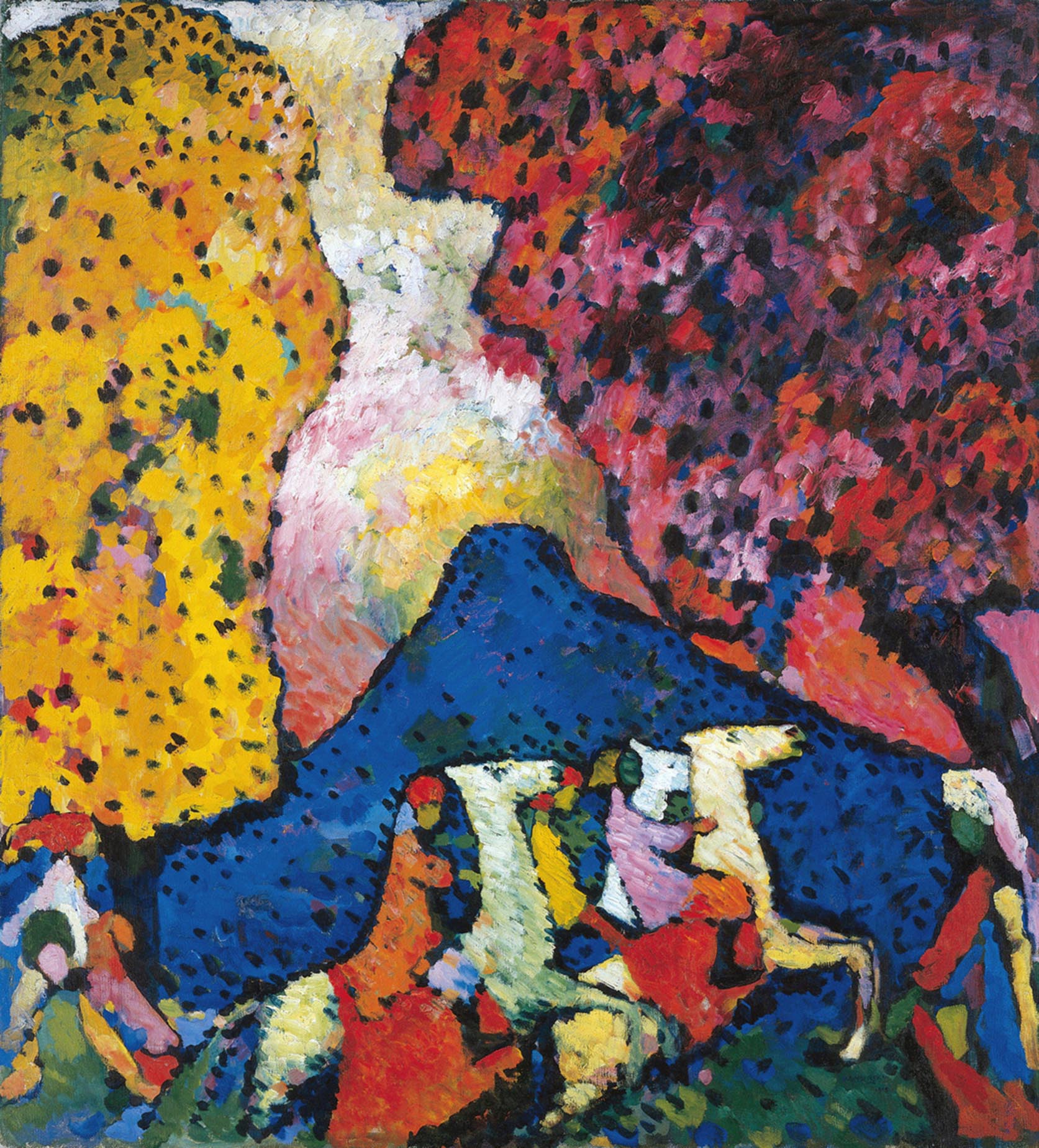
The Blue Mountain is a painting by Wassily Kandinsky from 1908–1909: a blue mountain speckled with dark dots stands at the centre of the canvas, a yellow tree to one side and a red one to the other, and three riders cross the foreground. It is held by the Solomon R. Guggenheim Museum in New York. We make it as a hand-painted reproduction in oil on canvas, in eight sizes or to your own measurements; before dispatch you receive a photograph of the finished work for approval.
| Title: | The Blue Mountain |
| Other titles: | Der blaue Berg · La montagna blu · Modra gora |
| Painter: | Wassily Kandinsky (1866–1944) |
| Year: | 1908–1909 |
| Original size: | 96.6 cm x 106 cm |
| Original technique: | Oil on canvas |
| Painting style: | Expressionism |
| Location: | Solomon R. Guggenheim Museum, New York (inv. 41.505) |
| Our reproduction: | hand-painted oil on canvas, 8 sizes from 50 x 55 cm to 150 x 170 cm, custom sizes on request |
The Blue Mountain – Wassily Kandinsky
Is anything recognisable in the painting?
Yes, and that is exactly what sets it apart from Kandinsky’s later canvases. A mountain stands at the centre, trees to left and right, and in the foreground riders on horseback and a few standing figures. All of it can be named, although none of it is painted as it would look in nature: the mountain is blue, the tree on the left is yellow, the crowns on the right are red and purple, the horses white, yellow and orange. The colours do not describe; they are chosen. The work still has a scene, then, but that scene has already been given over to colour – and that is where it stands on the painter’s road.
What is on the canvas?
The canvas is upright and almost square. A broad blue mountain with a rounded summit takes the centre, speckled with short dark dots that set the surface shimmering. A tall yellow tree stands at the left, dotted just as densely with dark marks; at the right two crowns in red, pink and purple touch one another and shade down into orange. Between the yellow tree and the mountain a pale band rises – white, cream and faintly pink – reading as a second, paler mountain behind the blue one. Across the lower third ride three horsemen: an orange-red horse at the left with its head down, a pale yellow horse standing in the middle, and a light horse rearing at the right; the riders are painted in white, yellow, pink and red and have no faces. Two figures in red and green stand in the lower left corner and one more in the lower right. The strokes are short and visible, the colours set side by side rather than mixed on the canvas, so the whole surface shimmers.
Why is the painting called The Blue Mountain?
Because the mountain is blue, and because the blue here is a decision rather than a description. A mountain in nature is not blue; Kandinsky painted it blue because he used colour as a means and not as a report on what he saw. The title therefore says what matters most on the canvas: not the mountain as a place, but the mountain as a large blue field with everything else arranged around it. The same holds for the German title Der blaue Berg and the Slovene Modra gora – all three name the colour before the thing.
What do the riders mean?
Here we do not guess; we report what the museum that holds the work says. According to the Guggenheim’s own account, the horse-and-rider motif stood for Kandinsky’s crusade against conventional aesthetic values and for his dream of a more spiritual future brought about by art. The rider appears in many guises – as a fairy-tale figure, a medieval knight, and Saint George, saving humankind from evil. The museum adds that around 1909 his style was becoming increasingly abstract and expressionistic, and the subjects of his paintings were changing from the portrayal of natural events to apocalyptic narratives: by 1910 many of his canvases drew on the book of Revelation, and the rider came to signify the Horsemen of the Apocalypse. That is what the museum sets out in its own material on Kandinsky, which is what we draw on here: the Guggenheim Museum material.
Why does this painting matter?
Because it stands exactly at the turn. Before it Kandinsky painted scenes; after it he will paint relations of colour and form with no object at all. The Blue Mountain still has both at once: a scene that can be read, and colours already coming loose from it; an abstract painting it is not yet, but it is on the way. In 1911 he founded the group Der Blaue Reiter — the Blue Rider — with Franz Marc, and the name came about, as he told it himself, because both of them were fond of blue, Marc of blue horses and he of blue riders. The blue rider and the blue mountain belong to one thought. The work is today in the Solomon R. Guggenheim Museum in New York, which received it by gift as part of the founding collection.
How is our hand-painted version made?
This is a canvas painting made with a brush and oil colours, not with a printer. The painter works from a high-resolution reference and builds the surface in layers. With this subject the hardest thing is the one that looks easiest: the densely dotted fields. The dots on the blue mountain, on the yellow tree and in the red crowns are not a pattern but separate strokes of differing size and direction, and if the painter lays them down evenly the surface stiffens. So they go on unevenly, as they do in the original. An oil painting reproduction holds that balance over years, because the colour does not fade the way a print does. We have no studio photographs of this work yet, so you will find none on this page – once the next copy is painted we photograph it and the images come here. Before dispatch every customer receives a photograph of their own finished canvas for approval. Because everything is done by hand, every hand-painted copy is its own and two copies are never quite the same.
Which size for which wall?
If you are unsure: 97 x 106 cm. That size is also the closest to the original, which measures 96.6 x 106 cm, so its proportions are all but exactly those of the work. The canvas is nearly square, which is a forgiving shape on a wall: it sits well above a chest of drawers, above a bed, or on a narrower wall where a landscape format would look overblown. The 50 x 55 and 60 x 70 cm sizes belong above a desk or in a hallway; 70 x 80 and 80 x 90 cm suit a bedroom or a smaller sitting room. At 97 x 106 cm this is the natural painting for the living room above the sofa, and 110 x 120 cm suits a larger wall. The largest sizes, 130 x 140 and 150 x 170 cm, are for open living spaces, halls and stairwells. Because the colour here is strong and unmixed, the work needs a little quiet wall around it.
Custom sizes, stretcher and frame
If none of the eight sizes fits your wall, we paint the work to your measurements; that is our painting made to measure. Like all our paintings on canvas, this copy is delivered stretched on a wooden stretcher and ready to hang. For the frame use our 3D application: it shows every frame profile on this subject, so you can compare gold, silver, black, white and natural wood before deciding – it is for choosing a frame, nothing else. With colours this saturated a narrow, quiet profile usually works better than a wide, decorated one.
Delivery and guarantee
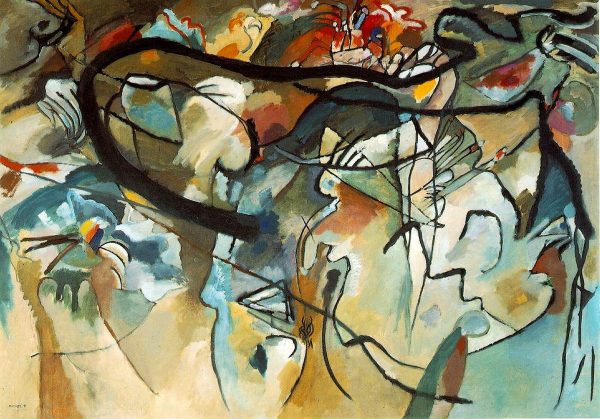
Every copy is made to order in our studio in Slovenia: allow 15 to 45 days by size. We send it stretched and protected, framed if you have chosen a frame, across the EU without customs. Before dispatch you receive a photograph of the finished work for approval, and our returns policy applies. The whole range is in the Wassily Kandinsky gallery, and the painter’s path is described in our article about Wassily Kandinsky. Related works from the same range are Several Circles, Dominant Curve and Composition VII.
Frequently asked questions
Where is the original?
In the Solomon R. Guggenheim Museum in New York, as part of the founding collection, under accession number 41.505.
How large is the original?
It measures 96.6 cm wide and 106 cm high; our 97 x 106 cm size is therefore all but identical.
When was it painted?
In 1908 and 1909, when Kandinsky was painting in Murnau and Munich.
What is shown in the painting?
A blue mountain at the centre, a yellow tree at the left, red and purple crowns at the right, and three riders with a few standing figures in the foreground.
Is this a print?
No. This is a reproduction painted by hand in oil on canvas; the brushstrokes are visible and can be felt.
Which size should I choose?
For a living room 97 x 106 cm, which is also the size of the original; for really large walls 150 x 170 cm, and for other walls see the size guide above.
Can I have a size that is not on the list?
Yes, we paint to measure and keep the proportions of the subject.
How is it delivered?
Stretched and framed if you chose that, in 15 to 45 days after you approve the photograph of the finished work.
What is the painting about, in short?
About the turn: a scene of mountain, trees and riders that colour is slowly leading away from nature.
Is the original for sale, and what is it worth?
No. It belongs to the Guggenheim’s public collection and is not for sale, so we do not guess at its value.
Does it make a good gift?
Yes, for anyone who loves modern art. If you would rather leave the choice to them, there is a gift voucher.
- Subject: a blue speckled mountain between a yellow and a red tree, with three riders below
- Original: Solomon R. Guggenheim Museum, New York, inv. 41.505, 1908–1909, 96.6 x 106 cm
- Our version: a hand-painted Kandinsky reproduction in oil, eight sizes from 50 x 55 to 150 x 170 cm, stretched and framed on request
- Worth knowing: the group Der Blaue Reiter got its name because both Kandinsky and Marc were fond of blue – he of blue riders, Marc of blue horses