







































Description
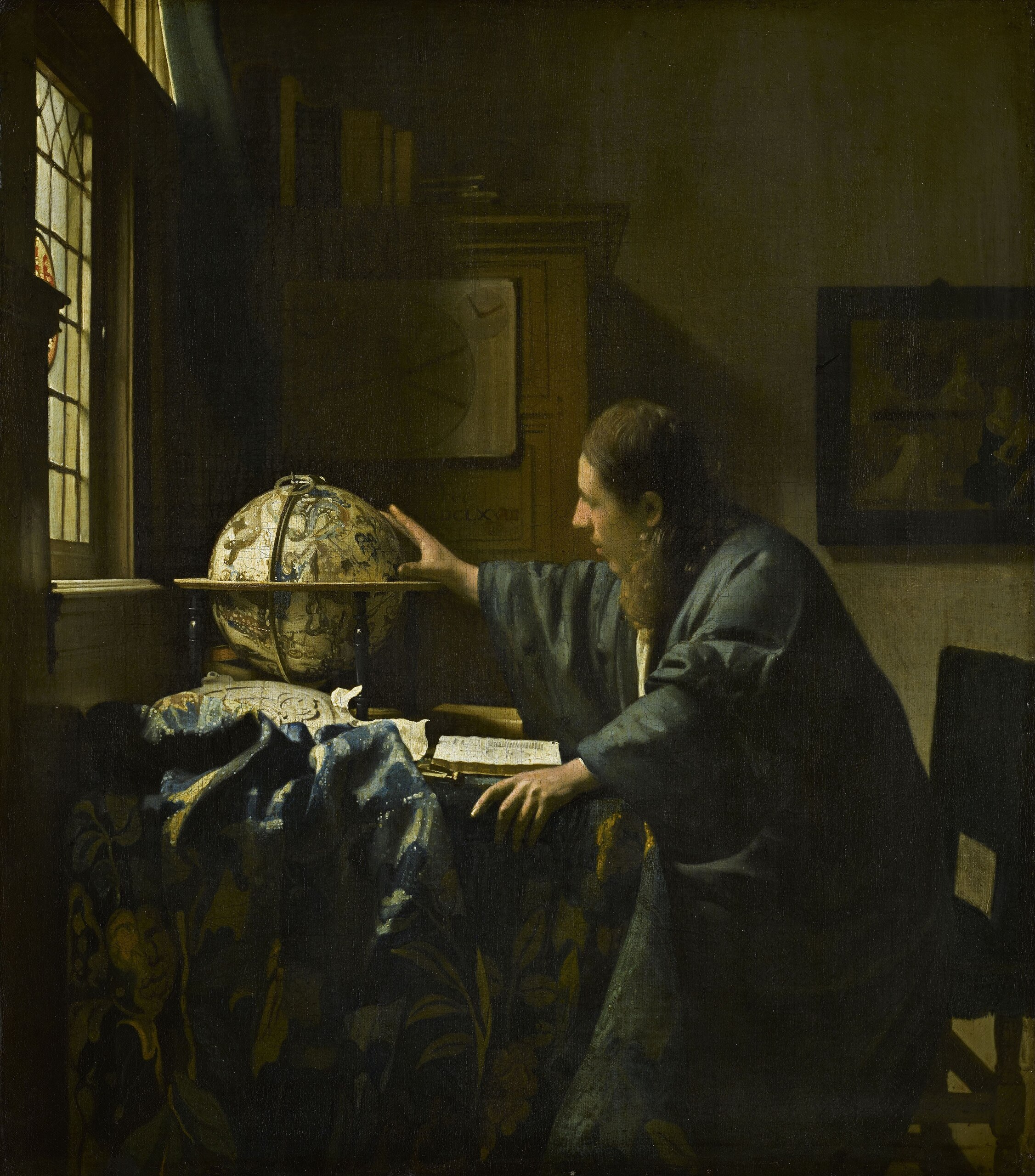
The Astronomer is a painting by Johannes Vermeer from 1668: a long-haired scholar in a blue-grey robe leans over a table beside a leaded window and reaches out towards a celestial globe, with an open book and a heavy patterned cloth in front of him. The original, oil on canvas, is 50.8 cm high and 46.3 cm wide and belongs to the Louvre in Paris. Our painter paints it by hand in oil on canvas in 8 portrait sizes, from 43 x 47 to 190 x 200 cm, or to your own measurement, and we show you the finished painting in a photograph before dispatch.
| Title: | The Astronomer |
| Other titles: | De astronoom · Der Astronom |
| Painter: | Johannes Vermeer (1632–1675) |
| Year painted: | 1668 |
| Original size: | 50.8 cm x 46.3 cm (height x width) |
| Original technique: | Oil on canvas |
| Painting style: | Baroque, Dutch Golden Age |
| Located at: | Musée du Louvre, Paris (acc. no. RF 1983-28) |
| Our reproduction: | Hand-painted oil on canvas, 8 sizes or made to measure |
The Astronomer – Johannes Vermeer
What does The Astronomer show?
The scene is small and quiet. Light comes in from the left, through a window of small panes set in lead. A man with long hair, wrapped in a loose blue-grey robe, leans over the table and touches a celestial globe with his fingers spread.
On the table lies a heavy, richly patterned cloth gathered in deep folds, with an open book on top. Behind the man stands a cupboard, a framed painting of the Finding of Moses hangs on the wall, and a chair shows at the right edge. The light falls on his face, his hand and the globe, while the rest of the room stays in soft shadow.
What does the scene mean, and who is the astronomer?
Vermeer tells no story through action; he shows a person lost in thought. The scholar studies the sky without a telescope, using a globe of the starry heavens and a book. The globe is by Jodocus Hondius, and the book is Adriaan Metius’s astronomy book of 1621.
Who sat for Vermeer is not certain. It may have been Antonie van Leeuwenhoek, but that remains a possibility, not a fact.
The painting has a companion: The Geographer, in the Städel in Frankfurt, shows the same man in the same room. Both canvases were cut from the same bolt of cloth, so they belong together even in their material.
Why is The Astronomer so admired?
Vermeer left only a few dozen paintings, and each one is a rarity. The Astronomer holds everything he is known for: daylight from the left, a still interior and objects you almost want to touch.
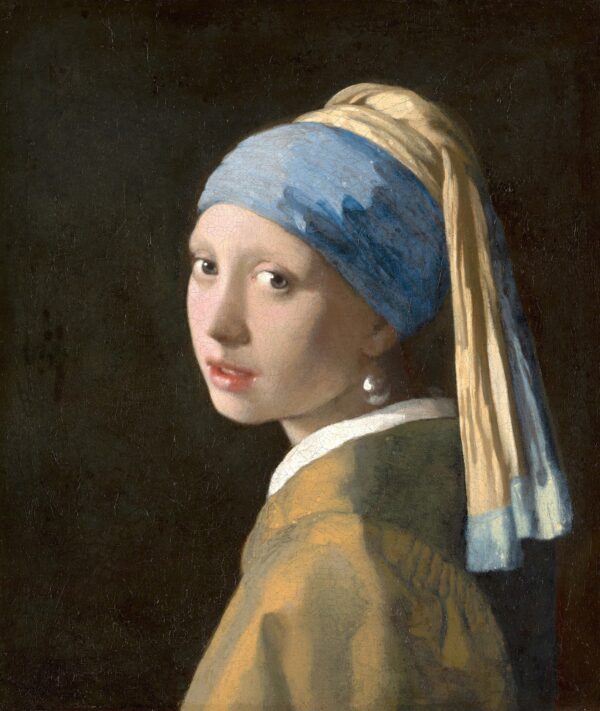
Its history in the 20th century and its companion in Frankfurt make it special too. Just as small, and among the most famous Vermeer paintings, is Girl with a Pearl Earring, 44.5 cm high and 39 cm wide.
If you would like to know more about its past, there is a detailed Wikipedia article.
Where is the original, and how did it get there?
The original is in the Louvre in Paris, under the number RF 1983-28. It reached the museum through these stations, listed here in order.
In 1713 it was sold in Rotterdam together with The Geographer, and the two paintings stayed together until about 1800. From the 1880s it belonged to the Rothschild family. In 1940 the Nazi ERR seized it from the home of Édouard de Rothschild and earmarked it for Hitler’s planned museum in Linz. After the war it was returned to the Rothschilds. In 1983 the French state acquired it in lieu of inheritance taxes, and it has been in the Louvre ever since.
The Astronomer or another Vermeer?
The Astronomer suits a study, a library, an office or the home of anyone drawn to science, maps and stars. The scene is calm, without drama, and sits well with wood, books and warm light.
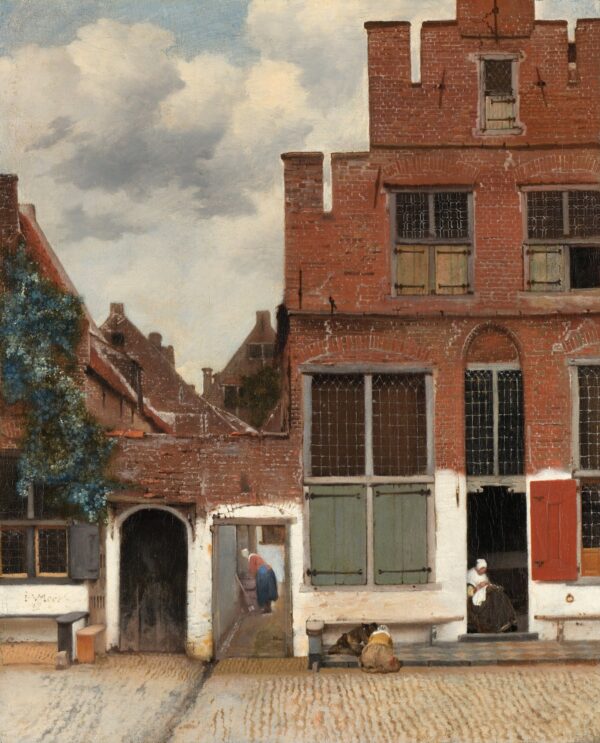
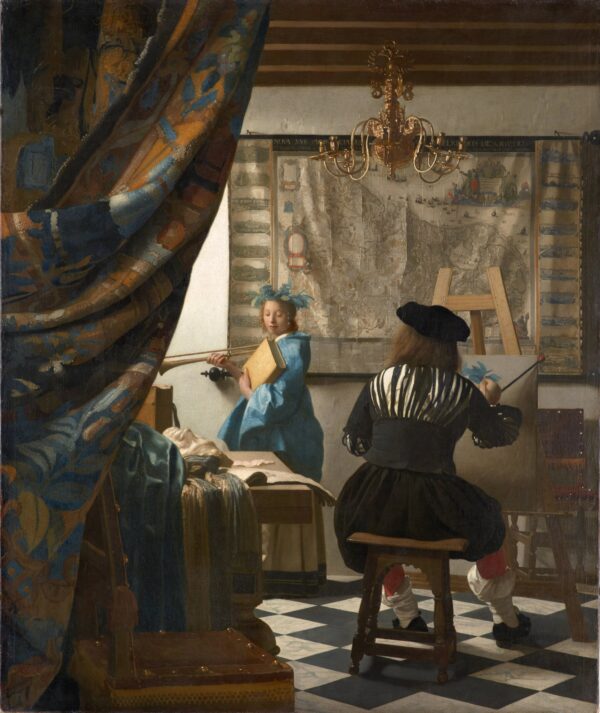
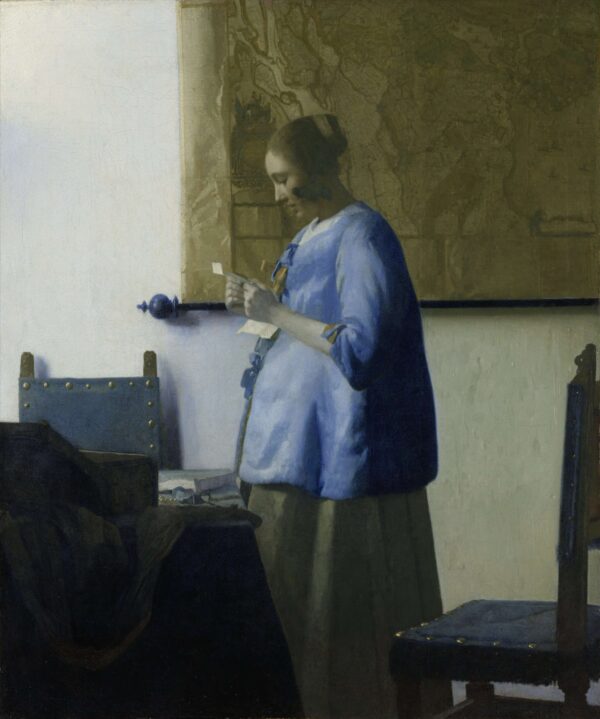
If you would like another Vermeer room with a large map, there is The Art of Painting, where a painter at his easel paints his model. Quiet reading by a window is the subject of Woman in Blue Reading a Letter, while The Little Street shows the front of an old house in Delft.
Every Vermeer we paint to order is gathered on the Johannes Vermeer page.
How does our painter paint your Astronomer?
Each Astronomer is painted to order, layer by layer, in oil on canvas. The painter first lays in the dark tones of the room and the pale plane of the window, so that light and shadow are right from the first layer.
Then he builds the figure: the blue-grey robe with its soft folds, the face and the hand on the globe. After that come the heavy patterned cloth, the pages of the open book and the glint of light on the curve of the globe.
This Vermeer reproduction differs from a print at first glance: you can see the brushstrokes on the surface, and the colour has a depth that paper cannot reach. As daylight moves through your room, an oil painting reproduction like this looks slightly different every hour.
Which size for which wall?
In short: 43 x 47 or 50 x 55 cm for a desk, a shelf or a narrow wall, 68 x 75 or 75 x 85 cm above a chest of drawers or in a study, 98 x 104 and 125 x 140 cm above a sofa, and 145 x 160 and 190 x 200 cm for a tall, empty wall.
We paint The Astronomer in 8 portrait sizes (width x height): 43 x 47, 50 x 55, 68 x 75, 75 x 85, 98 x 104, 125 x 140, 145 x 160 and 190 x 200 cm. The original is small, 46.3 cm wide and 50.8 cm high. The 43 x 47 cm size is 3.3 cm narrower and 3.8 cm shorter, and the 50 x 55 cm size 3.7 cm wider and 4.2 cm taller.
So our smallest sizes stay close to the scale of the original, while the larger ones turn the quiet scene into the centrepiece of a room. As a painting for the living room above a sofa, choose 98 x 104 or 125 x 140 cm, and hang it so that the globe sits roughly at eye level.
Can I choose another size or a frame?
Yes. The original is only a little taller than it is wide, roughly 9 : 10, so we can also transfer it to a size that is not on the list without losing the globe or the window at the edge. Send us the width and height and we will reply with a price and a date.
We send it rolled, stretched on a stretcher bar or framed. Our workshop in Slovenia does the stretching and framing, and prepares every canvas painting we send in the same way. Frames for the Astronomer are compared in our 3D application, which exists for that choice alone; a view of the painting on your own wall is a separate service.
A dark wooden frame goes with the blue-grey robe and the dark wood of the cupboard, while a slim gold edge brings out the light on the globe and the cloth.
When will The Astronomer arrive?
We start painting your Astronomer once the order arrives, and within 15 to 45 working days it is ready to ship. When it is finished we photograph it and send you the photo before dispatch; if you would like anything changed, we correct it. The parcel travels without customs within Slovenia and to every other EU country, and our returns policy applies to every order.
The Astronomer makes a fine gift for a teacher, a researcher or anyone who loves the night sky. If you would rather let them choose the size, give a wall art voucher.
Frequently asked questions
Where can I see the original Astronomer?
In the Louvre in Paris, under the number RF 1983-28.
What is the astronomer touching?
A celestial globe made by Jodocus Hondius.
Why is there no telescope?
Vermeer did not paint one; the scholar studies the sky with the globe and the 1621 book by Adriaan Metius.
Is this a printed copy?
No. Our painter paints your Astronomer with a brush in oil on canvas, so it is a hand-painted copy, not a print.
How large is the original painting?
It is 50.8 cm high and 46.3 cm wide; our closest sizes are 43 x 47 and 50 x 55 cm.
Does it suit an office or a study?
Very well, as it shows someone absorbed in thought; it also sits calmly in a library or a bedroom.
What is the companion of The Astronomer?
The Geographer in the Städel in Frankfurt, with the same man in the same room.
How did the painting come to the Louvre?
The French state acquired it in 1983 in lieu of inheritance taxes and placed it in the Louvre.
- Subject: a scholar in a blue-grey robe leans over a table by the window and reaches for a celestial globe.
- Original: 1668, oil on canvas, 50.8 x 46.3 cm, Musée du Louvre, Paris.
- Our Astronomer: painted by hand in oil on canvas, in 8 portrait sizes from 43 x 47 to 190 x 200 cm or made to measure.
- Worth knowing: its companion, The Geographer, shows the same man in the same room.