







































Description
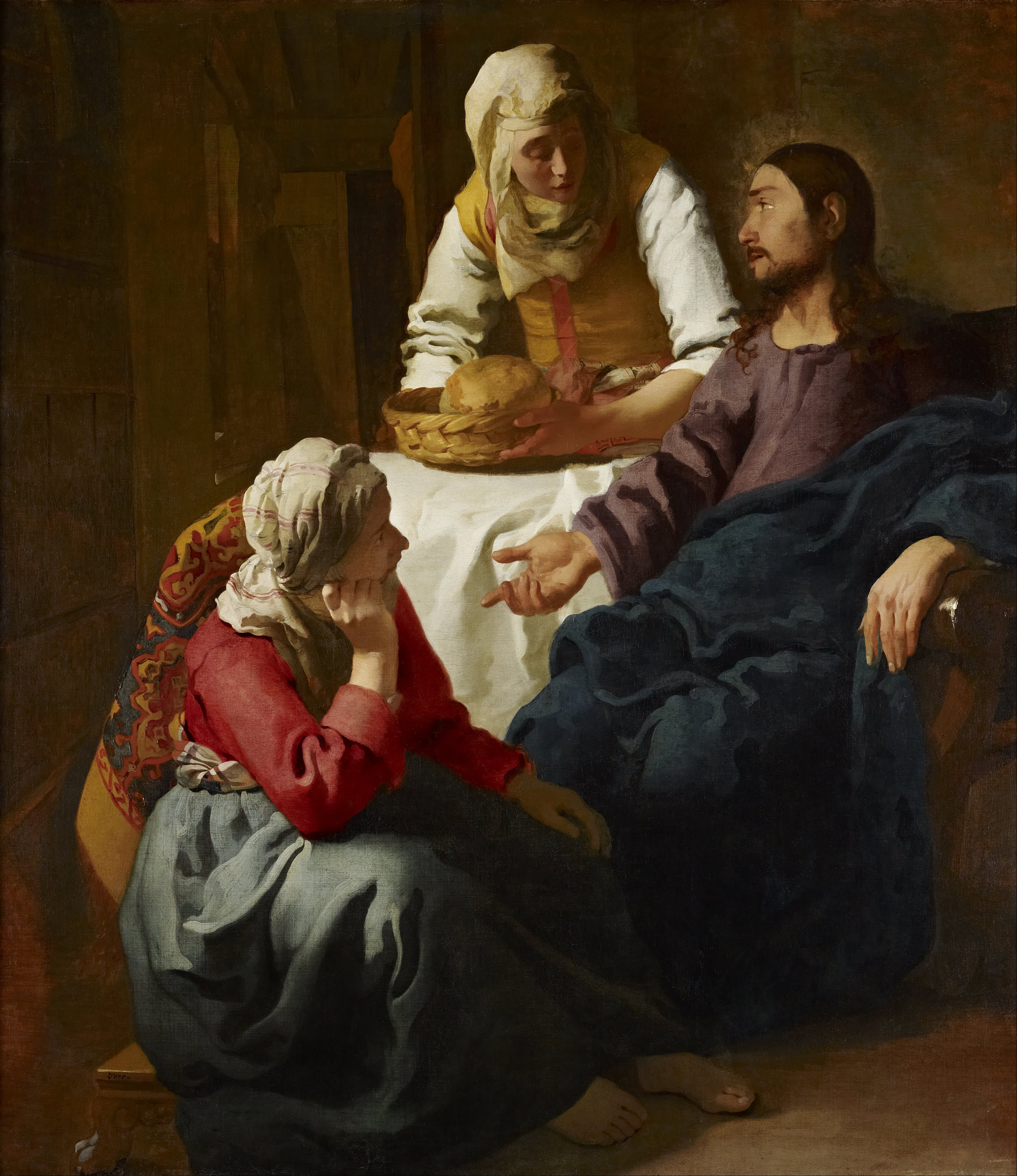
Christ in the House of Martha and Mary is a painting by Johannes Vermeer from around 1655 and the largest he made: Christ sits in a chair and points towards Mary, who sits at his feet with her head resting on her hand, while behind them Martha leans in with a basket of bread. The original, oil on canvas, is 158.5 cm high and 141.5 cm wide and belongs to the Scottish National Gallery in Edinburgh. Our painter paints it for you to order in oil on canvas, in one of 8 portrait sizes from 45 x 50 to 172 x 200 cm or to your own measurement, and before dispatch we send you a photograph of it.
| Title: | Christ in the House of Martha and Mary |
| Other titles: | Christus in het huis van Martha en Maria · Christ in the House of Mary and Martha |
| Painter: | Johannes Vermeer (1632–1675) |
| Year painted: | c. 1655 |
| Original size: | 158.5 cm x 141.5 cm (height x width) |
| Original technique: | Oil on canvas |
| Painting style: | Baroque, Dutch Golden Age |
| Located at: | Scottish National Gallery, Edinburgh |
| Our reproduction: | Hand-painted oil on canvas, 8 sizes or made to measure |
Christ in the House of Martha and Mary – Johannes Vermeer
What does Christ in the House of Martha and Mary show?
Three figures are gathered close together around a table covered with a white cloth. Christ sits in a chair and stretches out his hand towards Mary, who sits beside his feet.
Mary has rested her head on her hand and listens closely. It is as if everything else in the house has gone quiet for her for a moment.
Behind them Martha leans in. She carries a basket with the bread she has brought to the table and bends over Christ as though she wants to tell him something. The white cloth and the bread remind us that this visit is also a meal.
Which story does the scene tell?
The scene comes from the tenth chapter of the Gospel of Luke. Christ visits the sisters Martha and Mary. Martha busies herself with serving, while Mary sits down at his feet and listens to what he says.
Vermeer chooses the moment when two ways of welcoming a guest meet at the same table: looking after him and listening to him. Both sisters are with Christ, each in her own way.
The gesture of his hand leads the eye to Mary. The painter needs no words for this; a hand that points and a face that listens are enough. The story makes sense even to someone who does not know the Bible: a guest arrives, one sister serves, the other sits down beside him.
Why does this painting stand apart among Vermeer’s works?
Johannes Vermeer (1632–1675) lived and worked in Delft, and today he is known above all for small, quiet interiors. Christ in the House of Martha and Mary breaks that pattern: it is his largest painting and one of very few with a religious subject.
It is an early work, painted around 1655, when Vermeer was still taking his themes from the Bible and from mythology. In 1656 came The Procuress, his first scene of everyday life, and that path led him to the works people love him for today.
For admirers of Vermeer this makes it precious: it shows a young painter before he found his quiet world of rooms by a window. The Wikipedia article (in English) has more on it.
Where is the original?
The original is in Edinburgh, in the Scottish National Gallery. The canvas is 158.5 cm high and 141.5 cm wide, unusually large for Vermeer; most of his other works are much smaller.
Anyone travelling to Scotland can see it there in person. At home you can have it in the size that suits your wall, from a smaller portrait format up to a large canvas that comes near the scale of the original.
Christ in the House of Martha and Mary or another Vermeer?
This painting belongs in rooms where the family gathers: a dining room, a spacious living room or a hallway with a high ceiling. Near a table where people eat, the story of the guest and the bread feels especially at home.
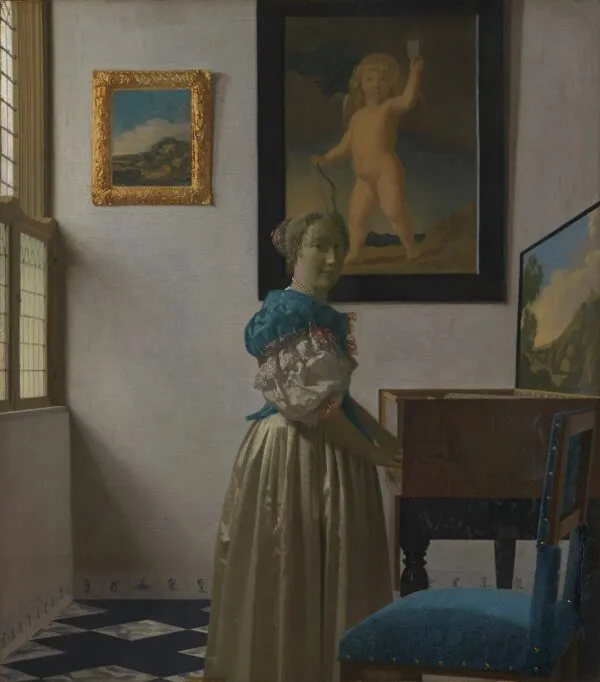
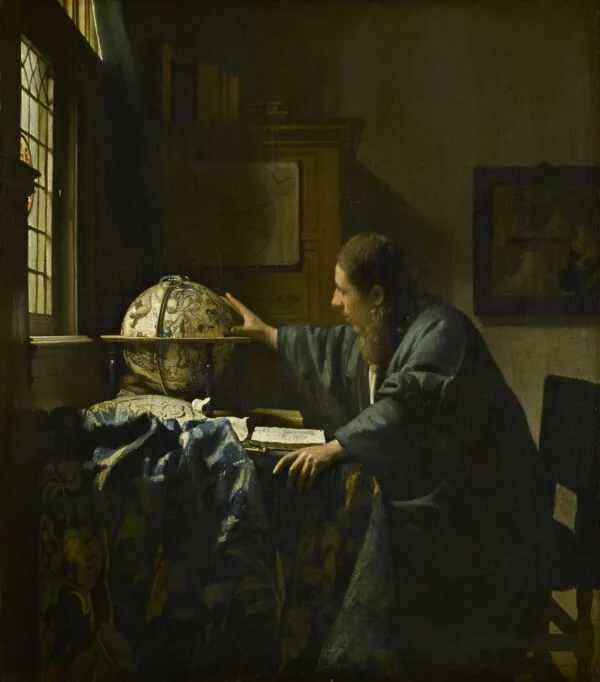
If you prefer a calm scene with a single figure, choose Woman in Blue Reading a Letter. A study suits the scholar bent over his map in The Geographer, and anyone who loves cities and sky will find View of Delft hard to pass by.
Our full range of famous Vermeer paintings, all in one place, is on the Johannes Vermeer page.
How does our painter paint it?
We begin only once your order has arrived. The painter applies the oil paint to the canvas in layers and first sets out the three figures and the table, so that their proportions to one another are right.
Then he turns to the details that carry the scene: the pointing hand of Christ, Mary’s face resting on her palm and Martha’s basket of bread. The white cloth needs particular care, because white comes alive on canvas only when the painter builds it from several thin layers.
A Vermeer reproduction made by hand in this way keeps the brushstrokes and layers of paint that no print can show. An oil painting reproduction of this size also behaves differently in a room than a photo on a screen: its colours shift with daylight and with lamplight in the evening.
Which size for which wall?
In short: 45 x 50 or 56 x 64 cm for a smaller wall or a hallway, 68 x 75 or 85 x 95 cm above a chest of drawers or in a dining room, 97 x 106 or 120 x 140 cm above a sofa, and 140 x 150 or 172 x 200 cm for a large wall or a stairwell.
There are 8 portrait sizes (width x height): 45 x 50, 56 x 64, 68 x 75, 85 x 95, 97 x 106, 120 x 140, 140 x 150 and 172 x 200 cm. The one closest to the original is 140 x 150 cm, which is 1.5 cm narrower and 8.5 cm lower.
Because the original is large, the scene stays readable in the smaller sizes, while the bigger ones give it the presence it has in the gallery. Above a sofa, as a painting for the living room, 97 x 106 and 120 x 140 cm work best; hang it so that Christ’s hand is roughly at eye level.
Can I have another size or a frame?
Yes. The original is roughly 9 : 10 in proportion, so we can carry the scene over to a size that is not on the list without losing Martha’s basket or Mary’s head at the edges. Send us the width and height through our page for paintings made to order, and we will reply with a price and a date.
This one can reach you rolled, stretched on a stretcher bar or already framed. The stretching and framing are done by our workshop in Slovenia, which handles every canvas painting we send out.
You choose the frame in our 3D application, which is meant for frame choice only; seeing the painting on your own wall is a separate service. A wider dark wooden frame suits the larger sizes and calms the scene, while a narrow gold one works in a bright modern room.
When will the painting arrive?
The painter starts once we have confirmed your order, and within 15 to 45 working days the painting is ready to go. Before it leaves, we send you a photograph of the finished work; if you would like anything changed, we change it.
Within Slovenia and to every other EU country it travels without customs, and our returns policy covers your order.
It makes a fine gift for a new home, for a couple who love having guests, or for someone close to this story. To leave the size to them, a wall art voucher is the easy answer.
Frequently asked questions
Where can I see the original?
In the Scottish National Gallery in Edinburgh, Scotland.
Who are the two women with Christ?
The sisters Mary and Martha: Mary sits at his feet, Martha brings bread from behind him.
What does Christ’s gesture mean?
He points towards Mary and so draws the eye to the sister who is listening.
Is this a print?
No. Each one is a hand-painted copy, made with a brush and oil paint on canvas.
How large is the original?
It is 158.5 cm high and 141.5 cm wide, the largest of all Vermeer’s works.
Which size suits a dining room?
Above a dining table 85 x 95 or 97 x 106 cm looks good, and in a larger room 120 x 140 cm too.
Can I get it in a different size?
Yes; tell us the width and height and we will send you a quote.
How long will I wait?
From 15 to 45 working days, and before dispatch you get a photograph of the painting.
- Subject: Christ in a chair points towards Mary at his feet, while Martha leans in behind him with a basket of bread.
- Original: c. 1655, oil on canvas, 158.5 x 141.5 cm, Scottish National Gallery, Edinburgh.
- Ours: hand-painted in oil on canvas, 8 portrait sizes from 45 x 50 to 172 x 200 cm or a size you choose.
- Worth knowing: It is Vermeer’s largest painting and one of the few in which he painted a story from the Bible.