







































Description
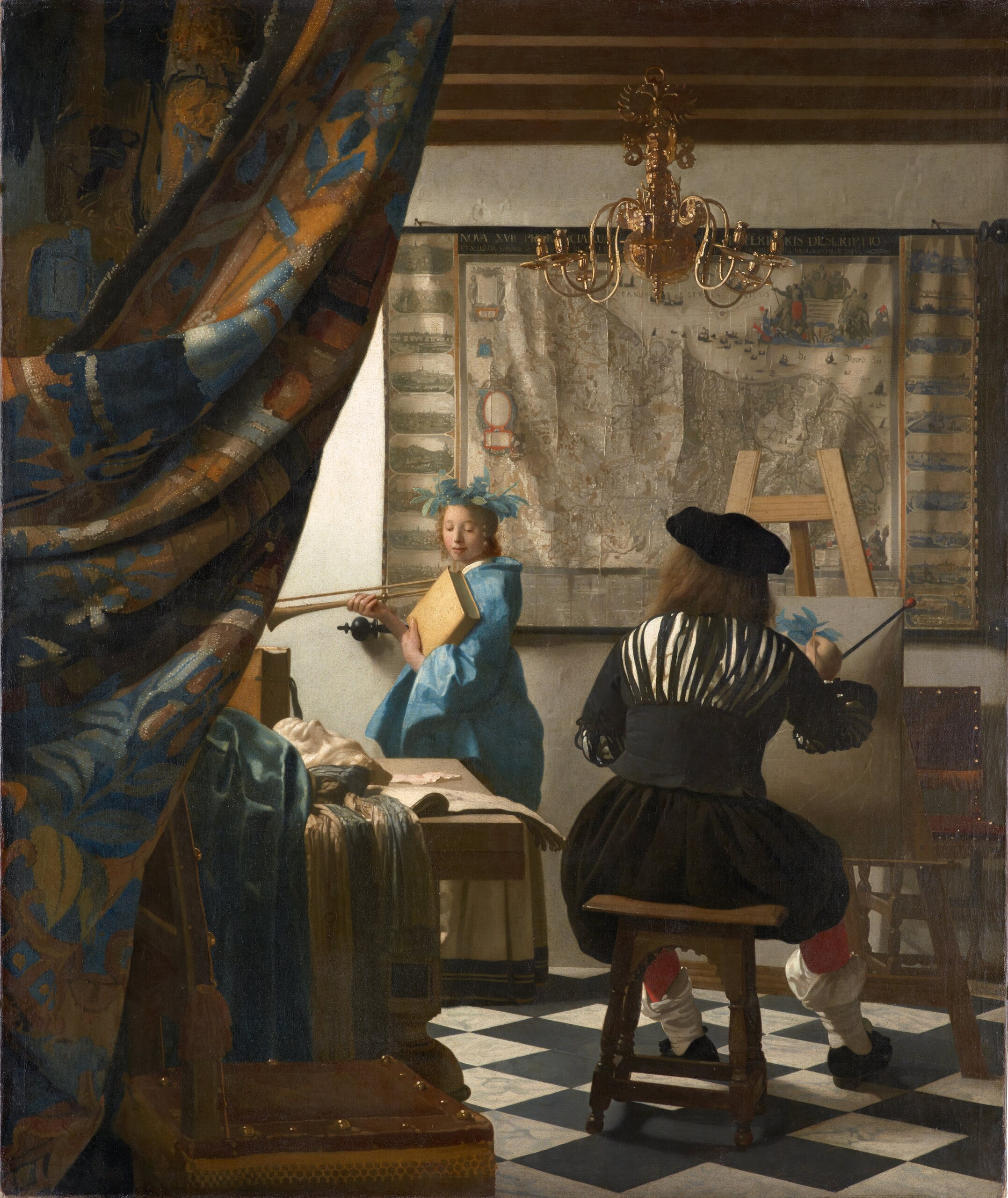
The Art of Painting is one of the largest paintings by Johannes Vermeer, made around 1666–1668: a heavy patterned curtain pulled aside on the left opens the view into a room where a painter, seen from behind, sits at his easel painting a young woman in blue who wears a laurel wreath and holds a trumpet and a yellow book, while a large map of the Netherlands hangs on the wall behind her. The original, oil on canvas, is 120 cm high and 100 cm wide and belongs to the Kunsthistorisches Museum in Vienna. We paint it by hand in oil on canvas in 8 portrait sizes, from 43 x 53 to 172 x 200 cm, or to your own measurement, and before dispatch we show you the finished painting in a photograph.
| Title: | The Art of Painting |
| Other titles: | Die Malkunst · The Allegory of Painting |
| Painter: | Johannes Vermeer (1632–1675) |
| Year painted: | c. 1666–1668 |
| Original size: | 120 cm x 100 cm (height x width) |
| Original technique: | Oil on canvas |
| Painting style: | Baroque, Dutch Golden Age |
| Located at: | Kunsthistorisches Museum, Vienna (inv. 9128) |
| Our reproduction: | Hand-painted oil on canvas, 8 sizes or made to measure |
The Art of Painting – Johannes Vermeer
What does The Art of Painting show?
It all begins with the curtain. On the left hangs a heavy, densely patterned cloth, drawn back like a theatre curtain, and behind it opens a room with pale walls. The floor is laid with black and white marble tiles, and a brass chandelier hangs from the ceiling.
The painter sits before his easel with his back to us. He wears a black doublet with slashed sleeves, red stockings and a black beret. He is at work on the laurel wreath that his model wears on her head.
The young woman stands by the window on the left, where daylight comes in. She is dressed in blue, crowned with laurel, and holds a trumpet in one hand and a yellow book in the other. On the table in front of her lie a plaster mask and a folded cloth, and on the back wall hangs a large map of the Seventeen Provinces of the Netherlands.
What does the allegory mean?
According to the Kunsthistorisches Museum, Vermeer raises the scene of a painter at work into an allegory of the art of painting. The model poses as Clio, the Muse of History, who inspires the painter and proclaims the fame of Netherlandish painting.
The wreath, the trumpet and the book are the signs by which we recognise her as the Muse.
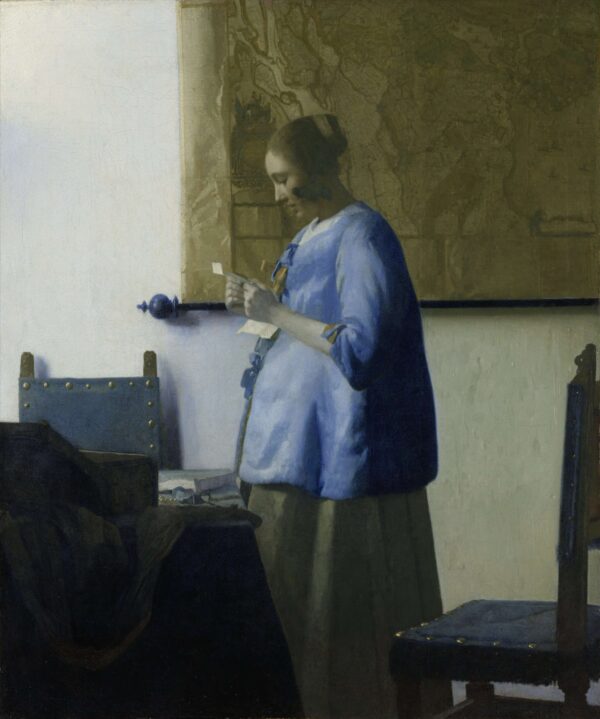
The map plays its part too. It shows the Netherlands before the split into north and south, bringing into the room the country whose painting Clio celebrates. A large map also hangs behind the young woman in Woman in Blue Reading a Letter.
Why is the painting so famous?
Because it is among the largest works Vermeer made. He mostly painted small canvases, and only a few dozen of his paintings are known today; this one is a full 120 cm high.
Vermeer kept the painting for himself and never sold it. He signed it on the lower edge of the map: “I Ver-Meer”.
It also holds the eye because we never see the painter’s face. All we have is the black back, the hand with the brush and the model in the light. The Muse, the map and the signature are covered in more depth by the Wikipedia article (in English).
Where is the original, and how did it reach Vienna?
The original hangs in the Kunsthistorisches Museum in Vienna, in the Picture Gallery under inventory number 9128.
According to the museum’s record, after Vermeer’s death his widow Catharina Bolnes kept it, and in 1676 she passed it to her mother Maria Thins. In 1677 it came up at auction in Delft. Later it belonged to Gottfried van Swieten in Vienna, and from 1813 to Count Rudolf Czernin and the Czernin gallery in Vienna.
In 1940 it was acquired by Adolf Hitler. In 1945 it was at the Munich Collecting Point, and on 7 November 1946 it was handed to the Kunsthistorisches Museum.
The Art of Painting or another Vermeer?
This painting suits anyone who likes to watch painters at work and has room for a larger upright canvas: a lounge, a library, a home office or a hallway with a high ceiling. The scene is calm, so it also belongs in a bedroom.
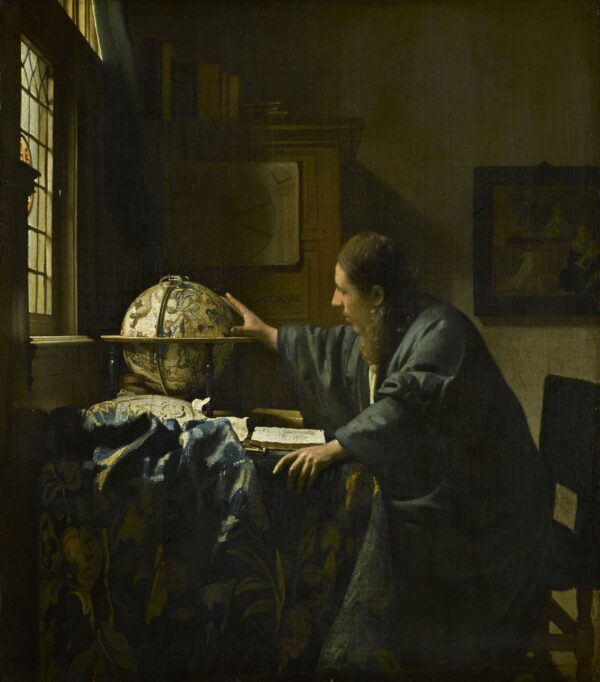
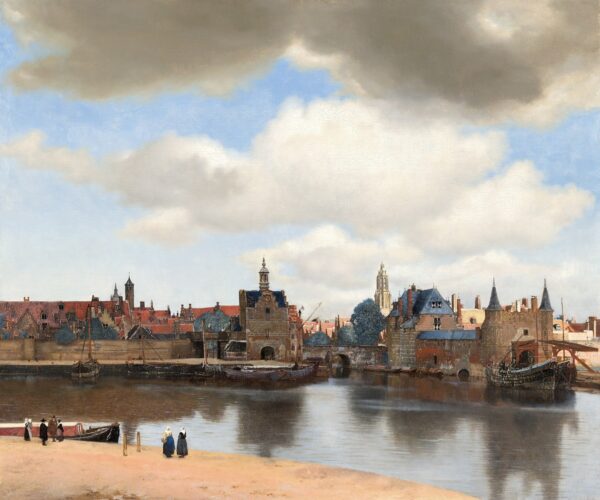
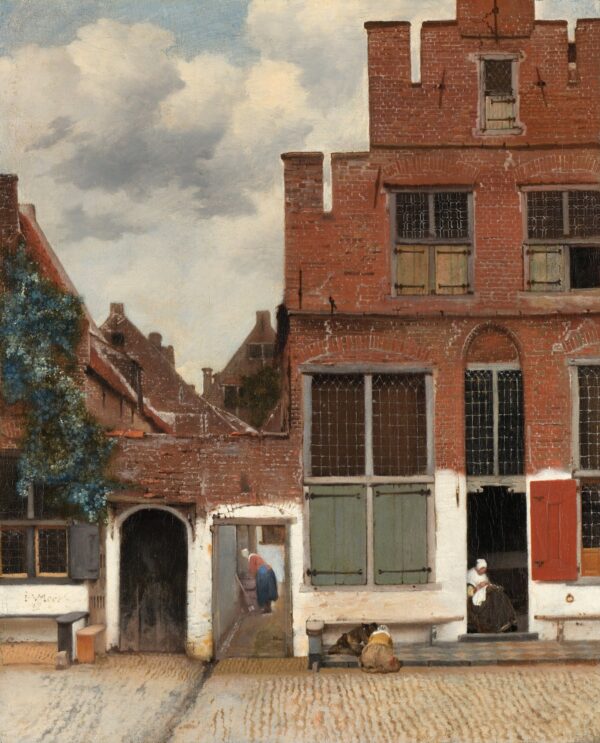
If a scholar in a room full of objects appeals to you, there is The Astronomer; for a wide view of a town under a big sky, View of Delft.
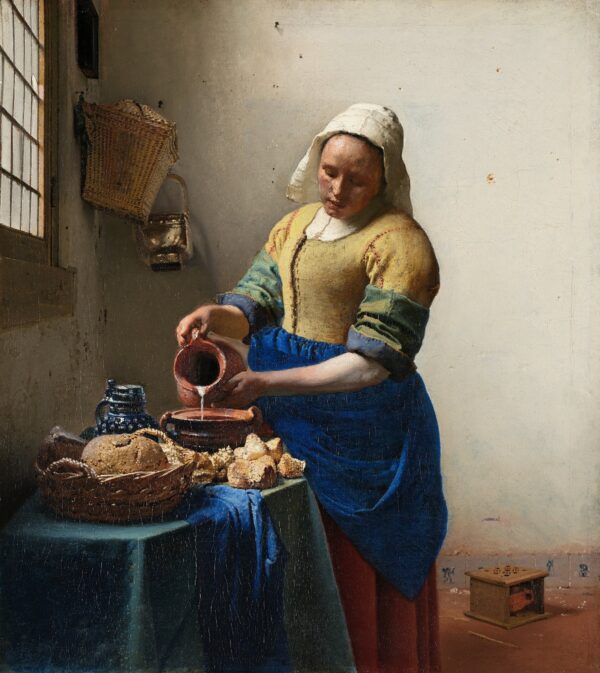
Vermeer’s most homely scene, a maid slowly pouring milk into a bowl, is The Milkmaid. Each of the famous Vermeer paintings we paint to order, this allegory included, is listed on the Johannes Vermeer page.
How does our painter paint your Art of Painting?
Your Art of Painting is made only after you order it, layer by layer in oil on canvas. First the painter fixes the perspective: the black and white marble floor, the edge of the table and the easel have to agree, or the room would lose its depth.
Then come the dark curtain in front and the pale wall behind, then the painter in black and the woman in blue. Last come the small things: the creases in the map, the gleams on the brass chandelier, the laurel leaves and the yellow book.
This Vermeer reproduction will carry visible brushstrokes and paint laid on in several layers, which a print on paper cannot give. An oil painting reproduction on the wall changes with the daylight, so the blue of the dress looks different in the morning than in the evening.
Which size for which wall?
In short: 43 x 53 or 55 x 66 cm for a narrow wall or above a chest of drawers, 64 x 76 or 80 x 96 cm above a desk or in a bedroom, 90 x 107 or 120 x 140 cm above a sofa, and 130 x 162 and 172 x 200 cm for a tall wall.
There are 8 portrait sizes (width x height): 43 x 53, 55 x 66, 64 x 76, 80 x 96, 90 x 107, 120 x 140, 130 x 162 and 172 x 200 cm. The original measures 100 x 120 cm. The nearest are 90 x 107 cm, 10 cm narrower and 13 cm shorter, and 120 x 140 cm, 20 cm wider and 20 cm taller than the original.
As a painting for the living room above a sofa, 120 x 140 cm works best, because the curtain, the room and both figures then stand before you as if you were on the threshold. Hang the centre at about eye level, around 150 cm from the floor.
Can I have a custom size and a frame?
Yes. The original is 5 : 6 in proportion, so it carries over to almost any portrait size without the curtain on the left or the chandelier at the top falling off the edge. Send us a request for the size you need and we will reply with a price and a date.
For The Art of Painting our workshop in Slovenia stretches the canvas on a stretcher bar and frames it if you wish. We ship it rolled, stretched or framed, the same as every canvas painting we send. Choose the frame in the 3D application, which is only for choosing the frame; seeing the painting on your own wall is a separate service.
When and how does the painting arrive?
We start as soon as your order comes in; within 15 to 45 working days The Art of Painting is ready to ship. Before dispatch you receive a photograph of the finished painting, and whatever you would like different, we change.
Within the EU the parcel with The Art of Painting travels without customs duty, and our returns policy applies to every order.
Because it is about painting itself, this is a lovely gift for a painter or an art lover. If you would rather the recipient chose the size, give the wall art voucher.
Frequently asked questions
Where can I see the original Art of Painting?
In Vienna, at the Kunsthistorisches Museum, where it is listed under inventory number 9128.
Who is the woman in blue?
According to the museum, Clio, the Muse of History, with a laurel wreath, a trumpet and a yellow book.
Is it a print?
No. Each one we make is a hand-painted copy in oil on canvas, painted only after you order it.
How big is the original?
It is 120 cm high and 100 cm wide, unusually large for Vermeer.
Which size fits above a sofa?
Above a sofa about two metres wide, 120 x 140 cm fits best; above a narrower one, 90 x 107 cm.
Can you paint The Art of Painting in a size that is not listed?
Yes. We carry the original’s 5 : 6 proportion over to the size you need and send you a price.
How long does it take to make?
From 15 to 45 working days; before dispatch we send you a photograph of the painting.
What does the map on the wall mean?
It shows the Netherlands before the split into north and south, the country whose painting Clio celebrates.
- Subject: a painter seen from behind paints a young woman in blue who poses as Clio with a laurel wreath, a trumpet and a book.
- Original: c. 1666–1668, oil on canvas, 120 x 100 cm, Kunsthistorisches Museum, Vienna.
- Ours: painted by hand in oil on canvas, in 8 portrait sizes from 43 x 53 to 172 x 200 cm or made to measure.
- Worth knowing: Vermeer never sold this painting; he kept it until his death.