







































Description
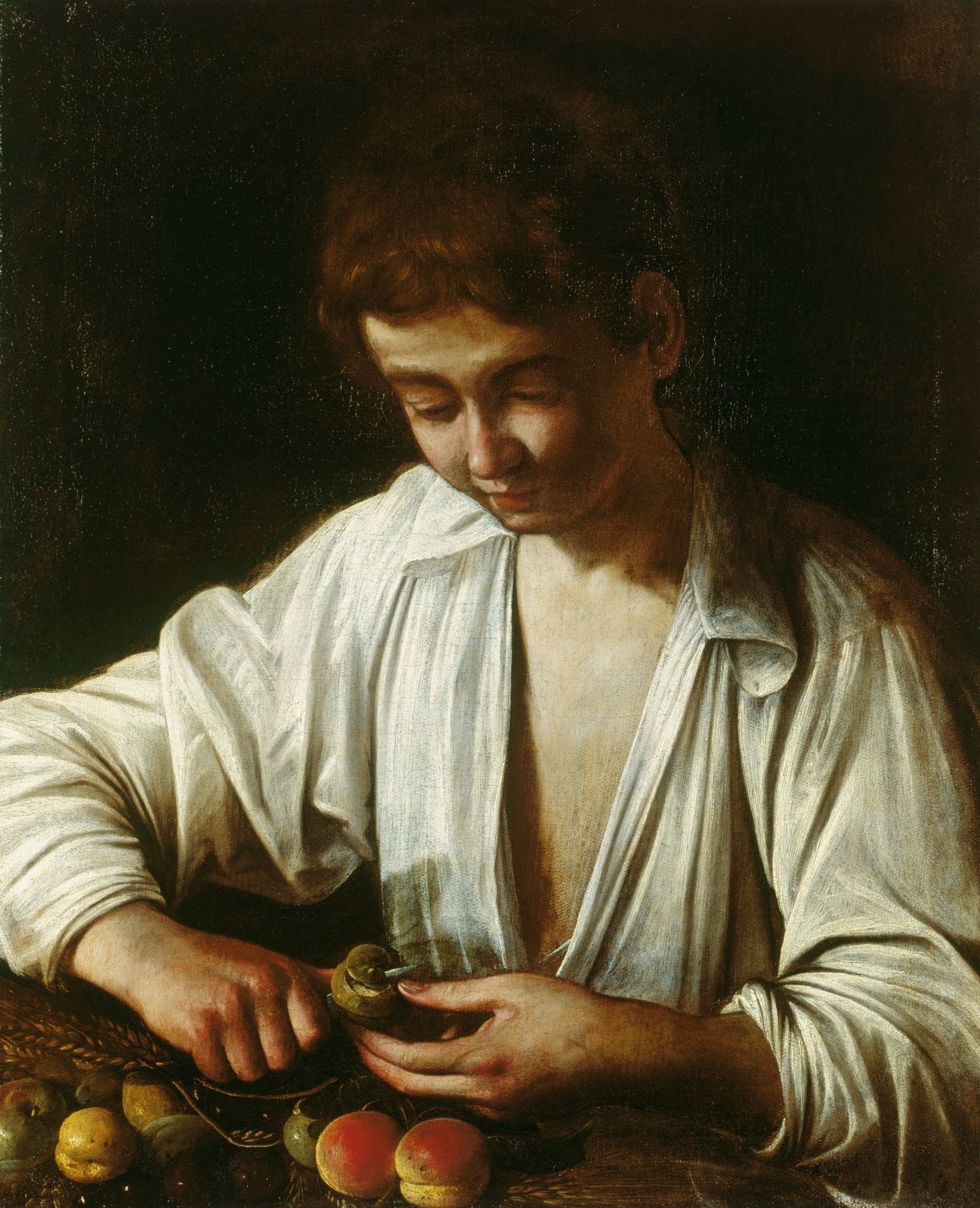
Boy Peeling Fruit is thought to be the earliest known work by Caravaggio, painted around 1592–1593, soon after he arrived in Rome. A boy in a loose white shirt bends his head over a small greenish fruit and peels it with a knife. The version we paint from, oil on canvas, 63 cm high and 53 cm wide, belongs to the Royal Collection and hangs at Hampton Court Palace. When you order, our painter paints it by hand in oils on canvas, in 8 portrait sizes from 40 x 49 to 102 x 122 cm or made to measure, and you receive a photograph of the finished painting before it is dispatched.
| Title: | Boy Peeling Fruit |
| Other titles: | Ragazzo che monda un frutto · Früchte schälender Knabe |
| Painter: | Michelangelo Merisi da Caravaggio (1571–1610) |
| Year painted: | c. 1592–1593 |
| Original size: | 63 cm x 53 cm (height x width) |
| Original technique: | Oil on canvas |
| Painting style: | Baroque, tenebrism |
| Located at: | Royal Collection, Hampton Court Palace, United Kingdom |
| Our reproduction: | Hand-painted oil on canvas, 8 sizes or made to measure |
Boy Peeling Fruit – Caravaggio
What does Boy Peeling Fruit show?
A boy sits at a table, absorbed in a small task: his head of reddish-brown, slightly tousled hair is bowed, his eyelids are lowered and his gaze rests on the fruit in his hands.
He wears a loose white shirt with a large, soft collar, open at the neck. The sleeves billow in many folds, and he rests one forearm on the edge of the table. One hand holds a small greenish fruit; the other guides a thin blade and lifts away the skin.
In the foreground two red-gold peaches lie on the table beside yellow and green fruit and a few darker ones, perhaps plums. The background is almost black, so the light from the upper left strikes face, shirt and hands all the more strongly.
Which fruit is he peeling, and what does the scene mean?
At first sight this is a simple everyday scene, a genre painting. Wikipedia points out an important difference: the boy is not the grubby, ragged urchin such subjects usually showed, but clean and neatly dressed.
Exactly which fruit he is peeling is uncertain. It is probably a pear. Some have suggested a bergamot, a pear-shaped citrus grown in Italy, while others object that it is sour and practically inedible. The nectarines or plums lying on the table are not usually peeled at all.
Because fruit carried a complex symbolism in the Renaissance, a hidden meaning is plausible too. The Caravaggio scholar John T. Spike has suggested that the boy shows resistance to temptation, passing over the sweeter fruits in favour of the bitter bergamot; no single reading, however, is widely accepted.
Why does this early work matter so much?
Because it is considered the earliest Caravaggio to have come down to us. He painted it soon after moving from his native Milan to Rome in mid-1592.
According to his contemporary Giulio Mancini, he lodged for a few months with Monsignor Pandolfo Pucci and left because he disliked the way Pucci treated him.
Much of what would make him famous is already here: a model painted from life, a strong light that pulls the face and hands out of the dark, and fruit observed with the care of a still life.
The English-language Wikipedia article covers the versions and their history in more detail.
Where is the original, and how many versions exist?
The version we paint from belongs to the Royal Collection (RCIN 402612) and has hung in the Cumberland Gallery at Hampton Court Palace since 2004.
Several versions of the composition are known, and all of them may be by Caravaggio. It has been suggested that his early pictures stood in the shop window of the workshop of Giuseppe Cesari, the Cavaliere d’Arpino, and that he painted more versions when buyers showed interest. Which came first remains open: John Spike named a painting auctioned in London as the likely original, while others argue for the Ishizuka version or the one in the Royal Collection.
Wikipedia also notes that a painting of this subject was among the works Cardinal Scipione Borghese seized from Cesari in 1607, together with Young Sick Bacchus and Boy with a Basket of Fruit.
Boy Peeling Fruit or another Caravaggio?
This is a quiet, concentrated canvas painting. It sits naturally in a kitchen, a dining room, a breakfast corner or a hallway, where you pause for a moment beside the absorbed boy.
For a sudden moment from the same years, look at Boy Bitten by a Lizard: a boy in a white shirt, a rose behind his ear, jerks back with a cry as a lizard bites his finger. Livelier and full of tension is The Cardsharps, where two tricksters cheat an unsuspecting young man at cards.
All the famous Caravaggio paintings we offer are gathered on our Caravaggio page.
How does our painter paint this work?
We start only once you order, and build the painting in oils on canvas, layer upon layer. The painter first lays a dark, warm ground, then draws in the head, shirt, hands, knife and fruit with a fine brush.
The white shirt takes the longest. White here is not a single colour: it turns grey in the folds, bluish at the collar and almost pure on the shoulder where the light lands.
As a Caravaggio reproduction made by hand, it carries real brushstrokes that show when light glances across the canvas. With its dark ground and pale shirt, this oil painting reproduction looks its best where daylight or the warm light of a wall lamp falls on it.
Which size suits which wall?
In short: 40 x 49 or 46 x 55 cm for a kitchen, beside a shelf or between two windows, 54 x 65 or 64 x 76 cm above a chest of drawers or in a dining room, 70 x 87 or 80 x 96 cm above a sofa or dining table, and 90 x 107 or 102 x 122 cm for a larger wall or a bright hallway.
It comes in 8 portrait sizes (width x height): 40 x 49, 46 x 55, 54 x 65, 64 x 76, 70 x 87, 80 x 96, 90 x 107 and 102 x 122 cm. The closest to the original is 54 x 65 cm, 1 cm wider and 2 cm taller.
The original is small, so our larger sizes go well beyond it: at 102 x 122 cm the boy is almost twice as large as he is at Hampton Court. As a painting for the living room it is most convincing at 80 x 96 or 90 x 107 cm; hang it so that the hands with the fruit sit at about eye level.
Can I have another size or a frame?
Yes. If you need different proportions, we adapt the composition so that the head, the hands with the knife and the fruit on the table stay whole. Tell us the width and height you have in mind, and we will send you a price and a lead time.
You can receive the painting rolled, stretched on a stretcher bar or framed and ready to hang. Stretching and framing are handled in our workshop in Slovenia, which every order passes through before it leaves. The moulding is chosen in our 3D app, which serves only for picking a frame; seeing the painting on your own wall is a separate service.
A narrow dark-wood moulding or a restrained antique-gold frame suits the dark ground and the white shirt.
When will it arrive, and how is it sent?
Once you confirm your order the painter begins, and the painting is ready to travel within 15 to 45 working days. Before it leaves, we send you a photograph of it; if you want something changed, we do so before packing. No customs duty applies anywhere in Slovenia or the wider EU, and our returns policy covers each order.
It makes a fine gift for a keen cook or for anyone drawn to the young Caravaggio. If you are unsure about the size, give a wall art voucher and let them choose.
Frequently asked questions
Where does the original hang?
The version we paint from belongs to the Royal Collection and is on view at Hampton Court Palace.
What is the boy holding?
A small greenish fruit, probably a pear, and a thin knife with which he lifts away the skin.
Is this a print?
No, every stroke is made with a brush: it is a hand-painted copy in oils on canvas.
How big is the original?
It is 63 cm high and 53 cm wide, so fairly small; our nearest size is 54 x 65 cm.
Does it suit a kitchen?
Very well: fruit, a knife and a table belong in a kitchen.
Could you paint it at a size that is not on the list?
Yes. Send us the width and height you want, and we will reply with a price and a delivery date.
How long does it take?
Between 15 and 45 working days; the photograph of the finished painting reaches you before dispatch.
Does the scene have a hidden meaning?
Perhaps. One reading sees resistance to temptation in it, but not everyone accepts this.
- Subject: a boy in a loose white shirt bends his head to peel a small greenish fruit; peaches and other fruit lie before him against a dark background.
- Original: c. 1592–1593, oil on canvas, 63 x 53 cm, Royal Collection, Hampton Court Palace.
- Ours: hand-painted to order in oils on canvas, 8 portrait sizes from 40 x 49 to 102 x 122 cm or made to measure.
- Worth knowing: it is thought to be Caravaggio’s earliest known work, painted soon after he reached Rome.