







































Description
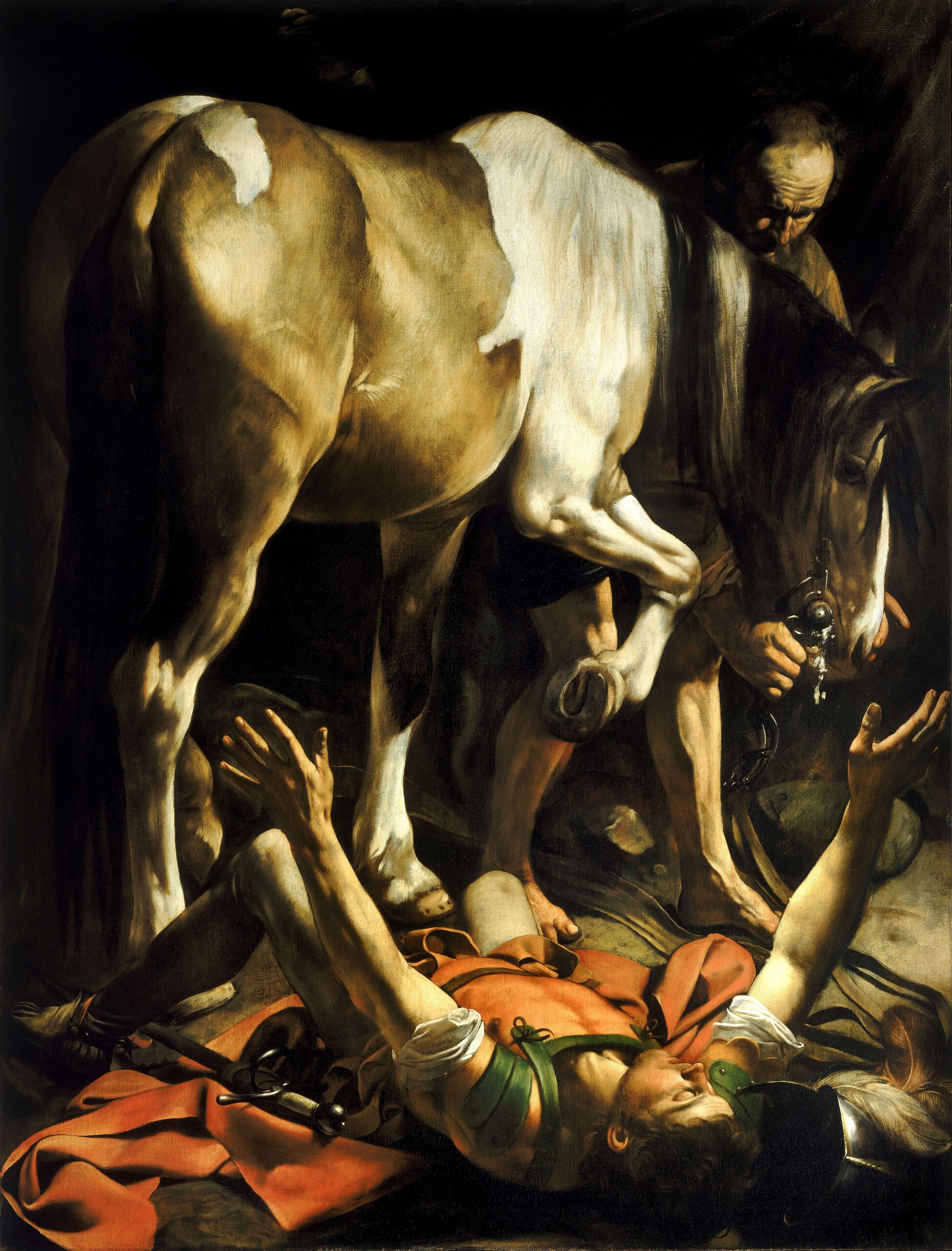
The Conversion on the Way to Damascus is a painting by Caravaggio from 1601: a huge piebald horse fills the upper half of the canvas and lifts one hoof, an old groom holds it by the bridle, and on the ground Saul lies on his back in Roman military dress, arms spread wide and eyes closed. The original, oil on canvas, is 230 cm high and 175 cm wide and still hangs in the Cerasi Chapel of Santa Maria del Popolo in Rome, for which it was painted. Our painter paints it for you by hand in oil on canvas in 8 portrait sizes, from 40 x 55 to 156 x 200 cm, or made to measure, and we send you a photograph of the finished painting before dispatch.
| Title: | The Conversion on the Way to Damascus |
| Other titles: | Conversione sulla via di Damasco · Die Bekehrung auf dem Weg nach Damaskus |
| Painter: | Michelangelo Merisi da Caravaggio (1571–1610) |
| Year painted: | 1601 |
| Original size: | 230 cm x 175 cm (height x width) |
| Original technique: | Oil on canvas |
| Painting style: | Baroque, tenebrism |
| Located at: | Cerasi Chapel, Santa Maria del Popolo, Rome |
| Our reproduction: | Hand-painted oil on canvas, 8 sizes or made to measure |
The Conversion on the Way to Damascus – Caravaggio
What does The Conversion on the Way to Damascus show?
Almost the whole upper part of the canvas belongs to the horse. It is enormous, patched brown and cream, with its head lowered and one front hoof held in the air, as if unsure where to set it down. Beside its head stands an old groom, holding the bridle and calming the animal.
Along the bottom edge a young man lies on his back. This is Saul, dressed as a Roman soldier, his red cloak spread out beneath him. He opens his arms towards the light, his eyes are shut, his helmet has fallen from his head and his sword lies at his side.
No Christ appears, and no angel. Only light comes from heaven, falling on Saul’s body and the horse’s flank while everything else sinks into darkness. Of a landscape or a road there is barely a hint.
What does the story mean?
The scene comes from the Acts of the Apostles. Saul of Tarsus persecuted the first Christians and was on his way to Damascus to arrest them. On the road a light from heaven shone around him, he fell to the ground and heard a voice: “Saul, Saul, why do you persecute me?”
When he got up he could see nothing, so his companions led him by the hand into the city. The persecutor became the apostle Paul. Caravaggio paints not the fall itself but the moment just after it: Saul cannot see, yet with open arms he accepts what has happened to him.
Curiously, the Bible never mentions a horse. It came from painters’ tradition, and Caravaggio gave it almost more room than the saint.
Why is this Caravaggio so famous?
Because Caravaggio broke with the way the scene had been painted before him. Usually there was a rearing horse, Christ in the sky and a troop of confused soldiers. Here only three figures remain in the dark, together with the light that strikes them.
That was exactly what bothered the critics. In 1672 Giovanni Pietro Bellori found the story bereft of action, and in 1953 Bernard Berenson still objected that the beast outweighed its rider.
Opinion turned in the middle of the 20th century. In 1952 Roberto Longhi called it perhaps the most revolutionary painting in the history of religious art. The Wikipedia article (in English) traces this shift in detail.
Where is the original Conversion on the Way to Damascus?
The original still hangs in the Cerasi Chapel of Santa Maria del Popolo in Rome. Monsignor Tiberio Cerasi, treasurer to Pope Clement VIII, commissioned both side paintings of the chapel in September 1600, and Caravaggio finished them in 1601.
On the opposite wall of the chapel hangs The Crucifixion of Saint Peter, and on the altar between them is the Assumption of the Virgin by Annibale Carracci.
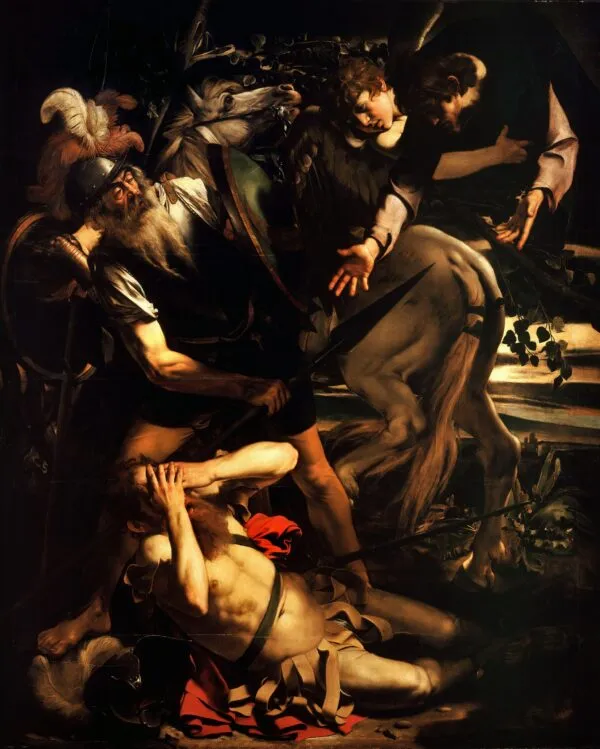
This is the second version. The first, rejected one went to Cardinal Sannesio, according to Giovanni Baglione; today it is The Conversion of Saint Paul, in the Odescalchi collection. It is brighter and busier: Christ, held up by an angel, reaches down from the sky towards the blinded Paul.
The Conversion on the Way to Damascus or another Caravaggio?
This is a canvas painting for people who like drama without violence: nobody is hurt, and everything happens in silence and light. A canvas this tall needs a free wall, in an entrance hall, by a stairway or in a home office.
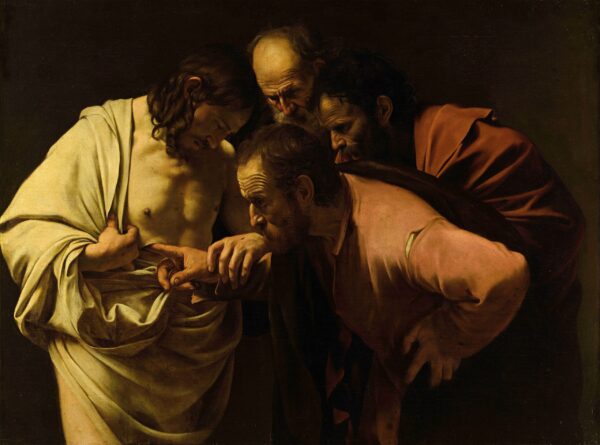
If the moment when a life changes course speaks to you, The Calling of Saint Matthew is a close relative, where light also turns a man onto a new path. For a quieter scene of doubt, see The Incredulity of Saint Thomas, where four heads crowd around Christ’s wound.
The Caravaggio page brings together the famous Caravaggio paintings our painter makes to order; this is the most unusual of them, with an animal in the leading role.
How does our painter paint your Conversion on the Way to Damascus?
The painter starts with the dark: the almost black ground and the shadow under the horse’s belly come first, and only then the three figures, so that the light later falls from outside.
Next he builds up the horse: the brown and cream patches of its coat, the muscles of its flank, the raised hoof and the bridle in the groom’s hand. After that come the old man’s face, Saul’s armour, the red cloak beneath him and the glint of light on the helmet and sword.
The result is a Caravaggio reproduction with brushstrokes and layers of paint that no print can imitate. A real oil painting reproduction changes in evening light, because light returns from deep within the paint.
Which size suits which wall?
In short: 40 x 55 or 48 x 60 cm for a narrow wall or a hallway, 60 x 81 or 68 x 90 cm above a chest of drawers or a desk, 84 x 115 or 106 x 145 cm above a sofa, and 124 x 157 or 156 x 200 cm for a tall wall or a stairwell.
Every size is upright (width x height): 40 x 55, 48 x 60, 60 x 81, 68 x 90, 84 x 115, 106 x 145, 124 x 157 and 156 x 200 cm. The closest to the original is the largest, 156 x 200 cm, which is 19 cm narrower and 30 cm shorter.
As a painting for the living room above a sofa, 106 x 145 cm works best: the horse and Saul read clearly from across the room without the canvas crowding the ceiling. Leave about 25 cm above the backrest so that Saul stays in view.
Is another size or a frame possible?
Yes. The original is roughly 3 : 4, so it carries over to an unlisted size without losing the raised hoof or Saul’s arms at the edge. Tell us the width and height and we will quote a price and a date.
It ships rolled, stretched on a stretcher bar or framed, with stretching and framing done in our workshop in Slovenia. You choose the frame in our 3D application, which is meant only for choosing frames; seeing the painting on your own wall is a separate service.
A dark frame with a narrow gold edge suits the dark ground and picks up the warm light on the horse’s flank.
When does the painting arrive, and how?
Painting starts when your order comes in, and within 15 to 45 working days Saul and the horse are ready to ship. First you get a photograph of the finished canvas, and anything you want changed, we change. Nothing is charged at customs within Slovenia or anywhere else in the EU, and every order is covered by our returns policy.
The Conversion on the Way to Damascus is a thoughtful gift for someone starting a new chapter, or for a lover of the Baroque. To let them choose the size themselves, give a wall art voucher.
Frequently asked questions
Where does the original hang today?
In the Cerasi Chapel of Santa Maria del Popolo in Rome, in place since 1605.
Why is there a horse if the Bible does not mention one?
It comes from painters’ tradition; Caravaggio simply made it the centre of the scene.
Is this a print?
No. It is a hand-painted copy in oil on canvas, made by our painter especially for you.
How big is the original?
It is 230 cm high and 175 cm wide; our largest size, 156 x 200 cm, is 19 cm narrower and 30 cm shorter.
Does it suit a living room or an office?
Yes. With no blood or violence, the tall scene sits well in a living room, office or hall.
Which size goes above a sofa about 200 cm wide?
Choose 84 x 115 or 106 x 145 cm; the two larger sizes are meant for a tall wall.
Can you paint it in a different size?
Yes. Send us the width and height you want, and we will reply with a price and a date.
How long does it take to make?
15 to 45 working days, with a photograph of the finished painting before dispatch.
- Subject: Saul on the ground beneath a huge piebald horse held by an old groom; only light, no Christ, no angel.
- Original: Rome, Santa Maria del Popolo, Cerasi Chapel; oil on canvas, 230 x 175 cm, 1601.
- Ours: Saul and the horse painted by hand in oil on canvas, in 8 portrait sizes from 40 x 55 to 156 x 200 cm or made to measure.
- Worth knowing: the Bible mentions no horse, yet Caravaggio placed one at the centre of the scene.