







































Description
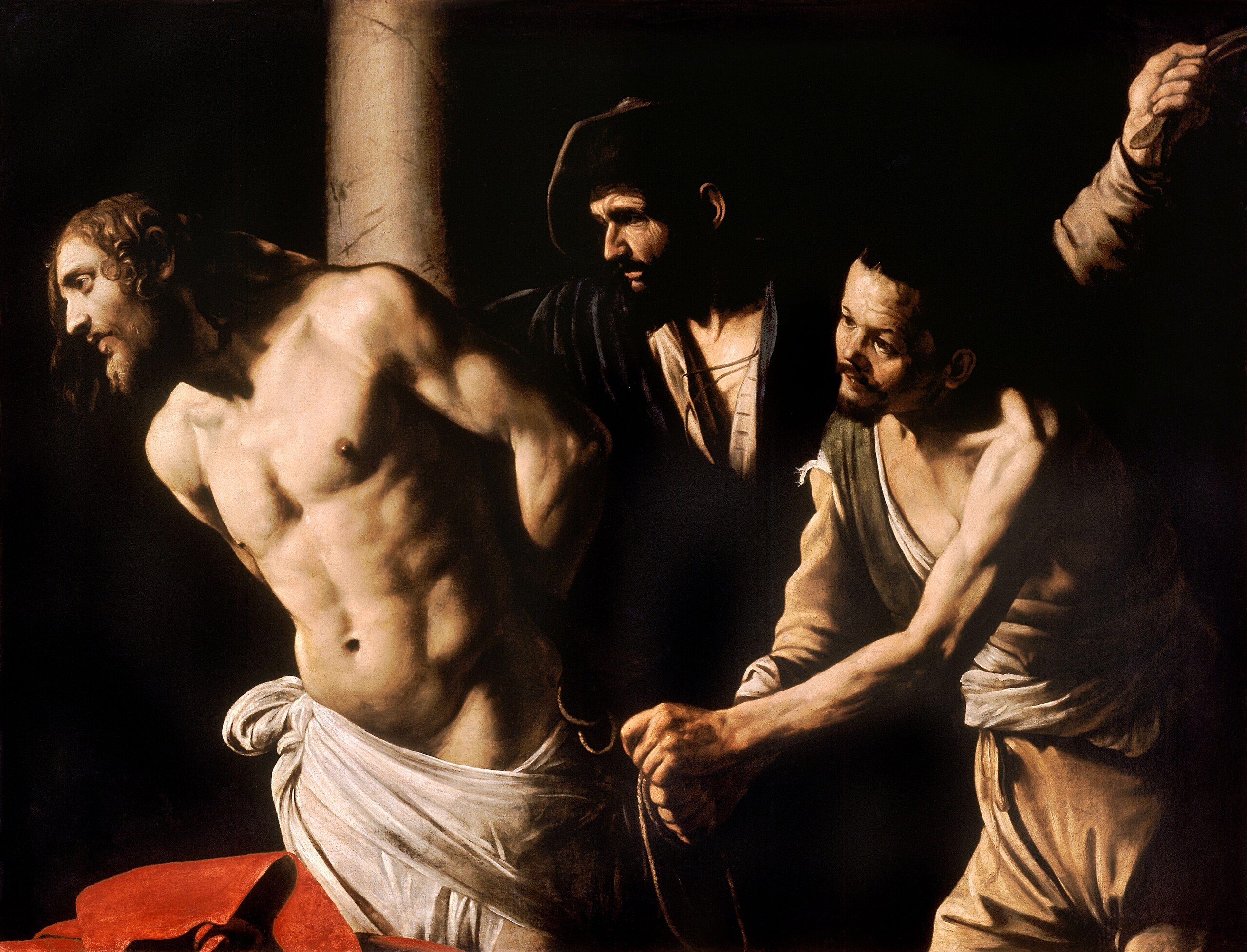
Christ at the Column is a painting by Caravaggio from about 1606–1607: Christ, in a white loincloth and a crown of thorns, stands on the left bound to a column with his head bowed, while on the right three men tie him and make ready to strike, all of it set in deep darkness. The original, oil on canvas, is 134.5 cm high and 175.5 cm wide and belongs to the Musée des Beaux-Arts in Rouen. Our painter paints this scene for you by hand in oil on canvas in 8 landscape sizes, from 56 x 41 to 200 x 159 cm, or to a size you give us, and before it ships we show you the finished painting in a photograph.
| Title: | Christ at the Column |
| Other titles: | Cristo alla colonna · Christus an der Geißelsäule |
| Painter: | Michelangelo Merisi da Caravaggio (1571–1610) |
| Year painted: | c. 1606–1607 |
| Original size: | 134.5 cm x 175.5 cm (height x width) |
| Original technique: | Oil on canvas |
| Painting style: | Baroque, tenebrism |
| Located at: | Musée des Beaux-Arts de Rouen, France |
| Our reproduction: | Hand-painted oil on canvas, 8 sizes or made to measure |
Christ at the Column – Caravaggio
What does Christ at the Column show?
The canvas is wider than it is tall and almost entirely given over to darkness. At the left edge stands Christ, wearing only a white loincloth, the crown of thorns on his head, bound to the column. His body is still, offering no resistance.
To his right three tormentors crowd together. They pull the ropes tight and hold him fast, ready for the first blows. Out of the shadow come the faces of two of them and a hand gripping a whip, and the whip itself runs past the edge of the canvas, so we never see it.
The light falls on Christ’s face and torso, the brightest passages in the painting, while the tormentors stay half in shadow. Behind them there is only a dark void.
What story does the scene tell?
The Gospels relate that after his arrest and trial Christ was scourged before he was led away to be crucified. For centuries painters set this moment of the Passion in front of a column, which, Wikipedia suggests, may allude to the judgement hall of Pilate.
He painted the subject twice, late in 1606 or early in 1607, soon after he arrived in Naples. The other version is The Flagellation of Christ, an upright altarpiece 286 cm high with Christ at the centre and the tormentors around him. The Rouen canvas is horizontal and tighter: Christ stands at the left edge and the tormentors are packed together on the right.
Why is this painting so remarkable?
Because it turns deliberately away from the most famous model of its day, Sebastiano del Piombo’s Flagellation in the church of San Pietro in Montorio in Rome. There several idealised figures twist through complex layers of space, a design that later artists imitated again and again.
Caravaggio pressed the space flat, kept only the figures he needed and let the light pick out what matters: Christ’s face and torso, the faces of two tormentors and the hand whose whip lies outside the frame. The English Wikipedia article also describes how the composition is built.
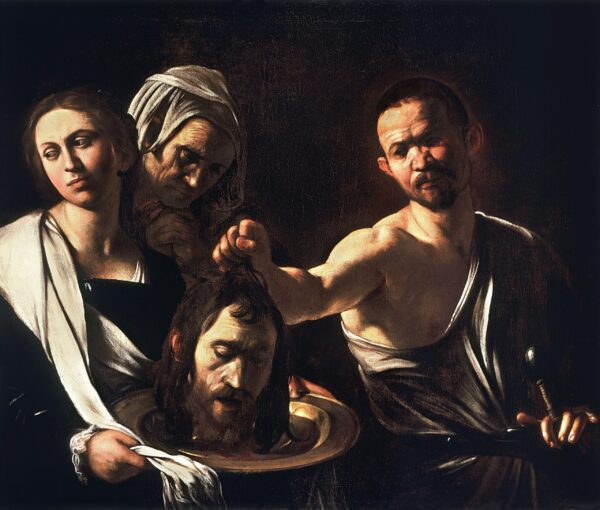
And because the people in it are real. According to Wikipedia, the snub-nosed tormentor on the far right is the same man who sat for one of the torturers in the Naples painting and for the executioner in Salome with the Head of John the Baptist. Caravaggio painted from live models.
Where is the original of Christ at the Column?
It belongs to the Musée des Beaux-Arts in Rouen, in France, far from Naples, where it was painted, and far from its twin, which hangs today in the Museo di Capodimonte in Naples.
Wikipedia notes that the painting is also known as The Flagellation of Christ, so the two are easily confused. Our reproduction on this page follows the Rouen composition: a single lit figure at the column on the left and three tormentors on the right.
Christ at the Column or another Caravaggio?
Christ at the Column is a serious, quiet canvas painting for a study, a library, a hallway or a corner set aside for prayer. If you want another scene of martyrdom from the same years, look at The Crucifixion of Saint Andrew of 1607, now in a museum in Cleveland.
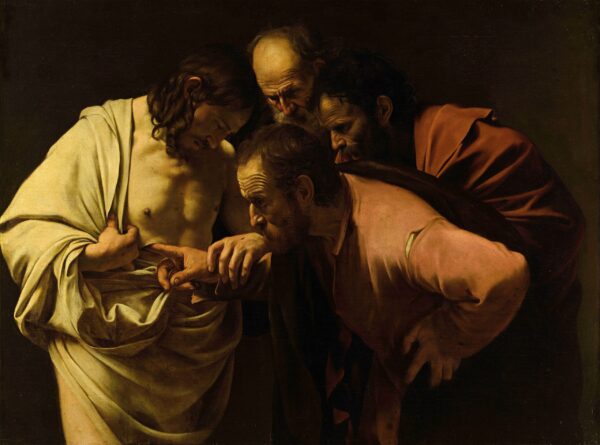
A calmer companion is The Incredulity of Saint Thomas, in which the risen Christ shows the apostle his wound himself. A wholly different mood comes with The Fortune Teller, a worldly scene in which a girl reading a young man’s palm slips the ring from his finger without his noticing.
The Caravaggio page brings together the famous Caravaggio paintings we offer, from the early worldly scenes to the late works from Naples.
How does our painter paint your Christ at the Column?
Every Christ at the Column is painted to order, layer by layer, in oil on canvas. The painter first covers the whole canvas in a dark tone and sketches in the column, the figure of Christ and the heads of the tormentors.
Only then does he build up the light. Christ’s torso takes a warm glow, the loincloth a cooler white, the crown of thorns sharp dark points. The ropes and the hand with the whip get particular care.
This Caravaggio reproduction shows visible brushwork in the light passages and, in the shadows, a depth that no print can match. An oil painting reproduction like this one changes with the light in the room: calm by day, while under a lamp in the evening the figure of Christ comes out of the darkness even more strongly.
Which size for which wall?
In short: 56 x 41 or 70 x 52 cm for a smaller wall, 80 x 59 or 101 x 74 cm above a chest of drawers or in a hallway, 110 x 85 or 140 x 110 cm above a sofa, and 160 x 123 or 200 x 159 cm for a large empty wall.
We paint Christ at the Column in 8 landscape sizes (width x height): 56 x 41, 70 x 52, 80 x 59, 101 x 74, 110 x 85, 140 x 110, 160 x 123 and 200 x 159 cm. The closest to the original is 160 x 123 cm, which is 15.5 cm narrower and 11.5 cm lower.
As a painting for the living room it works best in a quieter corner, above a reading chair for instance, where 110 x 85 cm shows the scene well without taking over the room.
Can I order another size or a frame?
Yes. Christ stands at the left edge and the tormentors at the right, so we adapt the composition to other proportions in a way that leaves every figure its head and hands. For your Christ at the Column, tell us the width and height you would like and we will reply with a price and a production time.
Your Christ at the Column travels rolled, stretched on a stretcher bar or framed. The stretching and framing are done by our workshop in Slovenia, which prepares every painting we dispatch for the journey. Frame choice happens in our 3D app, which does that and nothing else; a view of the painting on your own wall is a separate service.
When and how will the painting arrive?
We start on your Christ at the Column as soon as the order comes in, and within 15 to 45 working days it is ready to travel. Before dispatch we send you a photograph of the finished painting, and if you would like something changed, we see to it. Deliveries within Slovenia and the rest of the EU carry no customs, and our returns policy covers every order.
It is a fitting gift for someone who cares about sacred art. Should the recipient prefer to pick the size, a wall art voucher leaves that choice to them.
Frequently asked questions
In which museum is the original?
In the Musée des Beaux-Arts in Rouen, France.
What happens in the scene?
Before the crucifixion Christ is bound to a column while three men pull the ropes tight and prepare to scourge him.
Is it a print?
No. You receive a hand-painted copy, made by our painter with a brush and oil paints on canvas.
How big is the original?
It is 134.5 cm high and 175.5 cm wide; of our sizes, 160 x 123 cm comes closest.
How does it differ from the Flagellation in Naples?
The Naples version is upright with Christ in the centre; the Rouen one is horizontal with Christ at the left edge.
Does it suit a bedroom or a living room?
It suits a study, a hallway or a quiet corner of a living room better than a bedroom, since it is a serious scene from the Passion.
Can you paint it in a size that is not listed?
Yes. Send us the width and height and we will give you a price and a date.
How long will I wait?
15 to 45 working days; we send a photograph of the finished painting before it ships.
- Subject: Christ crowned with thorns and bound to a column, with three tormentors who tie him and prepare to strike.
- Original: c. 1606–1607, oil on canvas, 134.5 x 175.5 cm, Musée des Beaux-Arts, Rouen.
- Ours: painted by hand in oil on canvas, in 8 landscape sizes from 56 x 41 to 200 x 159 cm or made to measure.
- Worth knowing: Caravaggio painted the same subject twice in Naples; the other version is an upright altarpiece.