


Description
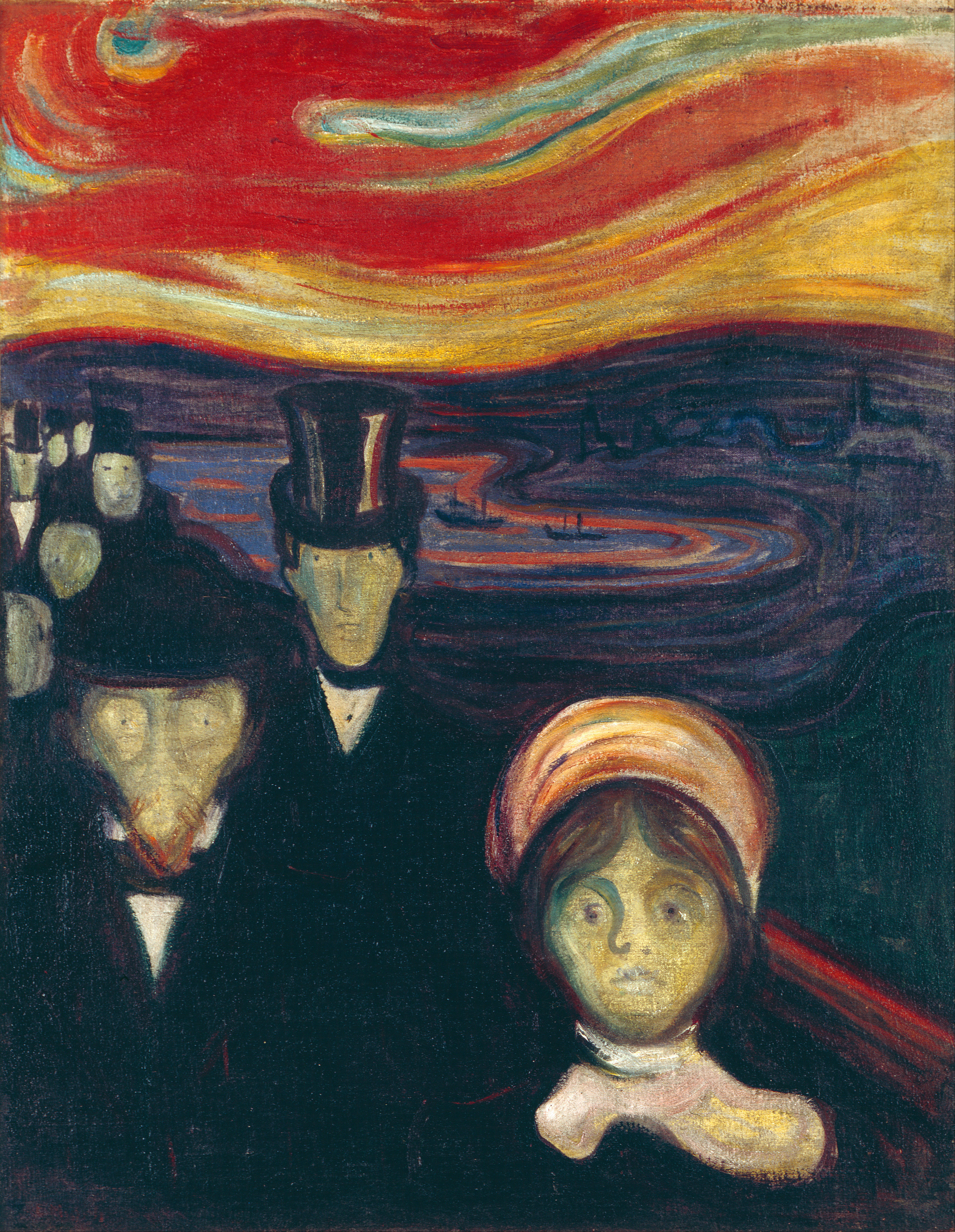
Anxiety is a work by Edvard Munch from 1894: a group of pale faces in dark clothes comes along the road above the fjord straight towards the viewer, and a blood-red sky rolls above them. The original is held by the Munchmuseet in Oslo under inventory number MM.M.00515 and measures 93.5 x 73 cm, oil on canvas. With us it is made as a hand-painted reproduction in oil; you receive a photograph of the finished work for approval before dispatch, and you choose between ten sizes or a size of your own.
| Title: | Anxiety |
| Other titles: | Angst · Die Angst · L’ansia · A szorongás · Tjeskoba · Tesnoba |
| Painter: | Edvard Munch (1863–1944) |
| Year: | 1894 |
| Original size: | 93.5 cm x 73 cm |
| Original technique: | Oil on canvas |
| Painting style: | Expressionism |
| Location: | Munchmuseet, Oslo (inv. no. MM.M.00515) |
| Our reproduction: | hand-painted oil on canvas, 10 sizes from 40 x 50 cm to 180 x 230 cm, custom on request |
Anxiety – Edvard Munch
What is shown?
Along the road beside the railing a group of people comes straight towards us. At the front stand a woman in a dark headdress and a man in a top hat; behind them the faces thicken into a mass that dissolves towards the back. None of them is named: the museum entry carries no names, Munch named no models, and he did not describe any of these figures as a portrait. The faces are pale, almost greenish, the eyes dark and empty, the mouth pressed into a straight line. Nobody looks at anybody else. They all look out, towards the viewer, and it is that gaze that makes the scene uncomfortable: the group is physically together while every individual in it is alone.
What is painted on the original?
The upper third is the sky, layered from broad rolling bands of red, orange and yellow running horizontally across the full width. Below it lies the dark blue-green water of the fjord, also in waves, so that sky and water answer one another. On the left the railing of the road leads the eye into depth and creates a fast perspective. The figures are painted as narrow dark columns; the clothing is almost black surface without detail, and the faces are light patches into which the painter set eyes and mouth with a few strokes. Munch laid the colour thin and quick, in places so that the weave of the canvas shows through. It is precisely this withholding of detail that gives the scene its force: because the faces are not finished, we read them as a type rather than as people.
Why does this painting matter?
Expressionism found its vocabulary in works of this kind. Munch took the motif of strollers, which painting had until then used for scenes of city life, and turned it inside out: instead of company he painted solitude inside a crowd. The road along the fjord and the rolling red sky are the same as in his best-known work, but beneath them here stands not a single figure but a procession. As an expressionist painting, Anxiety is the middle link between the early and the late works of this cycle, and it appears in surveys of modern art as an example of colour taking over the role of narrative.
What does the painting mean?
The title describes a state, not an event. Nothing happens in the scene: nobody screams, nobody runs, the group simply walks. The tension comes from the mismatch between the quiet action and a colour that does not confirm that quiet. The sky is a colour no sky has, and because its waves repeat in the water, the whole space seems to breathe. The faces are turned towards us but do not see us; they look through. Munch wrote often about anxiety as something that arrives from outside and takes up residence in the body, and that is exactly how this work is built: the feeling is in the surroundings and the people merely carry it. Reading the scene as a funeral adds a story it does not contain; what remains is that all these people know the same thing and none of them says it.
Where does Anxiety sit among Munch’s works?
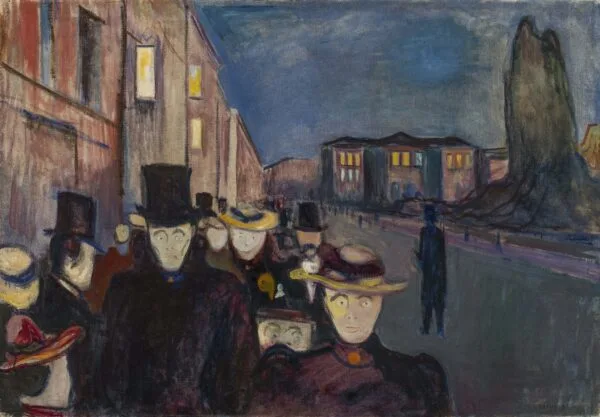
Munch used the motif of the road above the fjord several times, and Anxiety stands on its middle link. A year earlier came The Scream, where a single figure stands on that same road; two years earlier Despair, with the same railing and the same sky but a stooping figure looking down. The crowd of faces turned towards the viewer returns in Evening on Karl Johan, this time in a city street rather than above water, and the railing with its view into depth in The Girls on the Bridge. If you were looking for the scene with one figure and hands at the head, that is The Scream and not this work; here the figures are many and none of them covers its ears. The whole range is in the Edvard Munch gallery.
How is our hand-painted version made?
This is a canvas painting made with brush and oil colour, not a printer. The painter works from a high-resolution museum reference and builds the scene in the same order as the original: first the broad bands of sky and water, then the dark surfaces of the clothing, and last the pale faces, which on this work are the most delicate part and decide whether the scene holds. Because the faces are painted with few strokes, every one of them stays visible, and that is why every hand-painted copy is its own; two examples are never quite alike. For this work we have no photographs of our own from the workshop, so you will not find any on this page, and before dispatch you always receive a photograph of the finished canvas for approval.
Which size for which wall?
If you are unsure: 73 x 94 cm. That size matches the original, which measures 93.5 x 73 cm, and is the only one on which you see the scene at the size it was painted. The format is upright and the road carries the eye into depth, so the work needs a little room at the sides and does not take a tight corner. The 40 x 50 and 50 x 60 cm sizes belong in a hallway or in a group of smaller works; 60 x 80 and 90 x 120 cm sit well above a chest of drawers or a desk; 110 x 140 and 130 x 170 cm are the real painting for the living room above a sofa; 150 x 190, 160 x 205 and 180 x 230 cm suit stairwells, tall rooms and large walls. Because the red sky is strong, the scene works best on a quiet, neutral wall and where the viewer can step back a little. All ten sizes are made to order; no size here is held in stock as an already painted work.
Custom size, stretcher bar and frame
If none of the ten sizes suits your wall, we paint to your measurements and keep the proportion of the original, so the procession does not lose its depth; that is our painting made to measure. Every example arrives stretched on a wooden stretcher bar, ready to hang; the stretcher bar can be left off at the order. On this page the canvas is offered without a frame; the frame is chosen separately with our 3D application, which shows every one of our frame profiles on this motif: gold, silver, black, white and natural wood. The application is for frame choice only. If you would like to see how the work will look on your own wall, that is our separate room-placement service.
Delivery and guarantee
Every example is made to order in our studio in Slovenia, so allow 15 to 45 days depending on size. We ship it stretched and protected for transport, without customs inside the European Union. Before dispatch you receive a photograph of the finished work for approval, and our returns policy applies to every order. Every painting on canvas we make is made the same way, including paintings by famous painters from other periods; we write about Munch’s path and the making of this cycle in our article on Edvard Munch.
Frequently asked questions
Where is the original?
In the Munchmuseet in Oslo, under inventory number MM.M.00515.
Who are the people in it?
Nobody by name. The record carries no names and Munch named no models; they are nameless figures standing for a type rather than for particular people.
Is this the same work as The Scream?
No. The Scream came a year earlier and has a single figure with its hands at its head. Anxiety shows a procession of faces on the same road and under the same sky.
Is this a print?
No. The order is painted by hand in oil colour onto canvas; the brushstrokes can be seen and felt.
Which size should I choose?
The 73 x 94 cm size matches the original almost one to one; for other walls see the guide above.
Can I have a size that is not listed?
Yes, we paint to measure and keep the side ratio of the original.
How is it delivered?
Stretched on the stretcher bar and protected for transport, in 15 to 45 days, once you confirm the photograph of the finished work.
What does the work say in one sentence?
That a person can be alone in the middle of a group, and that anxiety arrives from the surroundings rather than from an event.
Is the original for sale and what is it worth?
No. The work is in the public collection of the Munchmuseet and is not for sale; a hand-painted canvas is the one way to have this scene at home.
How high should I hang it?
The centre at eye level, roughly 145–150 cm from the floor; above a sofa 15–25 cm over the back.
Is it suitable as a gift?
It is a demanding motif, so choose it for someone who already knows Munch. At 50 x 60 and 60 x 80 cm it arrives stretched and ready to hang. If you would rather leave the choice to the recipient, a gift voucher is available.
- Subject: a procession of pale faces on the road above the fjord, a rolling red sky, the gaze turned towards the viewer – 1894
- Original: 93.5 x 73 cm, oil technique on canvas, Munchmuseet, Oslo (MM.M.00515)
- Ours: a hand-painted oil work, ten sizes from 40 x 50 to 180 x 230 cm, stretched on a stretcher bar, unframed
- Worth knowing: the road and the sky are the same as in The Scream, only here there is no single figure but a crowd – the same setting, the opposite story