



Description
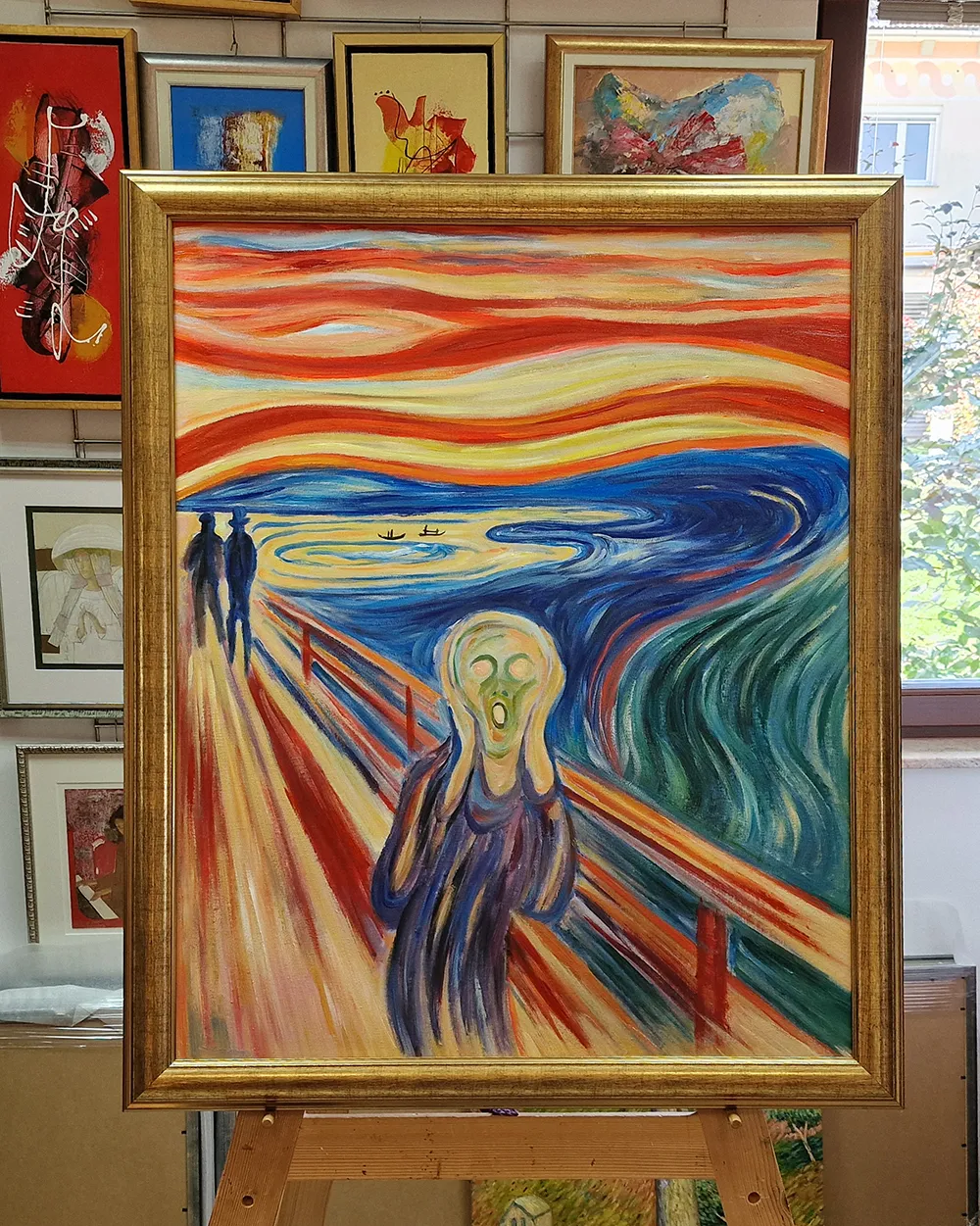
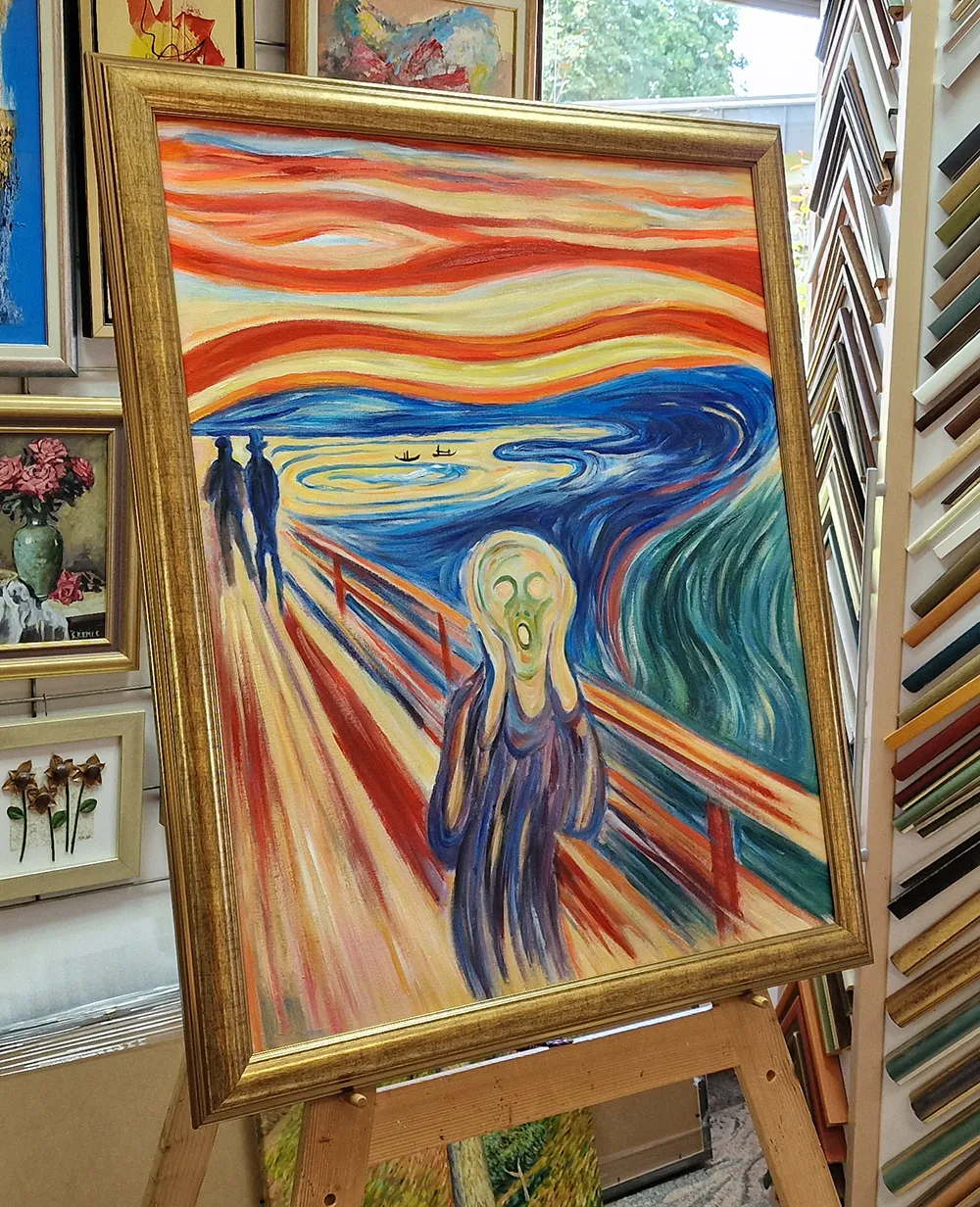
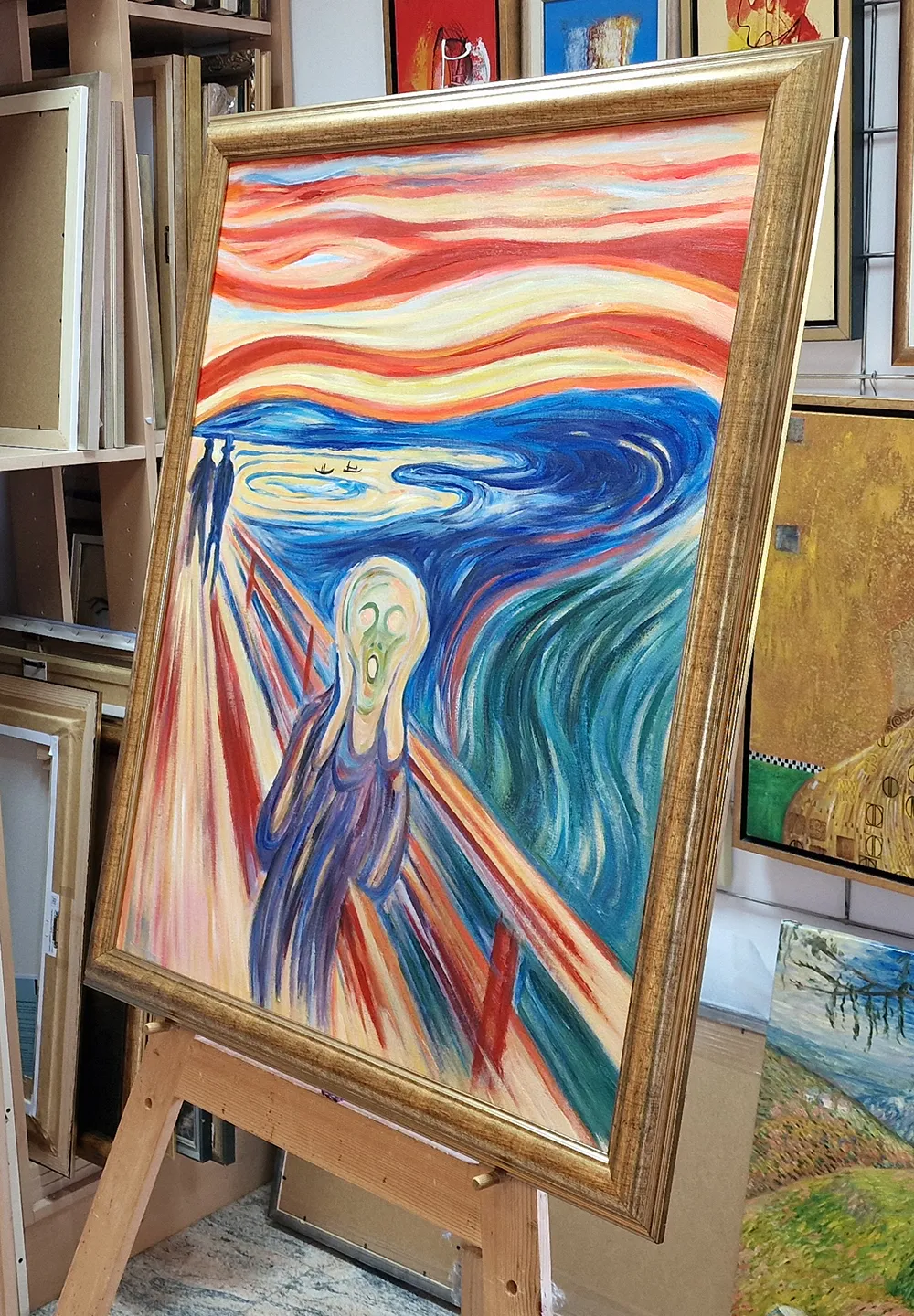
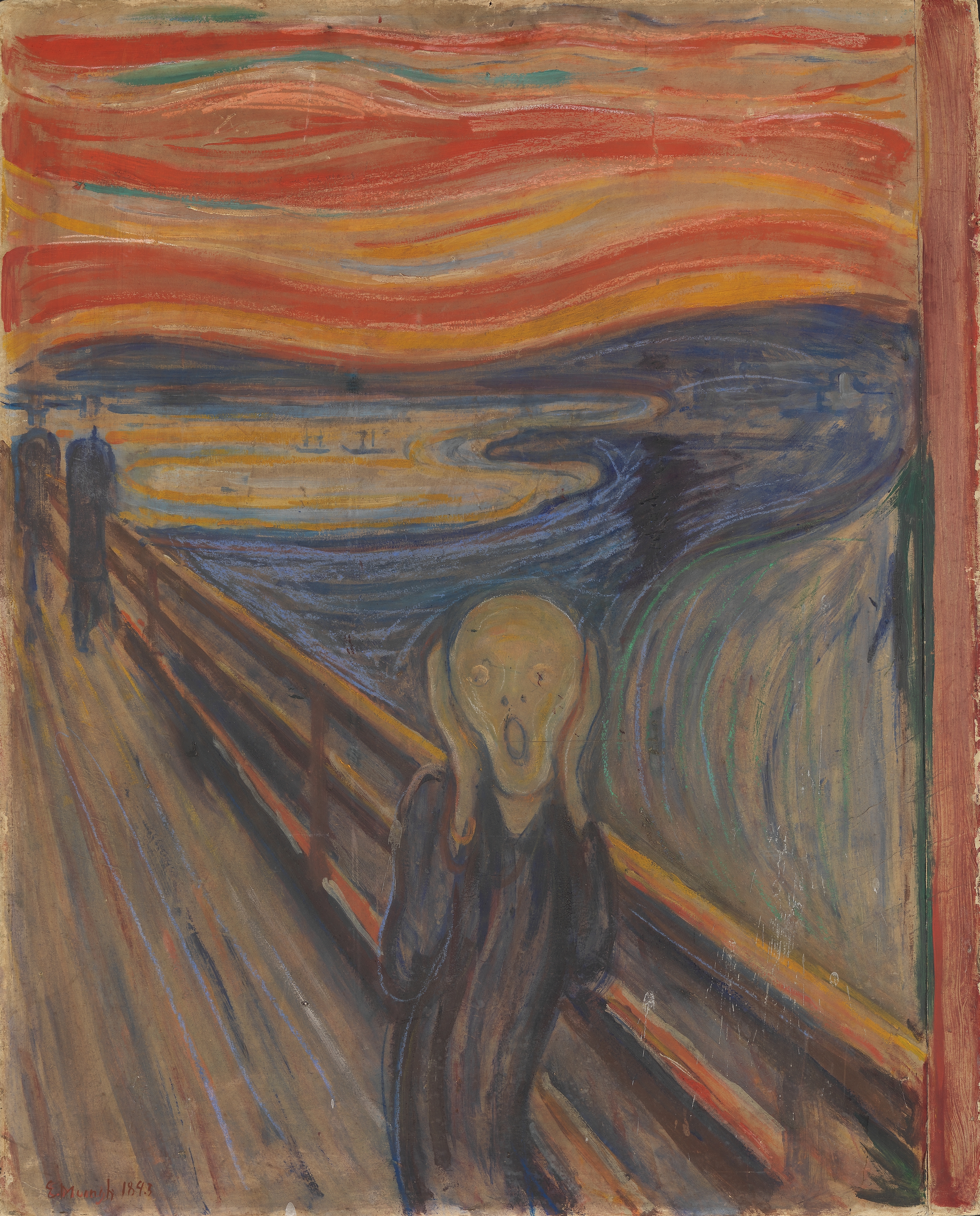
The Scream is a work by Edvard Munch from 1893: a figure on a bridge above the fjord at Kristiania presses both hands to its head and hears a scream passing through nature. The original is held by the Nasjonalmuseet in Oslo under inventory number NG.M.00939 and is not painted on canvas but in tempera and oil crayon on cardboard. With us it is made as a hand-painted reproduction in oil; you receive a photograph of the finished work for approval before dispatch, and you choose between ten sizes or a size of your own.
| Title: | The Scream |
| Other titles: | Skrik · Der Schrei · Krik · L’urlo · A sikoly · Vrisak |
| Painter: | Edvard Munch (1863–1944) |
| Year: | 1893; the work is signed twice, one signature over the other |
| Original size: | 73.5 cm x 91 cm |
| Original technique: | Tempera and oil crayon on cardboard |
| Painting style: | Expressionism |
| Location: | Nasjonalmuseet, Oslo (inv. no. NG.M.00939) |
| Our reproduction: | hand-painted oil on canvas, 10 sizes from 40 x 50 cm to 180 x 225 cm, custom on request |
The Scream – Edvard Munch
What is shown?
On a bridge above the fjord stands a single figure, turned towards the viewer, hands beside its face, mouth open on one long sound. Who it is has never been recorded: the museum entry carries no name, Munch did not call it a self-portrait, and he named no model. In the background, along the same railing, two dark figures in hats are walking away; they too remain unnamed. The difference carries the whole tension: they walk on, this one has stopped. The scene takes place above Kristiania, today’s Oslo.
What is painted on the original?
The upper third is the sky, layered from horizontal bands of red, crimson and orange-yellow with short blue-green strokes between them. Below it the water winds in dark blue and almost black S-curves towards the horizon, with small dark outlines of boats and two masts. The railing cuts diagonally from the lower left corner in brown, ochre and reddish lines. The face is green-yellow, eyes and mouth dark hollows, the body a wavering blue-black silhouette repeated in the curves of the water. The support is unusual: Munch worked on cardboard and left it bare at the right edge and in the sky, so its warm sandy colour takes part in the scene. Tempera and oil crayon lie thin; that is exactly why the original is so sensitive to light that the museum rarely shows it for long.
Why does this painting matter?
Expressionism found its most recognisable form here. Munch recorded not how a scene looks but how it feels: the colour of the sky is a state of nerves, not weather, and the perspective of the bridge pulls the viewer in with nowhere to stand. The generations that followed in Germany and Austria took it as their starting point. Outside art history the motif is a language for dread; few works have the reach of an expressionist painting quoted this often.
What does the painting mean?
The commonest mistake in reading this work is to assume the figure is screaming. It is not screaming – it is listening. In a diary note of 1892 Munch described an evening walking with two friends above the town, stopping as the sky turned blood red, and wrote that he sensed an infinite scream passing through nature. The scream comes from the surroundings, not the mouth; the hands at the head are a defence against the sound, not its source. The note is Munch’s own and not an art historian’s reading, so we quote it as what it is – the painter’s testimony about his own scene.
Is this the painted version or a pastel?
Ours is painted, and it is the first of the two painted ones. The motif exists in four coloured versions, not one: two painted, two pastels. Ours follows the 1893 version on cardboard, held by the Nasjonalmuseet as NG.M.00939. The second was made no earlier than 1910 and is in the Munchmuseet in Oslo, carried out in tempera and oil on unprimed cardboard. Of the pastels, one carries no signature and no year and is also dated to 1893; the other is signed and dated 1895 and is the only one in private hands, sold at auction in 2012. Munch also made the motif as a lithograph in 1895, that is as a graphic print rather than a coloured work. The reverse of our original also carries a sketch of the scene. If you want the red-sky version held in Oslo, this is the right page; the whole range is in the Edvard Munch gallery. Closest is Despair of 1892, where the same bridge and sky carry a stooping figure; a year later came Anxiety from the same spot, and the bridge returns in The Girls on the Bridge and Evening on Karl Johan.
How is our hand-painted version made?
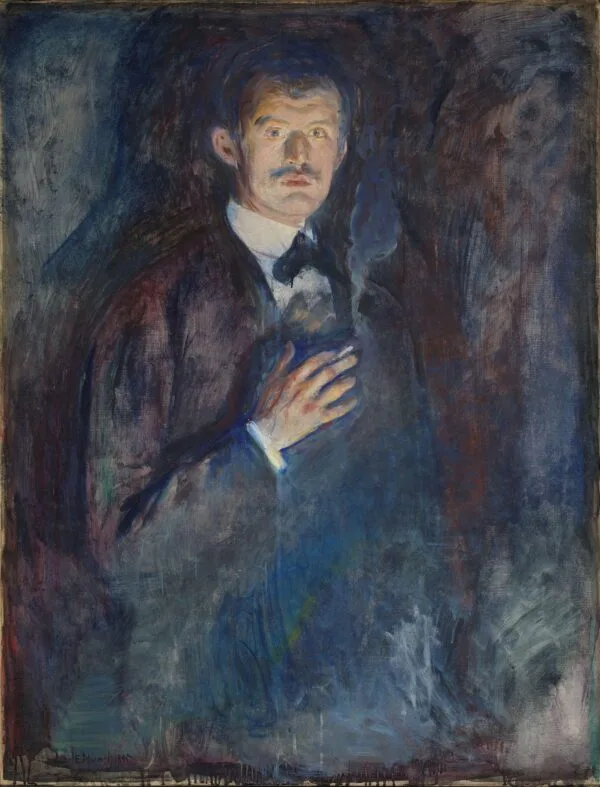
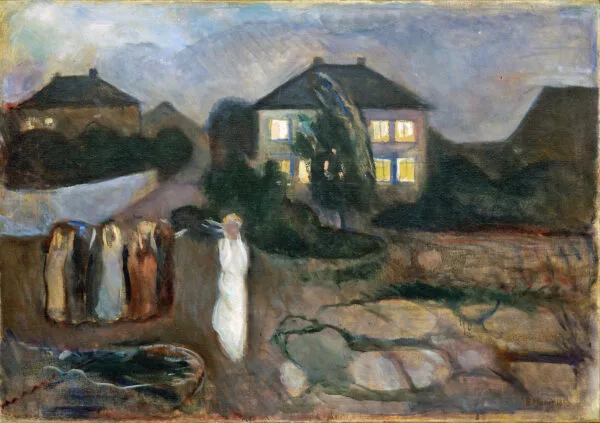
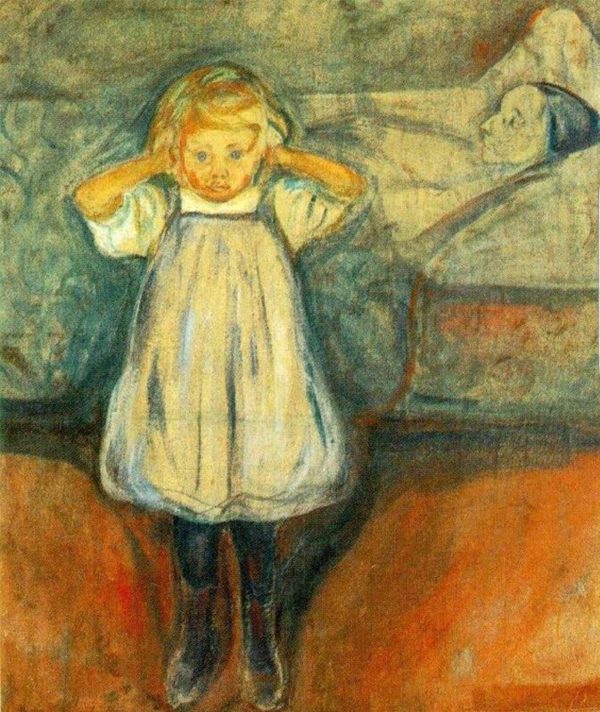
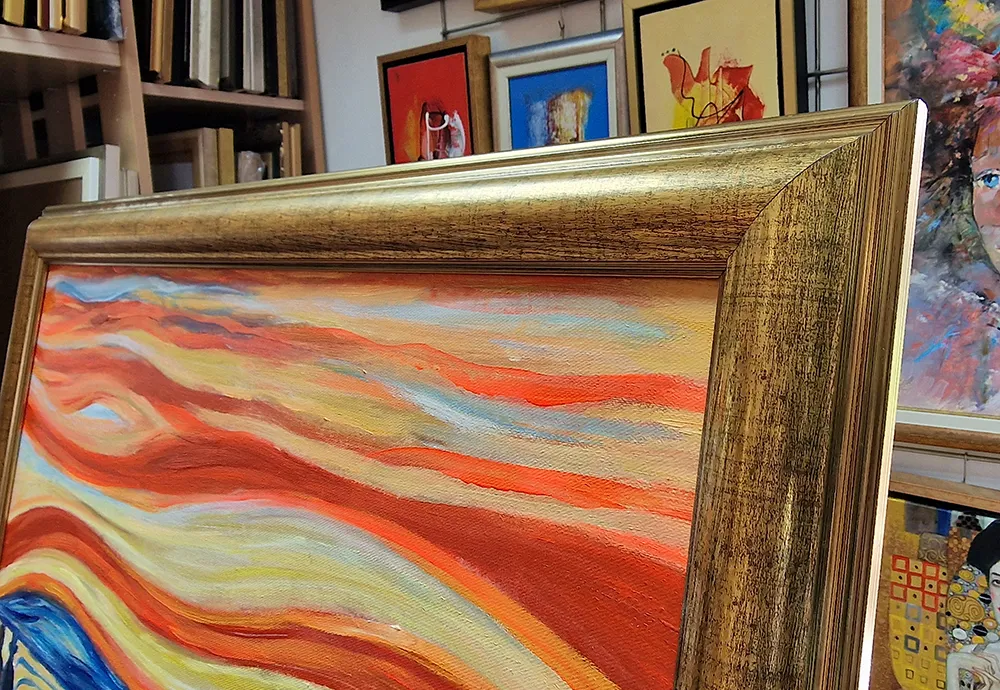
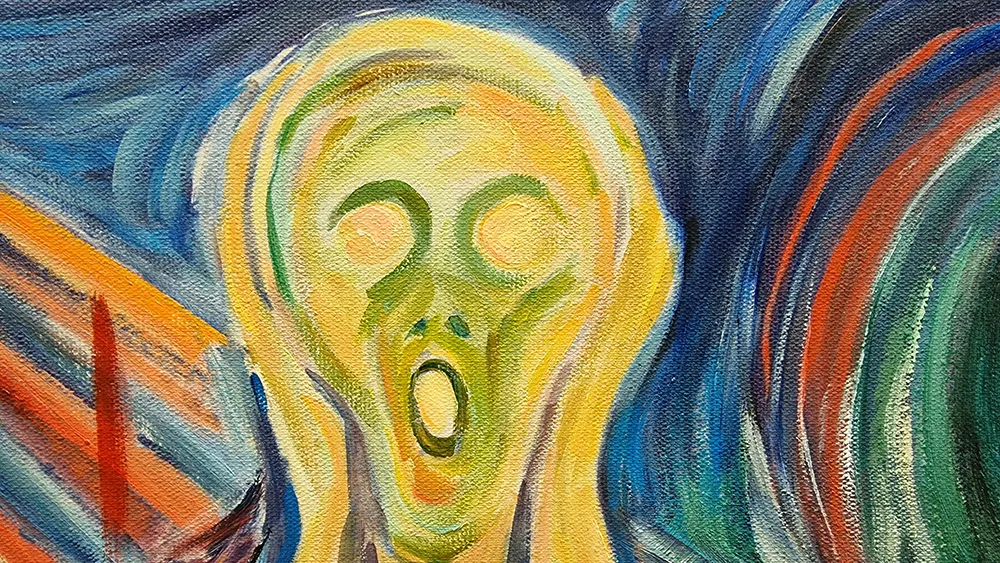
This is a canvas painting made with brush and oil colour, not a printer. Because the original is not on canvas, our painter does not imitate the cardboard but carries the colour order of the scene onto canvas, where oil gains a denser and more durable surface than thin tempera can. The photographs above this description show our own works, taken in the workshop, not the museum original: that is exactly what you receive. In the third photograph the finished work stands on our workshop easel among framed pieces, just before the final check. In the fourth photograph the sky is shot close up, so individual brushstrokes and the weave of the canvas show beside the frame corner – a print cannot give that relief, because a flat sheet has nothing to cast a shadow. In the fifth photograph a macro of the head and hands shows that every surface really was laid on by hand. The first and the second photograph show the same work whole, square-on and at an angle. Because everything is done by hand, every hand-painted copy is its own; two examples are never quite alike.
Which size for which wall?
If you are unsure: 74 x 91 cm. It matches the original, 73.5 x 91 cm, almost exactly, and is the only one showing the scene at the size it was painted. The format is upright and the horizon low, so the work asks for a slightly higher hang. The 40 x 50 and 50 x 60 cm sizes belong in a hallway; 60 x 70 and 90 x 110 cm above a chest of drawers; 110 x 140 and 130 x 160 cm are the real painting for the living room above a sofa; 150 x 190, 160 x 200 and 180 x 225 cm suit stairwells, tall rooms and large walls where the sky needs air. Because the red sky is strong, the scene works best on a quiet, neutral wall, since at a distance the bands join into a whole. All ten sizes are made to order; no size here is held in stock as an already painted work.
Custom size, stretcher bar and frame
If none of the ten sizes suits your wall, we paint to your measurements and keep the proportion of the original, so the figure and the bridge are never squeezed; that is our painting made to measure. Every example arrives stretched on a wooden stretcher bar, ready to hang; the stretcher bar can be left off. On this page the canvas is offered without a frame; the frame is chosen separately with our 3D application, which shows every one of our frame profiles on this motif: gold, silver, black, white and natural wood. The application is for frame choice only. If you would like to see how the work will look on your own wall, that is our separate room-placement service.
Delivery and guarantee
Every example is made to order in our studio in Slovenia, so allow 15 to 45 days depending on size. We ship it stretched and protected for transport, without customs inside the European Union. Before dispatch you receive a photograph of the finished work for approval, and our returns policy applies to every order. Every painting on canvas we make is made the same way, including paintings by famous painters from other periods; we write about Munch’s path in our article on Edvard Munch.
Frequently asked questions
Where is the original?
In the Nasjonalmuseet in Oslo, inventory number NG.M.00939; it entered the museum in 1910 as a gift from Olaf Schou.
Who is the figure on the bridge?
Nobody by name. The record carries no name and Munch did not list it as a portrait; the two companions in the background are likewise unnamed.
Is Skrik the same work as The Scream?
Yes. Skrik is the Norwegian title, Der Schrei the German, Krik the Slovene, L’urlo the Italian and A sikoly the Hungarian.
Is this a print?
No. The order is painted by hand in oil colour onto canvas; the brushstrokes can be seen and felt. The 1895 lithograph is a print; our version is not.
Which size should I choose?
The 74 x 91 cm size matches the original almost one to one; for other walls see the guide above.
Can I have a size that is not listed?
Yes, we paint to measure and keep the side ratio of the original.
How is it delivered?
Stretched on the stretcher bar and protected for transport, in 15 to 45 days, once you confirm the photograph of the finished work.
What does the work say in one sentence?
That the figure has heard a scream passing through nature and presses its head because of it: the sound is in the scene.
Is the original for sale and what is it worth?
No. The Oslo version is in a public collection and not for sale. Only the 1895 pastel in private hands was, auctioned in 2012; a hand-painted canvas is the one way to have this scene at home.
How high should I hang it?
The centre at eye level, roughly 145–150 cm from the floor; above a sofa 15–25 cm over the back. Because the horizon is low it may sit higher.
Is it suitable as a gift?
Yes, especially at 50 x 60 and 60 x 70 cm, which arrive ready to hang. Because the work is made to order, allow 15 to 45 days; if you would rather leave the choice to the recipient, a gift voucher is available.
- Subject: a nameless figure on a bridge above the fjord at Kristiania, a banded red sky, two companions walking away – 1893
- Original: 73.5 x 91 cm, tempera and oil crayon on cardboard, Nasjonalmuseet, Oslo (NG.M.00939)
- Ours: hand-painted oil on canvas, ten sizes from 40 x 50 to 180 x 225 cm, stretched on a stretcher bar, unframed
- Worth knowing: the figure does not give out the scream, it hears it – Munch wrote that the scream passed through nature