



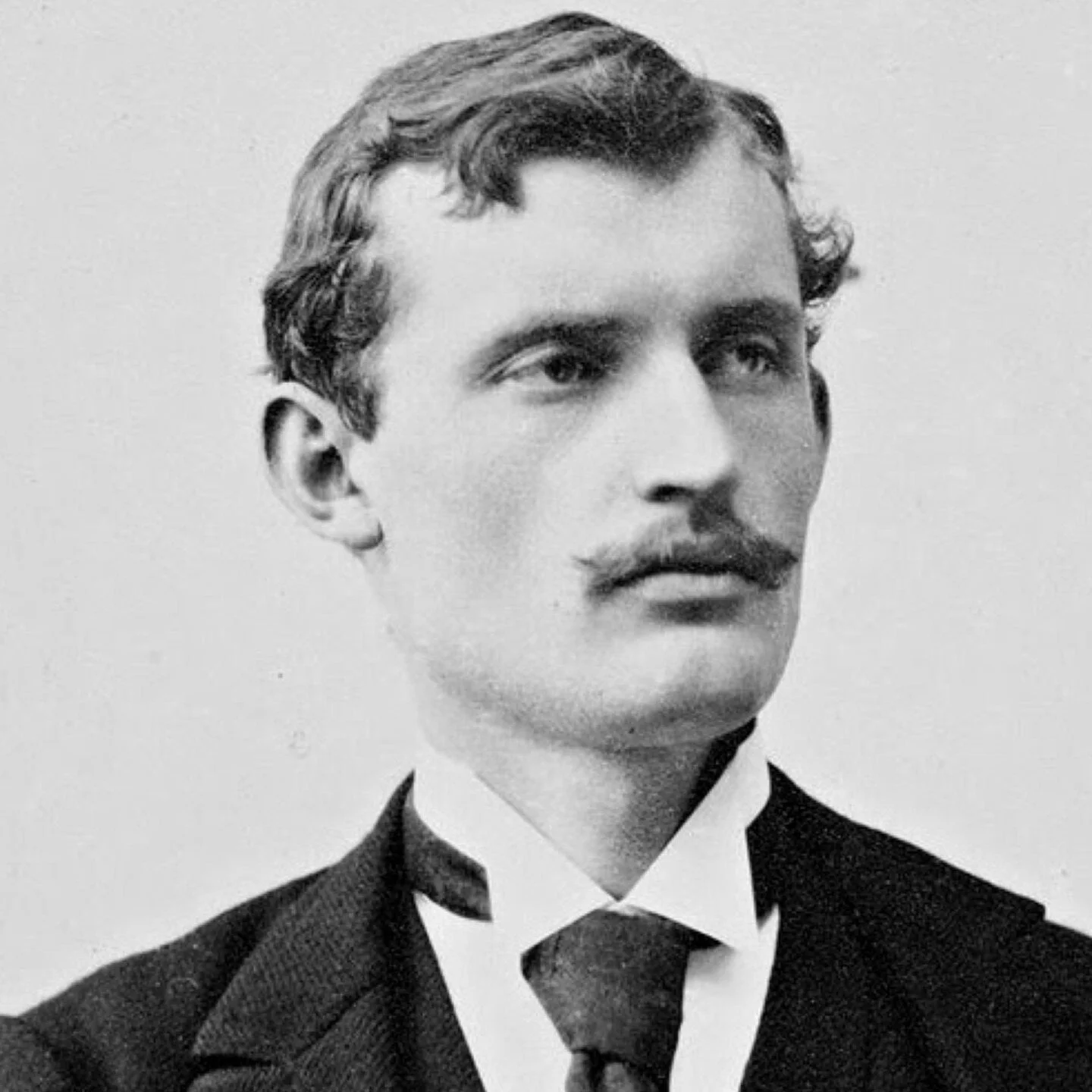
Edvard Munch (1863-1944) was a Norwegian painter and printmaker who painted inner states rather than scenes: love, anxiety, illness and death. He is best known for The Scream, one of the most recognisable images of the 20th century, but his influence reaches far beyond that single canvas – he is counted among the fathers of expressionism, and he showed modern art that colour and line can carry emotion by themselves.
He was born on 12 December 1863 in Løten, Norway, and grew up in Kristiania, today’s Oslo. His mother died of tuberculosis when he was five and his sister Sophie nine years later; both deaths return in his work for decades. He trained at the Royal School of Drawing in Kristiania and from the late 1880s worked in turn in Paris, Berlin and Norway. In 1916 he bought the Ekely estate above Oslo and spent his last twenty-eight years there; he died on 23 January 1944.
Edvard Munch – 10 things worth knowing
- He did not paint The Scream once but four times, in four different media – two versions are painted, two are pastels.
- He wrote the moment down in his diary: he was not screaming himself, he heard a scream passing through nature. The figure in the painting is covering its ears.
- His 1892 Berlin exhibition was closed after barely a week by a vote of the Berlin artists’ association – an episode that echoed across the German art world.
- He often painted on unprimed or only thinly primed canvas, so that the weave shows through the paint.
- He deliberately left some canvases outdoors in rain, snow and sun. He called it the horse cure.
- He did not repeat motifs as copies but reworked them each time – a second version is a new work for him, not a reproduction of the first.
- He was also one of the most important printmakers of his time; woodcut, lithography and etching stand equal to painting in his output.
- Between 1909 and 1916 he painted the large murals for the assembly hall of the university in Oslo.
- He left the city of Oslo roughly 1,100 paintings, 4,500 drawings and watercolours and 18,000 prints – the foundation of the Munch Museum.
- The Scream was stolen twice, in 1994 and in 2004, and recovered both times.
The Scream: four versions, not one
The commonest mistake about The Scream is that it is a single painting. Munch carried the motif out four times between 1893 and 1910, in two painted and two pastel versions. The best known is the painted version of 1893, executed in tempera and oil crayon on cardboard, held by the National Museum in Oslo under the inventory number NG.M.00939. From the same year there is a version in crayon or pastel, from 1895 a pastel that is in private hands and was sold at Sotheby’s in 2012, and from 1910 a tempera held by the Munch Museum.
Munch also made a lithograph of the same motif in 1895. It was the print, more than any single painting, that carried the image across Europe. We have written about the story and meaning of the motif in our article on The Scream.
How Munch painted: materials, application and the horse cure
Munch is written about endlessly as a painter of feeling and hardly at all as a maker of objects – although it is exactly the making that separates his canvas from a printed reproduction. He often painted on unprimed or only thinly primed canvas. He laid the paint on thin and fast, in long strokes, and did not smooth it; in places he left the ground entirely bare, so that the weave of the canvas takes part in the scene instead of disappearing under the paint.
For the 1893 Scream he did not use oil on canvas at all, but tempera and oil crayon on cardboard. Cardboard is absorbent and matt, colour behaves differently on it than on canvas, and the crayons leave a dry, crumbling trace. The original is therefore not smooth and varnished but grainy and in places almost drawn – a detail invisible on a screen and decisive on a canvas.
The strangest part of his practice was leaving canvases out in the weather on purpose. Munch left paintings outdoors in rain, snow and sun, sometimes for weeks; he called it the horse cure, after the way horses were hardened. Some contemporaries read it as neglect, while he maintained that a painting acquired its proper surface that way. The consequences are still visible: some canvases carry worn, dusty and cracked passages that are not damage in the ordinary sense but part of how the work was made. Conservators therefore preserve them rather than repair them.
The last feature of his method is repetition. Munch painted the same motifs again and again, sometimes twenty years apart, and differently every time – other colours, another format, a different tension. He did not regard these versions as copies but as continuations of the same thought. That is also why a hand-painted reproduction means something different with Munch than with a painter who made a motif once: Munch himself carried the same scene out several times, newly each time.
The Frieze of Life
Munch did not understand his major works as separate paintings but as parts of one cycle, which he called the Frieze of Life. The cycle is about love, anxiety and death; the paintings answer one another, motifs move from one canvas to the next, and the same shoreline and the same band of evening sky return in several works. Madonna, Ashes, The Dance of Life and The Scream belong to it. Hung together they read differently than they do alone, which was Munch’s intention. He never closed the cycle: he added works, withdrew them and rearranged them, so the Frieze of Life is not a fixed list but a way in which Munch thought his paintings together.
Munch’s best-known works
Besides The Scream, his best-known works include Madonna, Anxiety, Ashes and late landscapes such as Winter Night. The late self-portraits belong among the high points too, for instance Self-Portrait by the Window, in which he painted himself without softening anything. You will find all of these motifs among our hand-painted reproductions of Munch’s works.
Style: expressionism before expressionism
Munch painted inner states rather than scenes: undulating lines, a burning sky, and figures caught between landscape and feeling. A generation before the German expressionists he showed that colour and line can carry fear, love and grief. The Scream is also on our list of the most famous paintings.
Frequently asked questions about Edvard Munch
How many versions of The Scream exist, and where are they?
Four. The painted version of 1893, executed in tempera and oil crayon on cardboard, is in the National Museum in Oslo (NG.M.00939). The crayon or pastel version of 1893 and the tempera of 1910 are in the Munch Museum in Oslo. The pastel of 1895 is in private hands; it was sold at Sotheby’s in 2012. Alongside these four, Munch made a lithograph of the same motif in 1895.
What did Munch paint with?
Mostly oil on canvas, often on unprimed or only thinly primed canvas and in a thin, rapid application through which the weave shows. But he also used tempera, oil crayon and cardboard – the 1893 Scream is made in tempera and oil crayon on cardboard, not oil on canvas. He was an experienced printmaker as well, working in woodcut, lithography and etching.
Is the figure in The Scream screaming?
No. By Munch’s own diary entry the painter stopped during a walk and felt an infinite scream passing through nature; the figure in the painting is therefore covering its ears against a scream that comes from outside. The title refers to the scream of nature, not to a scream from this figure – a detail that most reproductions and parodies get backwards.
What is the Frieze of Life?
The Frieze of Life is a cycle of paintings about love, anxiety and death that Munch built from the early 1890s onwards and exhibited several times as a whole. The Scream, Madonna, Ashes and The Dance of Life belong to it. The paintings answer one another within the cycle, which is why Munch wanted them hung together rather than as separate works.
Why did he paint the same motifs several times?
Because he did not regard them as finished. Munch returned to the same motif even twenty years later and carried it out differently each time – in another format, with another palette, with a different application. The later versions are therefore not copies of the first but independent works continuing the same thought. The same is true of The Scream, which exists in four versions.
Where do Munch’s originals hang today?
Most of them are in Oslo. The Munch Museum holds by far the largest collection – the painter left the city of Oslo roughly 1,100 paintings, 4,500 drawings and watercolours and 18,000 prints. The National Museum in Oslo holds the best-known painted version of The Scream and Madonna. Individual works are outside Norway as well, for example in the Museum of Modern Art in New York and in the Sprengel Museum in Hannover.
We paint our reproductions of Munch’s works entirely by hand, in oil on canvas; they are not prints. Every canvas is made to order and in the size you choose. You will find the motifs among the paintings of Edvard Munch.