Description
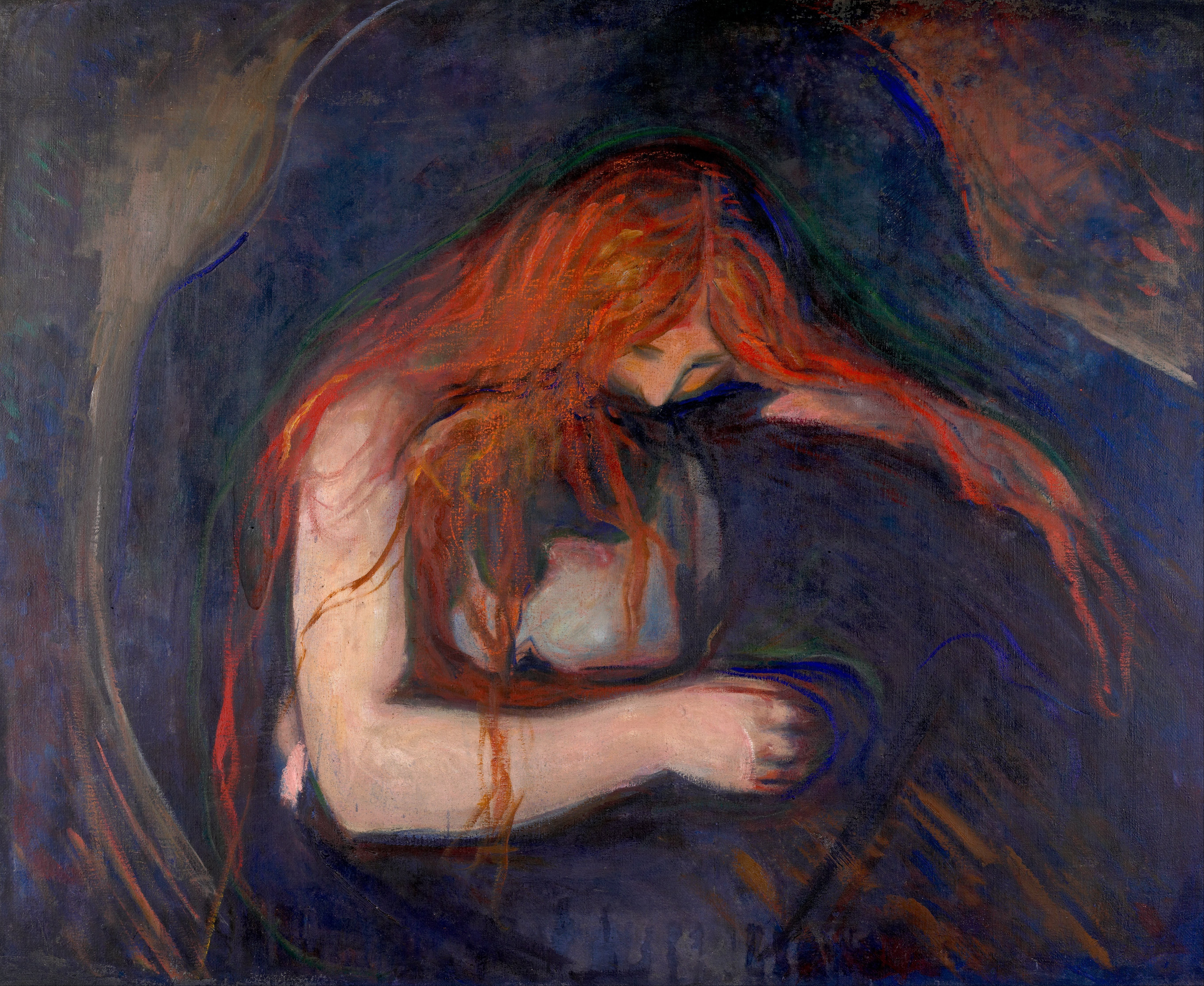
Vampire by Edvard Munch is a symbolist painting from 1895, held under accession number MM.M.00679 by the Munch Museum in Oslo: a woman with fiery red hair bends over a man whose head is bowed into her lap. With us it is made as a hand-painted reproduction in oil, brushed onto canvas; you receive a photograph of the finished work for approval before dispatch, and you choose between ten sizes or a size of your own.
| Title: | Vampire |
| Other titles: | Vampyr · Vampir · Vampiro · Vámpír |
| Painter: | Edvard Munch (1863–1944) |
| Year: | 1895 |
| Original size: | 109 cm x 91 cm |
| Original technique: | Oil on canvas |
| Painting style: | Symbolism |
| Location: | Munch Museum, Oslo (inv. no. MM.M.00679) |
| Our reproduction: | hand-painted work in oil, 10 sizes from 50 x 40 cm to 180 x 150 cm, custom on request |
Vampire – Edvard Munch
What is shown?
The two figures fill almost the whole canvas and are seen from close up. The woman’s hair is the strongest element in the scene: it is painted in long orange-red strokes that fall across the man’s back and shoulders, some running downward as thin threads. Her face is sunk into the back of his neck, so that only the forehead and the cheek are visible, both pale, and the eye is closed. Her arms are painted in pale pink flesh; one crosses the foreground horizontally and ends at the right with the palm. The man is bent forward and stays a dark mass: his clothing and hair are almost black, with traces of blue and green, and his face we do not see at all. No emptiness is left between them; the bodies touch along their whole length, and neither figure can be identified.
What is painted on the original?
Her figure is light, his is dark, and it is that contrast which carries the whole composition. Between them a patch of pale bluish white catches the light. The background is deep blue and blue-violet; on the left a large grey-brown and olive arc winds up the full height, like a curved shadow. In the upper right corner warmer red-brown and dark blue marks appear. The background gives nothing to stand on: no room, no landscape, no floor, no wall. The colour is laid on fluidly and in long strokes, the hair with a single stroke per lock over an already dark ground. The edges of the figures are soft and dissolve into the background. The museum records the work as unsigned.
Why does this painting matter?
Symbolism works here through a single colour. Everything on the canvas is dark, cool and without support, except the hair, which is the one saturated thing in the scene and leads the eye from top to bottom across the man’s back. Because there is no background, the scene has neither place nor time; only the relation between two bodies is left. That is exactly why the work appears in surveys of the late nineteenth century as an example of painting that removes from a scene everything not strictly needed. As a symbolist work it stands close to the Munch motif that became his best known.
What does the painting mean?
There is neither a bite nor blood on the canvas. We see an embrace: one figure bends over the other, the other holds its head down and does not show its face. Whether that is comfort or dominance the scene itself does not say, and it is precisely this ambiguity that keeps the work alive. We keep to what is visible: the red hair lies across the dark figure as the one light thing in the scene, and the bodies do not come apart. Anyone who sees a particular story or particular people in the scene is adding it; the canvas does not confirm it. The Munch Museum places the work among its love themes in its record, and gives Vampire as its title.
Where does Vampire sit among Munch’s works?
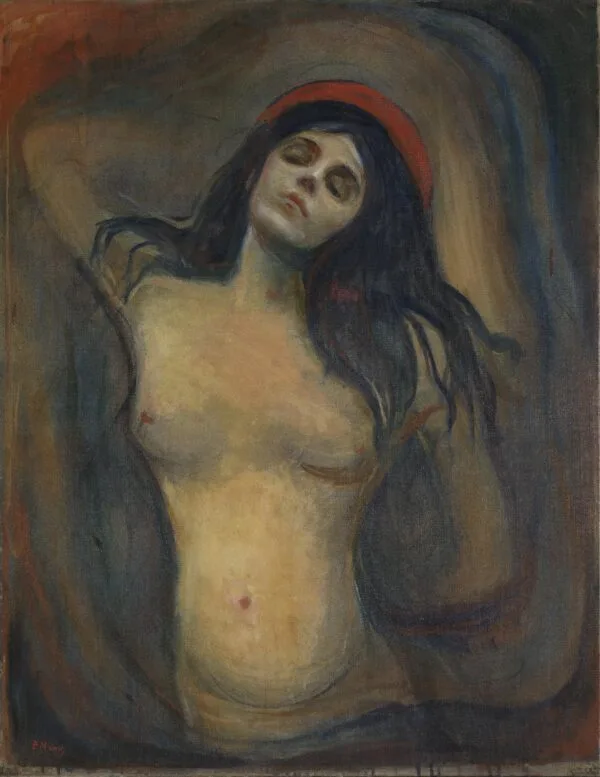
The motif exists in more than one version, and the Munchmuseet lists them on the page of this record: beside ours it names further oils on canvas of 1893, 1893 and 1894 and one of 1916–1918, a pastel of 1893–1896, the lithograph Vampire II of 1895/1902 and several drawings. Our reproduction follows the version with accession number MM.M.00679, which the museum dates to 1895 and records under the catalogue number Woll M 377, and no other. The embrace that ends in the loss of a face turns the other way in The Kiss, where the two faces merge into a single surface. The female figure as a symbol in its own right arrives with Madonna, and the parting of the same couple with Separation. The same motif is set into a wider scene in The Dance of Life. The whole range is in the Edvard Munch gallery.
How is our hand-painted version made?
This is a painting on canvas made with brush and oil colour, not with a printer. The painter works from a high-resolution reference and builds the scene from the back forward: the deep blue background to begin with, then the two figures, and only at the end the hair. The hair is the hardest part: each lock is a single stroke, set over an already dry dark ground, and if the red mixes with the underpainting it loses all its force. Because every hand-painted copy is made for its own order, no two match down to the detail, and small differences in the laying-on are a mark of the human hand and not a fault. For this work we have no photographs of our own from the workshop, so you will not find any on this page; the photograph of the finished canvas always reaches you for approval before dispatch.
Which size for which wall?
If you are unsure: 100 x 80 cm. At that size the single lock of hair separates from the one beside it, and the work still fits an ordinary wall. The 109 x 91 cm size is the closest to the proportion of the original and stands effectively life-size. The format is landscape and only a little wider than square, so it asks not for a wide wall but for a quiet one. The 50 x 40 and 60 x 50 cm sizes belong in a hallway or among several smaller works; 70 x 60 and 80 x 70 cm sit well above a chest of drawers; 100 x 80 and 130 x 110 cm are the real painting for the living room or a quiet corner of a bedroom; 150 x 130, 170 x 140 and 180 x 150 cm are for large walls and rooms with enough distance. Because the work is dark with a single strong colour, it works best on a warm wall, not a white one. All ten sizes are made to order; none is held in stock as an already painted work.
Custom size, stretcher bar and frame
If none of the ten sizes suits your wall, we paint to your measurements and keep the proportion of the reference, so the two figures are not stretched sideways; that is our painting made to measure. Every example arrives stretched on a wooden stretcher bar, ready to hang; the stretcher bar can be left off at the order. On this page the canvas is offered without a frame; the frame is chosen separately with our 3D application, which shows every one of our frame profiles on this motif: gold, silver, black, white and natural wood. The application is for frame choice only. If you would like to see how the work will look on your own wall, that is our separate room-placement service.
Delivery and guarantee
Every example is made to order in our studio in Slovenia, so allow 15 to 45 days depending on size. We ship it stretched and protected for transport, without customs inside the European Union. Before dispatch you receive a photograph of the finished work for approval, and our returns policy applies to every order. Every canvas painting we make is made the same way, including paintings by famous painters from other periods; we write about Munch’s path in our article on Edvard Munch.
Frequently asked questions
Where is the original?
In the Munch Museum in Oslo, under accession number MM.M.00679. We read the detail on the museum’s own record page.
Why does it say 1895 here and 1893 elsewhere?
Because the museum record for this accession number gives 1895. On the same page the museum lists further oils on canvas with the same motif, dated 1893 and 1894; the year 1893 belongs to those and not to this work.
Who are the people in it?
Nobody by name. Her face is sunk into the back of his neck, his we do not see at all, and there are no names on the canvas or in the museum record.
Is the work signed?
No. The museum record lists it as unsigned, so we add no signature to our canvas either.
Is this a print?
No. The order is painted by hand in oil colour onto canvas; the brushstrokes can be seen and felt.
Which size should I choose?
At 100 x 80 cm the single lock of hair still separates from the one beside it; for other walls see the guide above.
Which size is closest to the original?
The 109 x 91 cm size. The original measures 109 x 91 cm, so that rung of the ten stands life-size.
Can I have a size that is not listed?
Yes, we paint to measure and keep the side ratio of the reference.
How is it delivered?
Stretched on the stretcher bar and protected for transport, in 15 to 45 days, once you confirm the photograph of the finished work.
Is the original for sale?
No. The work is in a public collection; a hand-painted canvas is the one way to have this scene at home.
Is it suitable as a gift?
It is a strong gift and does not suit everyone; know the recipient well. At 70 x 60 and 80 x 70 cm it arrives stretched and ready to hang. If you would rather leave the choice to them, a gift voucher is available.
- Subject: a woman with fiery red hair bends over a man whose head is bowed into her lap
- Original: oil on canvas, 1895, 109 x 91 cm, unsigned, Munch Museum in Oslo, inv. no. MM.M.00679
- Ours: a hand-painted work in oil, ten sizes from 50 x 40 to 180 x 150 cm, stretched on a stretcher bar, unframed
- Worth knowing: there is neither a bite nor blood on the canvas – only an embrace, red hair and a background with no place