


Description
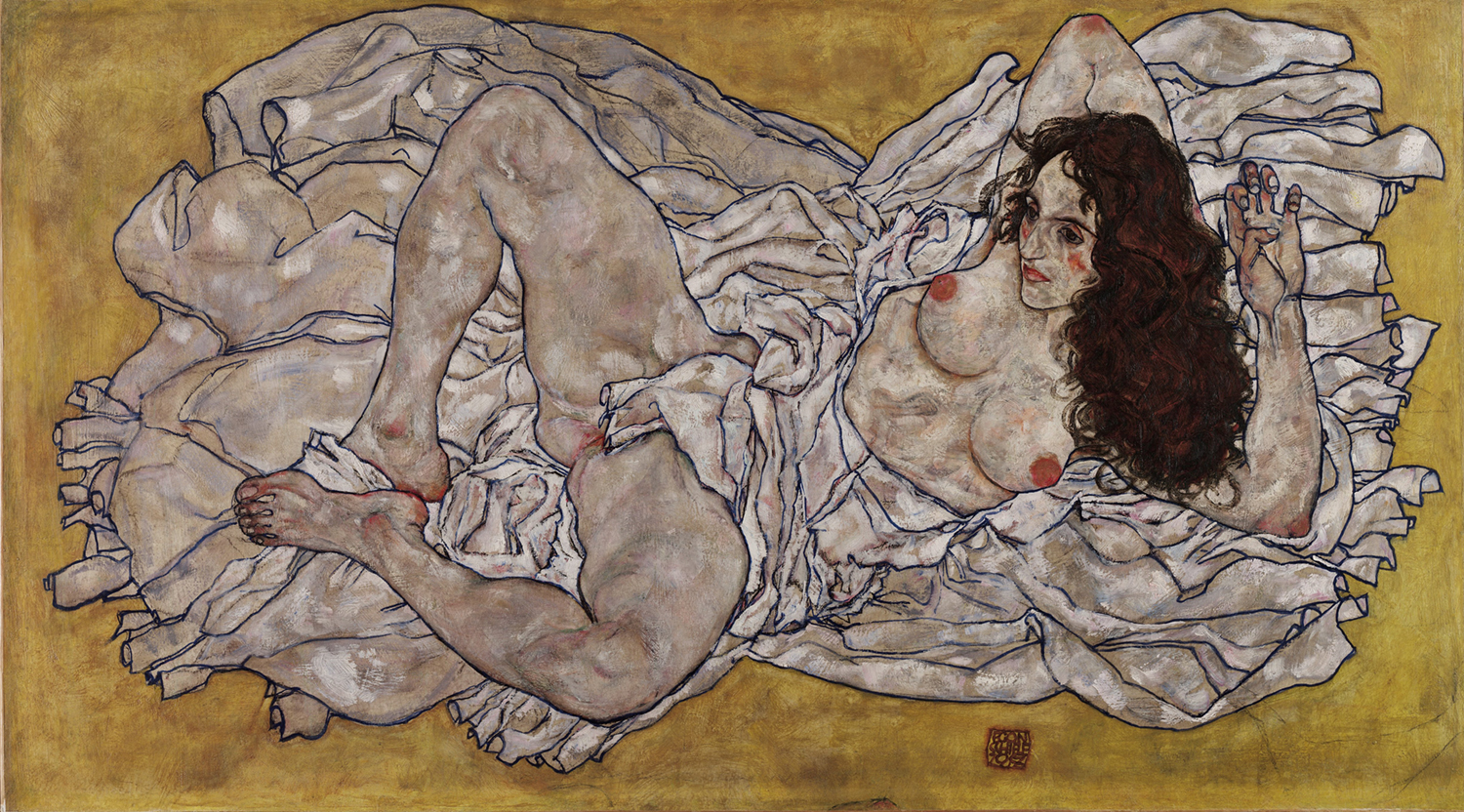
Reclining Woman is a work of 1917 by Egon Schiele: a female nude on a heap of white sheets, seen from above, against a smooth golden-yellow ground. The original is in the Leopold Museum in Vienna under inventory number 626 and, per the museum record, is on display on level OG3; it measures 171 x 96 cm, so it is almost twice as wide as it is tall. We make it as a hand-painted oil painting on canvas, in thirteen sizes or to your own measurement, and we send you a photograph of the finished work for approval before it ships.
| Title: | Reclining Woman |
| Other titles: | Liegende Frau · Ležeča ženska |
| Painter: | Egon Schiele (1890–1918) |
| Year: | 1917; signed and dated in the lower half at the right “EGON SCHIELE 1917” |
| Original size (width × height): | 171 cm x 96 cm |
| Original technique: | Oil on canvas |
| Style: | Expressionism |
| Location: | Leopold Museum, Vienna (inv. 626), on display at OG3 |
| Our reproduction: | hand-painted oil on canvas, 13 sizes from 70 x 40 cm to 210 x 120 cm, or a made-to-measure size |
Reclining Woman – Egon Schiele
What does the work show?
A woman lying on rumpled white sheets, seen from above. The body runs diagonally across a very wide canvas: the head at the right, the feet at the left. The hair is dark, thick and curling and spreads out over the cloth; the face is turned straight towards the viewer, the lips red, the look steady. One arm is raised above the head with the fingers apart, the other lies beside the body, the fingers likewise spread. The skin is pale, almost grey, edged by a thin dark blue line that runs without a break; red appears only in a few small places. A sheet is drawn across the hips. Beyond the linen the ground is smooth and golden yellow, with no objects in it.
Who posed for this work?
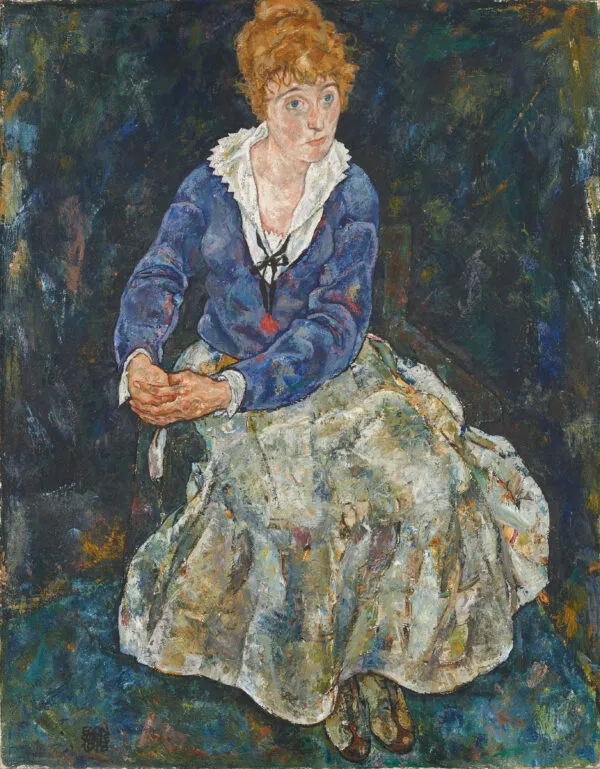
Most probably the painter’s wife Edith, per the museum record, which infers it from a drawing of 1916 made as a study for this canvas and adds that the head was afterwards altered. The record states a presumption and gives its reason, and that is how we report it here. How Schiele painted Edith a year later, seated, clothed and still, is shown by the Portrait of the Artist’s Wife, Edith Schiele of 1918.
Why is the background empty?
Because there is nothing in it to explain the scene. The museum description says so plainly: neither the amorphous golden-yellow ground nor the white billowing sheet offers any narrative context. No room, no furniture, no window — only a body on cloth and a field of colour around it. That is why the work depends so much on drawing.
How is the composition built?
More symmetrically than it looks at first. The museum description speaks of a top view in which the posture of the wide-spread legs is mirrored in the arms beside the head, so that the scene falls into two opposite, roughly equal halves. Once that is noticed the work reads differently: it is built around its own middle, where the cloth lies across the body — and the record adds that this cloth intensifies the attention rather than calming it.
Where is the signature?
At the right, in the lower half of the canvas. The museum record gives it as signed and dated there, “EGON SCHIELE 1917”. On the canvas it sits inside a small rectangular ochre panel of the kind the painter used as a mark: not written across the paint but closed into a little box near the bottom edge, easy to miss at first glance.
Is the format upright or horizontal?
Horizontal, and emphatically so. The record gives 171 x 96 cm, and the museum’s own description says the painter chose a landscape format for this subject and used it across its whole length. Our steps follow that: every one is wider than it is tall, from 70 x 40 cm to 210 x 120 cm. For a wall it means the work is looking for length rather than height.
Can I have it at the size of the original?
Yes, and larger if you want. The original measures 171 x 96 cm; our 170 x 95 cm step is one centimetre from it in each direction, the closest match in the whole ladder. For this work the original is neither too small nor too large for what we offer: above that step there are still 180 x 102 cm, 190 x 110 cm and 210 x 120 cm, so it can be ordered larger than the original is. The original is painted, per the record, with oils on canvas; ours is painted in oils on canvas as well.
Where does the work come from and where is it now?
The provenance note this page already carried follows directly below and is kept word for word, unaltered. It covers the middle of the chain: the years with Bruno Grimschitz between 1939 and 1948, and the restitution to Frederik Knize in 1948. The museum publishes a longer one. Before Grimschitz it names Karl Grünwald and Richard Lanyi (both Vienna), Otto Kranz (Vienna, before 1925) and Friedrich (Fritz) Wolff (Vienna and New York, before 1928 to 1939). From 1949 the work was with Annie Knize in New York, and here the museum records something our carried note does not have: an export licence was refused by the Federal Monuments Office and the Ministry of Education. Then come Fritz Kamm of Zug and the Galerie Würthle in Vienna, Rudolf Leopold (Vienna, before 1959 to 1994), and in 1994 the Leopold Museum-Privatstiftung. Among the sources cited are Nirenstein’s catalogue of 1930 and a dossier by Sonja Niederacher of 16 May 2011. The work is today in the Leopold Museum under inventory number 626 and, per the record, on display; the museum’s whole Schiele holding is on the Leopold Museum’s Egon Schiele page.
Provenance and restitution
Between 1939 and 1948 — that is, across the Nazi era — the painting was with the Vienna art historian Bruno Grimschitz. In 1948 it was restituted to Frederik Knize in New York and later sold; it is now held at the Leopold Museum in Vienna.
Where does this work sit among Schiele’s works?
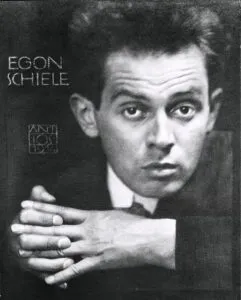
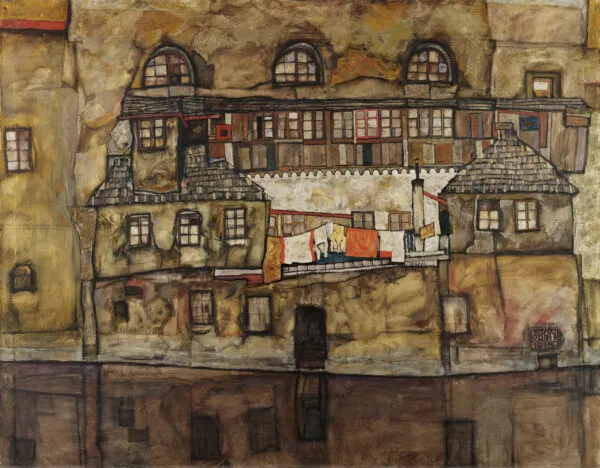
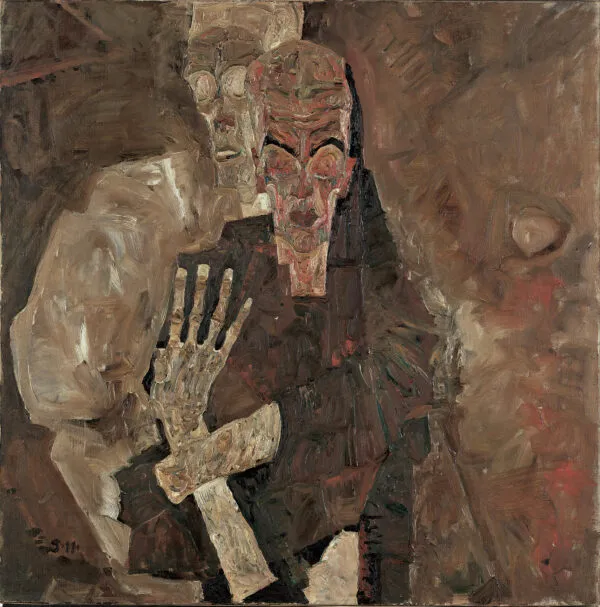
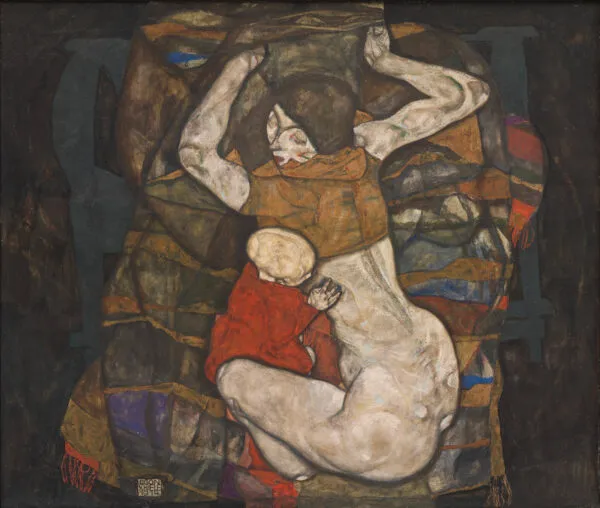
Among the late, large canvases: 1917, two years after House Wall on the River and Levitation (The Blind II), six years after The Lyricist, all three from the same collection. In the spring of 1918 it was shown at the 49th exhibition of the Vienna Secession, for which Schiele also designed the well-known sheet with the round table; that exhibition brought him his first substantial financial success in the city, and he died a few months later. The full selection is in the Egon Schiele gallery, and there is more on his life in our article about Egon Schiele. Schiele was a younger contemporary of Gustav Klimt; Viennese Expressionism is the movement he helped define, and Austrian art of the period is still read through those two names. As an expressionist painting this is one of his largest and best-known canvases.
How is our hand-painted version made?
Every canvas is painted by an artist in oils, stroke by stroke — not a machine impression but a hand-painted copy made specifically for your order. On this subject three places are the hardest. The first is the bedding: a large white field that has to stay white and yet stay articulated, or the middle collapses into a pale smear. The second is the outline of the body, a single dark line running from the feet to the head; if it hesitates or doubles, the work loses its hold. The third is the golden-yellow ground, which must be even without being as smooth as lacquer. When it is finished we photograph it and send you the photograph for approval, and only then does it ship. For this family we hold no studio photographs — the work has not been photographed in our workshop yet, and nothing has been removed; when it is next painted it will be photographed and the images added to this page. As a canvas reproduction it arrives stretched on a wooden bar and ready to hang.
Which size suits which wall?
Short answer: this subject needs length, not height. Above a sofa or a bed, 150 x 85 cm and 170 x 95 cm work well; for a smaller wall 90 x 50 cm or 100 x 55 cm is enough; for a large room there are 190 x 110 cm and 210 x 120 cm. Our smallest size is 70 x 40 cm. A canvas painting at that scale needs distance: the folds and the outline settle together only from a few metres.
How do I order a made-to-measure size, stretcher bar and frame?
If none of the thirteen sizes suits your wall, we paint the work to your own measurement. The canvas comes stretched on a wooden bar; our 3D application is for choosing a frame only, not for showing the work on your wall. The frame is chosen separately and need not be part of the order.
How is it delivered and what do we guarantee?
We paint to order and deliver to sixteen countries in the European Union, among them Germany, France, Italy, the Netherlands and Poland; the United Kingdom and Ireland are not currently among them. Before dispatch we send you a photograph for approval; if you are not satisfied we correct the work or paint it again. Because each one is made individually, the production time varies with the size and the studio’s workload.
Frequently asked questions
Where is the original kept?
In the Leopold Museum in Vienna, inventory number 626; per the museum record, on display at OG3.
Who was the model?
Per the museum record, most probably Edith Schiele; the head was afterwards altered.
How is the work marked?
At the right in the lower half, with a signature and the year “EGON SCHIELE 1917”.
How large is the original canvas?
171 x 96 cm, so almost twice as wide as it is tall.
Which of your sizes is closest to the original?
170 x 95 cm; it is one centimetre from the original in each direction.
Can I have it larger than the original?
You can; the largest step is 210 x 120 cm.
Is this a print?
No. Every canvas is painted by hand in oils by an artist.
When was the work made?
In 1917, a year before the painter’s death.
How does it arrive?
Stretched on a wooden bar and protectively packed; the frame is optional.
Is the original for sale?
It is not for sale; it belongs to the Leopold Museum’s collection and is not on the market.
Does it work as a gift?
It does; if you are unsure which size to choose there is a gift voucher.
- Subject: a female nude on white sheets, seen from above, against a smooth golden-yellow ground.
- Original: 1917, oil on canvas, 171 x 96 cm, signed at the right in the lower half, Leopold Museum, Vienna, inv. 626.
- Ours: hand-painted in oils on canvas, 13 sizes or a made-to-measure size.
- Worth knowing: our 170 x 95 cm step is one centimetre from the original in each direction.