



Description
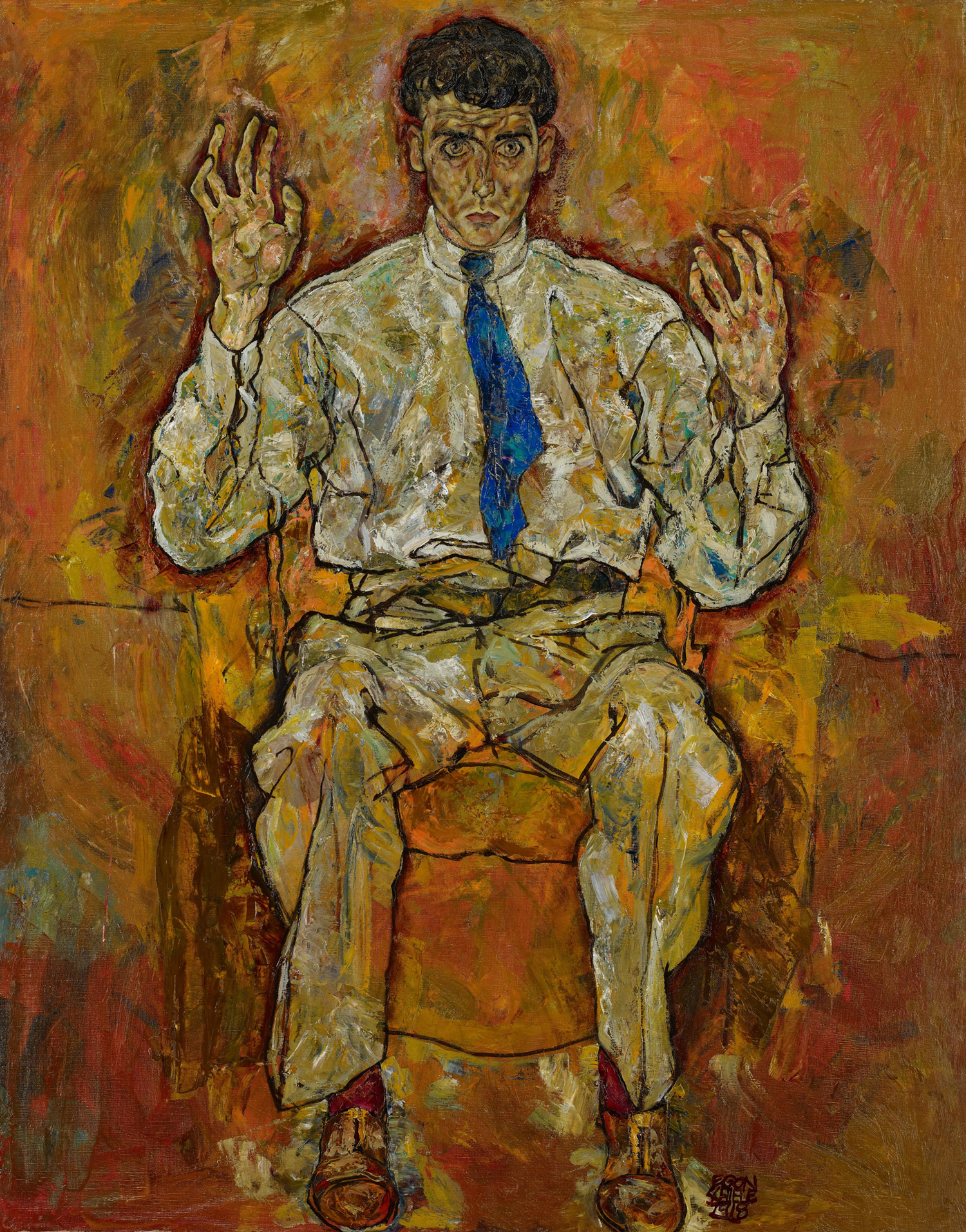
Portrait of Paris von Gütersloh is a 1918 work by Egon Schiele: his friend Albert Paris von Gütersloh, seated and facing us in a pale suit with a blue tie, both hands raised and open, against a loose ground of orange and red. The original canvas measures 140.02 x 110.33 cm and is held by the Minneapolis Institute of Art under accession number 54.30. We paint it by hand in oils, in the size you choose or to your own measurement, and before dispatch we send you a photograph of the finished work for approval.
| Title: | Portrait of Paris von Gütersloh |
| Other titles: | Portrait of Albert Paris von Gütersloh · Bildnis Paris von Gütersloh |
| Painter: | Egon Schiele (1890–1918) |
| Year: | 1918, signed and dated in red paint “Egon / Schiele / 1918” |
| Original size (width × height): | 140.02 cm x 110.33 cm (canvas; the museum does not label the axes) |
| Original technique: | Oil on canvas |
| Style: | Expressionism |
| Location: | Minneapolis Institute of Art, Minneapolis (inv. 54.30) |
| Our reproduction: | hand-painted oil on canvas, in the size you choose, or a made-to-measure size |
Portrait of Paris von Gütersloh – Egon Schiele
Who is in the painting?
Albert Paris von Gütersloh (1887–1973), a painter, writer, actor and director, and a friend of Egon Schiele (1890–1918). The Austrian painter portrayed him in 1918, the year of his own death: Schiele died in October 1918 in the Spanish influenza pandemic. The museum lists it under the sitter’s full name, Portrait of Albert Paris von Gütersloh; our shop uses the shorter form.
What is on the canvas?
A man sits square to us on a yellow and orange chair whose arms show at either side of him. He wears a pale suit laid on in thick strokes of cream, white, ochre and grey-green, a white shirt with a high collar and a narrow blue tie that runs down the middle of his chest as the one stripe of cool colour in the whole work. Both hands are raised to about shoulder height, open and turned towards us, the fingers long, bent and spread; his left hand, on our right, sits a little lower than the other. The face is framed by dark, curly hair; the brow is furrowed and the eyes are wide and round, looking straight out at the viewer. At the bottom, brown shoes and dark red socks stand on the floor. A dark outline runs round the whole figure, and behind it the ground is a loose weave of orange, red, ochre and brown, crossed at the height of the chair’s arms by a thin dark line. The paint is thick on the suit and the hands and thinner in the ground. The signature is written in red paint in three lines: Egon, Schiele, 1918.
Why does this painting matter?
For two reasons that the facts on this page support. It comes from the last year of Schiele’s life: it is dated 1918, and he died that October. And it is a portrait of a friend who was an artist himself, so it shows one artist looking at another rather than at a model. For a buyer there is a third, practical reason: the original is a large canvas, 140.02 x 110.33 cm, and the figure fills almost all of it.
What does the painting mean?
The museum’s record offers no interpretation, and we do not invent one for it. What anyone can see is this: the sitter does not rest his hands in his lap; he lifts them, open, as if in the middle of saying something, while his face stays still and serious. The work turns on that contrast between a calm, frontal pose and restless hands, set against a ground that never settles into one colour. You can read it as a man caught mid-thought, as a gesture of surprise, or simply as a study of hands.
Where does the work come from?
The Minneapolis Institute of Art records the painting under accession number 54.30 and names its source in the credit line: Gift of the P. D. McMillan Land Company. The museum’s online record carries no separate provenance section, so this page names no earlier owners and gives no dates that cannot be checked against that record. Where the painting is today is set out in the note below.
Where is it?
The painting is now at the Minneapolis Institute of Art, which acquired it in 1954.
Where does this work sit among Schiele’s works?
Among his portraits of men. On our shelf you will also find Portrait of Johann Harms, Portrait of Victor Ritter von Bauer and Portrait of Dr Franz Martin Haberditzl. If you are choosing between them, open them side by side; in this one it is the raised hands that carry the work. The full selection is in the Egon Schiele gallery, with more on his life in our article about Egon Schiele.
How is our hand-painted version made?
An artist in our workshop paints every canvas in oils, stroke by stroke: a hand-painted copy made for your order, not a machine print. Three passages decide whether a copy of this work succeeds. The first is the hands: long, bent fingers outlined in dark paint, with pink, yellow and red worked into the palms; smoothed into ordinary hands, they would take the point of the portrait with them. The second is the suit, which is not a flat pale area but a crust of cream, white, grey-green and ochre strokes, with dark lines for the folds; it has to keep that texture. The third is the ground, where orange, red and brown lie loosely side by side and must not be blended into one even colour. The original is oil on canvas, and so is our copy: the same kind of support, with the brushstrokes standing up from the weave and catching the light. When the work is finished we photograph it and send you the photograph for approval, and only then does it ship. This work has not yet been photographed in our workshop; we will add photographs to this page once we have them. Like every canvas we send, it can arrive stretched on a wooden stretcher bar; you choose that under the Stretcher option.
Which size for which wall?
Short answer: let the wall and the furniture decide, not the original. The original is a large canvas, but you do not need a large room for this subject: one seated figure with a clear outline stays legible at a modest size too. Start by measuring the piece of furniture it will hang above. Above a sofa, choose a width of roughly two thirds of the sofa’s length; narrower than that, the work looks lost, wider, it crowds the room. Above a chest of drawers, a sideboard or a desk, stay a little narrower than the furniture itself. On a free wall in a hallway, where you pass close by, a smaller size works well, because the face and the hands are read from a step or two away. On a large empty wall, in a stairwell or in a room with a high ceiling, choose one of the larger sizes and give it space, with bare wall on each side. A canvas painting of this subject also needs distance: close up, the suit and the ground break into single strokes, and the figure only comes together from a few steps back, so the larger the size, the further back the best view. If you are torn between two sizes, cut paper to both, tape the sheets to the wall and live with them for a day. Sizes and prices are in this product’s size selector. A hand-painted painting hangs best with its centre at eye level, roughly 145–150 cm from the floor; above a sofa, 15–25 cm above the backrest.
Custom size, stretcher bar and frame
If none of the sizes offered suits your wall, we paint the work to your own measurement. If you choose “YES” under the Stretcher option, the canvas comes stretched on a wooden stretcher bar, ready to hang. Our 3D application is for choosing a frame only, not for showing the work on your wall; seeing it on your wall is a separate service. The frame is chosen separately and need not be part of the order. With this subject, a plain, narrow frame in dark or warm natural wood sits quietly next to the orange ground, while a heavy ornate frame competes with the hands for attention.
Delivery and guarantee
We paint to order and deliver to sixteen countries in the European Union, among them Slovenia, Croatia, Austria, Italy, Hungary, Germany and France; we do not currently deliver to Ireland or the United Kingdom. The work travels protectively packed. Before dispatch we send you a photograph of the finished work to approve. Production time depends on the size and on the studio’s workload. Every order is covered by our Returns and Refund Policy.
Frequently asked questions
Who was Albert Paris von Gütersloh?
An Austrian artist and writer (1887–1973), born Albert Conrad Kiehtreiber, who painted, wrote novels, acted, directed and designed for the stage. After the Second World War he taught Ernst Fuchs, Arik Brauer and Anton Lehmden, and is counted among the strongest influences on the Vienna School of Fantastic Realism. The Minneapolis Institute of Art lists the work under his full name, Portrait of Albert Paris von Gütersloh.
How did Paris von Gütersloh know Egon Schiele?
They were friends from Schiele’s early years in Vienna. In 1911 Gütersloh wrote “Egon Schiele. Versuch einer Vorrede”, the first essay devoted to Schiele, published for his first solo exhibition at the Galerie Miethke in Vienna. Seven years later Schiele painted his portrait.
When did Schiele paint Portrait of Paris von Gütersloh?
In 1918, the last year of his life: the canvas is signed and dated in red paint “Egon / Schiele / 1918”. Schiele died that October in the Spanish influenza pandemic, three days after his wife Edith, at the age of 28.
Why are Gütersloh’s hands raised in the portrait?
That is the question the work turns on. Widely quoted descriptions of it read the lifted, open hands, the fixed eyes and the tense body as Gütersloh caught at the moment of artistic inspiration, in a gesture that seems to draw in and push away at once. They also say Schiele admired his friend’s intellectual and artistic gifts and wanted to show him as a creative mind.
Where is Portrait of Paris von Gütersloh today?
In the Minneapolis Institute of Art in the United States, under accession number 54.30; the museum acquired it in 1954, and its credit line reads Gift of the P. D. McMillan Land Company. The canvas is large, 140.02 x 110.33 cm, and the seated figure fills almost all of it.
Does it work as a gift?
Yes; if you are unsure which size to choose, there is a gift voucher.
- Subject: Albert Paris von Gütersloh, seated and facing us, pale suit, blue tie, both hands raised, orange and red ground.
- Original: 1918, oil paint on canvas, 140.02 x 110.33 cm, signed in red paint, Minneapolis Institute of Art, acc. 54.30.
- Ours: hand-painted in oils, in the size you choose or made to measure, stretched on a stretcher bar if you choose Stretcher: “YES”.
- Worth knowing: dated 1918, the year of Schiele’s death; the museum’s title gives the sitter’s first name, Albert.