


Description
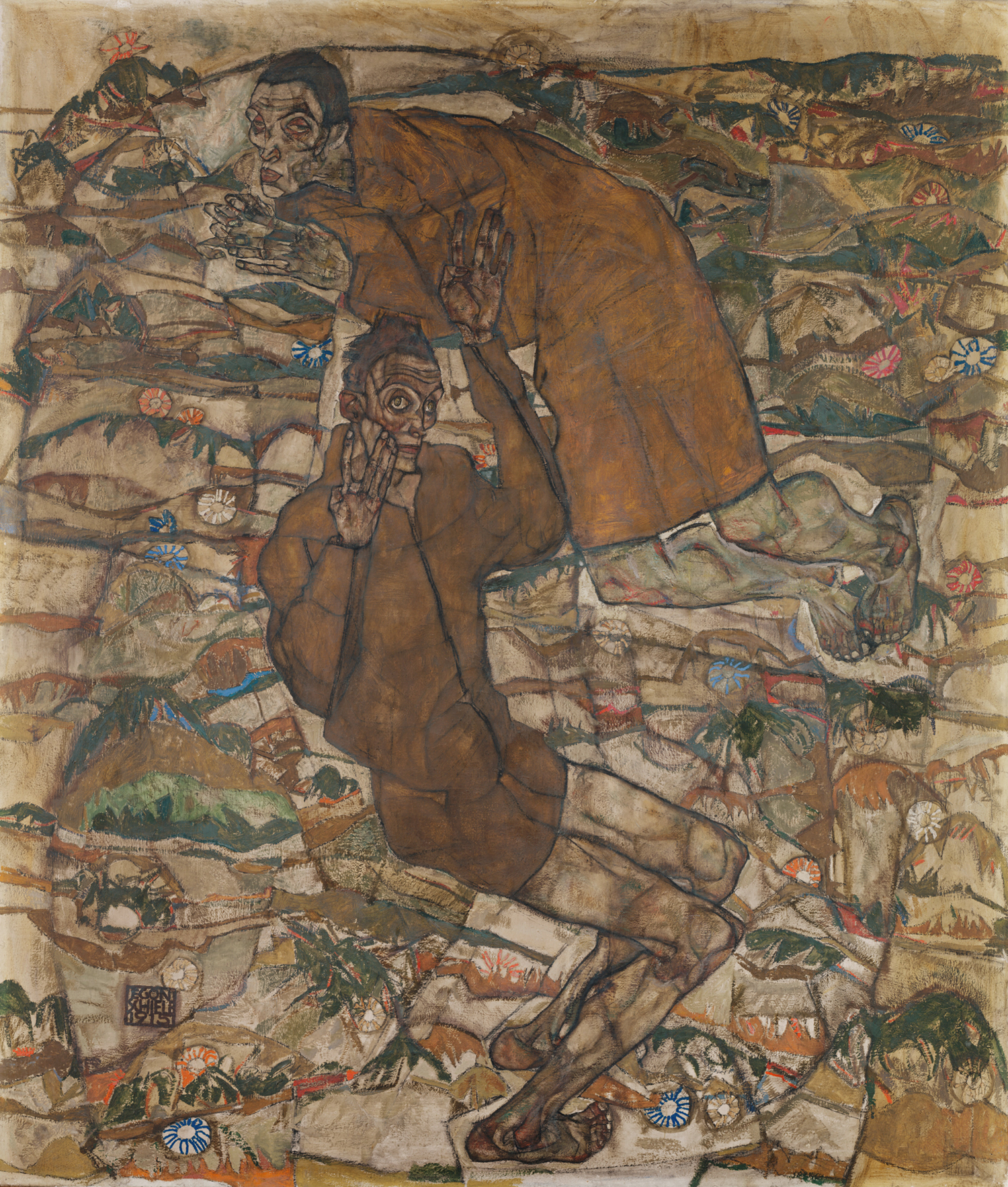
Levitation (The Blind II) is a 1915 painting by Egon Schiele: two gaunt men in long brown robes float one above the other over a dense, patchwork-like ground. We paint it by hand in oils at the size you choose, and before dispatch we send you a photograph of the finished work for approval.
| Title: | Levitation (The Blind II) |
| Other titles: | Entschwebung · Transfiguration |
| Painter: | Egon Schiele (1890–1918) |
| Year: | 1915, signed and dated lower left “EGON SCHIELE 1915” |
| Original size (width × height): | 171.6 cm x 201.2 cm |
| Original technique: | Oil and opaque colour on canvas |
| Style: | Expressionism |
| Location: | Leopold Museum, Vienna |
| Our reproduction: | hand-painted oil on canvas, 15 sizes from 50 x 60 cm to 172 x 200 cm, or a made-to-measure size |
Levitation (The Blind II) – Egon Schiele
What does the painting show?
The Austrian painter Egon Schiele (1890–1918) painted it in 1915. It shows two male figures in brown robes, one hovering above the other. The upper man lies almost level across the top of the canvas: his head is at the upper left, his hands with long, splayed fingers reach forward, and his bare feet stick out at the right. The lower man is set lower and further left, his knees bent, both palms raised beside his face and his wide, pale eyes turned towards us. Neither of them stands on anything. Behind them the whole surface is covered with small patches in ochre, olive, cream and brown, like fields and hills seen from above, scattered with little round flowers in blue, white, red and orange. In the lower left, a small dark square holds the signature and the date, EGON SCHIELE 1915.
Why do people love it?
Because it holds two moods at once. The figures are heavy, dark and earthy, and yet they float; the ground is busy and colourful, and yet from a distance it reads as calm. The faces and hands are drawn with dark, restless lines that stay visible, so up close there is always something new to find, while from across the room the whole thing reads as one strong shape against a warm, speckled field. The colours – browns, ochres and olive greens with small sparks of blue and red – sit easily with wood, stone and white walls. It does not shout in a room, but it fills it.
Provenance
From Schiele’s estate (1918) the painting passed to Arthur Stemmer (Vienna/London, 1918–1954) and then to Rudolf Leopold; it is now at the Leopold Museum in Vienna.
Where does it sit among Schiele’s works?
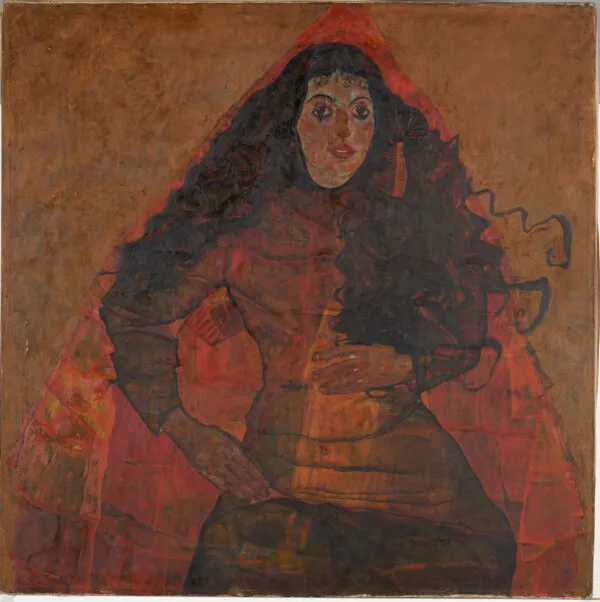
It is one of his large canvases: the original measures 171.6 x 201.2 cm. In our Egon Schiele selection it hangs beside other works you can order in the same way, painted by hand at your size – for example House Wall (Windows), The Hermits and Trude Engel. The full selection is in the Egon Schiele gallery, and there is more on his life in our article about Egon Schiele.
How is our hand-painted version made?
A painter works the whole canvas in oils, stroke by stroke: a copy made by hand for your order, not a print. The original is in oil and opaque colour on canvas; ours is painted as oil on canvas. The hardest parts here are the ground, where hundreds of small patches must stay separate and still add up to one surface, and the two faces with their hands, whose dark outlines carry the whole composition. When the work is finished we photograph it and send you the photograph for approval; only then does it ship. This work has not yet been photographed in our workshop, so for now this page shows no workshop photos of it.
Which size for which wall?
We offer this work in fifteen sizes, from 50 x 60 cm to 172 x 200 cm. In a hallway, a study or above a chest of drawers, 50 x 60 cm or 60 x 70 cm is enough. Above a sofa or a sideboard in the living room, 90 x 105 cm or 100 x 115 cm fills the space well. For a large wall, a stairwell or a room with a high ceiling, choose 130 x 150 cm or our largest size, 172 x 200 cm. A canvas painting with this much detail in the ground wants some distance: step back a few metres and the patches join into one field around the two figures. A hand-painted painting hangs best with its centre at eye level, roughly 145–150 cm from the floor; above a sofa, 15–25 cm above the backrest.
Custom size, stretcher bar and frame
If none of our sizes suits your wall, we paint the work to your own measurement. If you choose “YES” under the Stretcher option, the canvas comes stretched on a wooden stretcher bar, ready to hang. Our 3D application is for choosing a frame only; the frame is chosen separately and need not be part of the order.
Delivery and guarantee
We paint to order and deliver to sixteen countries in the European Union, among them Slovenia, Croatia, Austria, Italy, Hungary, Germany and France; the United Kingdom and Ireland are not currently among them. Before dispatch we send you a photograph of the finished work to approve. Production time depends on the size and on the studio’s workload. Every order is covered by our Returns and Refund Policy.
Frequently asked questions
Who are the two men in Levitation?
Both are Schiele himself: the Leopold Museum describes the work as a double self-portrait that runs the full height of the large canvas. He shows himself twice in a short, monk-like habit, a costume he had already worn in earlier self-portraits.
What does Levitation (The Blind II) mean?
The Leopold Museum reads it as a picture about letting go of life: the lower figure, eyes wide open, still keeps in touch with the world, while the upper one seems to have crossed over to the other side already. Red eyelids, hollow faces and touching fingertips point to farewell and death. The museum calls it one of Schiele’s most enigmatic self-portrayals.
Why is it called Levitation and The Blind?
Schiele gave the work both titles himself: Entschwebung, literally “floating away”, and Die Blinden, “The Blind”. The first describes the two figures hovering above the patterned ground; the museum does not explain the second, but it does point to the tired, half-closed eyes with reddened lids.
When did Schiele paint Levitation?
In the first half of 1915; it is signed and dated lower left “EGON SCHIELE 1915”. It was first shown in August 1915 at Guido Arnot’s gallery on the Kärntnerring in Vienna and stayed unsold until Schiele’s death in 1918. He painted it shortly before his wedding to Edith Harms and his call-up to military service.
Where is Levitation (The Blind II) today?
In the Leopold Museum in Vienna, under inventory number 467. It passed from Schiele’s estate to Arthur Stemmer, then to Rudolf Leopold in 1954, and with his collection to the Leopold Museum Private Foundation in 1994.
Does it work as a gift?
Yes; if you are unsure which size to choose, there is a gift voucher.