


Description
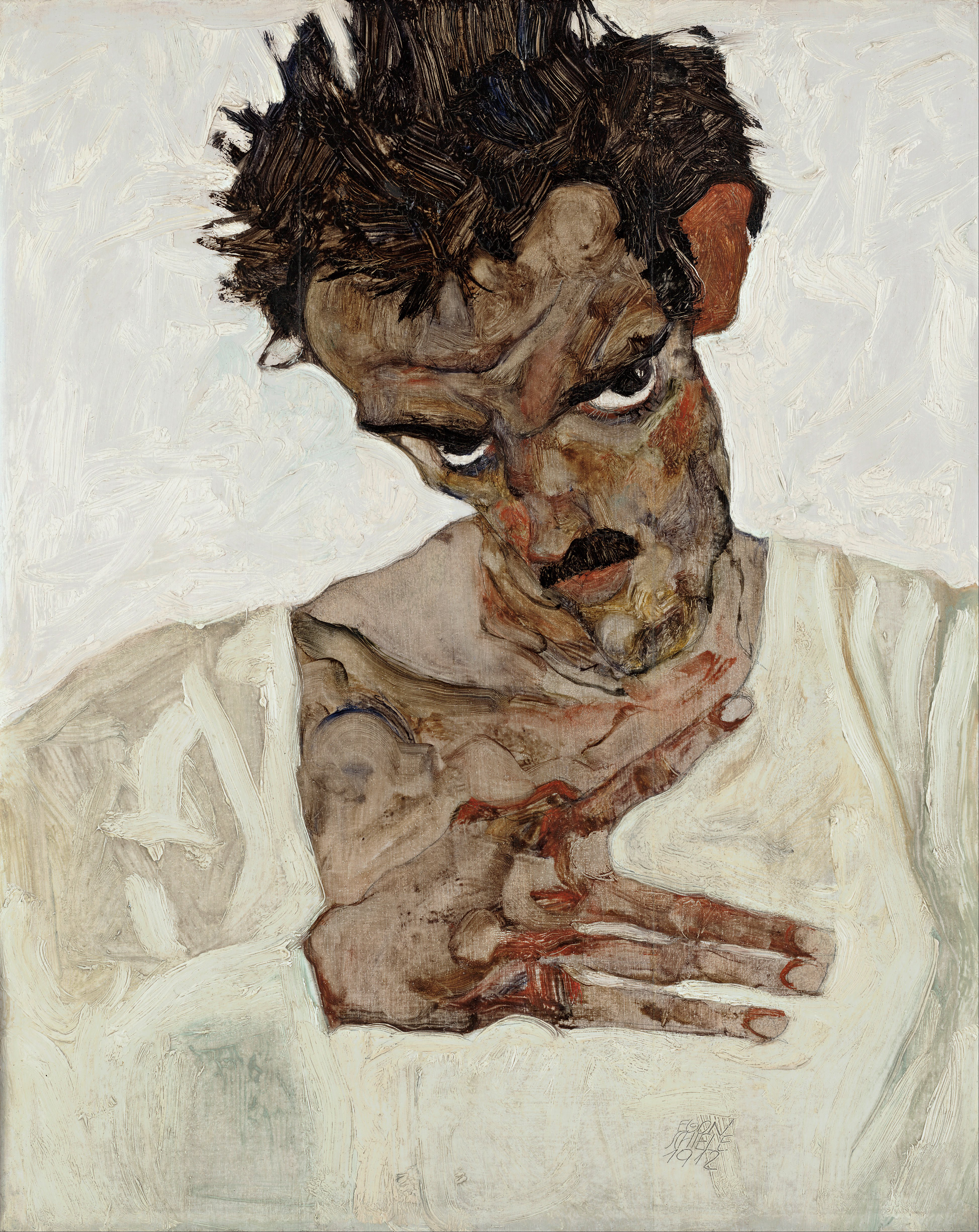
Self-Portrait with Lowered Head is a painting by Egon Schiele from 1912: the artist from the chest up, his head bowed and turned aside, his eyes raised towards the viewer and one hand with spread fingers across his bare chest. We paint it by hand in oils at the size you choose, and before dispatch we send you a photograph of the finished work for approval.
| Title: | Self-Portrait with Lowered Head |
| Other titles: | Selbstbildnis mit gesenktem Kopf · Avtoportret s sklonjeno glavo |
| Painter: | Egon Schiele (1890–1918) |
| Year: | 1912, signed and dated lower right “EGON SCHIELE 1912” |
| Original size (width × height): | 33.7 cm x 42.2 cm |
| Original technique: | Oil on wood |
| Style: | Expressionism |
| Location: | Leopold Museum, Vienna |
| Our reproduction: | hand-painted oil on canvas, 13 sizes from 50 x 65 cm to 160 x 205 cm, or a made-to-measure size |
Self-Portrait with Lowered Head – Egon Schiele
What does the painting show?
The Austrian painter shows himself from the chest up. The head is bowed steeply forward and tilted to one side, under thick, dark, dishevelled hair laid on in rough strokes. The face is dark – olive, grey-brown and ochre, with red touches around the nose and mouth and a small black moustache – yet the eyes look up and out at us, their whites showing under heavy brows. One ear is a bright brick red, the strongest colour in the picture. Below, the chest is bare and outlined in red-brown, and a hand with long, spread fingers lies across it. A white garment falls open from the shoulders and almost merges with the creamy white ground, which is laid on in broad, visible strokes. The signature and year stand at the lower right.
Why do people love it?
Because of the eyes. The head goes down, the gaze comes up, and that small contradiction makes the face hard to look away from. The hand adds to it: the fingers held apart, drawn with the same red-brown line as the chest. The palette is limited – white, brown, olive and a few strokes of red – so the work stays clear on a wall, and the pale ground gives the dark head plenty of air. It works in a study, a hallway or above a desk, where it meets you at eye level.
Where does it sit among Schiele’s works?
Among the other Schiele works in our shop, you can compare it with Cardinal and Nun (Caress), House Wall (Windows) and The Hermits; if you are choosing between them, open them side by side. The full selection is in the Egon Schiele gallery, with more on his life in our article about Egon Schiele.
How is our hand-painted version made?
One of our artists paints it by hand in oils, stroke by stroke, for your order – it is not a print. Two places decide the result. The first is the eyes: small white crescents under dark brows, and if they are softened or moved even slightly, the look is gone. The second is the hand, whose fingers must stay separate and keep their red-brown outline instead of dissolving into the chest. Any painter is also tempted to set the white garment clearly apart from the white ground; we keep the two close, as they are in the original. The original is painted on a wooden panel and ours is oil on canvas, so the surface will not be identical. When it is finished we photograph it and send you the photograph for approval, and only then does it ship. This work has not yet been photographed in our workshop; we will add pictures to this page once we have them.
Which size for which wall?
Short answer: the face is the whole picture, so choose by how close you will stand to it. We offer it in thirteen sizes, from 50 x 65 cm to 160 x 205 cm. Above a desk or in a study, 50 x 65 cm or 60 x 75 cm; in a hallway or above a chest of drawers, 70 x 90 cm or 80 x 100 cm; above the sofa in a living room, 100 x 130 cm or 120 x 150 cm; on a large wall or in a stairwell, 140 x 180 cm or 160 x 205 cm. A canvas painting of this size needs some distance: close up you see the single strokes in the hair and the ground, and the face comes together from a few steps back. A hand-painted painting hangs best with its centre at eye level, roughly 145–150 cm from the floor; above a sofa, 15–25 cm above the backrest.
Custom size, stretcher bar and frame
If none of the thirteen sizes suits your wall, we paint the work to your own measurement. If you choose “YES” under the Stretcher option, the canvas comes stretched on a wooden stretcher bar, ready to hang. Our 3D application is for choosing a frame only, not for showing the work on your wall. The frame is chosen separately and need not be part of the order.
Delivery and guarantee
We paint to order and deliver to sixteen countries in the European Union, among them Slovenia, Croatia, Austria, Italy, Hungary, Germany and France; the United Kingdom and Ireland are not currently among them. The work travels protectively packed. Before dispatch we send you a photograph of the finished work to approve. Production time depends on the size and on the studio’s workload. Every order is covered by our Returns and Refund Policy.
Frequently asked questions
When did Schiele paint Self-Portrait with Lowered Head?
In 1912: the panel is signed and dated at the lower right “EGON SCHIELE 1912”. The small moustache fits that date, since, according to the Leopold Museum, Schiele wore one only between the late autumn of 1911 and the beginning of 1912.
How is Self-Portrait with Lowered Head related to The Hermits?
It was made alongside The Hermits, Schiele’s large double portrait of 1912, which is also in the Leopold Museum. From it he took the posture of the head and the splayed fingers, which in the double portrait rest on the hip of the left-hand figure.
Why are Schiele’s eyes turned upwards in this self-portrait?
The head goes down while the gaze moves the other way, up and out towards us. In the museum’s words, this contrary movement makes the white crescents of the eyeballs stand out below the black eyebrows with diabolic intensity.
How many self-portraits did Schiele make?
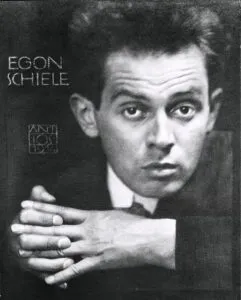
About 200, according to the Leopold Museum, most of them between 1910 and 1914. He worked with the mirror and, in 1914, also with photographs taken by Anton Josef Trčka, in which he staged dramatic gestures and expressions.
Where is Self-Portrait with Lowered Head today?
In the Leopold Museum in Vienna, under inventory number 462. It is a small panel in oil on wood, 33.7 x 42.2 cm. The museum sees in such works Schiele’s move away from Gustav Klimt and the Secession towards a completely new, radically expressive style.
Does it work as a gift?
Yes; if you are unsure which size to choose, there is a gift voucher.