







































Description
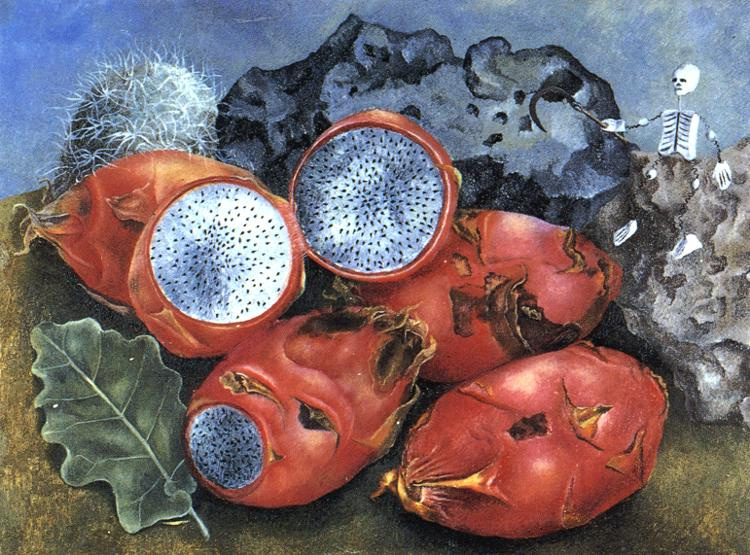
Pitahayas is a still life Frida Kahlo painted in 1938: a heap of red pitahayas, some cut open to white flesh flecked with black seeds, lies on dark earth in front of a block of volcanic rock, while a small white skeleton stands on the rock to the right. The original is oil on metal, 25.4 cm high and 35.6 cm wide, held by the Madison Museum of Contemporary Art in Madison, Wisconsin. Our painter paints it for you by hand in oil colours on canvas, in one of 2 landscape sizes, 53 x 38 or 60 x 42 cm; both are larger than the original, and before dispatch you receive a photograph of the finished work.
| Title: | Pitahayas |
| Other titles: | Pitahayas (Spanish) · Pitahaya |
| Painter: | Frida Kahlo (1907–1954) |
| Year painted: | 1938 |
| Original size: | 25.4 cm x 35.6 cm (height x width) |
| Original technique: | Oil on metal |
| Painting style: | Mexican modernism |
| Located at: | Madison Museum of Contemporary Art, Madison (Wisconsin, USA) |
| Our reproduction: | Hand-painted oil on canvas, 2 sizes or made to measure |
Pitahayas – Frida Kahlo
What does Pitahayas show?
In the foreground a pile of red fruit crowds together on dark brown earth. The skins are thick and fleshy, broken here and there by dry brown scales that stick out like small tongues.
Three of the fruits are cut. Two large cut faces in the middle show almost white flesh, dense with tiny black seeds; the third, lower down, is opened only at its tip.
At the lower left lies a large green leaf with pale veins and a toothed edge, and at the upper left a round cactus covered in long white spines that look almost like wool.
Behind the fruit rises a dark, grey-black volcanic rock. On its right edge stands a small white skeleton, holding a curved blade in its raised hand. Above it all stretches a blue sky crossed by restless pale streaks of cloud.
When was it painted, and what was happening then?
The painting dates from 1938. Wikipedia describes 1937 and 1938 as exceptionally productive years, in which Kahlo painted more than in all eight previous years of her marriage to Diego Rivera.
Early in 1938 the National Autonomous University of Mexico exhibited some of her work, in April the French Surrealist André Breton visited Rivera, and in November her first solo exhibition opened at Julien Levy’s gallery in New York. Whether Pitahayas hung there, the sources we use do not say.
According to Wikipedia she drew on the nature and objects of Mexico, and in the 1930s her style owed much to retablos, small votive paintings by amateur artists, roughly the size of a postcard.
Why do Kahlo admirers value this still life?
Pitahayas joins two things you meet often in her work: a still life of juicy Mexican fruit and a sign of death, the little skeleton.
Wikipedia lists skeletons among the symbols she took from Aztec mythology and notes that many of her paintings set opposites side by side, life and death among them. Here just such a figure stands beside ripe, cut fruit, and the painting leaves the reading to the viewer.
The format is small too, oil on metal, like the retablos she collected: she owned about 2,000 of them, and they hung on the walls of La Casa Azul, the Blue House.
To learn more about her life, read the article on Frida Kahlo on the English Wikipedia; it covers the painter, and this painting has no article of its own.
Where is the original today?
The original belongs to the Madison Museum of Contemporary Art, the museum of contemporary art in Madison, Wisconsin.
It is painted in oil on a metal plate and measures 25.4 cm in height and 35.6 cm in width. Year, technique, size and collection come from the list of her works on the English Wikipedia; how the painting reached the museum, that list does not say, so we leave it out.
Our hand-painted copy is made on canvas rather than metal: canvas is lighter, it is stretched on a stretcher bar, and you can frame it as you like.
Pitahayas or another Kahlo still life?
The palette here is warm and earthy: red skins, grey rock and olive-brown ground sit well with wood, brick, terracotta or kitchen tiles, while the white flesh of the fruit brings light into a room. Its modest size makes it easy to place in a dining room, a kitchen or an entrance hall.
A year earlier she painted Cactus Fruits, also oil on metal, with three prickly pears on a white plate. From the same year as Pitahayas comes the still life Fruits of the Earth, with corn cobs and mushrooms under a cloudy sky, while What the Water Gave Me shows a completely different scene from 1938.
If painted fruit appeals to you, look too at Viva la Vida (Watermelons), one of her last paintings, with watermelons beneath a blue sky. All the famous Frida Kahlo paintings we paint to order for customers are gathered on the Frida Kahlo page.
How does our painter paint the fruit and the skeleton?
The original is painted on smooth metal, so it has no canvas grain: the colours are clean and bright, the outlines sharp, the transitions short. Our painter first primes the canvas several times and sands it smooth so the surface comes out as even as possible.
The painter starts with the blue sky and clouds and the dark rock, then builds the red skins in several thin layers, from deeper shadows to pale highlights on the rounded sides. The dry brown scales go on last, in a warm ochre.
The white flesh takes the most patience: on a greyish-white base the painter sets a mass of tiny black seeds with a fine brush, one at a time. The cactus spines and the thin bones of the skeleton are drawn just as lightly. The result is a Frida Kahlo reproduction with real layers of oil paint, something no print can offer.
Which size suits your wall?
In short: 53 x 38 cm for a smaller wall above a chest of drawers, in a kitchen or a hallway, and 60 x 42 cm above a desk or sideboard or beside the dining table.
For this work we offer only two landscape sizes (width x height): 53 x 38 and 60 x 42 cm. The original measures about 36 x 25 cm (exactly 35.6 x 25.4 cm), so each of our sizes is larger: the smaller is 17.4 cm wider and 12.6 cm taller, the larger 24.4 cm wider and 16.6 cm taller.
As a painting for the living room, 60 x 42 cm works better, on a narrow wall, by a reading corner or above a shelf. Over a wide sofa we suggest two smaller paintings as a pair, for example Pitahayas next to another still life.
Is another size possible, and which frame suits it?
The original’s sides are almost exactly in the ratio 7 : 5. If you need a different size, send it to us through the custom painting form; we check whether it can be done and send you a price and a timescale.
Your painting travels rolled, stretched on a stretcher bar or already in its frame. Stretching and framing are done by our workshop in Slovenia, which prepares every canvas painting we sell.
You pick the frame in the 3D app, which is there for choosing frames and nothing else. A preview of the pitahayas on your own wall is not part of it; that is a separate service.
A dark wooden frame repeats the colour of the volcanic rock, while a thin black frame makes the red fruit glow.
How soon will it arrive, and how does it travel?
Painting begins as soon as you confirm the order and takes 15 to 45 working days. Once it is finished, we first send you a photograph of it; if a detail is not to your liking, the painter corrects it before dispatch.
Shipments within Slovenia and to other EU countries go through no customs formalities, and our returns policy covers every order.
Pitahayas makes a fine gift for someone who loves cooking, loves Mexico or collects still lifes. If you do not know the wall it would hang on, choose a gift voucher and leave the choice to them.
Frequently asked questions
Which museum holds the original?
The Madison Museum of Contemporary Art in Madison, Wisconsin, USA.
What fruit is shown?
Red pitahayas; three are cut open, showing white flesh with tiny black seeds.
Will I receive a print or an oil painting reproduction?
A painting: it is made with a brush in oil colours on canvas, layer by layer, and nothing is printed.
How large is the original?
25.4 cm high and 35.6 cm wide; both of our sizes are larger.
Can I order a different size?
Write to us with the size you need; we check it and tell you the price.
When will the painting reach me?
Painting takes 15 to 45 working days, then it ships, with no customs inside the EU.
Does it suit a kitchen or dining room?
Yes, the red fruit and warm tones belong naturally where people cook and eat.
What does the skeleton mean?
Our sources do not interpret this painting; Wikipedia only says Kahlo often set life and death side by side.
- Subject: red pitahayas, some cut open, on dark earth before volcanic rock, with a small white skeleton on the right.
- Original: 1938, oil on metal, 25.4 x 35.6 cm, Madison Museum of Contemporary Art, Madison.
- Ours: oil on canvas, hand-painted to your order, in 2 landscape sizes (53 x 38 and 60 x 42 cm).
- Worth knowing: The original is smaller than both sizes; even 53 x 38 cm is well over it.